
TL;DR:
- A sales manager leads a team to achieve revenue targets by coaching, forecasting, and hiring, not by closing deals personally.
- Effective management focuses on pipeline hygiene, proactive hiring, and maintaining forecast accuracy, with team size ideally between five and eight.
A sales manager is defined as the leader responsible for directing a sales team, setting revenue targets, coaching representatives, and translating corporate sales strategy into measurable results. The role sits at the heart of every revenue-generating organisation, yet many HR professionals and business leaders underestimate its complexity when writing a sales manager job description. Get the description wrong and you hire a top salesperson who cannot lead. Get it right and you build a team that hits target every quarter. This guide covers the full sales manager role: duties, qualifications, team structure, compensation, and the leadership traits that separate good managers from great ones.
What are the primary responsibilities of a sales manager?
A sales manager’s core responsibility is scaling team performance, not closing personal deals. Sales managers rarely close deals themselves; they focus on enabling their team and step in only for escalated or late-stage opportunities. That distinction matters enormously when you write a job description, because candidates who thrive on personal selling often struggle to make the shift.
The daily and weekly duties of a sales manager break down into clear categories. First-line managers allocate their time roughly as follows:
- Coaching (25%): Weekly 1-on-1 sessions with each representative to review performance, address blockers, and build confidence.
- Pipeline reviews (20%): Examining deal stages, identifying stalled opportunities, and guiding reps on next steps.
- Forecasting (15%): Producing accurate revenue predictions for senior leadership and finance.
- Hiring (15%): Sourcing candidates, conducting interviews, and checking references to maintain team strength.
- Meta-work (15%): Internal reporting, process documentation, and performance administration.
- Cross-functional collaboration (10%): Working with marketing, product, and customer success to align on messaging and priorities.
The weekly 1-on-1 session deserves special attention. The 1-on-1 is the highest-impact activity for a sales manager because it enables early risk detection and builds the trust needed for honest performance conversations. A manager who skips these sessions loses visibility into pipeline risk and loses the confidence of their team at the same time.
Pro Tip: Structure every 1-on-1 around three questions: What is the rep working on this week? Where are they stuck? What do they need from you? This keeps sessions focused and prevents them from becoming status updates.

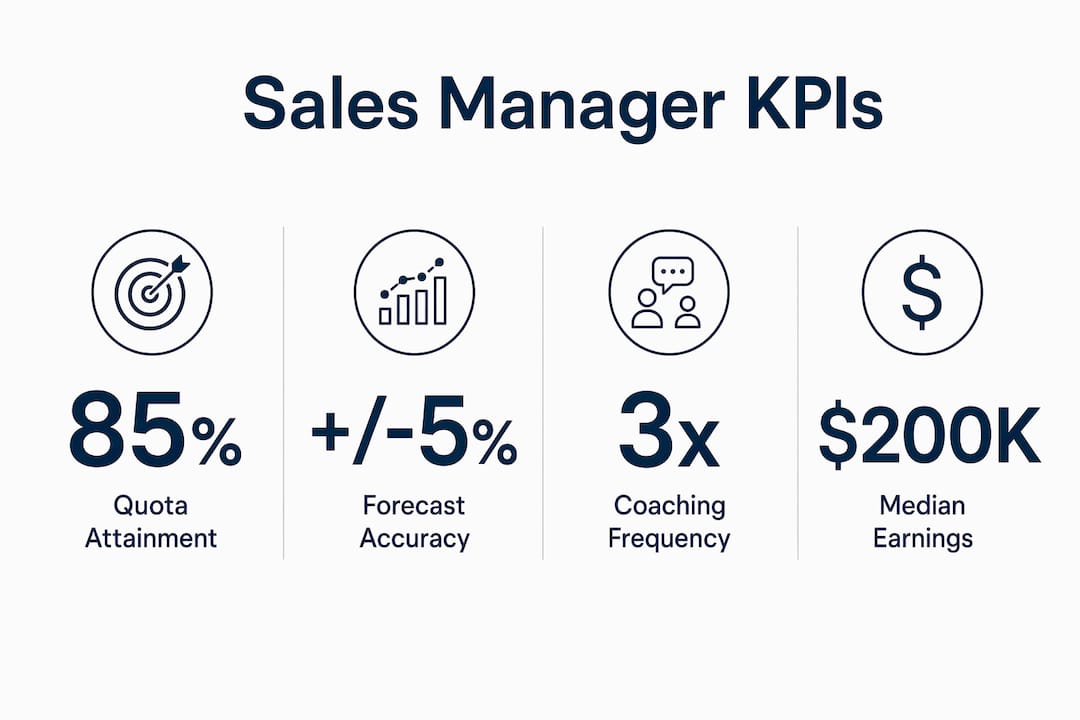
Forecasting accuracy is another defining duty. Forecast accuracy within 5% of actual sales is the benchmark that distinguishes respected managers from unreliable ones. It signals operational discipline and builds credibility with the board. If you want to assess a candidate’s competence quickly, ask them how they build their forecast and how often they hit it. The answer tells you almost everything.
What qualifications and skills define a successful sales manager?
The right qualifications for a sales manager depend on the sector, but clear patterns emerge across industries. Standard qualifications in 2026 favour candidates with bachelor’s or master’s degrees in business administration or marketing, combined with proven quota achievement in sectors such as IT or FMCG. Education alone is not sufficient. Demonstrated sales success and leadership potential are the real filters.
The skills that separate effective managers from average ones fall into four categories:
- Leadership and coaching ability: The capacity to motivate individuals, give direct feedback, and develop reps who underperform. Coaching ability and interpersonal aptitude distinguish top performers from technically competent but ineffective managers.
- Data analysis and forecasting: Reading pipeline data, spotting trends, and producing reliable revenue projections. A manager who cannot read a CRM report cannot manage a modern sales team.
- Hiring judgement: Identifying candidates with the right attitude and potential, not just the best CV. Hiring quality talent has a disproportionate impact on team performance; managers who hire well reduce the need for remedial coaching later.
- Communication and influence: Presenting to senior leadership, negotiating internally for resources, and keeping a team motivated through difficult quarters.
CRM proficiency is now a baseline requirement, not a differentiator. Any candidate who cannot navigate a CRM system confidently will struggle to run pipeline reviews or produce accurate forecasts. When writing a sales manager job description, list CRM experience as a minimum requirement, not a preference.
Pro Tip: When interviewing candidates, ask them to walk you through a deal they coached a rep to close. If they cannot describe their coaching input clearly, they are likely still thinking like an individual contributor.
How is the sales manager role structured within a sales team?
The sales manager sits between frontline representatives and senior sales leadership, typically reporting to a Sales Director or VP of Sales. Understanding this sales team structure helps HR professionals set realistic expectations for scope, authority, and accountability.
Team size directly affects coaching quality. The optimal span of control for a first-line sales manager is 5 to 8 quota-carrying representatives. Larger teams reduce coaching quality and forecast reliability. A manager overseeing 12 reps cannot run meaningful weekly 1-on-1 sessions without sacrificing pipeline review time. If your organisation has grown beyond that ratio, the answer is a second manager, not a larger team.
Compensation reflects the weight of the role. Median on-target earnings for sales managers in 2026 range from $200,000 to $280,000 in competitive markets, with base-to-variable pay splits typically structured at 50/50 or 60/40. The variable component ties the manager’s income directly to team quota attainment. Performance-based compensation aligns managers’ success with their team’s customer acquisition and retention results, which is exactly the incentive structure you want.
| Structural element | Typical standard |
|---|---|
| Team size | 5–8 quota-carrying representatives |
| Reporting line | Sales Director or VP of Sales |
| Base-to-variable split | 50/50 or 60/40 |
| Primary accountability | Team quota attainment |
| Key operational metric | Forecast accuracy within 5% |
Pro Tip: If your sales manager is consistently managing more than eight reps, audit coaching frequency first. You will almost certainly find that 1-on-1 sessions have been cut or shortened, which is where performance problems begin.
What are best practices and common challenges in sales management?
Effective sales management requires balancing two very different demands: strategic planning and day-to-day coaching. Most managers default to one or the other. The best ones hold both simultaneously.
The most common failure mode is the manager who keeps selling. Sales managers act as a critical structural layer translating corporate strategy into rep-level execution through coaching, forecasting, and hiring. Failure occurs when managers continue direct selling rather than scaling team performance. This is not a character flaw; it is a structural problem. The manager was promoted because they were the best salesperson, and nobody told them the job had fundamentally changed.
Best practices for effective sales management include:
- Maintain pipeline hygiene weekly. A well-managed sales pipeline removes stalled deals promptly and keeps forecast data clean. Dirty pipelines produce inaccurate forecasts, which erode trust with leadership.
- Hire proactively, not reactively. Effective hiring consumes roughly 15% of a manager’s time as an ongoing activity, not a crisis response. Managers who only hire when a seat is empty always start from a deficit.
- Separate coaching from performance management. Coaching is about development. Performance management is about accountability. Mixing the two in the same conversation confuses reps and undermines trust.
- Build a motivational environment deliberately. Motivating teams under pressure is a core skill, not a personality trait. Managers who rely on enthusiasm alone burn out their teams. Structured recognition, clear targets, and honest feedback create sustainable motivation.
- Protect forecasting integrity. A manager who inflates their forecast to please leadership destroys their own credibility within two quarters. Accurate forecasting, even when the number is uncomfortable, builds long-term trust.
The shift from individual contributor to team leader is the defining challenge of the role. Every other skill can be trained. This mindset shift cannot be forced; it has to be understood and chosen. When you hire a sales manager, you are not hiring a better salesperson. You are hiring someone who finds genuine satisfaction in making others successful.
Key takeaways
A sales manager’s effectiveness is measured by team quota attainment, forecast accuracy, and coaching consistency, not by personal deal volume.
| Point | Details |
|---|---|
| Core role distinction | Sales managers scale team results; they do not replace rep-level selling. |
| Time allocation | Coaching takes 25% of a manager’s time; pipeline reviews take 20%. |
| Optimal team size | Managing 5–8 reps preserves coaching quality and forecast reliability. |
| Hiring as a priority | Proactive hiring reduces remedial coaching and sustains team performance. |
| Forecast discipline | Accuracy within 5% of actual sales is the benchmark for operational credibility. |
What I have learned about hiring and developing sales managers
Here is something I see repeatedly when working with businesses on their sales leadership: they promote their best salesperson into a management role, give them a new title, and assume the rest will follow. It rarely does. The skills that make someone brilliant at closing deals are not the same skills that make someone brilliant at developing a team.
The managers I have seen succeed fastest are the ones who genuinely enjoy the coaching conversation more than the sales call. They get more satisfaction from watching a rep land a deal they coached them through than from closing one themselves. That is not a common trait, and it is worth testing for explicitly in your interview process. Ask candidates to describe a time they helped someone else improve. Listen for specificity and enthusiasm. Vague answers about “mentoring colleagues” are a warning sign.
Forecast discipline is the other quality I prioritise. A manager who cannot produce a reliable forecast is not managing their pipeline; they are guessing. I would rather hire a candidate with a slightly less impressive sales track record who can tell me exactly how they build their forecast and why it is accurate than a high performer who treats forecasting as an afterthought.
The hiring mistake I see most often is over-weighting charisma. Charismatic managers are energising in the short term. But charisma without coaching structure and data discipline produces teams that feel motivated but miss target. The coaching techniques that drive consistent results are learnable, but only by managers who are willing to be disciplined about applying them week after week.
— Jerry
How Aheadofsales helps you build stronger sales leadership
Building a sales team that hits target every quarter starts with the right manager and the right development programme behind them.

Aheadofsales combines bespoke 1-on-1 coaching with structured training and consultancy to develop sales managers who coach effectively, forecast accurately, and lead teams to consistent growth. Whether you are onboarding a new sales manager or developing an existing leader, the sales training services at Aheadofsales are built around the specific skills this role demands: pipeline management, coaching discipline, hiring judgement, and forecast integrity. Packages start from £4,500 and are designed for businesses with 50 to 1,000 staff who are serious about growth.
FAQ
What is a sales manager’s primary role?
A sales manager is responsible for leading a sales team to meet revenue targets through coaching, forecasting, pipeline management, and hiring. The role focuses on scaling team performance rather than personal selling.
How many reps should a sales manager oversee?
The optimal span of control is 5 to 8 quota-carrying representatives. Teams larger than this reduce coaching quality and forecast reliability.
What qualifications does a sales manager need?
Most employers in 2026 require a bachelor’s or master’s degree in business administration or marketing, combined with proven quota achievement in a relevant sector such as IT or FMCG.
What does a sales manager do on a daily basis?
Daily and weekly activities include 1-on-1 coaching sessions, pipeline reviews, forecasting, hiring, and cross-functional collaboration. Coaching accounts for approximately 25% of a first-line manager’s time.
How is a sales manager’s performance measured?
Sales managers are measured primarily on team quota attainment and forecast accuracy. Forecast accuracy within 5% of actual sales is the benchmark that distinguishes operationally credible managers from unreliable ones.