
TL;DR:
- Step by step sales training aligns skills development with each sales stage and emphasizes ongoing coaching. It requires documenting the sales process, identifying skill gaps through data, and building targeted modules accordingly. Regular coaching and behavior-based assessments ensure measurable improvement, leading to consistent quota achievement over time.
Step by step sales training is a structured, repeatable process that builds sales skills tied directly to deal stages and reinforced by regular coaching and assessment. Most sales teams underperform not because of poor effort, but because their training lacks sequence, specificity, and follow-through. Training works when tied to a system with ongoing behaviour measurement and coaching, not one-off seminars. Aheadofsales builds every programme around this principle, sequencing skill development from prospecting through to closing, with weekly coaching that keeps learning alive in the real world.
What does step by step sales training actually involve?
Step by step sales training, known in the industry as structured sales enablement, means organising your training curriculum around the stages of your actual sales process. Each stage, whether prospecting, qualification, discovery, demo, or closing, gets its own skill objectives, delivery format, and assessment criteria. The goal is not to teach everything at once. It is to build competence progressively, so each skill reinforces the next.

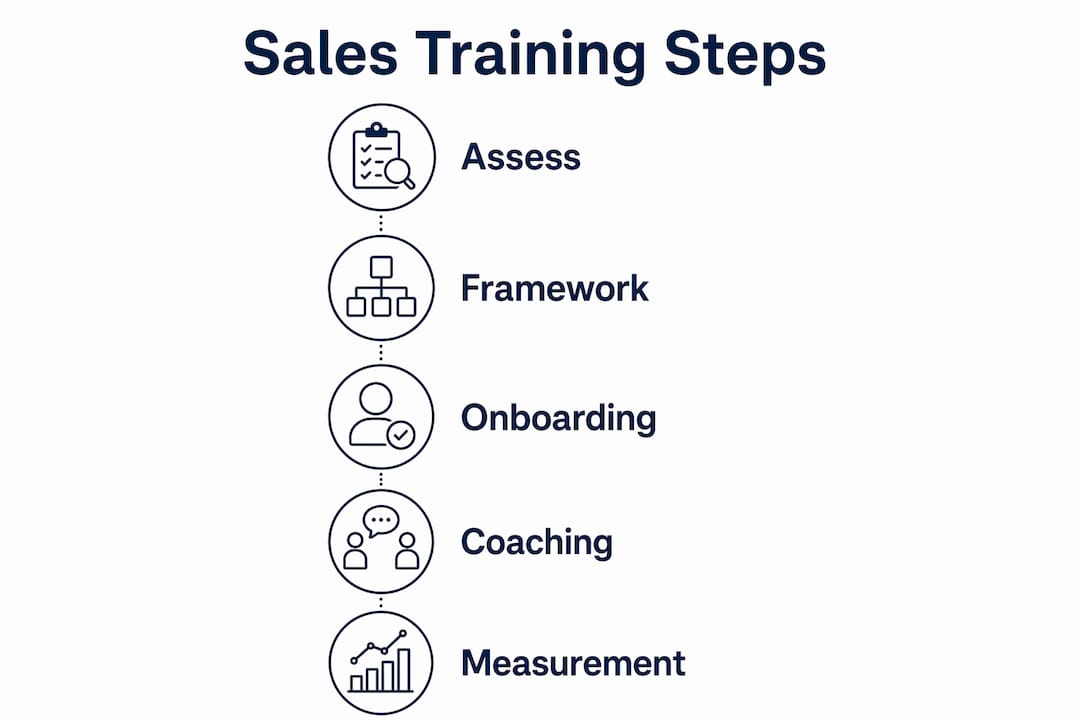
Sales development requires six sequential steps: assess gaps, set a skill framework, run onboarding, deliver weekly coaching tied to pipeline, use coachable moment tools, and track leading indicators beyond quota. Skipping any step stalls development and reduces programme efficacy. That is the single most important structural principle to understand before you design anything.
What do you need before you start?
The most common mistake is launching training before you have the right foundations in place. You need three things before writing a single module: a documented sales process, a clear picture of your current skill gaps, and the right tools to capture and assess performance.
Documenting your sales process
Your sales process must be written down, stage by stage, before training begins. If your team cannot agree on what “qualified” means, no amount of objection handling practice will fix your pipeline. Map each stage, define the exit criteria, and identify the key behaviours a rep must demonstrate to move a deal forward.
Identifying skill gaps with data
Call recordings and pipeline data are your two most reliable sources of truth. Listen to discovery calls and score them against a simple rubric. Look at where deals stall most often in your pipeline. That data tells you exactly which skills to prioritise, and in which order.
Pro Tip: Do not rely on manager opinion alone to identify gaps. Score at least ten calls per rep before drawing conclusions. Patterns only emerge from volume.
Tools you need to get started
| Tool type | Purpose | When to use |
|---|---|---|
| Call recording software | Capture real conversations for review | Before and during training |
| Skills assessment rubric | Score observable behaviours on a 1–5 scale | Gap analysis and ongoing coaching |
| Pipeline analytics | Identify deal stage drop-off patterns | Prioritising training focus |
| Coaching feedback platform | Deliver structured, timestamped feedback | Weekly coaching sessions |
Tooling should amplify a documented sales process that the team has already mastered, not replace the fundamentals. Buy the tools after you have the process. Not before.
How do you structure training modules by deal stage?
Once your foundations are in place, you can build the curriculum. The sequence matters enormously. Start with prospecting, then move through qualification, discovery, demo, objection handling, and closing. Each module should have a behaviour objective written before any content is created.
A behaviour objective sounds like this: “By the end of this module, the rep will be able to ask three open discovery questions that surface the prospect’s financial impact.” That is specific, observable, and measurable. Vague objectives like “understand discovery” produce vague results.
The core module sequence
- Prospecting — targeting, outreach messaging, and pipeline generation
- Qualification — applying a framework such as BANT or MEDDIC to assess deal viability
- Discovery — open questioning, active listening, and surfacing business pain
- Demo or proposal — linking your solution directly to the prospect’s stated priorities
- Objection handling — responding to price, timing, and competitor concerns with confidence
- Closing — decision leadership and gaining clear next steps
Core skills to prioritise include active listening, discovery questioning, objection handling, financial literacy, and pipeline discipline. Address one skill per week so reps can practise it in live deals before moving on.
Asynchronous versus live delivery
Conceptual knowledge suits asynchronous delivery, while skill practice needs live interaction. Send your reps a short video or reading on the theory of discovery questioning before the session. Then spend the live session doing role-play with immediate feedback. This split prevents training fade, which is the rapid loss of learning that happens when reps sit through slide decks with no chance to practise.
Pro Tip: Teach the ‘why’ behind each sales stage, not a script. Frameworks from SPIN Selling and The Challenger Sale give reps mental models they can adapt in any conversation. Principles over scripts is the difference between a rep who performs in training and one who performs in the field.
Build your scoring rubric before you write your content. Measurement should focus on behaviour change aligned to deal stages, not knowledge recall. If you cannot observe and score the behaviour, the module is not specific enough.
How does ongoing coaching cement what training starts?
Training without coaching is information without application. 1:1 call coaching provides double the quota improvement compared to training alone, using a Skills Gym model that focuses on one core skill per week with a 1–5 rubric for performance grading. That is not a marginal gain. It is the difference between a team that improves and one that plateaus.
The 1:1 coaching approach that Aheadofsales uses follows a four-step cycle every week.
- Assess — the rep and manager each score the same call recording independently using the rubric
- Drill — the manager runs a focused role-play on the one skill that scored lowest
- Review — both parties discuss what changed and what still needs work
- Repeat — the same skill stays in focus until the rubric score reaches the target
This cycle keeps coaching grounded in real pipeline activity, not hypothetical scenarios. Pipeline-tied coaching feedback focusing on exact moments in calls bridges the gap between effort and skill improvement. When a rep hears specific feedback on a specific call moment, they can act on it immediately in their next conversation.
Common coaching mistakes to avoid
The three most damaging coaching habits are: giving general feedback (“you need to listen better”), coaching too many skills at once, and skipping sessions when the pipeline gets busy. Each one breaks the cycle and resets progress. Protect the weekly session as non-negotiable. The pipeline pressure that tempts you to skip coaching is exactly the pressure that makes coaching most valuable.
Pro Tip: Keep a shared coaching log. Record the skill focus, the rubric score before and after, and the agreed action for the following week. This creates accountability on both sides and gives you data to show whether coaching is working.
How do you measure success and fix what is not working?
Quota attainment is a lagging indicator. By the time it moves, you have already lost weeks of opportunity. Track leading indicators instead: discovery depth scores, qualification discipline, and the ratio of deals that progress past each stage. These tell you whether behaviour is changing before the revenue numbers confirm it.
Assessments aligned to behaviour change rather than knowledge recall give you an accurate picture of training effectiveness. A rep who scores 90% on a knowledge quiz but still fails to ask open questions in discovery has not been trained. They have been informed. The distinction matters.
Common challenges and how to solve them
| Challenge | Root cause | Solution |
|---|---|---|
| Training fade after workshops | No live practice or follow-up | Add weekly coaching and role-play sessions |
| Reps revert to old habits | Skills not tied to real deals | Coach on live pipeline calls, not hypotheticals |
| Inconsistent results across the team | No shared rubric or process | Document the sales process and standardise scoring |
| Managers skip coaching sessions | No accountability structure | Make coaching metrics part of manager performance reviews |
| Training does not move the pipeline | Modules not aligned to deal stages | Redesign curriculum around stage-specific behaviour objectives |
Iterate your curriculum every quarter. Collect feedback from reps after each module, review rubric scores across the team, and adjust the content that is not producing behaviour change. Lead nurturing strategies also compound the impact of training by keeping prospects warm while reps develop their skills.
Pro Tip: Align your hiring criteria to your training framework. If you hire reps who already demonstrate the core behaviours your training targets, the programme compounds rather than starts from zero every time. Sales success is a teachable craft, but hiring people with the right foundations accelerates everything.
Key takeaways
Effective sales training delivers measurable skill improvement only when it follows a documented, stage-sequenced process reinforced by weekly 1:1 coaching and behaviour-focused assessment.
| Point | Details |
|---|---|
| Sequence training by deal stage | Build modules from prospecting to closing so each skill reinforces the next. |
| Document the process first | A written sales process with exit criteria is the foundation every module depends on. |
| Use live coaching, not slide decks | Weekly 1:1 coaching on real calls doubles quota improvement compared to training alone. |
| Measure behaviour, not knowledge | Score observable behaviours on a rubric before writing any training content. |
| Iterate every quarter | Review rubric scores and rep feedback to revise modules that are not changing behaviour. |
What I have learned building sales training programmes that actually stick
The most common thing I see when working with sales teams is this: the training exists, but it is disconnected from the actual sales process. There are slide decks, there are workshops, and there might even be a CRM full of data. But nobody has sat down and mapped the training to what happens in a real deal, stage by stage.
The second thing I see is an over-reliance on natural talent. Businesses quietly build their revenue around two or three strong performers and call it a sales team. That is not a team. That is a dependency. Relying on naturally talented reps is a risky and non-scalable strategy. The moment one of those people leaves, the pipeline collapses.
What actually works is unglamorous but reliable. You document the process. You identify the gaps with data. You build modules around specific, observable behaviours. You coach weekly on real calls. You score everything. And you revise the curriculum when the scores tell you something is not working.
The teams I have seen grow fastest are not the ones with the biggest training budgets. They are the ones where the manager shows up every week with a call recording and a rubric, and has an honest conversation about one skill. That consistency, repeated over months, is what builds a team that hits target every quarter.
If you want to explore effective sales training methods that go beyond the theory, the principles in this guide are a solid starting point.
— Jerry
How Aheadofsales can accelerate your team’s development
Aheadofsales combines bespoke 1:1 coaching with structured training and consultancy to help businesses achieve at least 50% sales growth every year. Every programme is built around the stage-sequenced methodology described in this guide, tailored to your actual sales process and your team’s specific skill gaps.
Whether you manage a team of 10 or 500, the approach is the same: document the process, identify the gaps, build the curriculum, coach weekly, and measure behaviour change. Aheadofsales packages start from £4,500 and are designed for businesses with 50–1,000 staff who are serious about growth. If you are ready to build a team that hits target every quarter, explore the sales training services Aheadofsales offers and find the right fit for your team.
FAQ
What is step by step sales training?
Step by step sales training is a structured programme that builds sales skills in sequence, aligned to each stage of the sales process, and reinforced through regular coaching and behaviour assessment.
How long does it take to see results from sales training?
Behaviour change typically becomes visible within four to six weeks of consistent weekly coaching. Revenue impact follows as a lagging indicator, usually within one to two quarters.
Why is 1:1 coaching more effective than group training alone?
1:1 coaching focuses on a rep’s specific call behaviour in real deals, which produces double the quota improvement compared to training without coaching.
What skills should sales training cover first?
Start with prospecting and qualification before moving to discovery and objection handling. Reps cannot handle objections effectively if they have not qualified the deal properly.
How do you measure whether sales training is working?
Track leading indicators such as discovery depth scores, stage progression rates, and rubric scores from call reviews. These move before quota attainment does and show whether behaviour is genuinely changing.