
TL;DR:
- A sales support manager oversees operational workflows and manages teams to keep sales deals moving efficiently. They play a strategic role by designing processes, utilizing AI, and measuring performance to drive growth. Recognizing this role’s importance can help businesses scale sales without proportional increases in headcount.
A sales support manager is defined as the operational leader who keeps a sales team running efficiently by designing workflows, managing support staff, and removing the friction that slows deals down. This role sits between front-line sales and back-office operations, making it one of the most consequential positions in any growth-focused business. The salary range for this role typically falls between $65,000 and $100,000, reflecting the genuine strategic weight it carries. With AI now reshaping how sales teams work, the function has moved well beyond administration. If you are a sales professional, HR manager, or business leader trying to build a high-performing team, understanding this role is the starting point.
What does a sales support manager actually do?
A sales support manager oversees the operational infrastructure behind sales functions, covering order entry, fulfilment coordination, and customer communication. That description sounds tidy on paper, but the reality is messier and more demanding. When a deal stalls because a contract has not been processed, or a key account goes quiet because no one followed up on a delivery query, this is the person who fixes it.
The daily scope of responsibilities typically includes:
- Managing a team of sales coordinators, analysts, and administrators
- Overseeing order processing and ensuring fulfilment timelines are met
- Designing and documenting escalation paths for customer and sales rep issues
- Partnering with sales leadership on capacity planning and headcount decisions
- Identifying workflow bottlenecks before they become deal-breakers
The coordination work is relentless. A sales operations coordinator might handle individual tasks, but the manager holds the whole system together. When a sales rep submits ten urgent requests on a Friday afternoon, the manager decides which ones are genuinely urgent and which ones can wait until Monday without damaging a relationship.
Pro Tip: Map every recurring escalation your team handles for one month. Patterns will emerge. Those patterns reveal the process gaps that are costing your sales team time and deals.
Cross-functional alignment is where the role gets genuinely interesting. The best managers in this position do not just react to problems. They sit in pipeline reviews, spot where deals are stalling, and redesign the support process before the next quarter begins. That proactive posture is what separates a good support manager from a great one.
What skills and qualifications does a sales support manager need?
Employers typically require a bachelor’s degree in business, communications, or supply chain management, though many accept an associate degree combined with five or more years of progressive experience. Experience requirements generally sit at 4–7 years in sales support or order management, with at least 2 years in a supervisory role. That supervisory experience matters more than most job descriptions let on.
Hard skills that employers prioritise
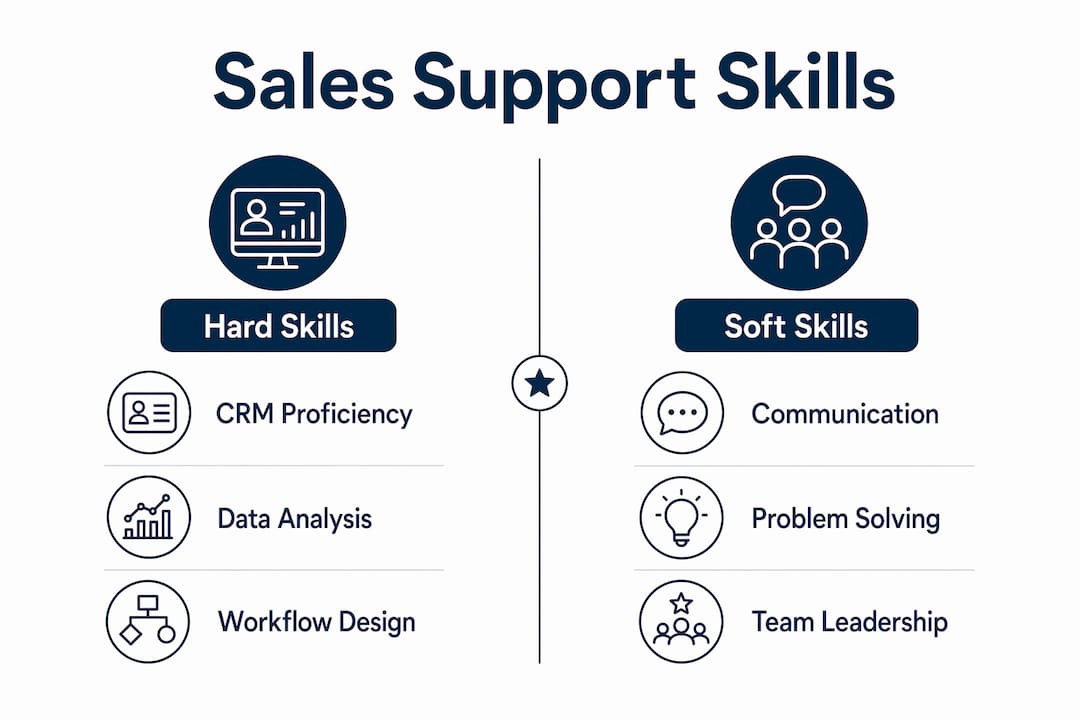
The technical requirements for this role have grown considerably. CRM proficiency is non-negotiable. Most employers expect hands-on experience with platforms like Salesforce or HubSpot, because the manager needs to read pipeline data, not just trust what reps tell them. Process improvement methodologies, data analysis, and documentation design round out the core hard skill set.
Soft skills that separate good from great
Communication is the most underrated skill in this role. The manager must translate operational constraints into language that sales reps understand, and translate sales priorities into instructions that support staff can act on. Stakeholder management, the ability to say no without damaging a relationship, is equally critical. Strategic thinking ties it all together, because the role increasingly requires planning for volume growth without proportional headcount increases.
Hiring managers who treat this role as a strategic operator position rather than an administrative one see measurably better outcomes. The distinction is not semantic. It changes who you recruit, how you onboard them, and what you ask them to build.
| Skill category | Key requirements |
|---|---|
| Education | Bachelor’s degree in business, communications, or supply chain; associate degree accepted with 5+ years’ experience |
| Experience | 4–7 years in sales support or order management; 2+ years supervisory |
| Hard skills | CRM proficiency, process improvement, data analysis, documentation design |
| Soft skills | Communication, stakeholder management, strategic thinking, conflict resolution |
| Salary range | $65,000–$100,000 depending on company size, industry, and equity arrangements |
How are sales support managers using AI to improve efficiency in 2026?
75% of B2B sales organisations now combine traditional sales support with AI-guided selling to maintain efficiency without losing the human element. That figure tells you the direction of travel is settled. The question is no longer whether to integrate AI, but how to do it without creating new problems.

The most effective approach in 2026 is the AI-human hybrid workflow. Routine tasks, including scheduling, data enrichment, lead scoring, and follow-up sequencing, move to AI automation. Human effort concentrates on complex conversations, relationship management, and decisions that require judgement. The result is a support team that handles significantly more volume without burning out.
Practical AI applications that sales support managers are deploying right now include:
- Meeting assistants that transcribe calls, extract action items, and update CRM records automatically
- Lead routing tools that assign inbound enquiries based on rep capacity, territory, and deal stage
- Conversation intelligence platforms that flag at-risk deals based on language patterns in sales calls
- Next-best-action engines that recommend follow-up steps based on pipeline data and historical win rates
- Forecasting models that give managers a more accurate view of which deals will close this quarter
“Mastering the AI-human hybrid workflow means focusing human effort on complex, high-value interactions while automating routine tasks through AI tools. The managers who get this balance right build teams that scale without proportional headcount growth.”
60% of B2B sales organisations have already shifted from experience-based to data-driven selling by integrating analytics into their core processes. That shift changes what a support manager needs to know. Reading a dashboard and acting on it is now a baseline expectation, not a bonus skill.
The risk worth flagging is over-automation. When AI handles too much of the customer-facing communication, deals can feel impersonal and response quality drops. The manager’s job is to set the boundaries: automate the task, not the relationship.
How can sales support managers measure and improve team performance?
Performance measurement starts with identifying the right KPIs. Pipeline velocity, the speed at which deals move from stage to stage, is the most direct indicator of whether your support function is working. Win rate by deal stage tells you where deals are being lost. Response time on customer queries tells you whether your team’s workload is sustainable.
Most B2B sales cycles last 3–9 months. Unclear support processes lengthen those cycles and increase deal failures. That is a concrete cost, not an abstract concern. When you can show leadership that a process change reduced average cycle length by two weeks, you have made a business case that sticks.
Pro Tip: Run a monthly bottleneck audit. Ask every sales rep to name the one support task that slowed them down most in the past four weeks. The answers will cluster around two or three recurring issues. Fix those first.
Diagnosing bottlenecks requires looking at the handoff points between teams. Poor alignment between sales and marketing results in lost leads and wasted opportunities. The support manager is often the person best placed to spot this misalignment, because they see both sides of the handoff. When marketing passes leads that sales cannot qualify, or when sales ignores marketing-generated content, the support function absorbs the friction.
The B2B sales cycle stages framework gives managers a structured way to audit where deals are stalling. Pair that with a consultative selling approach and you have a system for continuous improvement rather than reactive firefighting.
Iterative testing is the discipline that separates high-performing support functions from average ones. Change one process at a time, measure the impact over four to six weeks, and keep what works. Treating the support function as a data-driven engine that tests and iterates based on pipeline velocity leads to faster deal closure and steadily improving performance.
| Performance area | Weak signal | Strong signal |
|---|---|---|
| Pipeline velocity | Deals stall at the same stage repeatedly | Consistent movement through each stage within target timeframes |
| Sales and marketing alignment | Leads go unworked; content goes unused | Shared lead handoff process with agreed response times |
| Support team capacity | Reps escalate the same issues weekly | Documented escalation paths reduce repeat queries |
| Process improvement | Changes made reactively after problems | Monthly audits drive proactive process updates |
Key takeaways
A sales support manager drives sales performance by designing processes, managing operational teams, and using data to remove friction from the pipeline.
| Point | Details |
|---|---|
| Role definition | The sales support manager leads operational infrastructure, not just administrative tasks. |
| Experience requirements | Employers expect 4–7 years in sales support and at least 2 years in a supervisory role. |
| AI integration | Hybrid AI-human workflows free teams to focus on high-value conversations and complex decisions. |
| Performance measurement | Pipeline velocity and win rate by stage are the most direct indicators of support effectiveness. |
| Strategic positioning | Managers who design scalable processes reduce the need for proportional headcount growth. |
Why the sales support manager role is more strategic than most businesses realise
I have worked with a lot of sales teams over the years, and the pattern I see repeatedly is this: businesses underinvest in the support function and then wonder why their reps are underperforming. The support manager gets hired as a glorified administrator, given a small team and a reactive brief, and then blamed when the pipeline slows down.
The uncomfortable truth is that this role is a force multiplier. When it is filled by someone who thinks like a process designer rather than a task manager, the whole sales team performs better. Reps spend more time selling. Deals move faster. Customer experience improves. The GSA customer service model illustrates this well: when support functions are designed with a growth mindset, they actively contribute to revenue rather than simply protecting it.
What I find most encouraging in 2026 is that AI has made the strategic case for this role undeniable. You cannot implement an AI-human hybrid workflow without someone who understands both the operational detail and the sales strategy. That person is the support manager. Businesses that recognise this early will build sales functions that scale without the usual growing pains.
My advice to anyone in this role right now: stop waiting to be invited into strategic conversations. Bring data. Show leadership what the pipeline velocity numbers say about your support processes. Make the business case for process investment before problems force the conversation. The managers I have seen succeed long-term are the ones who position themselves as growth enablers, not operational firefighters.
— Jerry
How Aheadofsales helps sales support managers build high-performing teams
Sales support management is a skill set that develops fastest with the right coaching and structure behind it.

Aheadofsales works with businesses of 50–1,000 staff to build sales teams that hit target every quarter and generate at least 50% sales growth year on year. The sales training programmes cover everything from process design and CRM optimisation to consultative selling and pipeline management. For SaaS businesses specifically, the SaaS-focused training addresses the unique challenges of longer sales cycles and complex stakeholder management. Packages start from £4,500, with bespoke 1:1 coaching built into every engagement. If you are serious about building a support function that drives growth rather than just managing volume, this is where to start.
FAQ
What is a sales support manager?
A sales support manager is the operational leader responsible for managing sales support teams, designing workflows, and removing process friction that slows deal progression. The role covers order management, customer coordination, escalation handling, and cross-functional alignment with sales leadership.
What experience is needed to become a sales support manager?
Most employers require 4–7 years of experience in sales support or order management, including at least 2 years in a supervisory role, alongside a bachelor’s degree or equivalent progressive experience.
How does a sales support manager differ from a sales operations coordinator?
A sales operations coordinator handles individual tasks within defined processes, while a sales support manager designs those processes, manages the team, and takes responsibility for overall operational performance and capacity planning.
What KPIs should a sales support manager track?
Pipeline velocity, win rate by deal stage, and support team response times are the most direct indicators of sales support effectiveness. Tracking where deals stall reveals the process gaps that need fixing first.
How is AI changing the sales support manager role?
AI automates routine tasks such as scheduling, lead scoring, and data enrichment, freeing support teams to focus on complex, high-value work. The manager’s role shifts toward designing and governing these hybrid workflows rather than supervising manual processes.