
TL;DR:
- ARR reflects predictable subscription income expected over a year, excluding variable, one-time fees, and non-recurring revenue. It is best used for valuation, planning, and assessing business health, but does not show actual cash flow or profit. Proper segmentation and consistent definition are essential for accurate analysis and strategic growth.
Annual recurring revenue (ARR) is the total value of predictable, contractually committed subscription income a business expects to receive over a 12-month period. It excludes variable fees, one-time charges, and anything not guaranteed to repeat. ARR is the standard metric investors, boards, and finance teams use to assess the health and growth trajectory of subscription-based businesses. If you run or advise a SaaS company, a managed services firm, or any business built on recurring contracts, ARR is the number that defines your baseline. Understanding what it includes, what it excludes, and how to interpret it correctly is the difference between confident strategic planning and costly misreading of your own business.
What is annual recurring revenue and how is it calculated?
ARR is calculated using one straightforward formula: ARR = MRR × 12. MRR stands for monthly recurring revenue, which is the total value of active subscription contracts in a single month. Multiply that by 12 and you have your annualised figure. The simplicity of the formula, however, masks a significant amount of judgement in what you include.
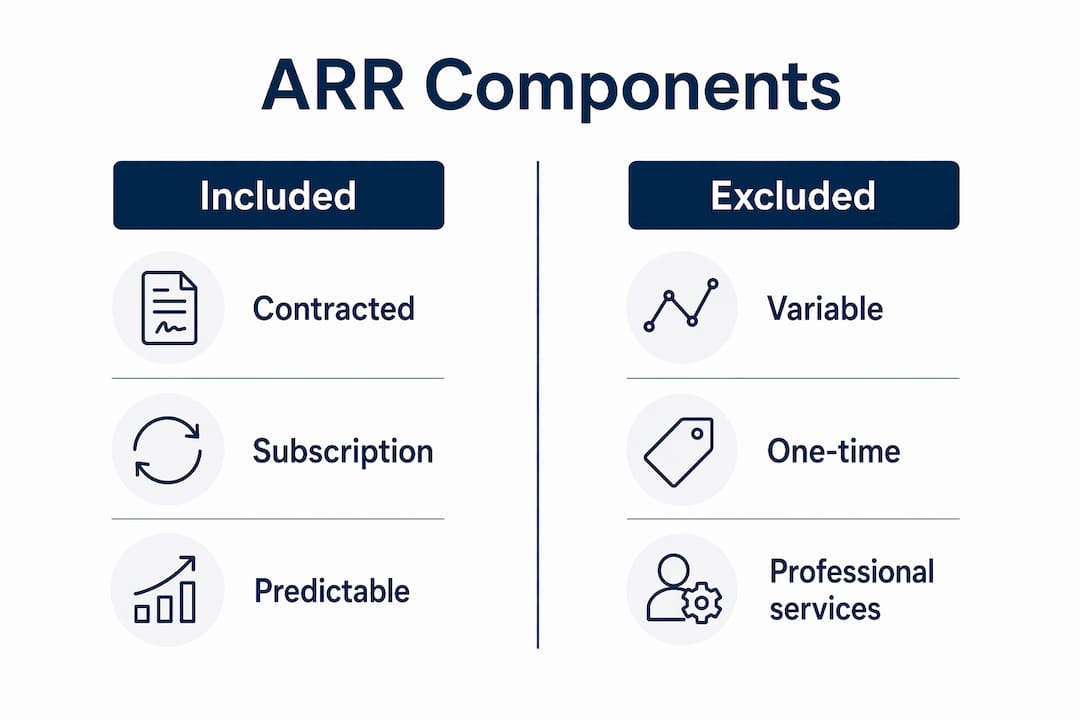
The components that belong in ARR are:
- Contracted subscription fees paid on a monthly or annual basis
- Recurring add-ons that are part of a signed contract, such as additional user licences or feature tiers
- Expansion revenue from upsells and cross-sells where the customer has committed contractually
The components that do not belong in ARR are equally important. ARR specifically excludes variable, non-recurring income such as one-time professional services, hardware sales, setup fees, and usage overages. This distinction is deliberate. The metric is designed to reflect future stability, not past cash flow spikes.
A practical example: if your business has 50 customers each paying £500 per month on annual contracts, your MRR is £25,000 and your ARR is £300,000. If three of those customers also paid a one-time onboarding fee of £1,000, that £3,000 does not enter the ARR calculation.

Inconsistent inclusion of professional services or add-ons in ARR calculations can skew reports significantly. Best practice is a documented internal definition of exactly which revenue streams count toward ARR, reviewed and agreed by finance, sales, and leadership together. Without that document, different teams will calculate ARR differently, and your board updates will contradict each other.
Pro Tip: Create a one-page ARR definition document that lists every revenue line in your business and explicitly marks each one as “included” or “excluded.” Review it every six months as your product and pricing evolve.
What is the difference between ARR and MRR?
ARR and MRR measure the same underlying subscription revenue, but they serve different purposes and suit different audiences. Professional teams track ARR alongside MRR to balance long-term planning with short-term health monitoring. Using only one of them leaves gaps in your understanding.
| Dimension | ARR | MRR |
|---|---|---|
| Time period | 12 months | 1 month |
| Primary use | Valuation, board reporting, fundraising | Churn monitoring, tactical decisions |
| Volatility | Lower, smoothed over a year | Higher, reflects monthly changes |
| Audience | Investors, executives, board members | Finance teams, sales leaders, operators |
| Calculation | MRR × 12 | Sum of active monthly subscription values |
ARR is the metric you present to investors and use for annual budgeting. It gives a stable, annualised view that strips out month-to-month noise. MRR is the metric your sales and finance teams watch weekly. It catches churn early, shows the impact of a strong sales month, and signals whether your growth rate is accelerating or slowing.
Businesses that track only ARR miss the early warning signs that MRR reveals. A company with £1.2 million ARR might look healthy on paper, but if MRR has declined for three consecutive months, the annual figure is already out of date. The two metrics work together, not in competition.
Pro Tip: Report MRR to your sales and operations team monthly and ARR to your board quarterly. Align the definitions used in both reports so the numbers reconcile cleanly when anyone checks.
What are the pitfalls of interpreting ARR incorrectly?
ARR is a snapshot metric, not a cash figure. ARR is a normalised, contractual metric and does not represent cash in the bank. Misunderstanding this causes liquidity gaps, particularly in growth-stage companies that spend against ARR as though it were already collected revenue.
The most common misinterpretations are:
- Treating ARR as GAAP revenue. ARR is not GAAP revenue and does not appear on your profit and loss statement in the same form. Revenue recognition rules require income to be recorded as it is earned, not as a forward-looking annual contract value.
- Ignoring churn within the headline number. High ARR can mask poor retention without component analysis. A business adding £50,000 of new ARR per month while losing £45,000 to churn has a net ARR growth of only £5,000. The headline looks fine; the underlying business is struggling.
- Conflating ARR with total revenue. ARR strips away noise such as one-time fees to show the true baseline for valuation. Conflating total revenue and ARR is a common reporting error that misleads business assessment.
- Ignoring timing sensitivity. A contract signed on the last day of the month contributes a full month of MRR in most calculations. A contract cancelled on the first day of the month removes a full month. These timing decisions compound across hundreds of contracts and create material differences in reported ARR.
The solution to most of these pitfalls is segmentation. Break your ARR into four components: new ARR from new customers, expansion ARR from upsells, churned ARR from cancellations, and contraction ARR from downgrades. This breakdown turns ARR from a headline number into a diagnostic tool for growth that reveals where your business is winning and where it is losing ground.
Real-time billing software helps avoid manual errors in ARR calculation. Sophisticated automation improves accuracy and prevents the timing mistakes that distort revenue recognition. If your team is still calculating ARR from spreadsheet exports, the risk of error is significant.
Separately, ARR tells you nothing about cash flow timing. A customer on an annual contract paid upfront generates the same ARR as one billed monthly, but the cash positions are entirely different. For UK SMEs managing growth, understanding cash flow alongside ARR is not optional. It is the difference between a business that grows confidently and one that runs out of cash while technically profitable.
How do businesses use ARR strategically for growth?
ARR is most powerful when it moves from a reporting metric to a planning tool. Here is how high-performing subscription businesses use it strategically:
-
Budget against ARR, not total revenue. Use your current ARR as the floor for next year’s cost base. Any spend above that floor must be justified by projected new ARR from your sales pipeline. This discipline prevents overspending against optimistic forecasts.
-
Set ARR growth targets by segment. Rather than chasing a single headline ARR number, set separate targets for new ARR, expansion ARR, and churned ARR. This forces your sales and customer success teams to own distinct parts of the growth equation. Account management best practices directly affect expansion ARR through upsells and renewals.
-
Use ARR in investor and board communication. ARR is the standard language of subscription business valuation. Present it with a clear breakdown of its components, the net ARR movement quarter on quarter, and the implied ARR multiple relative to your last funding round or market comparables.
-
Align your sales team’s targets to ARR contribution. Sales reps who understand how their deals contribute to ARR, not just closed revenue, make better decisions about deal structure, contract length, and pricing. Consultative selling techniques that focus on long-term customer value naturally drive higher ARR per customer.
-
Review ARR definitions before every fundraising round. Investors will scrutinise exactly what you include in ARR. A definition that inflates the number by including professional services or one-time fees will be challenged in due diligence and can damage credibility at a critical moment.
Financial experts stress that ARR is fundamental for valuation, distinct from total revenue, and gives a clear baseline for future spending and fundraising preparations. The businesses that use ARR most effectively treat it as a living metric, reviewed monthly, segmented carefully, and tied directly to sales and customer success targets.
Key takeaways
ARR is the single most important metric for subscription businesses, but only when it is calculated consistently, segmented properly, and never confused with cash collected or GAAP revenue.
| Point | Details |
|---|---|
| ARR formula | Multiply monthly recurring revenue by 12, including only contracted, recurring income. |
| Exclude one-time fees | Setup charges, professional services, and hardware sales must be excluded to keep ARR accurate. |
| Segment for insight | Break ARR into new, expansion, churned, and contraction components to reveal true growth health. |
| ARR is not cash | ARR does not reflect when cash arrives; manage cash flow separately alongside your ARR figures. |
| Document your definition | An agreed, written ARR definition prevents reporting errors across finance, sales, and board updates. |
ARR in practice: what I have seen go wrong
I have worked with subscription businesses at various stages of growth, and the ARR mistakes I see most often are not calculation errors. They are definition errors. Two people in the same business are calculating ARR differently, neither knows it, and the board is making decisions based on a number that nobody can fully defend.
The fix is unglamorous but effective: write it down. A single document, agreed by finance and sales leadership, that defines every revenue line and its ARR treatment. It takes an afternoon to create and saves months of confusion.
The second mistake I see is treating ARR as a proxy for business health on its own. A growing ARR headline can hide a churn problem that will catch up with the business within two or three quarters. I always push clients to show me the net ARR movement, broken into its components, before I accept that a business is genuinely growing. The headline number is the starting point, not the conclusion.
ARR also does not tell you whether your sales team is selling effectively. A business can have strong ARR and still be leaving significant expansion revenue on the table because account managers are not having the right conversations. The metric tells you the result; it does not tell you how to improve it. That is where SaaS-specific sales training and structured coaching make a measurable difference.
Finally, do not let ARR become a vanity metric. I have seen founders quote ARR in investor meetings without being able to explain the churn rate, the average contract value, or the net revenue retention. Investors notice. Know your number and know what is inside it.
— Jerry
How Aheadofsales helps subscription businesses grow ARR
Understanding ARR is one thing. Building the sales capability to grow it consistently is another.

Aheadofsales works with subscription and SaaS businesses to build the sales skills, processes, and coaching structures that drive ARR growth quarter after quarter. Our SaaS sales training is built specifically for teams selling recurring contracts, where deal structure, contract length, and customer retention all feed directly into ARR. We combine bespoke 1:1 coaching with group training and consultancy, and our clients target at least 50% sales growth per year. If your business has 50 to 1,000 staff and you are serious about growing recurring revenue, our packages start from £4,500. Speak to us about what that looks like for your team.
FAQ
What is annual recurring revenue in simple terms?
Annual recurring revenue (ARR) is the total value of subscription income a business expects to receive over 12 months, based on active contracts. It excludes one-time fees and variable charges.
How do you calculate ARR?
Multiply your monthly recurring revenue (MRR) by 12. MRR is the sum of all active subscription contract values in a single month, excluding non-recurring income.
What is the difference between ARR and total revenue?
ARR covers only predictable, contracted subscription income. Total revenue includes one-time fees, professional services, and hardware sales, which ARR deliberately excludes to show a stable baseline.
Does ARR represent cash in the bank?
No. ARR is a contractual metric, not a cash figure. A customer on an annual contract paid upfront and one billed monthly generate the same ARR but very different cash positions. Manage cash flow planning separately.
Why should businesses segment ARR?
Segmenting ARR into new, expansion, churned, and contraction revenue reveals where growth is coming from and where it is being lost. A strong headline ARR figure can hide a serious churn problem without this breakdown.