
TL;DR:
- A structured sales consultancy process improves sales performance through data assessment, process redesign, and governance. It begins with establishing a clear baseline, followed by stages of auditing, prioritization, process redesign, implementation, and handover. Effective governance, detailed process design, and thorough handover ensure lasting results and team ownership.
An effective sales consultancy process is a structured engagement that delivers measurable sales performance improvements through data-driven assessment, process redesign, and governance implementation. Most business owners and sales leaders invest in consultancy without first establishing a performance baseline, which makes it nearly impossible to prove impact or sustain results. The industry term for this approach is “sales process consulting,” and it covers everything from audit and scoping through to playbook delivery and team handover. Done well, it produces documented workflows, CRM alignment, qualified pipeline growth, and a team that no longer depends on the consultant to function.
What are the essential stages in an effective sales consultancy process?
A well-run sales consultancy engagement follows a clear sequence. Each stage builds on the last, and skipping any one of them creates gaps that surface later as adoption failures or measurement blind spots.
Consultants review data and interview stakeholders to set a performance baseline before any process work begins. That baseline is the reference point against which every improvement is later measured. Without it, you are guessing at progress.
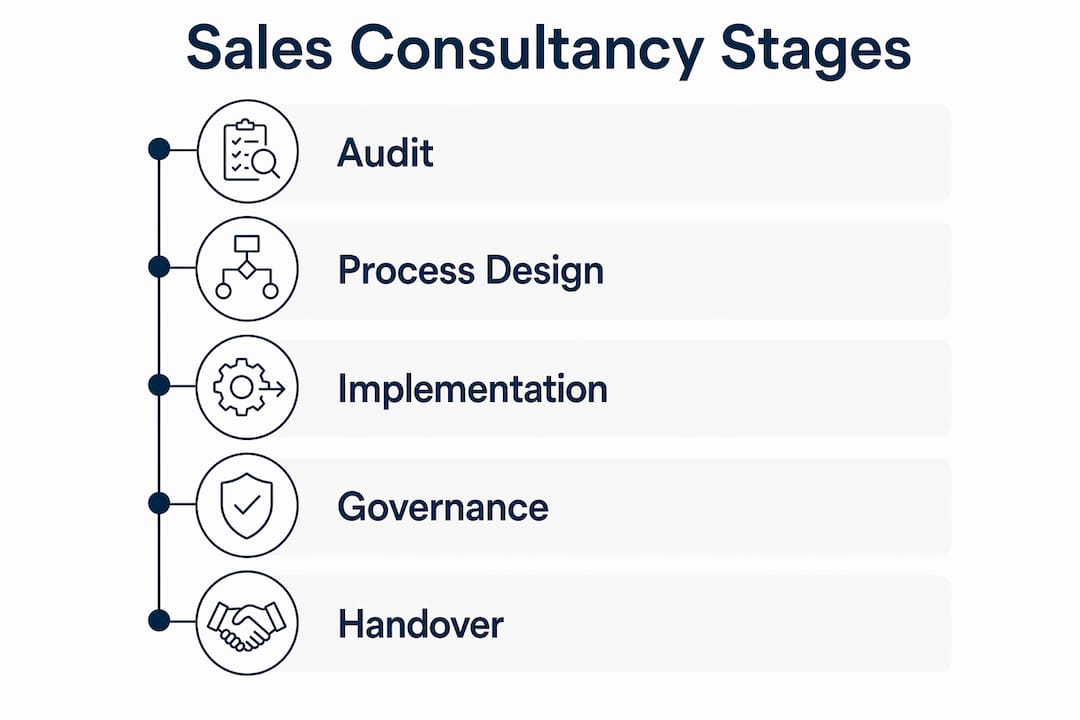
The five core stages are:
- Audit. Review CRM data, pipeline reports, and win/loss records. Interview sales reps, managers, and key stakeholders. Identify where deals stall, where data is missing, and where process is inconsistent.
- Prioritisation. Rank findings by business impact. A long sales cycle caused by unclear qualification criteria will cost more revenue than a poorly formatted proposal template. Fix the high-impact items first.
- Process redesign. Define deal stages, the meetings or actions required at each stage, and the exit criteria a rep must satisfy before moving a deal forward. This is where a repeatable workflow is built.
- Implementation. Run coaching sessions, update CRM pipeline stages, and onboard the team to the new process. This phase requires patience. Reps need time to practise new behaviours before they become habits.
- Handover. Transfer a documented sales playbook and KPI dashboard to the internal team. The goal is full autonomy, not ongoing dependency on the consultant.
Pro Tip: When prioritising audit findings, ask one question: “If we fix this, does it directly affect revenue within 90 days?” If the answer is yes, it goes to the top of the list.
How to scope and govern a successful sales consultancy engagement
Scoping is where most consultancy engagements go wrong before they even start. Vague outcomes and undefined deliverables create disagreements, wasted time, and a client who cannot tell whether they received value.
Effective consultancy scoping includes 1–3 outcomes tied directly to business decisions, deliverables with acceptance criteria, a KPI pack with clear definitions and reporting cadence, and exit criteria after an initial sprint. Each deliverable should have a written acceptance criterion so both parties agree on what “done” looks like.
The table below shows the difference between well-governed engagements and the pitfalls that derail them.
| Governance element | Well-governed engagement | Common pitfall |
|---|---|---|
| Outcomes | 1–3 specific, measurable results | Broad goals like “improve sales” |
| Deliverables | Defined with acceptance criteria | Vague outputs with no sign-off process |
| KPI pack | Baseline, definition, and cadence set upfront | Metrics chosen after the engagement ends |
| Weekly meetings | Fixed agenda, decision rights, issue log | Ad hoc check-ins with no record |
| Change control | Formal process for scope additions | Scope creep absorbed without discussion |
| Exit criteria | Agreed sprint review triggers handover | Engagement drifts indefinitely |
A governance cadence, typically a weekly meeting with a fixed agenda and a shared issue log, keeps the engagement on track. It also creates a record of decisions, which protects both the client and the consultant when priorities shift.
What does process design look like in an effective sales consultancy?
Process design is the technical core of any sales consultancy engagement. It is where abstract findings from the audit become a repeatable, teachable workflow.

The Sales Process Designer approach defines deal stages, meetings, and exit criteria to create repeatable workflows that guide reps and prevent bottlenecks. Each stage needs three things: a name, a required action or meeting, and a clear exit criterion that a rep must satisfy before progressing the deal.
Here is what that looks like in practice:
- Stage: Qualified. Required action: discovery call completed. Exit criterion: budget, authority, need, and timeline confirmed and logged in CRM.
- Stage: Solution presented. Required action: demonstration or proposal delivered. Exit criterion: decision-maker attended the meeting and confirmed next steps in writing.
- Stage: Negotiation. Required action: commercial discussion held. Exit criterion: verbal agreement on price and scope, with a signed order form requested.
Without defined exit criteria tied to CRM hygiene, stage creep distorts pipeline accuracy. Stage creep happens when reps move deals forward based on optimism rather than evidence. The result is a pipeline full of deals that look close but are not, which destroys forecast reliability.
CRM hygiene routines with assigned ownership and embedded schedules maintain data quality far better than periodic audit projects. Assign a named owner to review CRM data weekly. Make it part of the operating rhythm, not a quarterly fire drill.
Pro Tip: Link every CRM stage exit criterion to a real rep action, such as a logged call note, an uploaded proposal, or a confirmed meeting. If the action is not in the CRM, the deal does not move. This single rule eliminates most pipeline inflation.
For a deeper look at how pipeline stages connect to CRM design, the sales pipeline stages guide from Aheadofsales covers the practical mechanics in detail.
Which key metrics and tools are vital to track sales consultancy effectiveness?
Measurement is the part of sales consultancy that most organisations get wrong. Most organisations cannot prove a consultancy’s effectiveness because they lack baseline measurement of key metrics before the engagement begins. You cannot show a 40% improvement in close rate if you did not record the close rate at the start.
The three metrics that matter most are:
| Metric | Definition | Purpose |
|---|---|---|
| Qualified pipeline per SDR per month | Total value of deals meeting ICP and qualification criteria, generated per sales development rep each month | Measures top-of-funnel health and rep productivity |
| Opportunity-to-close rate | Percentage of qualified opportunities that convert to closed-won deals | Reveals conversion efficiency and process quality |
| Average sales cycle length | Mean number of days from opportunity creation to closed-won | Identifies bottlenecks and tracks process improvement over time |
A B2B sales consultancy engagement often concludes with a 90-day KPI dashboard covering ICP definition, sales process documentation, qualification criteria, onboarding guides, and CRM pipeline updates. That dashboard is not a report. It is a live management tool that the internal team uses to run weekly pipeline reviews after the consultant has left.
Documentation matters as much as the metrics themselves. An ICP definition, a qualification scorecard, and a rep onboarding guide give new hires a structured path to productivity. Without them, every new team member restarts from zero.
How to ensure sustainable adoption and handover post sales consultancy
The handover phase is where most consultancy investments either pay off or quietly unravel. A new process that lives only in the consultant’s head is not a process. It is a dependency.
Transitioning ownership through shadowing and co-facilitation supports lasting process adoption. The sequence matters: the consultant runs the session first while the internal manager observes, then they co-facilitate, and finally the manager leads while the consultant observes. By the end, the manager owns the process.
The handover package should include:
- A documented sales playbook covering ICP, qualification criteria, deal stages, and objection handling
- A KPI dashboard with baseline data, definitions, and a weekly review template
- A governance cadence template: weekly pipeline review agenda, issue log format, and decision rights
- Named internal owners for each process component, including CRM hygiene, pipeline review, and onboarding
The most common handover pitfall is handing over documents without transferring the habit of using them. A playbook that sits in a shared drive and is never opened is worthless. Build the review cadence into the team’s weekly calendar before the consultant exits. Make the process the default, not the exception.
Avoiding consultant dependency also means building internal coaching capability. If the sales manager cannot run a deal review using the new framework, the framework will not survive the first quarter without external support.
Key takeaways
An effective sales consultancy process requires a documented baseline, structured stage design, governance cadence, and a thorough handover to deliver lasting sales performance improvement.
| Point | Details |
|---|---|
| Baseline before everything | Measure qualified pipeline, close rate, and sales cycle length before the engagement starts. |
| Stage design with exit criteria | Define explicit deal stages with required actions and CRM-linked exit criteria to prevent pipeline inflation. |
| Governance keeps it on track | Weekly meetings, decision rights, and issue logs prevent scope creep and maintain accountability. |
| Handover transfers ownership | Use shadowing and co-facilitation to move process ownership to internal managers before the consultant exits. |
| Metrics prove impact | A 90-day KPI dashboard with baseline data is the tool that validates consultancy effectiveness. |
What I have learned from running sales consultancy engagements
The single biggest mistake I see business owners make is starting the process design before the audit is finished. They are eager to fix things, which is understandable. But redesigning a sales process without a clear baseline is like rewriting a script before you have read the original. You end up solving the wrong problems.
The governance cadence is the part clients underestimate most. A weekly meeting with a fixed agenda and a shared issue log sounds administrative. In practice, it is the mechanism that forces decisions, surfaces blockers, and keeps the engagement moving. Without it, weeks disappear into email threads and nothing gets resolved.
Handover is where I invest the most care. The goal of any good consultancy engagement is to make itself unnecessary. If the team still needs the consultant six months after the engagement ends, the handover failed. I build the internal coaching capability and the review cadence into the final phase of every project, because that is what determines whether the results last.
My practical advice for any leader starting a sales consultancy engagement: insist on a written baseline before week one ends, agree the exit criteria upfront, and treat the handover as a phase in its own right, not an afterthought.
— Jerry
How Aheadofsales supports your sales consultancy process
Aheadofsales combines bespoke 1:1 coaching with structured consultancy to help businesses build the kind of repeatable sales process described in this article.
The Aheadofsales approach integrates audit, process redesign, playbook delivery, and rep coaching into a single engagement. Packages are designed for businesses with 50–1,000 staff and start from £4,500, with sales acceleration packages for solo operators from £2,995. If you want a process that your team owns and runs without external support, the sales consultancy services page sets out exactly how the engagement works. For teams that need structured training alongside the consultancy work, the sales training services page covers the full range of options.
FAQ
What is an effective sales consultancy process?
An effective sales consultancy process is a structured engagement covering audit, process design, implementation, and handover. It delivers measurable sales performance improvements through documented workflows, CRM alignment, and governance cadence.
How long does a sales consultancy engagement typically take?
Most structured sales consultancy engagements run across an initial sprint of 30–90 days, followed by a handover phase. The timeline depends on the complexity of the existing process and the size of the sales team.
What metrics should I track during a sales consultancy engagement?
The three core metrics are qualified pipeline per SDR per month, opportunity-to-close rate, and average sales cycle length. Baseline measurement of these metrics before the engagement starts is critical to proving impact.
What should a sales consultancy handover include?
A thorough handover includes a documented sales playbook, a KPI dashboard with baseline data, a governance cadence template, and named internal owners for each process component. Shadowing and co-facilitation are the most effective methods for transferring process ownership.
How do I avoid consultant dependency after a sales consultancy engagement?
Build internal coaching capability during the engagement, not after it ends. Assign named owners to every process component, embed the review cadence into the team’s weekly calendar, and use the handover phase to transfer skills, not just documents.