
TL;DR:
- Team sales training enhances revenue growth, shortens sales cycles, and improves team morale.
- Collaborative learning accelerates skill development and reduces dependence on star performers.
Team sales training is a structured programme designed to build collective selling skills, close performance gaps, and drive measurable revenue growth across an entire sales organisation. The term “sales enablement training” is the recognised industry standard for this discipline, though “team sales training” captures the collaborative dimension that makes it most effective for managers leading groups of five or more. Research from CSO Insights confirms that companies with dynamic sales coaching and customised training see significantly higher win rates than those with inconsistent development. The benefits of team sales training extend well beyond individual skill improvement. They reshape how your entire team thinks, sells, and retains customers.
1. What are the primary benefits of team sales training?
Team sales training delivers results at the organisational level, not just for individual top performers. The most direct benefit is revenue growth. Ongoing training produces twice the performance levels compared to organisations that train irregularly. That gap compounds over time, meaning the cost of not training grows every quarter.

The second major benefit is shorter sales cycles. When every rep on your team knows how to qualify prospects quickly and handle objections with confidence, deals move faster. Larger deal sizes follow naturally, because trained reps understand how to position value rather than compete on price.
A third benefit that business leaders often underestimate is team morale. Sales training signals organisational belief in the team’s growth. Reps who feel invested in stay longer and perform better. Customer retention also improves, because trained reps build stronger relationships and follow through more consistently post-sale.
The fifth benefit is consistency. Strategic sales training builds repeatable success across the organisation rather than isolated wins from one or two star performers. When your whole team applies the same proven methods, your revenue becomes predictable.
Pro Tip: Map your team’s current win rate before starting any training programme. That baseline number becomes your most powerful measure of ROI six months later.
2. How does collaborative sales training enhance team effectiveness?
Collaborative selling techniques produce results that individual coaching alone cannot replicate. The principle behind this is collective intelligence: the idea that a team’s shared knowledge, when properly organised and accessible, outperforms any single rep’s experience. Sybill.ai’s research on beehive selling models shows how shared call libraries and AI tools accelerate rep ramp-up and reduce knowledge silos across the team.
The practical impact is significant for managers. When new hires can access recordings of your best reps handling difficult objections, their ramp-up time drops considerably. Mid-performers close the gap with top performers faster, because they are learning from real examples rather than abstract theory.
Collaborative training also changes how managers coach. Instead of reviewing individual deals in isolation, managers can identify themes across the team and address them in group sessions. This is a more efficient use of coaching time and produces broader improvements.
“Beehive selling models leverage collective intelligence and AI to democratise sales knowledge, improving overall team performance rapidly.” — Sybill.ai
The advantage of this model for business leaders is that it reduces your dependency on a handful of star reps. When knowledge is shared across the team, losing one top performer no longer threatens your quarterly target.
3. Which sales skills improve most through structured training?
Structured training produces the sharpest improvements in discovery and objection handling. These two skills determine whether a deal progresses or stalls, yet most untrained reps handle both reactively rather than deliberately. A well-designed programme teaches reps to ask precise discovery questions that surface real buying motivations, not just surface-level requirements.
The skills that improve most consistently through structured programmes include:
- Discovery questioning: Reps learn to uncover the buyer’s actual problem, not just the stated one.
- Objection handling: Teams develop prepared, confident responses rather than improvising under pressure.
- Guiding complex decisions: Reps learn to manage multi-stakeholder buying processes without losing control of the timeline.
- Post-sale engagement: Training covers how to sustain customer relationships after the contract is signed, which directly improves renewal rates.
Consultative selling training builds durable skills that improve customer engagement over the long term. This matters because consultative skills compound. A rep who genuinely understands a customer’s business becomes a trusted adviser, not just a vendor contact. That relationship produces higher customer satisfaction, loyal accounts, and referrals.
High trust selling reinforces this by focusing on partnership and long-term relationships rather than short-term pressure tactics. Customers who trust their rep buy more, complain less, and refer others.
Pro Tip: Run a skills audit before your training programme begins. Ask each rep to self-rate their confidence in discovery, objection handling, and closing. Then compare self-ratings to actual call recordings. The gaps are usually revealing.
4. How can continued reinforcement and coaching sustain training benefits?
Training without reinforcement produces short-term results at best. Research published in the Journal of Applied Psychology shows that learners lose up to 70% of learned skills within weeks after training ends without ongoing coaching. That figure should concern any business leader who has invested in a one-off workshop and seen little lasting change.
Sustaining training benefits requires a structured reinforcement approach. The most effective method follows these steps:
- Weekly coaching sessions: Managers review real calls or deals with individual reps, focusing on specific skills from the training programme rather than just deal outcomes.
- Team-wide skill reviews: Monthly group sessions where the whole team discusses what is working and what is not, using live examples.
- Real-time feedback loops: Managers give immediate, specific feedback after calls or pitches rather than waiting for formal review cycles.
- Integration into deal reviews: Coaching becomes part of the pipeline review process, not a separate activity. Managers ask skill-based questions alongside deal-based ones.
- Tracking leading indicators: Teams monitor skill-based metrics (discovery questions asked, objections handled, follow-up quality) alongside revenue metrics.
The manager’s role shifts from supervisor to consistent coach. This change in behaviour is often the hardest part of embedding training, but it is also the most impactful. Reps who receive regular, specific coaching improve faster and stay with the organisation longer.
5. What measurable business outcomes result from effective team sales training?
Effective team sales training produces outcomes that show up directly in your financial results and your team’s culture. Companies prioritising sales training achieve improved cross-functional alignment and a stronger sales culture, which reduces internal friction and speeds up deal execution.
The table below summarises the key business outcomes that structured training programmes deliver:
| Business outcome | What it means in practice |
|---|---|
| Higher revenue predictability | Consistent skills produce consistent pipeline conversion, making forecasting more reliable. |
| Improved cross-functional alignment | Sales, marketing, and leadership share a common language and process. |
| Stronger team engagement | Reps who receive training report higher job satisfaction and are less likely to leave. |
| Increased customer retention | Trained reps build deeper relationships, reducing churn and improving renewal rates. |
| Repeatable team performance | Success no longer depends on individual stars. The whole team performs at a higher baseline. |
The cumulative effect of these outcomes is a more profitable and resilient business. You are not just improving this quarter’s numbers. You are building a sales organisation that performs consistently regardless of who joins or leaves the team. That is the real competitive advantage of effective sales training strategies.
Key takeaways
Team sales training delivers its greatest value when it combines structured skill development, collaborative knowledge sharing, and consistent reinforcement through ongoing coaching.
| Point | Details |
|---|---|
| Training doubles performance | Organisations that train consistently outperform irregular trainers at twice the performance level. |
| Collaboration closes skill gaps | Shared call libraries and collective intelligence models accelerate ramp-up for new and mid-level reps. |
| Reinforcement prevents decay | Without ongoing coaching, learners lose up to 70% of new skills within weeks of training. |
| Consultative skills compound | Discovery and trust-building skills improve customer retention and generate referrals over time. |
| Consistency beats star performers | Repeatable team-wide skills produce more reliable revenue than relying on a few top individuals. |
Why I believe most businesses underinvest in team training
I have worked with sales teams across a wide range of sectors, and the pattern I see most often is this: a business invests in a training day, sees a short-term lift, and then watches performance drift back to where it started within two months. The training was not the problem. The follow-through was.
The businesses that see lasting results treat training as a system, not an event. They build coaching into the weekly rhythm of their managers. They track skill-based metrics alongside revenue metrics. They use collaborative tools to share what is working across the team rather than keeping best practices locked inside the heads of their top performers.
The other mistake I see regularly is buying generic training that does not match the team’s actual selling environment. A SaaS team selling to enterprise buyers needs different skills than a professional services firm selling to SMEs. Generic programmes produce generic results. The sales consultancy approach that works is one that starts with a genuine diagnosis of where the team is losing deals and builds the programme around that.
My honest view is that team sales training is one of the highest-return investments a business leader can make, provided it is designed properly and reinforced consistently. The teams that commit to it fully do not just hit their targets more often. They build a culture where improvement is expected and shared.
— Jerry
How Aheadofsales helps teams achieve lasting sales growth
Aheadofsales combines bespoke 1:1 coaching with group training and consultancy to help businesses generate at least 50% sales growth every year. Every programme starts with a diagnosis of where your team is currently losing deals, so the training addresses real gaps rather than assumed ones.
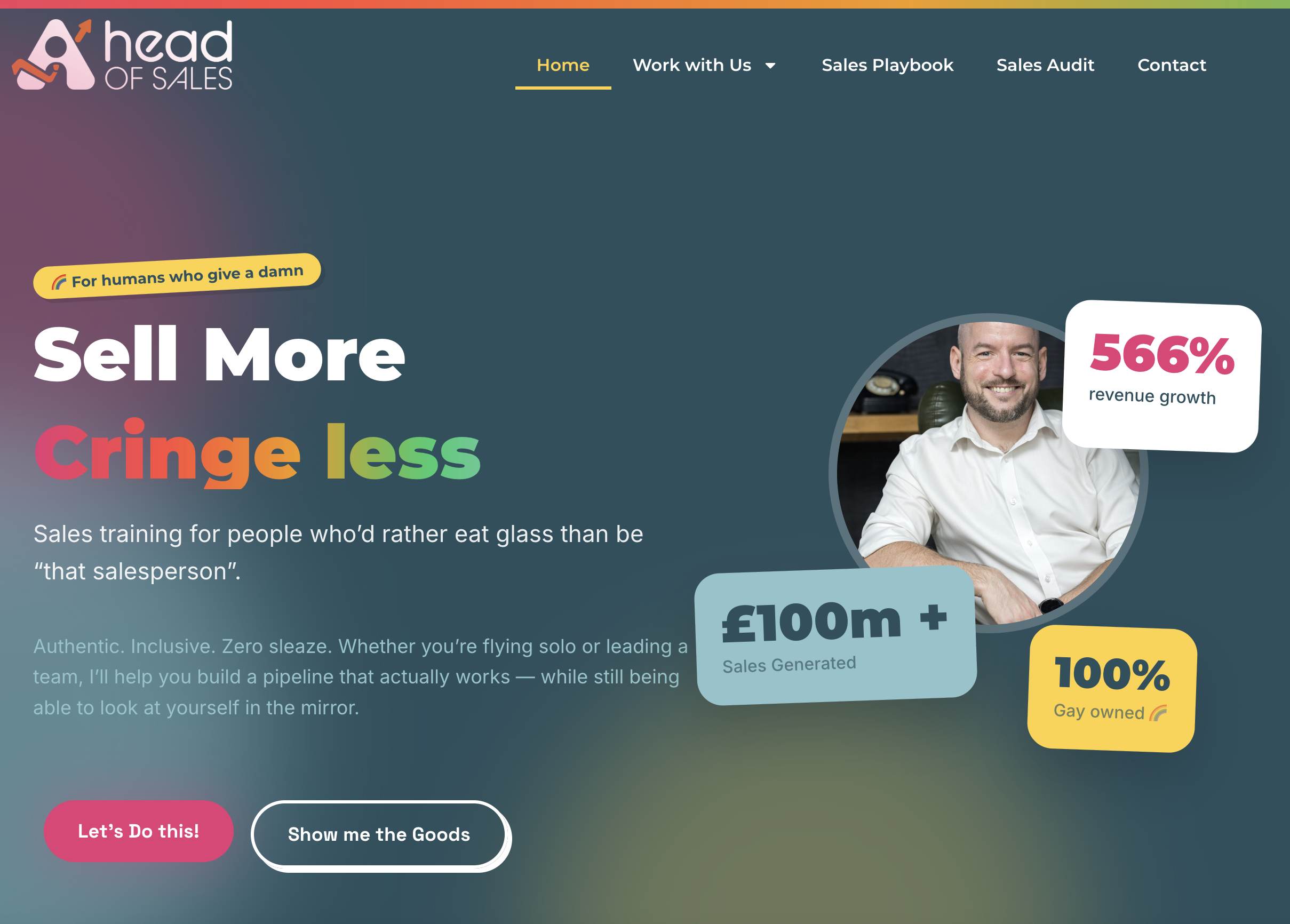
Packages for teams of 50 to 1,000 staff start from £4,500, with a focus on hitting target every quarter, not just improving skills on paper. For business leaders who want to see what a structured, results-focused programme looks like in practice, the team sales training programmes page sets out exactly what is included and how results are measured. If you lead a growing team and want a training partner who is accountable for outcomes, Aheadofsales is built for that conversation.
FAQ
What are the main benefits of team sales training?
Team sales training improves win rates, shortens sales cycles, and builds consistent performance across the whole team. Research from CSO Insights shows that companies with customised training see significantly higher win rates than those with inconsistent development.
Why use a sales training consultancy rather than training in-house?
A sales training consultancy brings an external diagnosis of where deals are actually being lost, which internal managers often miss due to proximity. Bespoke programmes built around real deal data produce faster and more durable results than generic in-house workshops.
How long does it take to see results from sales training?
Most teams see measurable improvements in pipeline conversion and deal velocity within 60 to 90 days of a structured programme, provided coaching reinforcement is built in from the start.
What is collaborative selling and why does it matter?
Collaborative selling is a team-wide approach where knowledge, call recordings, and winning techniques are shared across all reps rather than held by individuals. Sybill.ai’s research on beehive selling shows this model accelerates ramp-up and improves overall win rates.
How do you prevent skills from fading after training ends?
Weekly coaching sessions, real-time feedback after calls, and integrating skill reviews into pipeline meetings are the most effective methods. Without this reinforcement, the Journal of Applied Psychology research shows learners lose up to 70% of new skills within weeks.