
TL;DR:
- Net revenue retention measures how much recurring revenue from existing customers is retained and expanded over a year. A high NRR, especially above 100%, indicates sustainable growth without new customer acquisition, boosting valuation and profitability. Tracking both gross and net revenue retention enables early detection of underlying churn issues and guides strategic improvements.
Net revenue retention (NRR) is the percentage of recurring revenue a business retains and grows from its existing customer base over a defined period, typically one year. Also referred to as net dollar retention (NDR) in some SaaS circles, NRR is the single metric that tells you whether your existing customers are worth more to you today than they were twelve months ago. For business leaders and finance professionals managing recurring revenue models, understanding what is net revenue retention is not optional. It is the foundation of sustainable growth strategy.
What is net revenue retention and how does it work?
Net revenue retention measures how much of your starting recurring revenue you have kept and expanded, after accounting for upgrades, downgrades, and cancellations. The NRR metric isolates revenue growth from existing customers, completely independent of new sales. That distinction matters enormously. A business adding new customers at pace can still be haemorrhaging value from its existing base without ever noticing, until NRR exposes it.
The median NRR sits at 106% across SaaS businesses, with top-quartile companies achieving 120%–140%. That gap between median and top quartile is not a coincidence. It reflects fundamentally different approaches to customer success, upselling discipline, and product stickiness.
When NRR exceeds 100%, your existing customer base grows revenue on its own. You do not need a single new logo to increase recurring revenue. That is the definition of capital-efficient growth, and it is why investors scrutinise this number before almost any other.
How to calculate net revenue retention: formula and components
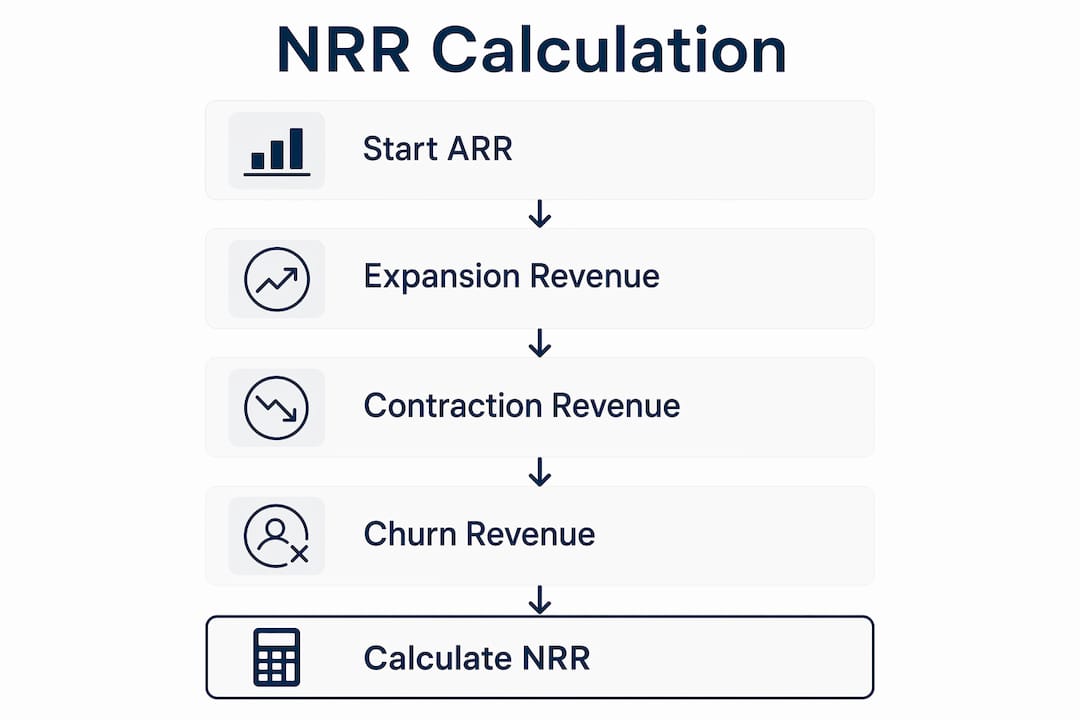
The NRR formula is straightforward once you understand each component:
NRR = (Starting ARR + Expansion Revenue − Contraction − Churn) ÷ Starting ARR × 100
Here is what each element means in practice:
- Starting ARR is the annual recurring revenue from a fixed cohort of customers at the beginning of the measurement period. You must use the same cohort throughout. Do not add new customers mid-calculation.
- Expansion revenue covers upsells, cross-sells, seat additions, and usage-based growth from that same cohort. If a customer upgrades their plan or adds users, that revenue counts here.
- Contraction is revenue lost from downgrades within the cohort. A customer moving from your enterprise tier to your starter plan reduces ARR without fully churning.
- Churn is revenue lost from full cancellations. A customer who leaves entirely removes their entire ARR contribution from the calculation.
A practical example: you start the year with £500,000 ARR from 50 customers. During the year, expansion adds £80,000, contraction removes £20,000, and churn removes £30,000. Your NRR is (£500,000 + £80,000 − £20,000 − £30,000) ÷ £500,000 × 100 = 106%.
The cohort rule is critical and often misapplied. Revenue from customers acquired during the measurement period must be excluded entirely. Including new logos inflates NRR and produces a misleading picture of how well you are retaining and growing existing relationships.
Pro Tip: If your business mixes recurring subscription revenue with one-off professional services fees, calculate NRR using recurring revenue only. Including one-time project fees distorts the metric and makes comparisons against industry benchmarks meaningless.
Why does net revenue retention matter for valuation and growth?
NRR is the most predictive metric of long-term investor appeal in recurring revenue businesses. Companies with 120%+ NRR command valuation multiples two to three times higher than peers sitting around 95% NRR. That is not a marginal difference. It represents a fundamentally different business model in the eyes of acquirers and investors.

The reason is compounding. An NRR of 120% means your existing customer base grows by 20% annually without a single new sale. Over five years, that compounds into a revenue base that dwarfs what a 95% NRR business could achieve even with aggressive new customer acquisition.
The importance of net revenue retention also shows up in profitability. Improving customer retention by just 5% can increase profitability by 25%–95%. Acquisition costs run five to twenty-five times higher than retention costs. Those two facts together make the case for prioritising NRR over new logo volume in almost every growth-stage business.
High-NRR businesses also tend to perform well against the Rule of 40, the benchmark used by SaaS investors to assess whether a company balances growth and profitability. NRR-driven companies consistently score well here because expansion revenue carries far higher margins than revenue from new customer acquisition cycles.
The practical implication for finance professionals is this: NRR belongs in your board reporting alongside ARR and gross margin. It is not a secondary metric. It is the leading indicator of whether your revenue model is structurally sound.
Gross revenue retention vs net revenue retention: what is the difference?
Gross revenue retention (GRR) and NRR measure different things, and confusing them leads to poor strategic decisions.
GRR measures only losses. It captures churn and contraction but excludes expansion revenue entirely. Because of this, GRR can never exceed 100%. It tells you how well you are holding on to existing revenue, nothing more.
NRR adds expansion to the picture. It can exceed 100% when upsell and cross-sell revenue outweighs losses from churn and contraction. NRR tells you whether your customer base is growing in value, not just whether you are keeping it intact.
| Feature | GRR | NRR |
|---|---|---|
| Includes expansion revenue | No | Yes |
| Can exceed 100% | No | Yes |
| Measures | Churn and contraction only | Full revenue movement |
| Primary use | Assessing retention health | Assessing growth from existing customers |
| Risk it reveals | Revenue erosion | Expansion masking churn |
The most dangerous scenario is a business with strong NRR but weak GRR. Imagine a company reporting 110% NRR but only 70% GRR. On the surface, NRR looks healthy. But low GRR signals a leaky bucket: the business is churning customers rapidly and papering over the losses with aggressive upsells to those who remain. That is not a sustainable model. It is a ticking clock.
Pro Tip: Always report GRR and NRR together in your financial reviews. If NRR is strong but GRR is declining quarter on quarter, investigate churn drivers immediately. The expansion revenue masking that churn will not last indefinitely.
How to increase net revenue retention: practical strategies for business leaders
Improving NRR requires deliberate action across sales, customer success, and product. The following approaches consistently move the needle.
Invest in consultative selling skills across your account management team. Consultative selling, as outlined in resources like Aheadofsales’ guide on consultative selling techniques, focuses on understanding customer outcomes rather than pushing product features. Account managers trained in this approach identify expansion opportunities naturally, because they understand where the customer wants to go next.
Segment your customer cohorts and treat them differently. Not all customers carry the same expansion potential. Analyse your cohorts by industry, company size, product usage, and tenure. Customers with high product engagement and growing headcount are your best upsell candidates. Customers with declining usage are churn risks that need proactive intervention, not a renewal call ninety days before contract end.
Build a structured upsell and cross-sell motion. Expansion revenue costs approximately 20%–30% of what new customer acquisition costs. That cost advantage makes expansion the primary lever for capital-efficient growth. Yet many businesses leave it to chance, relying on customers to ask for upgrades rather than proactively presenting them. A structured expansion playbook, with defined triggers and trained account managers, closes that gap.
Reduce contraction before it becomes churn. Contraction is often the early warning sign that a customer is heading for the exit. A customer who downgrades their plan is telling you something is wrong. Treat every downgrade as a retention conversation, not an administrative change. Understanding the reason behind the contraction gives you the opportunity to address it before the renewal decision arrives.
Align customer success with revenue outcomes. Customer success teams that are measured only on satisfaction scores or NPS are not aligned with NRR improvement. Tie at least part of their performance metrics to expansion revenue and gross retention. That alignment changes the conversation from “are you happy?” to “where do you want to grow next?”
For a deeper look at how client retention strategies connect to revenue growth, Aheadofsales has covered this in detail for business leaders across sectors.
Key takeaways
Net revenue retention is the definitive measure of whether your existing customer base is growing in value, and businesses that prioritise it consistently outperform peers on valuation, profitability, and capital efficiency.
| Point | Details |
|---|---|
| NRR definition | NRR measures retained and expanded recurring revenue from existing customers as a percentage. |
| NRR formula | Calculate as (Starting ARR + Expansion − Contraction − Churn) ÷ Starting ARR × 100. |
| Industry benchmarks | Median NRR is 106%; top-quartile SaaS businesses achieve 120%–140%. |
| GRR vs NRR | Always analyse both; high NRR with low GRR signals dangerous churn masked by expansion. |
| Improvement levers | Consultative selling, cohort segmentation, and structured upsell motions drive NRR growth. |
Why I think most businesses are measuring NRR too late
I have worked with enough growth-stage businesses to spot a common pattern. NRR only enters the conversation when someone is preparing for a fundraise or an exit. By that point, the metric has been neglected for years, and the structural problems it would have revealed are deeply embedded.
The businesses that genuinely compound value from their existing customers treat NRR as a monthly operating metric, not an annual reporting exercise. They review cohort performance the same way they review pipeline. They know which customer segments are expanding, which are contracting, and why.
What I find most telling is the GRR blind spot. I have seen businesses celebrate 115% NRR without ever looking at their GRR, which was sitting at 75%. That is not a healthy business. That is a business where a handful of large accounts are expanding fast enough to hide the fact that the majority of customers are leaving. When those large accounts eventually churn or plateau, the revenue cliff is severe.
My practical advice: build NRR and GRR into your monthly board pack now, not when you need to impress an investor. The earlier you see the signals, the more time you have to act on them. And if you want to move NRR in the right direction, the fastest lever is almost always the quality of your account management and the discipline of your expansion sales motion.
— Jerry
How Aheadofsales helps businesses grow NRR through smarter selling
If your NRR is below 100%, or if you have never measured it properly, the issue is rarely the product. It is almost always the sales and account management capability sitting around your existing customers.

Aheadofsales works with businesses of 50 to 1,000 staff to build the consultative selling skills and customer success disciplines that drive expansion revenue and reduce contraction. Our SaaS sales training programme is built specifically for recurring revenue businesses that want to turn their existing customer base into a growth engine. We also offer sales consultancy services for businesses that need a strategic review of their retention and expansion model before committing to a training programme. If you are serious about improving NRR, we should talk.
FAQ
What is net revenue retention in simple terms?
Net revenue retention is the percentage of recurring revenue a business keeps and grows from its existing customers over a set period. An NRR above 100% means existing customers are generating more revenue than they were at the start of the period.
What is a good NRR benchmark for SaaS businesses?
The median NRR for SaaS is approximately 106%, with top-quartile companies achieving 120%–140%. Anything above 100% indicates positive revenue growth from existing customers alone.
How does NRR differ from churn rate?
Churn rate measures only the revenue or customers lost. NRR includes churn but also adds expansion revenue from upsells and cross-sells, giving a complete picture of net revenue movement from the existing customer base.
Can NRR exceed 100%?
Yes. NRR exceeds 100% when expansion revenue from upsells and cross-sells outweighs revenue lost through churn and contraction. This is the hallmark of a capital-efficient, compounding revenue model.
Why should I track both GRR and NRR?
Tracking both metrics together reveals whether growth is genuinely healthy. High NRR alongside low GRR signals that expansion revenue is masking significant churn, which creates long-term revenue instability.
One Response