
TL;DR:
- A structured business development process converts opportunities into sustainable revenue growth through clear stages and disciplined management. It aligns activities with strategic goals, measures performance using key metrics, and promotes process documentation to ensure consistency and scalability. Properly implemented, it reduces reliance on individual talent, improves forecasting, and fosters long-term client relationships.
The business development process is a structured sequence of activities designed to identify, qualify, and convert opportunities into sustainable revenue growth. Unlike ad hoc selling, it connects market research, SMART goal frameworks, CRM pipeline management, and KPI tracking into a repeatable system. Organisations that treat this process with the same discipline as financial planning move from reactive activity to predictable expansion. The difference between businesses that hit their growth targets every quarter and those that scramble is almost always process. This guide gives you the architecture to build one that works.
What are the essential stages of a business development process?
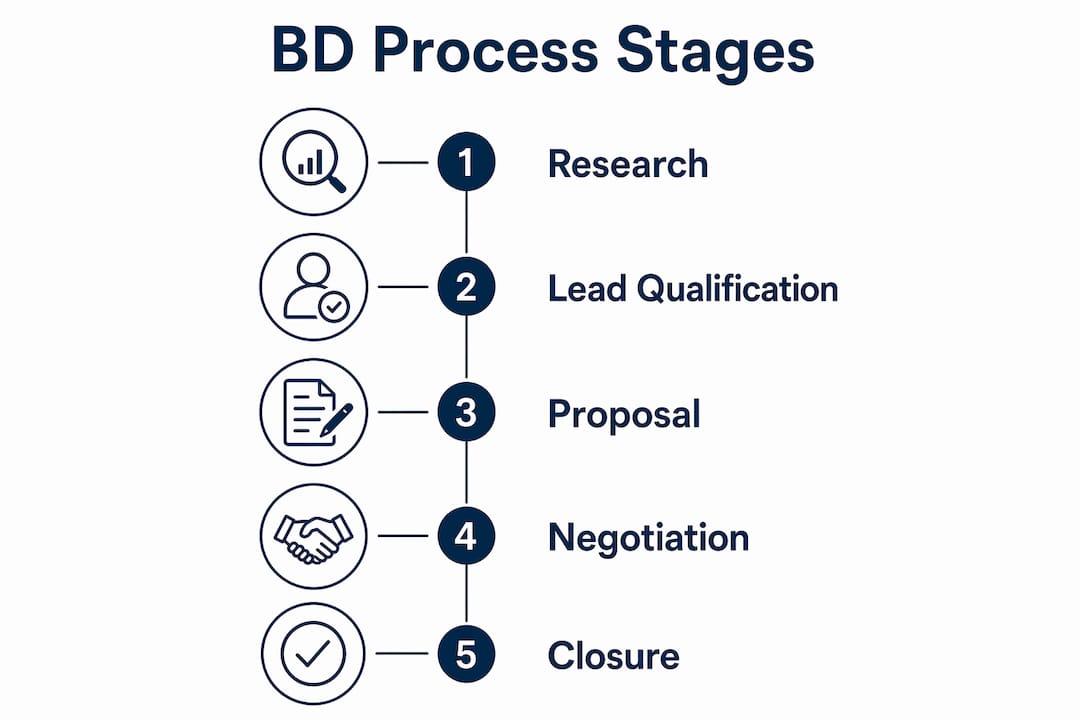
A well-structured pipeline typically runs through seven stages: prospecting, lead qualification, initial contact, relationship building, proposal, negotiation, and close or post-purchase engagement. Each stage has a defined purpose and a clear next step. Without that clarity, your team relies on instinct rather than process, and instinct does not scale.
Here is how each stage works in practice:
- Market research and audience segmentation. Identify which segments hold genuine growth potential before you approach anyone. Use data from sources like Skopos to understand B2B market dynamics and buyer behaviour in your sector.
- SMART goal setting. Define specific, measurable targets for each segment. “Win five new mid-market clients in Q3” is a SMART goal. “Grow the business” is not.
- Lead generation. Deploy a mix of networking, referrals, content marketing, and outbound outreach. The US Chamber of Commerce confirms that the most effective strategies distinguish between lead nurture and strategic partnership development from the outset.
- Lead qualification. Score prospects against your ideal client profile. Time spent on poorly qualified leads is time taken from high-value opportunities.
- Initial contact and relationship development. Open conversations with genuine curiosity about the prospect’s situation. This stage is about building trust, not pitching.
- Proposal and negotiation. Present a solution tailored to what you have learned. Negotiate on value, not price.
- Close and post-purchase engagement. Closing is not the end. Structured follow-up after the deal protects retention and generates referrals.
Pro Tip: Map each stage in your CRM with a defined exit criterion. A lead should only move to the next stage when a specific condition is met, such as a confirmed budget or a scheduled meeting. This removes ambiguity and makes your pipeline data trustworthy.
A repeatable development process improves pipeline consistency, forecasting accuracy, and reduces reliance on any single individual. That last point matters enormously for businesses with 50–1,000 staff. If your pipeline depends on one rainmaker, you do not have a process. You have a person.
How to align BD activities with business growth strategies
Business development planning touches every department, including sales, marketing, HR, finance, product development, and vendor management. Investopedia’s analysis confirms this cross-functional reach. That means your BD process cannot sit in isolation. It must connect to your broader business expansion plans.

BCG’s 2026 CEO growth research recommends that leaders apply data-driven planning and stress testing across both organic and inorganic growth scenarios. Stress testing means asking: “What happens to our pipeline if our top three clients reduce spend by 20%?” Most leadership teams never ask that question until it is too late.
A practical alignment framework looks like this:
- Set a 12–36 month strategic direction. Workday’s research defines an effective growth plan as a roadmap covering strategic direction, resource needs, execution steps, and KPIs across this horizon.
- Connect BD goals to revenue and market expansion targets. If the business needs to enter a new vertical, your BD team needs specific prospecting goals for that vertical, not generic activity targets.
- Build in scenario planning. Prepare at least two scenarios: one where market conditions are favourable, and one where they are not. Adjust your BD priorities accordingly.
- Review KPIs monthly, not quarterly. Monthly reviews catch drift early. Quarterly reviews often catch it too late to correct.
“Growth must be managed with the same discipline as costs and capital deployment to avoid over- or under-investing.” — BCG, 2026
The insight here is that BD is not a sales function you bolt onto the side of the business. It is a planning discipline that sits at the leadership table. When you treat it that way, your B2B sales strategy and your corporate strategy pull in the same direction.
What tools and metrics measure a BD process effectively?
The right measurement system turns your BD process from a collection of activities into a managed asset. CRM platforms such as Salesforce, HubSpot, and Pipedrive track pipeline stages, client data, and activity history in one place. Without a CRM, you are managing a pipeline in people’s heads, and that is not a pipeline at all.
| Metric | What It Measures | Why It Matters |
|---|---|---|
| Conversion rate by stage | Percentage of leads advancing at each step | Identifies where prospects drop off |
| Sales cycle length | Average days from first contact to close | Reveals process efficiency and bottlenecks |
| Pipeline value | Total weighted revenue in active pipeline | Supports revenue forecasting |
| Lead source quality | Conversion rate by acquisition channel | Directs budget to highest-performing channels |
| Win rate | Closed deals as a percentage of proposals sent | Benchmarks proposal quality and fit |
Tracking pipeline metrics identifies bottlenecks and improves revenue forecasting. That is the practical value of measurement. It tells you not just how much you are winning, but where and why you are losing.
Qualitative metrics matter too. Client satisfaction scores, feedback from lost deals, and team confidence ratings give you context that numbers alone cannot provide. The best BD leaders balance both.
Pro Tip: Build a simple weekly dashboard covering five metrics: new leads added, stage conversions, pipeline value, proposals sent, and deals closed. Review it every Monday morning. Fifteen minutes of data review prevents months of pipeline drift.
Aligning BD closely with sales processes and CRM use unlocks stronger pipeline governance and forecasting accuracy. This is not a technology problem. It is a discipline problem, and discipline starts with leadership.
What common mistakes derail business development processes?
The most damaging mistake is conflating business development with sales. Business development generates qualified opportunities. Sales converts them into revenue. Misaligning these roles harms pipeline quality and creates friction at the handoff point. When a BD person is chasing signatures and a salesperson is cold prospecting, both are doing the wrong job.
Other mistakes that consistently derail BD processes include:
- Unclear stage definitions. If your team cannot agree on what “qualified” means, your pipeline data is meaningless. Define entry and exit criteria for every stage.
- Reactive rather than repeatable activity. Chasing inbound enquiries feels productive. Building a proactive, structured outreach cadence actually is productive.
- Poor qualification discipline. Strong qualification prioritises prospects who match your ideal client profile and deprioritises those who do not, regardless of how appealing the opportunity looks on the surface.
- Weak follow-up. Most deals are lost not because the prospect said no, but because the follow-up was ambiguous or absent. Define the next step at the end of every conversation.
- Process dependency on individuals. If your BD process lives in one person’s notebook, it is not a process. Clarifying the purpose of each stage reduces reliance on individual intuition and makes the process transferable.
The fix for most of these mistakes is documentation. Write down what good looks like at every stage. Share it with your team. Review it regularly. A business process mapping exercise can surface hidden inefficiencies and make implicit knowledge explicit across your organisation.
Key takeaways
A repeatable, measurable business development process is the single most reliable driver of consistent pipeline growth and predictable revenue for businesses of any size.
| Point | Details |
|---|---|
| Define every pipeline stage | Set clear entry and exit criteria for each stage to make pipeline data reliable and actionable. |
| Align BD with corporate strategy | Connect business development goals to 12–36 month growth plans, revenue targets, and market expansion priorities. |
| Measure what matters | Track conversion rates, sales cycle length, and pipeline value weekly to catch and correct drift early. |
| Separate BD from sales | Business development generates qualified opportunities; sales converts them. Mixing the roles damages pipeline quality. |
| Build for repeatability | Document your process so it works without depending on any single individual in the team. |
Where most BD processes actually break down
I have worked with a lot of businesses that believed they had a business development process. What they actually had was a talented individual who knew a lot of people. The moment that person left or got promoted, the pipeline collapsed. That is not a process. That is a risk.
The businesses I see grow consistently, year after year, are the ones that have written down exactly what happens at every stage of their pipeline. They know their average sales cycle. They know their conversion rate from proposal to close. They know which lead sources produce the best clients, not just the most enquiries. That level of visibility does not come from talent. It comes from structure.
What I find most leaders underestimate is the value of scenario planning in BD. BCG’s 2026 guidance on stress testing growth assumptions is not just for large corporates. A business with 100 staff should absolutely be asking: “If our biggest client leaves tomorrow, what does our pipeline look like?” Most cannot answer that question. The ones who can sleep better and grow faster.
The other thing I would push back on is the idea that process kills relationships. I hear this often, particularly from professional services firms. The reality is the opposite. A clear process gives your BD team more time for genuine relationship building because they are not wasting hours on poorly qualified prospects or chasing ambiguous follow-ups. Structure creates space for the human connection that actually wins business.
If you are a decision-maker reading this and your BD activity still feels reactive, the answer is not to hire more people. The answer is to build the process first, then scale it.
— Jerry
Take your business development further with Aheadofsales
If this article has confirmed that your BD process needs more structure, measurement, or team capability, Aheadofsales can help you build it properly.

Aheadofsales combines bespoke 1:1 coaching with hands-on consultancy to help businesses with 50–1,000 staff generate at least 50% sales growth every year and hit their targets every quarter. The approach is not generic training. It is a tailored programme built around your pipeline, your team, and your growth goals. Explore the sales training services to see which package fits your business, or review the sales consultancy services if you need deeper strategic support for your BD and sales alignment.
FAQ
What is a business development process?
A business development process is a structured sequence of stages, from market research and lead generation through to deal closure and post-purchase engagement, designed to convert opportunities into repeatable revenue growth.
How does business development differ from sales?
Business development generates and qualifies opportunities; sales converts them into revenue. Misaligning these roles creates poor handoffs and weakens pipeline quality across the organisation.
Which CRM tools support a BD pipeline?
Salesforce, HubSpot, and Pipedrive are widely used CRM platforms that track pipeline stages, client data, and activity history to support structured pipeline management and forecasting.
How often should you review BD metrics?
Review core metrics such as conversion rates, pipeline value, and sales cycle length weekly. Monthly reviews of strategic KPIs allow course corrections before quarterly targets are at risk.
What makes a BD process repeatable?
A repeatable process has documented stage definitions, clear qualification criteria, and structured follow-up protocols that any team member can follow, reducing dependence on individual relationships or intuition.