
TL;DR:
- Strategic account management is a systematic approach to nurturing high-value clients through dedicated teams, planning, and long-term partnerships. It emphasizes account segmentation, stakeholder mapping, structured account plans, quarterly reviews, and expansion strategies to ensure growth and retention. Effective SAM requires leadership commitment, cross-functional involvement, disciplined execution, and deep multithreaded relationships to succeed.
Strategic account management (SAM) is defined as a systematic process of managing an organisation’s most valuable customer accounts through dedicated teams, coordinated planning, and long-term partnership focus. Unlike transactional selling, SAM treats your top clients as growth assets that require structured investment, not just periodic check-ins. The Strategic Account Management Association describes it as an operating system with multiple coordinated elements, including account segmentation, stakeholder mapping, joint business planning, Quarterly Business Reviews (QBRs), and expansion playbooks. If you lead a business with 50 or more people and you are serious about retaining and growing your highest-value clients, understanding SAM is non-negotiable.
What are the key elements of strategic account management?

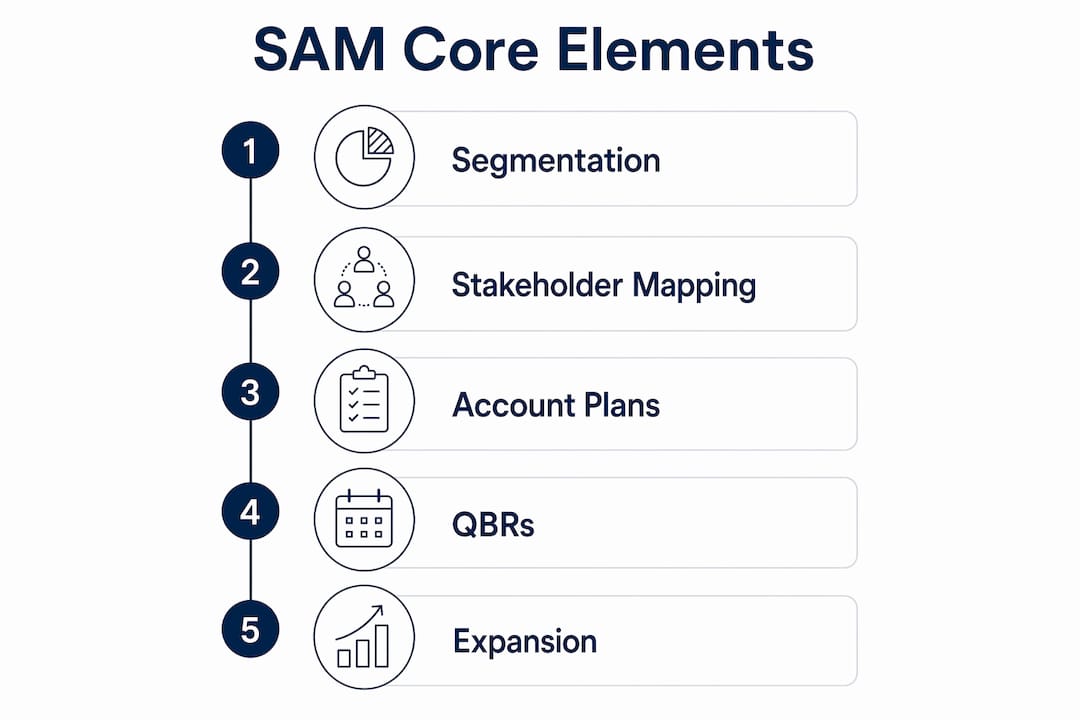
Strategic account management is built on five interconnected components that work together as a system, not as isolated activities. Each element reinforces the others, and skipping one creates gaps that competitors will eventually exploit.
Account segmentation and tiering is the foundation. You cannot apply the same level of resource to every client and expect meaningful results. SAM programmes typically designate 10–20 accounts as top-tier, giving them dedicated teams and executive sponsors. Lower-tier accounts receive progressively lighter coverage. This tiering model forces deliberate decisions about where your best people spend their time.
Stakeholder mapping goes beyond knowing who signs the contract. In any complex B2B account, buying committees span procurement, finance, operations, and the C-suite. Mapping these relationships, understanding each person’s priorities, and building connections across all of them is what separates SAM from ordinary account management. A single-threaded relationship, where you only know one contact, is a retention risk waiting to happen.
Living account plans are the operational core. An account plan in SAM is a document that maps goals, stakeholders, expansion whitespace, risks, and joint initiatives. It is updated regularly, not filed away after an annual review. Think of it as a shared business plan between you and your client.
Quarterly Business Reviews are the heartbeat of the programme. QBRs function as strategic conversations about customer goals, return on investment, and growth opportunities. They are not sales demos or status updates. Done well, they create alignment and open doors to expansion.
Expansion playbooks define how you grow within an account. Upsell and cross-sell opportunities do not appear by accident. A structured playbook identifies whitespace, assigns ownership, and sets timelines for pursuing additional revenue.
Pro Tip: Build your account plan template before you assign accounts to managers. A blank template forces clarity about what information actually matters, and it prevents every manager from inventing their own format.
How does SAM differ from traditional account management?
The distinction between SAM and traditional account management is not cosmetic. It reflects a fundamentally different operating model, resource commitment, and set of success metrics.
| Dimension | Traditional Account Management | Strategic Account Management |
|---|---|---|
| Relationship model | Reactive, rep-driven contact | Proactive, multithreaded across functions |
| Team structure | Single account manager | Cross-functional team with executive sponsor |
| Primary metric | New bookings and quota attainment | Retention rate and revenue expansion |
| Planning cadence | Annual or ad hoc | Continuous living account plans with QBRs |
| Customer focus | Transactional, product-led | Goal-aligned, value-led partnership |
Traditional account management is largely reactive. A client calls with a problem, and the account manager responds. SAM flips this. The account manager’s role becomes both customer-facing and catalytic internally, representing the client inside your organisation to mobilise resources before problems arise.
The metrics tell the same story. Traditional account management measures success by new bookings. SAM measures retention, net revenue retention, and expansion revenue. These are fundamentally different incentives, and they produce fundamentally different behaviours.
SAM and key account management are often used interchangeably, but SAM implies deeper executive involvement and a more deliberate partnership focus. If your organisation uses the term “key account management” without the structural elements described above, you are likely running a lighter version of what SAM requires.
Pro Tip: If your account managers are spending more than 40% of their time responding to inbound issues rather than proactively driving client goals, you have a traditional account management model dressed up as SAM. Audit the time split before redesigning the programme.
How to implement strategic account management effectively
Implementation is where most organisations stumble. The concept is straightforward; the execution requires discipline across multiple teams and leadership levels. Here is a practical sequence that works.
-
Define your account tiers explicitly. Decide which accounts qualify as strategic based on revenue, growth potential, and strategic fit. Document the criteria so the decision is repeatable and not political.
-
Assign cross-functional ownership. Each strategic account needs a named account manager, an executive sponsor, and clear involvement from customer success, product, and finance. Ownership without cross-functional backing is just a title.
-
Build living account plans for every tier-one account. Use a consistent template that captures the client’s business goals, key stakeholders, current risks, expansion whitespace, and joint initiatives. Review and update the plan at least quarterly.
-
Establish a QBR cadence and protect it. Schedule QBRs at the start of each quarter and treat them as non-negotiable. QBRs must follow a consistent structure that quantifies value delivered and locks in joint commitments. Without that structure, they drift into update meetings.
-
Track expansion metrics separately from new business. Net revenue retention and expansion revenue should appear on their own dashboard. Mixing them with new business metrics obscures whether your SAM programme is actually working.
The iterative cycle of SAM moves through planning, stakeholder mapping, success tracking, and expansion continuously. It is not a project with a start and end date. Organisations that treat implementation as a one-off exercise consistently underperform those that build it into their operating rhythm.
Explore the account management best practices that Aheadofsales recommends for teams at different growth stages. Pairing those with a consultative selling approach, as outlined in this guide to consultative selling for revenue growth, gives your account managers a complete toolkit.
What are the common pitfalls in managing strategic accounts?
Even well-designed SAM programmes drift over time. Knowing where the cracks appear helps you prevent them before they cost you a renewal.
-
Reactive management creeps back in. SAM ties account tiers directly to resourcing models that specify ownership, review frequency, and executive involvement. When those models are not enforced, managers default to firefighting rather than planning. The fix is a governance rhythm, not a motivational speech.
-
QBRs lose their structure. A QBR that becomes a product update or a relationship catch-up is not a QBR. It is a wasted hour. Every QBR should open with a review of agreed outcomes from the previous quarter, quantify value delivered, and close with documented commitments for the next 90 days.
-
Single-threaded relationships create fragility. Multithreaded relationships are not optional in SAM. When a champion leaves, a single-threaded account is immediately at risk. Building connections across procurement, operations, and the executive team is a deliberate activity, not something that happens naturally.
-
Internal mobilisation is neglected. The strategic account manager’s role is as much internal as external. Representing the client’s priorities inside your organisation, securing product roadmap input, or getting finance to approve a custom commercial structure requires political capital and cross-functional credibility. Managers who only focus outward miss half the job.
-
SAM is confused with extra attention. Executives often mistake SAM for simply paying more attention to big clients. It is a structured operating system with specific processes, metrics, and governance. Without that structure, you get inconsistent results that depend entirely on the individual manager’s skill and relationships.
My honest view on what SAM actually requires
I have worked with enough sales teams to know that the gap between organisations that describe SAM and those that actually run it is enormous. Most businesses have account plans sitting in a shared drive that nobody updates. They call their annual client dinner a “strategic review.” They assign their best sales rep to the biggest account and call that executive sponsorship.
Real SAM is a leadership commitment, not a sales tactic. It requires your CEO or commercial director to show up at QBRs. It requires product and finance to treat strategic accounts as internal priorities, not external requests. It requires your account managers to be skilled enough to lead a business conversation with a client’s CFO, not just maintain a friendly relationship with their day-to-day contact.
The organisations I have seen build genuinely durable client relationships all share one trait. They treat their top accounts the way a private equity firm treats a portfolio company: with structured oversight, regular performance reviews, and a clear plan for growth. That mindset shift, from “keeping the client happy” to “co-creating the client’s future,” is what SAM actually demands.
The competitive moat that comes from deep, multithreaded relationships with your most valuable clients is real. A competitor cannot replicate it quickly. But it only exists if you build it deliberately, with the right structure, the right people, and the right cadence.
— Jerry
Build your SAM capability with the right training
Understanding the theory of strategic account management is one thing. Equipping your team to execute it consistently, quarter after quarter, is another challenge entirely.
Aheadofsales works with businesses of 50 to 1,000 staff to build the skills, processes, and confidence that SAM requires. From bespoke 1:1 coaching for account managers to structured workshops on QBR facilitation, stakeholder mapping, and expansion planning, the programmes are built around your specific client base and growth targets. If your team is managing high-value accounts without a consistent framework, that is revenue left on the table. Explore the sales training services that Aheadofsales offers and find the right fit for your team’s current stage.
Key takeaways
Strategic account management is a structured operating system, not a mindset, and it requires explicit processes, cross-functional commitment, and consistent governance to deliver results.
| Point | Details |
|---|---|
| SAM is a system, not attention | It requires tiered segmentation, living account plans, QBRs, and expansion playbooks working together. |
| Tiering drives resource allocation | Top-tier accounts (typically 10–20) receive dedicated teams, executive sponsors, and custom plans. |
| QBRs must be structured | Every QBR should quantify value delivered and close with documented joint commitments for the next quarter. |
| Multithreading reduces risk | Building relationships across multiple stakeholders protects accounts when individual champions leave. |
| Internal mobilisation matters | Account managers must represent client priorities inside their own organisation to unlock cross-functional support. |
FAQ
What is the strategic account management definition?
Strategic account management is a systematic approach to managing an organisation’s most valuable clients through dedicated resources, cross-functional coordination, and long-term joint planning. It goes beyond transactional selling to focus on retention, expansion, and mutual value creation.
How does SAM differ from key account management?
SAM and key account management are often used interchangeably, but SAM implies deeper executive involvement, more deliberate strategic planning, and a stronger focus on long-term partnership. Key account management can exist without the full operating structure that SAM requires.
What are the core elements of a SAM programme?
The core elements are account segmentation and tiering, stakeholder mapping, living account plans, Quarterly Business Reviews, and expansion playbooks. Each element must be active and maintained regularly for the programme to function as intended.
How often should quarterly business reviews take place?
QBRs take place every quarter, as the name suggests, and should follow a consistent structure that reviews agreed outcomes, quantifies value delivered, and sets joint commitments for the next 90 days. Frequency without structure produces meetings, not results.
What is the biggest risk in a strategic account programme?
The biggest risk is single-threaded relationships, where your only meaningful contact at a client leaves the business. SAM programmes deliberately build connections across multiple stakeholders and functions to reduce this exposure and protect renewal and expansion opportunities.