
TL;DR:
- An ideal customer profile (ICP) identifies organizations most likely to benefit from and purchase your offerings, forming the foundation of effective B2B sales strategies. It combines firmographic, technographic, behavioral, and situational data to focus outreach on high-probability accounts and avoid wasted efforts on poor-fit prospects. Regularly updating and involving sales teams in developing the ICP ensures it remains a practical, operational tool that improves targeting, ROI, and overall sales performance.
An ideal customer profile (ICP) is a precise description of the type of organisation most likely to benefit from and purchase your product or service, forming the foundation of every effective B2B sales and marketing strategy. Used by companies like Salesforce, HubSpot, and Zendesk, the ICP is not a vague sketch of a potential buyer. It is a data-driven specification that combines firmographic, behavioural, technographic, and situational dimensions to identify not just who fits your offer, but who is ready to buy and why. Get this right and your sales team stops chasing the wrong accounts. Get it wrong and you waste budget, time, and goodwill on prospects who will never convert.
What is an ideal customer profile and why does it matter?
An ideal customer profile is defined as a detailed description of the buyer organisation best suited for what you sell, with the focus placed firmly on the company rather than the individuals within it. This is the standard industry term in B2B sales, often abbreviated to ICP, and it sits at the top of your entire go-to-market strategy.
The reason ICPs matter so much is straightforward. Without one, your sales and marketing teams are essentially guessing. With a well-constructed ICP, every outreach decision, every campaign, and every territory plan is grounded in evidence about which organisations actually generate revenue and retain long-term. The ICP becomes your filter, separating high-probability accounts from low-probability noise before a single call is made.
For businesses with 50 to 1,000 staff aiming for consistent quarterly growth, this filter is not optional. It is the difference between a sales team that hits target and one that perpetually misses it by chasing volume over fit.
What are the key components of an ideal customer profile?
ICPs combine firmographics, technographics, behavioural signals, and buying triggers to identify not just who fits but who is likely to buy and when. Understanding each dimension separately, and then combining them, is what separates a functional ICP from a superficial one.

Firmographic criteria
Firmographics are the structural facts about a company: industry sector, employee headcount, annual revenue, geographic location, and ownership structure. A SaaS business targeting mid-market UK manufacturers, for example, would specify something like: 100 to 500 employees, £10m to £50m annual revenue, operating in the East Midlands or North West, privately owned. These criteria are the starting point, but they are not sufficient on their own.
Technographic and behavioural factors
Firmographics alone are insufficient to distinguish between accounts that look identical on paper but behave very differently. Two companies of the same size in the same sector may have completely different buying timelines depending on their current technology stack, their existing integrations, and their recent purchasing patterns. A company already using Salesforce CRM and HubSpot Marketing Hub signals a certain level of digital maturity and budget appetite. That context changes your approach entirely.
Behavioural signals include engagement history, content consumption patterns, and prior interactions with your brand or competitors. These tell you not just who the account is, but where they are in their buying cycle.
Situational and trigger-based context
The 4D ICP framework adds a fourth dimension that most teams overlook: situational context. This includes trigger events such as leadership changes, new funding rounds, regulatory deadlines, or recent acquisitions. A company that has just appointed a new Chief Revenue Officer is far more likely to review its sales tools than one with a stable leadership team. Including these triggers in your ICP dramatically sharpens your timing.
Pro Tip: Build a short list of five to ten trigger events that historically preceded your best deals. These become your early-warning signals for high-priority outreach.
| ICP dimension | What it captures |
|---|---|
| Firmographic | Industry, size, revenue, location, ownership |
| Technographic | Current tools, integrations, digital maturity |
| Behavioural | Purchasing patterns, engagement, buying history |
| Situational | Trigger events, leadership changes, funding rounds |
How does an ICP differ from buyer personas and other segmentation tools?
An ICP defines which organisations to target, while buyer personas help tailor communication to the decision-makers inside those organisations. This distinction is one of the most misunderstood in B2B sales, and conflating the two costs teams significant time and resource.
The ICP operates at the account level. It answers the question: “Is this company worth pursuing at all?” The buyer persona operates at the individual level. It answers: “Now that we are pursuing this company, how do we speak to the Head of Sales, the CFO, or the IT Director?” One is a qualification filter; the other is a personalisation guide.
The total addressable market (TAM) sits above both. TAM defines the entire universe of potential buyers. The ICP narrows that universe to the accounts most likely to convert and retain. Buyer personas then inform how you communicate with specific stakeholders within those ICP-qualified accounts. Using all three in sequence gives you a genuinely targeted go-to-market approach. You can explore the different B2B buyer types to understand how personas sit within this framework.
Mixing up ICP and personas leads to wasted outreach and misaligned messaging. A sales rep who uses persona-level language to qualify accounts will often pursue companies that feel familiar but are fundamentally wrong fits. Equally, a marketer who uses ICP criteria to write email copy will produce generic, impersonal content that fails to resonate with any individual reader.
| Tool | Focus | Primary use |
|---|---|---|
| ICP | Organisation | Account qualification and selection |
| Buyer persona | Individual | Messaging and personalised outreach |
| TAM | Market | Total opportunity sizing |
How to create an ideal customer profile: a step-by-step approach
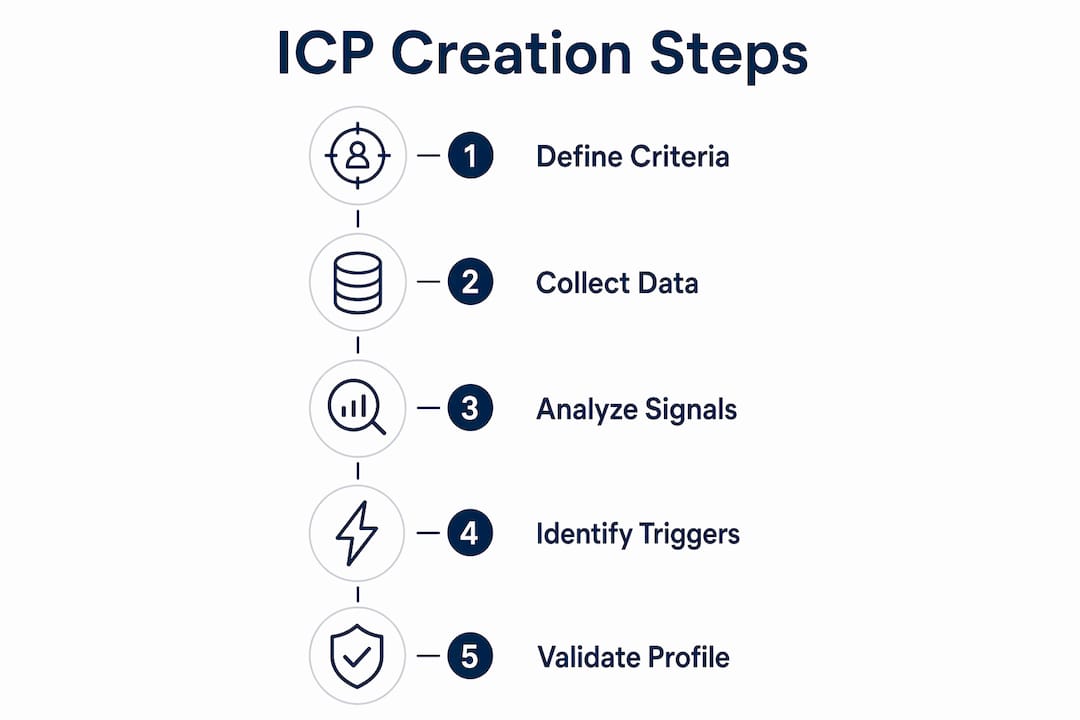
Creating an ICP involves analysing best customers, identifying common attributes and buying triggers, validating with lost-deal analysis, and including negative ICP criteria to exclude poor-fit prospects. Here is a practical sequence that works for businesses at any stage of growth.
-
Extract your best customers. Pull your top 10 to 20 accounts by revenue, retention, and ease of working relationship. These are your reference class. Interview the sales reps who closed them and, where possible, interview the customers themselves. Ask what triggered their decision to buy and what made them stay.
-
Identify shared attributes. Look for patterns across firmographic, technographic, behavioural, and situational dimensions. You will often find that your best customers cluster around two or three industries, a specific revenue band, and a handful of recurring trigger events.
-
Define negative ICP criteria. Explicitly defining negative ICP criteria reduces wasted cycles on poor-fit prospects. These are the characteristics that, when present, predict a bad outcome: companies that are too small to afford your solution, industries where your product creates compliance problems, or organisations with procurement processes that make your sales cycle unviable.
-
Validate with lost-deal analysis. Review the last 20 to 30 deals you lost or churned. What did those accounts have in common? Where did they fall outside your emerging ICP? This negative validation is as important as the positive case.
-
Express the ICP as a scoring model. A scoring and tiered system clarifies priorities and improves operational decision-making over static descriptions. Assign point values to each ICP criterion and tier your accounts into A, B, and C categories. Tier A accounts get priority outreach; Tier C accounts get minimal resource until they qualify further.
-
Schedule regular reviews. ICP drift occurs as market and customer cohorts change. Review your ICP against recent wins and losses every quarter. Update your scoring model to reflect shifts in your market, your product, or your competitive position.
Pro Tip: The fastest way to draft an initial ICP is to spend two hours with your three best-performing sales reps. Ask them to describe the last five deals they closed with ease. The patterns that emerge will give you 80% of your ICP in a single session.
How do businesses use ICPs to improve targeting and ROI?
Operationalising ICPs involves mapping them to account targeting, segmentation, and messaging personalisation in coordinated sales and marketing execution. The ICP is only as valuable as the decisions it drives.
In practice, this means your sales team uses ICP tier scores to prioritise their pipeline. Tier A accounts receive personalised outreach, bespoke proposals, and senior sales attention. Tier B accounts enter a structured nurture sequence. Tier C accounts are either deprioritised or passed to a lower-cost channel. This allocation alone can recover significant selling time that was previously lost to low-probability prospects.
Marketing teams use data-rich customer profiles including psychological drivers, decision behaviour, goals, and communication preferences to build campaigns that speak directly to ICP-qualified accounts. Account-based marketing (ABM) programmes, for example, are entirely dependent on a well-defined ICP. Without one, ABM becomes expensive spray-and-pray.
Territory planning also benefits directly. When sales leaders align territories to ICP density rather than geography alone, reps spend more time in front of high-fit accounts. Integrating your ICP criteria into CRM systems like Salesforce or HubSpot allows automatic scoring and routing, so the right accounts reach the right reps without manual triage. You can read more about identifying your ideal customer with a data-driven approach that complements this process.
The compounding effect of ICP-driven targeting is measurable. Shorter sales cycles, higher average deal values, and improved retention rates all follow from consistently pursuing accounts that genuinely fit your offer. The resource savings from avoiding poor-fit accounts are equally significant, even if they are harder to quantify on a dashboard.
Key takeaways
A well-constructed ICP, built from firmographic, behavioural, technographic, and situational data, is the single most effective tool for improving sales targeting and reducing wasted outreach in B2B businesses.
| Point | Details |
|---|---|
| ICP is organisation-level | It qualifies companies for pursuit, not individuals within them. |
| Four dimensions matter | Firmographic, technographic, behavioural, and situational data all contribute to accuracy. |
| ICP differs from personas | Personas personalise messaging; the ICP determines whether an account is worth pursuing at all. |
| Negative criteria are critical | Defining who does not fit prevents wasted cycles on poor-fit prospects. |
| Regular review prevents drift | Quarterly validation against wins and losses keeps the ICP relevant as markets shift. |
Why most ICPs fail before they are even finished
In my experience working with sales teams across a wide range of sectors, the most common failure point is not the data. It is the process. Teams spend weeks building a detailed ICP document, circulate it once, and then watch it gather dust while reps continue to pursue the same accounts they always have. The ICP never becomes operational because it was never connected to the day-to-day decisions of the sales team.
The second failure I see regularly is over-reliance on firmographics. A company that matches your size and sector criteria perfectly can still be a terrible fit if their buying behaviour, technology stack, or internal politics make a successful implementation impossible. I have watched sales teams close deals with accounts that looked perfect on paper, only to churn them within six months because the situational context was never assessed.
The teams that get this right treat the ICP as a living document, not a one-time exercise. They review it quarterly, they score every new account against it, and they use it to have honest conversations about pipeline quality. When a rep brings a Tier C account to a forecast meeting, the ICP gives the sales leader a factual basis for the conversation rather than a subjective argument.
My strongest advice is to involve your sales team in building the ICP from the start. They hold the qualitative intelligence that no data source can replicate. When they co-own the profile, they use it. When it is handed down to them, they ignore it.
— Jerry
Put your ICP to work with the right sales training
Understanding the theory of an ideal customer profile is one thing. Embedding it into how your team qualifies, prioritises, and closes deals is another challenge entirely.
At Aheadofsales, we work with businesses of 50 to 1,000 staff to build ICP-driven sales processes that deliver at least 50% sales growth year on year. Our sales training programmes combine bespoke 1:1 coaching with structured workshops to help your team operationalise their ICP, sharpen their qualification skills, and hit target every quarter. If you want your ICP to move from a document to a daily decision-making tool, that is exactly what we help you build.
FAQ
What is the difference between an ICP and a buyer persona?
An ICP defines the type of organisation worth pursuing; a buyer persona describes the individual decision-makers within that organisation. HubSpot describes the ICP as a pre-qualification filter and the persona as a personalisation guide.
How often should you update your ideal customer profile?
ICP drift is a recognised risk as markets and customer cohorts evolve. Best practice is to review and validate your ICP against recent wins and losses every quarter, updating your scoring model to reflect any shifts.
Can small businesses use an ideal customer profile?
Yes. Even solo service businesses benefit from defining their ICP, as it prevents wasted effort on poor-fit enquiries. The process is the same: identify your best clients, find the common attributes, and use those to filter future prospects.
What data do you need to build an ICP?
You need firmographic data (industry, size, revenue), technographic data (tools and integrations in use), behavioural data (purchasing patterns and engagement history), and situational data (trigger events like funding rounds or leadership changes).
What is a negative ICP?
A negative ICP defines the characteristics that predict a poor outcome: companies too small to afford your solution, sectors where your product creates problems, or procurement structures that make your sales cycle unworkable. Defining these criteria explicitly reduces wasted outreach.