
TL;DR:
- Effective SaaS sales pipelines are defined by buyer milestones that indicate genuine progress toward closing, not by salesperson activities. Clear, buyer-based stage criteria reduce forecast errors, improve alignment, and ensure more predictable revenue outcomes. Regular calibration using 12 to 24 months of historical data is essential for maintaining an accurate and reliable sales process.
SaaS sales pipeline stages are defined as verified buyer milestone checkpoints that mark genuine progress toward a closed deal, not a record of what your sales rep has done this week. Most CRM pipelines fail the forecast test precisely because they track seller activity rather than buyer commitment. When your stages reflect what the buyer has actually decided or confirmed, your forecast accuracy improves, your team aligns on what “progress” really means, and your revenue becomes predictable. This guide covers how to define, count, calibrate, and govern your pipeline stages so they work for you, not against you.
What are the typical SaaS sales pipeline stages?
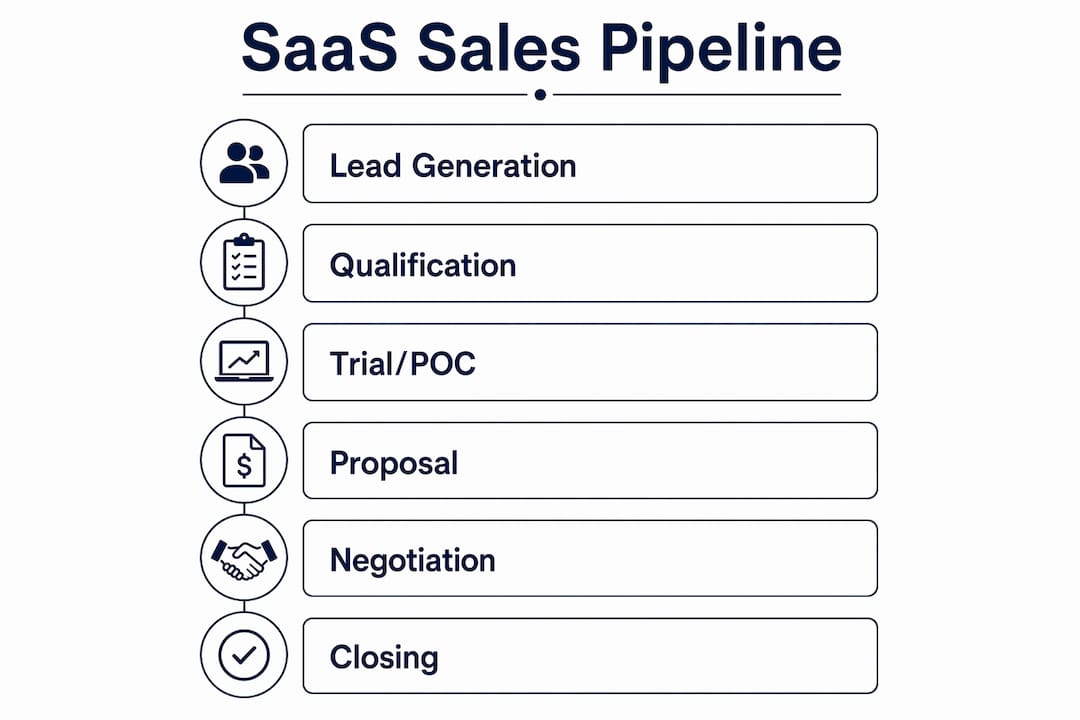
A typical B2B SaaS pipeline contains five to seven stages moving from Lead through MQL, SQL, Opportunity, Proposal, Negotiation, and finally Closed-Won or Closed-Lost, with separate expansion pipelines for renewals and upsells. The key distinction is that each stage is defined by what the buyer has done or confirmed, not by what the rep has scheduled or sent.
Here is how each stage should be defined in buyer terms:
- Lead: A contact has entered your system, but no qualification has occurred. The buyer has shown minimal intent, perhaps downloading a resource or attending a webinar.
- MQL (Marketing Qualified Lead): The buyer has demonstrated repeated, meaningful engagement with your content or product, meeting a predefined scoring threshold. Marketing has assessed fit.
- SQL (Sales Qualified Lead): A sales rep has spoken with the buyer and confirmed budget authority, need, and a credible timeline. The buyer has agreed to explore a solution.
- Opportunity: The buyer has confirmed a specific business problem, acknowledged your product as a potential fit, and agreed to a structured discovery or evaluation process.
- Proposal: The buyer has reviewed a formal proposal and confirmed they are evaluating it seriously. A verbal acknowledgement of interest is the minimum exit criterion here.
- Negotiation: The buyer has confirmed intent to purchase and is working through commercial or legal terms. This is not “proposal sent again.”
- Closed-Won / Closed-Lost: The deal is signed or formally abandoned, with a reason code recorded for every loss.
For product-led growth (PLG) pipelines, you will often insert a Trial or POC stage between Opportunity and Proposal. From 100 leads, roughly 25 to 35 reach a qualified stage, 10 to 15 take a demo, and only 4 to 7 enter a trial or proof of concept. This progressive drop-off is exactly why the Trial stage deserves its own position in the pipeline. It represents active buyer evaluation, which is a fundamentally different commitment level than passive interest.
Pro Tip: Write your stage definitions on a single page and ask three different reps to independently classify the same five deals. If they disagree on more than one, your criteria are not specific enough.

How many pipeline stages should a B2B SaaS process include?
The right number of stages depends directly on your deal cycle length and the number of genuine buyer decisions involved. Rework’s 2026 guidance is clear: for sales cycles of 30 days or fewer, four to five stages are sufficient. Mid-market cycles of 30 to 90 days typically need five to seven. Enterprise cycles exceeding 90 days can accommodate seven to ten, but only if every additional stage maps to a real buyer decision, not an internal process step.
| Deal cycle length | Recommended stage count | Common risk |
|---|---|---|
| Under 30 days | 4 to 5 stages | Too many stages create admin burden and slow reps |
| 30 to 90 days | 5 to 7 stages | Vague mid-stages inflate pipeline value |
| 90+ days (enterprise) | 7 to 10 stages | Stages reflect rep tasks rather than buyer decisions |
Adding stages arbitrarily inflates complexity and rep overhead. One stage per meaningful buyer decision is the governing principle. If you cannot name the specific buyer action that triggers entry into a stage, that stage should not exist.
A common mistake in growing SaaS businesses is cramming renewals, upsells, and new business into a single pipeline. These buyer journeys are structurally different. A renewal buyer has already committed to your product once. Their decision milestones are not the same as a net-new prospect. Build separate pipelines for expansion and renewal revenue rather than adding stages to your new business pipeline to accommodate them. This keeps your pipeline management clean and your forecasting accurate.
Why buyer milestones produce more accurate forecasts than seller activities
The most common pipeline design error in SaaS is labelling stages after rep actions: “Demo Scheduled,” “Proposal Sent,” “Follow-Up Pending.” These describe what the rep has done, not what the buyer has decided. Activity-based stages inflate pipelines and produce overly optimistic forecasts because a deal can sit in “Proposal Sent” indefinitely without any real buyer commitment.
Forecast errors of 30 to 40% are directly attributable to this misalignment between stage labels and actual buyer states. That is not a minor rounding error. For a SaaS business targeting £2 million in quarterly revenue, a 35% forecast error means you could be off by £700,000. That has consequences for hiring, cash flow, and board confidence.
“Stage transition should be backed by artefacts: the buyer confirms timeline and budget, an executive sponsor is identified, a technical evaluation is approved. Vague activity-based progress claims cause pipeline inflation.” Artefact Ventures
Rewriting your stages in buyer terms is straightforward once you know what to look for. Replace “Demo Scheduled” with “Buyer confirmed product addresses core use case.” Replace “Proposal Sent” with “Buyer reviewed proposal and confirmed evaluation is active.” These are observable, verifiable states that any rep or manager can confirm without ambiguity.
Stage exit criteria must be objective and agreed upon across the entire sales team. When two reps define “Opportunity” differently, your pipeline data becomes meaningless. Cross-rep alignment on entry and exit criteria is not a nice-to-have. It is the foundation of reliable B2B sales pipeline management.
Pro Tip: For every stage in your current CRM, ask: “What has the buyer done to earn this stage?” If the answer describes a rep action, rewrite the criterion before your next pipeline review.
Deals commonly stall in discovery, proposal, and negotiation stages. Sharper exit criteria and governance at these three points alone will reduce stalled deals and improve your close rate more than any other single change.
How to calibrate your pipeline stages using historical data
Calibrating your SaaS sales pipeline stages is a data exercise, not a gut-feel exercise. The goal is to assign accurate close probabilities to each stage based on what your historical data actually shows, not industry averages or optimistic assumptions.
Follow these steps to calibrate your pipeline properly:
- Pull 12 to 24 months of closed deal data from your CRM. Include both Closed-Won and Closed-Lost deals. Anything less than 12 months will not account for seasonal variation.
- Calculate stage-to-close rates. For each stage, divide the number of deals that eventually closed won by the total number of deals that entered that stage. This is your empirical close probability per stage.
- Compare against SaaS benchmarks. MQL to SQL conversion rates for SaaS pipelines range from 32 to 40%, and SQL to close runs at 20 to 25%. If your numbers are significantly lower, your qualification criteria are too loose. If they are higher, you may be qualifying too conservatively and missing revenue.
- Back-test your stage design. Test your pipeline design against your last 20 closed deals. Map each deal’s actual progression against your proposed stages. If deals routinely skip a stage or stall in one place, that is a signal to redesign.
- Record reason codes for every Closed-Lost deal. Without structured loss reasons, you cannot identify whether losses cluster at a specific stage, which is the most useful signal for improving your process.
| Stage | Typical SaaS conversion rate | What a low rate signals |
|---|---|---|
| MQL to SQL | 32 to 40% | Weak lead scoring or poor ICP definition |
| SQL to Opportunity | 50 to 65% | Discovery process needs tightening |
| Opportunity to Proposal | 60 to 75% | Qualification gaps before proposal stage |
| Proposal to Close | 20 to 25% | Competitive pressure or weak commercial terms |
Calibration is not a one-time task. Review your stage probabilities every quarter. As your product, pricing, and market evolve, so will your conversion rates. A SaaS sales strategy built on stale probabilities will consistently produce inaccurate forecasts regardless of how well your reps execute.
Key takeaways
A well-designed SaaS sales pipeline requires buyer-milestone-based stage definitions, an evidence-backed stage count matched to deal cycle length, and quarterly calibration using historical conversion data.
| Point | Details |
|---|---|
| Define stages by buyer actions | Each stage must reflect a verified buyer decision, not a rep task or scheduled activity. |
| Match stage count to deal length | Use 4 to 5 stages for short cycles, 5 to 7 for mid-market, and up to 10 for enterprise deals. |
| Rewrite activity-based stages | Replacing rep-activity labels with buyer-state criteria reduces forecast errors by 30 to 40%. |
| Calibrate with 12 to 24 months of data | Use historical close rates per stage to set accurate probabilities and identify bottlenecks. |
| Separate expansion pipelines | Renewals and upsells follow different buyer journeys and should not share your new business pipeline. |
Where most SaaS teams go wrong with pipeline design
I have worked with dozens of SaaS sales teams, and the pattern is almost always the same. The pipeline was built quickly when the company was small, nobody questioned the stage names, and now the CRM is full of deals that have been sitting in “Proposal Sent” for three months. The forecast is fiction, and the sales director is defending numbers they do not actually believe.
The fix is rarely complicated, but it does require honesty. You need to sit with your team and ask, stage by stage, what the buyer has actually done to be here. Not what the rep did. Not what was scheduled. What did the buyer confirm, agree to, or demonstrate? That conversation is uncomfortable because it often reveals that your pipeline is half the size you thought it was. But a smaller, accurate pipeline is worth ten times more than an inflated one you cannot trust.
One thing I would add that most articles miss: involve your delivery and finance teams in stage design. At the Proposal stage, your delivery team should be able to confirm that the deal is technically feasible and commercially viable before it progresses. I have seen SaaS businesses close deals that their delivery team could not fulfil at the agreed margin. That is a pipeline governance failure, not just a sales problem.
Involve your reps in rewriting the criteria. Reps who help define the rules are far more likely to follow them. And iterate. Your first redesign will not be perfect. Back-test it, review it quarterly, and adjust. The goal is a pipeline that tells you the truth, every single time you look at it.
— Jerry
How Aheadofsales helps SaaS teams build pipelines that actually work
If your pipeline stages are built around rep activities rather than buyer milestones, your forecasts will keep letting you down. Aheadofsales works directly with B2B SaaS sales teams to redesign pipeline stages, sharpen qualification criteria, and build the forecasting discipline that drives consistent quarterly performance. Our SaaS sales training programmes are bespoke, combining 1:1 coaching with structured workshops so your team does not just learn the theory. They apply it to your actual pipeline, your actual deals, and your actual revenue targets. If you are serious about scaling SaaS sales and hitting target every quarter, we should talk.
FAQ
What is the sales pipeline definition in SaaS?
A SaaS sales pipeline is a structured sequence of buyer milestone stages that tracks a prospect’s progress from initial qualification through to a closed deal. Each stage represents a verified buyer commitment, not a seller activity.
How many stages should a SaaS sales pipeline have?
For sales cycles under 30 days, four to five stages are sufficient. Mid-market cycles of 30 to 90 days typically need five to seven stages, while enterprise cycles can use up to ten, provided each stage maps to a genuine buyer decision.
What is the difference between MQL and SQL in a SaaS pipeline?
An MQL (Marketing Qualified Lead) has met a behavioural or demographic scoring threshold set by marketing. An SQL (Sales Qualified Lead) has been spoken to by a sales rep who has confirmed budget, authority, need, and timeline.
Why do activity-based pipeline stages cause forecast errors?
Activity-based stages such as “Demo Scheduled” or “Proposal Sent” reflect what the rep has done, not what the buyer has decided. Deals can sit in these stages indefinitely without real progress, which inflates pipeline value and produces forecasts that are 30 to 40% inaccurate.
How often should SaaS pipeline stages be reviewed and recalibrated?
Pipeline stage probabilities and exit criteria should be reviewed quarterly using updated conversion data. Back-testing against the last 20 closed deals is a reliable method for validating whether your stage design still reflects how buyers actually progress through your process.