
TL;DR:
- Deal velocity measures the time an individual sales opportunity takes from creation to close, revealing sales process efficiency. Tracking it alongside sales velocity helps diagnose bottlenecks, improve forecasting, and accelerate revenue growth. Improving velocity involves early qualification, clear next steps, stakeholder engagement, and leveraging CRM data to identify delays.
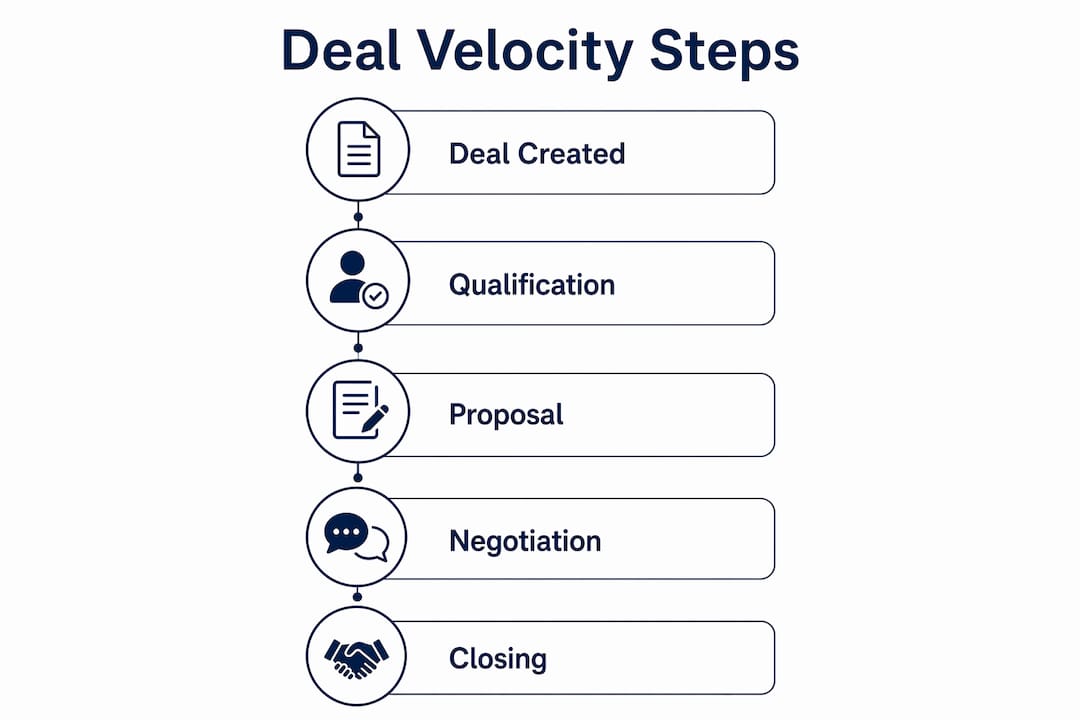
Deal velocity is defined as the speed at which an individual sales opportunity moves through your pipeline from creation to close, measured in days. It is one of the most direct indicators of sales process health available to a sales leader, and yet it remains one of the most misunderstood. Unlike broader revenue metrics, deal velocity tells you precisely where time is being lost on a deal-by-deal basis. Understand it properly, and you gain a real-time window into the efficiency of your entire sales operation, from first contact through to signed contract.
What is deal velocity and how is it defined?
Deal velocity is defined as the speed at which an individual sales opportunity progresses through the pipeline from creation to a terminal state, typically measured in days. The shorter the time, the higher the velocity. This is distinct from sales velocity, which is an aggregate, revenue-focused metric covering your entire pipeline. Deal velocity zooms in on a single opportunity and asks one question: how long is this taking, and why?

The practical value of this distinction is significant. A sales director reviewing pipeline health in a CRM tool such as Salesforce or HubSpot can see average deal ages, stage durations, and time-to-close at a glance. But without understanding deal velocity at the individual level, those averages can mask serious problems. One fast-moving deal can offset three stalled ones and make your pipeline look healthier than it is.
Deal velocity is also a lagging indicator of upstream process quality. If your qualification process is weak or your documentation is slow to prepare, that inefficiency shows up as poor velocity later in the cycle. Fixing velocity, therefore, often means fixing what happens at the very start of a deal.
How to calculate deal velocity and what metrics underpin it
The standard formula for deal velocity is straightforward: Total Sales Cycle Time ÷ Number of Deals Closed in a given period. If your team closed 10 deals last quarter and the combined sales cycle time across those deals was 600 days, your average deal velocity is 60 days per deal. The lower the number, the faster your deals are moving.
Deal velocity focuses solely on time and deal progression, unlike sales velocity, which incorporates revenue factors such as deal size, win rate, and number of opportunities. This distinction matters when you are trying to diagnose specific problems. The table below clarifies the key differences:
| Metric | Focus | Formula | Best used for |
|---|---|---|---|
| Deal velocity | Speed of individual deals | Total cycle time ÷ deals closed | Diagnosing stalls and bottlenecks |
| Sales velocity | Aggregate revenue momentum | Opportunities × deal size × win rate ÷ cycle length | Forecasting and revenue planning |
When calculating deal velocity, segment your deals by type. Expansion deals with existing clients move differently from new business wins, and blending them produces an average that is accurate for neither. Practitioners who segment by deal type get far more meaningful data to act on.
Pro Tip: Track deal velocity by pipeline stage, not just end-to-end. Knowing that your deals spend an average of 22 days in the proposal stage versus 8 days in discovery tells you exactly where to focus your coaching effort.
Why is deal velocity important for sales teams and business growth?
Deal velocity matters because it functions as a pulse metric for your sales operation. If velocity slows, revenue growth halts, and the warning signs appear in your pipeline weeks before they show up in your revenue figures. This makes it one of the most valuable early-warning tools a sales leader has access to.
“A 20% decline in deal velocity in a single month is a warning sign for potential quarterly target risks, even if pipeline volume remains stable.” — Revenue.io
The implications of that finding are worth sitting with. Your pipeline can look full and healthy in terms of volume, yet still be heading for a missed quarter. Deal velocity reveals that risk before it becomes a crisis.
Here is what tracking deal velocity consistently allows you to do:
- Identify which pipeline stages are creating the most friction and costing you time
- Spot individual deals that are stalling before they are formally lost
- Improve revenue forecasting accuracy by understanding realistic time-to-close
- Benchmark your team’s performance against historical data and industry norms
- Prioritise coaching conversations around the deals and stages that need the most attention
The connection to revenue is direct. Teams that use signal-driven account management close deals 128 days faster and achieve a 7.4x lift in average deal size compared to traditional methods. That is not a marginal improvement. It is the difference between a sales team that hits target and one that consistently falls short.
How does deal velocity differ from sales velocity and related metrics?
Sales velocity and deal velocity are related but serve different purposes, and conflating them leads to poor decisions. Sales velocity is calculated using four variables: number of opportunities, average deal size, win rate, and average sales cycle length. It gives you a revenue-per-day figure for your entire pipeline. Deal velocity, by contrast, strips all of that away and focuses purely on time for a single opportunity.
The practical implication is that you need both. Sales velocity tells you whether your pipeline is generating enough revenue momentum overall. Deal velocity tells you where individual opportunities are losing time and why. Using one without the other gives you an incomplete picture.
Higher deal velocity is not always positive. An increase in velocity accompanied by a drop in win rates may indicate that deals are being prematurely disqualified or that discounting is being used to force faster closes. Speed without quality is not progress. It is a different kind of problem.
Pro Tip: When reviewing your CRM data, always look at deal velocity and win rate together. If velocity improves but win rate drops, investigate your qualification and closing processes before celebrating the speed gain.
Deal health scores, which use behavioural signals such as idle days, activity volume, and stakeholder coverage, are a necessary complement to velocity metrics. A deal moving quickly through a pipeline with low engagement signals is not a healthy deal. It is a deal heading for a fast loss.
What factors influence deal velocity and where do deals stall?
Several factors consistently affect how quickly deals move, and most of them are within your control as a sales leader. Understanding what affects deal velocity is the first step to doing something about it.
The most common causes of slow deal velocity are:
- Weak qualification at the outset. Deals that enter the pipeline without a clear problem, budget, or decision-making process attached to them will stall. They were never going to move quickly because the foundations were not in place.
- Unclear next steps. Every sales conversation should end with a specific, time-bound next action agreed by both parties. Without this, deals drift.
- Single-threaded relationships. If your sales rep is speaking to only one contact at the prospect organisation, the deal is vulnerable. Decision-maker availability, internal politics, or a contact leaving the business can all bring a deal to a halt.
- Slow follow-up and internal delays. Legal review, procurement processes, and internal approvals are often cited as causes of stalling, but slow follow-up from the sales side is equally damaging and far more controllable.
- Lack of stakeholder engagement. Behavioural signals such as idle days and declining activity volume are reliable indicators that a deal is losing momentum before it formally stalls.
Deals that stall beyond 90 days face a significantly higher risk of being lost entirely. The longer a deal sits without forward movement, the more likely it is that the prospect’s priorities have shifted, a competitor has moved in, or internal enthusiasm has faded. Momentum, once lost, is difficult to recover.
How can you increase deal velocity and improve sales cycle efficiency?
Improving deal velocity is not about pressuring prospects to move faster. It is about removing the friction that slows deals down and creating the conditions for natural, confident progression. Here are the strategies that produce consistent results:
-
Qualify rigorously and early. Use a structured qualification framework such as MEDDIC or BANT to assess whether an opportunity is genuinely worth pursuing before it enters your pipeline. Deals that should not be in your pipeline are the single biggest drag on average velocity.
-
Set mutual action plans. A mutual action plan is a shared document agreed between your sales rep and the prospect that outlines every step required to reach a decision, with owners and deadlines attached. This creates accountability on both sides and removes ambiguity about what happens next. You can explore how this fits into a broader approach to shortening sales cycles for practical guidance.
-
Multithread your deals. Build relationships with multiple stakeholders at the prospect organisation. This protects your deal from single points of failure and accelerates internal consensus-building, which is often the real bottleneck in complex B2B sales.
-
Use CRM analytics to track stage-level velocity. Tools such as Salesforce, HubSpot, and Pipedrive all offer stage duration reporting. Set benchmarks for how long a deal should spend in each stage, and flag anything that exceeds that threshold for immediate attention.
-
Implement signal-driven account management. Rather than relying on scheduled check-ins, respond to engagement signals from your prospects. When a prospect revisits your proposal, watches a product video, or engages with your content, that is the moment to reach out. Research from SBI shows this approach reduces cycle times from 227 days to 195 days on average.
-
Balance speed with quality. Resist the temptation to push deals through stages before they are ready. Premature advancement leads to late-stage losses, which are far more costly in time and resource than a well-managed early disqualification.
Pro Tip: Review your five most recently lost deals and calculate how long each spent in each pipeline stage. The stage where the most time was lost before the deal died is almost always where your process needs the most work.
Key takeaways
Deal velocity is the single most direct measure of sales process efficiency at the individual opportunity level, and improving it requires fixing upstream qualification, stakeholder coverage, and stage-level follow-up.
| Point | Details |
|---|---|
| Deal velocity definition | The speed an individual deal moves from creation to close, measured in days. |
| Calculation formula | Total sales cycle time divided by number of deals closed in a period. |
| Forecasting value | A 20% monthly drop in velocity signals quarterly target risk even when pipeline volume looks healthy. |
| Speed versus quality | Higher velocity paired with lower win rates indicates premature disqualification or discounting, not genuine improvement. |
| Top improvement lever | Signal-driven account management reduces average cycle times and significantly increases deal size. |
Deal velocity in practice: what I have learned from working with sales teams
I have worked with sales teams across a wide range of sectors, and the pattern I see most often is this: leaders are tracking pipeline volume and win rate, but they are not tracking where time is being lost inside individual deals. They know they are missing targets, but they cannot pinpoint why. Deal velocity gives you that answer.
The most common misconception I encounter is that improving velocity means pushing harder or following up more aggressively. It does not. The teams that improve their deal velocity most consistently are the ones that get better at qualification and at setting clear next steps. They stop letting vague commitments like “we will be in touch” pass without challenge. They ask for a specific date and a specific action, every time.
I also think the distinction between deal velocity and sales velocity is genuinely underappreciated. Sales leaders who only track aggregate metrics miss the individual deal signals that predict problems weeks in advance. The two metrics work together, and you need both to manage a pipeline with any real precision.
One thing I would caution against is treating velocity as a target in itself. I have seen teams where reps were incentivised purely on speed, and the result was a pipeline full of fast losses. The goal is not fast deals. The goal is fast wins. Keep that distinction front of mind when you design your tracking and coaching approach.
— Jerry
How Aheadofsales can help you improve your deal velocity
If you recognise the patterns described in this article, whether that is deals stalling in the same stage repeatedly, reps struggling to set clear next steps, or a pipeline that looks healthy but consistently underdelivers, Aheadofsales can help you address them directly.
Our sales training programmes are built around the specific challenges that sales teams face in real pipeline situations, not generic theory. We work with businesses of 50 to 1,000 staff to improve qualification, deal progression, and pipeline management through bespoke 1:1 coaching and structured training. If you are serious about hitting target every quarter and generating consistent growth, explore our sales consultancy services to see how we work and what results our clients achieve.
FAQ
What is the deal velocity definition in simple terms?
Deal velocity is the measure of how quickly an individual sales opportunity moves through your pipeline from creation to close, expressed in days. The lower the number, the faster your deals are progressing.
How do you calculate deal velocity?
Divide your total sales cycle time by the number of deals closed in a given period. For example, if 10 deals closed with a combined cycle time of 500 days, your average deal velocity is 50 days.
What is the difference between deal velocity and sales velocity?
Deal velocity measures the time taken for a single opportunity to close. Sales velocity is an aggregate metric that combines number of opportunities, average deal size, win rate, and cycle length to produce a revenue-per-day figure for your whole pipeline.
What causes slow deal velocity?
The most common causes are weak qualification, unclear next steps, single-threaded relationships with only one stakeholder contact, and slow internal follow-up. Deals that stall beyond 90 days face a significantly higher risk of being lost entirely.
Can increasing deal velocity hurt your win rate?
Yes. Higher velocity paired with a falling win rate often signals premature disqualification or heavy discounting to force faster closes. Always track velocity and win rate together to get an accurate picture of pipeline health.