
TL;DR:
- Consultative selling training develops skills in strategic discovery, active listening, business acumen, and problem-solving to enhance sales effectiveness.
- Success depends on integrating ongoing reinforcement, manager coaching, and systematic behaviour tracking rather than relying on one-off workshops.
- Without embedding these practices into the sales process and team culture, the training’s impact on revenue growth remains limited.
Consultative selling training is a customer-centric skill development approach that equips sales professionals to uncover deep client needs, build genuine trust, and deliver solutions that directly address business problems. Unlike traditional product-pitch selling, which leads with features and pricing, the consultative approach centres on disciplined questioning, active listening, and business acumen. Organisations including Richardson, Zime AI, and TrainingPros have demonstrated that core buyer conversation skills such as strategic discovery and problem-solving produce measurable revenue gains. For sales leaders managing teams of 50 or more, this is not a soft-skills exercise. It is a structured, repeatable system for winning more business.
What key skills does consultative selling training develop?
Consultative selling training builds four interconnected skill areas that collectively shift a rep’s behaviour from presenting to diagnosing. Each one addresses a specific failure point in the average sales conversation.

Strategic discovery is the foundation. Reps learn to ask open-ended questions that explore the financial and operational impact of a client’s problem, not just its surface symptoms. Pulse RevOps describes a three-layer question model in which reps progress from situational facts to business consequences to personal priorities. Peer calibration sessions then sharpen question quality through group review, which prevents reps from reverting to shallow fact-gathering.
Active listening is the skill most reps believe they already have and most consistently underperform. Training here focuses on hearing what a buyer does not say directly, confirming understanding before responding, and resisting the urge to pitch before the problem is fully mapped. Highspot advocates blending call recordings with structured practice so reps can hear their own listening gaps in real conversations.
Business acumen separates average consultative sellers from exceptional ones. Reps need enough industry knowledge to connect a client’s stated challenge to broader commercial priorities. Without this, discovery conversations stay superficial and proposals miss the mark.
Problem-solving and critical thinking complete the picture. Reps learn to diagnose root causes rather than accept the first problem a buyer names, and to prioritise which issues carry the most weight for that specific stakeholder.
- Strategic discovery: open-ended questioning and financial impact exploration
- Active listening: confirming understanding and avoiding premature pitches
- Business acumen: aligning solutions with client commercial priorities
- Problem-solving: diagnosing root causes and prioritising buyer needs
- Adaptability: adjusting approach across different buyer roles and seniority levels
Pro Tip: Record your discovery calls and review them within 24 hours. You will consistently find moments where you answered your own question before the buyer had a chance to respond. That habit alone costs deals.
How does consultative selling training deliver measurable results?
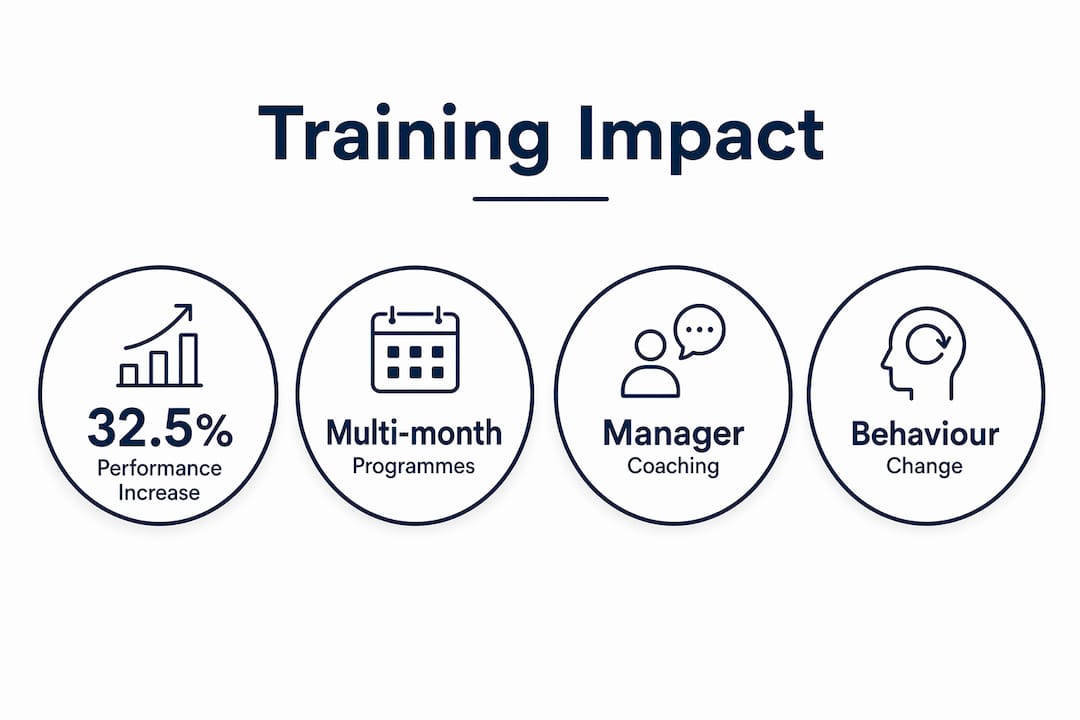
The evidence for behaviour-based consultative selling training is specific and replicable. A multi-month programme paired with manager coaching delivered a 32.5% increase in move-ins and lifted application-to-approval conversion from 49.0% to 58.1% within three months. That is not a marginal improvement. It represents a structural shift in how reps conduct conversations at every stage of the funnel.
The reason one-off workshops rarely produce these results is straightforward. Knowledge transfer and behaviour change are different problems. A rep can leave a training day knowing exactly what a great discovery question looks like and still default to product pitching under pressure. Zime AI emphasises that lasting impact requires making consultative actions automatic through repeated role-play and deal-review reinforcement, not just conceptual understanding.
Manager involvement is the multiplier most organisations underestimate. When managers review discovery quality in pipeline meetings rather than just deal size and close probability, reps receive the signal that consultative behaviour is measured and valued. Without that signal, training fades within weeks.
| Training element | Impact on performance |
|---|---|
| Behaviour-based multi-month programme | 32.5% increase in key sales metrics within 3 months |
| Manager coaching integration | Conversion rate lift of 9 percentage points |
| Role-play and call review | Embeds consultative habits under live deal pressure |
| AI-driven personalised reinforcement | Real-time guidance during active deals |
Pro Tip: Build a 90-day behaviour scorecard alongside any training programme. Track discovery question depth, stakeholder mapping quality, and next-step clarity. If you only track revenue, you will never know which behaviours are driving it.
What types of consultative selling training programmes are available?
The format of a consultative selling course matters as much as its content. Different structures suit different team sizes, sales cycles, and existing skill levels.
Multi-month structured programmes are the gold standard for behaviour change. They combine instructor-led sessions with spaced practice, manager coaching loops, and CRM-linked behaviour metrics. Richardson’s AI-powered Accelerate Prism system sits within this category, providing real-time coaching guidance tied to consultative and challenger sales methodologies during live deals. This approach treats training as a continuous system rather than an event.
Virtual instructor-led training (VILT) works well for geographically distributed teams. It preserves the interaction and role-play elements that self-paced eLearning cannot replicate. The trade-off is that without strong facilitation, virtual sessions can become passive viewing experiences rather than active skill-building.
Self-paced eLearning suits knowledge reinforcement between live sessions. It is not sufficient as a standalone approach for consultative selling because the skill is relational and requires practice with another person to develop properly.
Blended learning combines all three formats and is the most practical option for most sales teams. Reps build conceptual understanding through eLearning, practise skills in VILT or in-person workshops, and receive reinforcement through manager coaching and AI-guided deal reviews.
- Multi-month programmes: highest behaviour change impact, requires manager commitment
- VILT: good for distributed teams, depends heavily on facilitation quality
- Self-paced eLearning: useful for reinforcement, insufficient as a standalone approach
- Blended learning: most practical for teams balancing training with live deal activity
- AI-powered systems: provide real-time guidance but require integration with existing workflows
The single most important variable across all formats is manager coaching enablement. Programmes that train managers to coach consultative behaviours in pipeline reviews consistently outperform those that focus exclusively on rep-level skill development.
How can sales leaders implement consultative selling training effectively?
Practical implementation separates teams that see lasting gains from those that complete a training programme and revert to old habits within a quarter. The following sequence works consistently across teams of 50 to 500 reps.
-
Assess baseline skills before designing the curriculum. Record and review a sample of discovery calls to identify the specific gaps in your team. Are reps asking surface-level questions? Pitching too early? Failing to identify the right decision-maker? The answers shape which skills to prioritise.
-
Blend training with real-world practice from week one. Do not run a training block and then return to normal selling. Assign live deals as practice cases, review them in coaching sessions, and use the outcomes to calibrate the next training module.
-
Embed consultative prompts into your CRM workflow. Linking training behaviours to specific funnel stages, such as requiring a documented business impact summary before a deal advances to proposal stage, creates structural accountability. Reps cannot skip the consultative step if the CRM requires it.
-
Retrain managers first. A manager who coaches on deal size and close date will undermine every consultative selling course you run. Managers need their own training on how to review discovery quality, ask coaching questions rather than giving answers, and use behaviour metrics alongside pipeline metrics.
-
Use AI tools for on-demand role-play and call analysis. Tools that provide real-time personalised guidance allow reps to practise and receive feedback outside of scheduled training sessions. This is particularly valuable for large teams where manager coaching time is limited.
Pro Tip: Do not launch a consultative selling programme in Q4 when reps are focused on closing. Start in Q1 or Q2 so the behaviour change has time to compound before year-end pressure arrives.
What challenges can affect consultative selling training success?
Even well-designed training programmes encounter obstacles that reduce their impact. Recognising these in advance allows you to build in mitigations rather than troubleshoot after the fact.
The most common failure point is poor stakeholder management during complex sales cycles. Korn Ferry’s structured selling research highlights that consultative selling breaks down when reps spend time with the wrong people. A technically strong discovery conversation with a mid-level contact who has no budget authority produces no commercial outcome. Training must include explicit guidance on identifying true decision-makers and qualifying stakeholder influence before investing significant selling time.
Multi-stakeholder dynamics add a second layer of complexity. In B2B sales involving three or more stakeholders, each person has different priorities, different language, and different definitions of success. Reps need to adapt their consultative approach for each conversation rather than delivering a single message to the whole buying group.
Virtual and remote selling creates a third challenge. The rapport-building and active listening cues that work in person require deliberate adjustment online. Eye contact, pacing, and silence all function differently on a video call, and training programmes that were designed for face-to-face selling need updating to address this.
Scaling behaviour consistency across large teams is perhaps the hardest challenge of all. A team of ten can maintain quality through close manager oversight. A team of 200 requires systematic reinforcement through CRM integration, AI-guided coaching, and regular calibration sessions to prevent skill drift. Securing clear next steps at every meeting is one of the simplest and most consistently neglected disciplines in large sales teams.
Key takeaways
Consultative selling training delivers lasting revenue growth only when it combines behaviour-focused skill development, manager coaching, and systematic reinforcement rather than relying on one-off workshops.
| Point | Details |
|---|---|
| Behaviour change is the goal | Knowledge transfer alone does not shift how reps sell under live deal pressure. |
| Manager coaching is the multiplier | Programmes that include manager enablement consistently outperform rep-only training. |
| Measurable results are achievable | Behaviour-based training has produced a 32.5% increase in key sales metrics within 3 months. |
| Format matters less than reinforcement | Blended learning works, but only if spaced practice and coaching loops are built in. |
| Stakeholder discipline is non-negotiable | Identifying true decision-makers and securing next steps prevents wasted selling effort. |
Why I think most consultative selling training misses the point
I have worked with sales teams across a wide range of sectors, and the pattern is remarkably consistent. A business invests in a consultative selling course, reps attend, they find it genuinely useful, and then six weeks later the pipeline reviews look exactly the same as before. The training did not fail. The system around it did.
The uncomfortable truth is that consultative selling is as much a mindset as a skill set. You can teach someone the three-layer question model in an afternoon. Getting them to use it consistently when a prospect pushes back and asks for a price takes months of reinforcement and a manager who models the same behaviour. Organisations that treat training as an event will always be disappointed by the results.
What I have seen work, consistently, is tying every training element to a measurable business outcome from day one. Not “reps will understand consultative selling” but “application-to-approval conversion will increase by X within 90 days.” That specificity changes how managers engage, how reps practise, and how leadership evaluates the investment. You can explore consultative selling techniques that are built around this outcome-first thinking rather than abstract methodology.
The role of AI in this space is genuinely exciting, and not in a vague way. Real-time guidance during live deals, call analysis that flags missed discovery opportunities, and personalised practice scenarios that adapt to individual skill gaps are all available now. The teams that combine these tools with strong manager coaching will pull significantly ahead of those relying on quarterly workshops alone.
— Jerry
How Aheadofsales can support your sales team’s development
If you recognise the gap between your team’s current selling behaviour and the consultative approach described in this article, Aheadofsales is built to close it. Our sales training programmes combine bespoke 1:1 coaching with structured consultative skill development and ongoing reinforcement, designed specifically for businesses with 50 to 1,000 staff who are serious about hitting target every quarter.
We do not run one-off workshops and leave you to figure out the rest. Every programme includes manager coaching enablement, CRM-aligned behaviour metrics, and a clear 90-day performance target. Our packages start from £4,500, and our clients consistently achieve at least 50% sales growth within the first year. If you want to understand exactly how tailored coaching drives growth for teams like yours, the next step is a conversation.
FAQ
What is consultative selling training?
Consultative selling training is a structured skill development approach that teaches sales professionals to uncover client needs through strategic discovery, active listening, and business acumen rather than product pitching. It focuses on behaviour change rather than knowledge transfer alone.
How long does it take to see results from consultative selling training?
Behaviour-based programmes paired with manager coaching have delivered measurable improvements, including a 32.5% increase in key sales metrics, within three months. Results depend on the consistency of reinforcement and manager involvement throughout the programme.
What is the difference between consultative selling and traditional selling?
Traditional selling leads with product features and pricing. Consultative selling leads with questions that uncover the buyer’s business problem, financial impact, and priorities before any solution is presented.
How do you embed consultative selling skills into a sales team long-term?
Embedding consultative selling requires linking training behaviours to CRM funnel stages, training managers to coach on discovery quality, and using AI-powered tools for ongoing role-play and call analysis between formal training sessions.
Is consultative selling training suitable for complex B2B sales?
Consultative selling is particularly well-suited to complex B2B sales because it addresses multi-stakeholder dynamics, decision-maker identification, and the discipline of securing clear next steps at every stage of a long sales cycle.