
TL;DR:
- The buyer journey outlines the stages prospects go through from recognizing a problem to making a purchase, emphasizing the importance of tailored content and timing. It often follows a non-linear path, with multiple stakeholders entering at different stages, requiring adaptable sales and marketing strategies. Mapping this journey reveals gaps and aligns efforts, ultimately increasing conversion rates and ensuring better resource allocation.
The buyer journey is defined as the process a prospect goes through from first recognising a problem to making a purchase decision, typically structured across three phases: awareness, consideration, and decision. Recognised frameworks from Zendesk and HubSpot treat this as the sales funnel viewed from the prospect’s perspective, not the seller’s. Understanding it is the difference between marketing that intercepts buyers at the right moment and content that lands in the wrong inbox at the wrong time. The buyer journey is distinct from the broader customer journey, which extends into post-purchase experience. Get this distinction right and your budget allocation and KPIs will follow.
What is the buyer journey and why does it matter?
The buyer journey is the sequence of stages a potential customer moves through from identifying a problem to completing a purchase. It matters because buyers who receive the right information at the right stage convert faster and with less friction. When your content or sales approach is misaligned with where a buyer actually sits, you either overwhelm them with information they are not ready for or push for a close before trust is established.
For marketing professionals and business leaders, this is not an abstract model. It is a practical framework for deciding what content to produce, when your sales team should make contact, and how to measure progress through the funnel. Harvard Business School describes the buying process as a series of decisions, and the organisations that win are those that understand which decision a buyer is currently facing.
The standard three-stage model used by HubSpot and Zendesk provides a reliable starting point. Harvard Business School’s six-stage model adds nuance by separating preference and trial from conviction and purchase, which is particularly useful for businesses with longer sales cycles or high-value contracts.
What are the core stages of the buyer journey?
Each stage of the buyer decision-making process presents a different set of questions, emotions, and information needs. Treating all three stages as identical is one of the most common and costly mistakes in B2B marketing.

Awareness is where a buyer recognises a problem but has no clear picture of the solution. Consider a business owner whose sales team is missing target every quarter. They are not yet searching for a sales training company. They are searching for answers to questions like “why is my sales team underperforming?” At this stage, buyers need educational content: blog posts, diagnostic tools, and thought leadership that names the problem clearly.
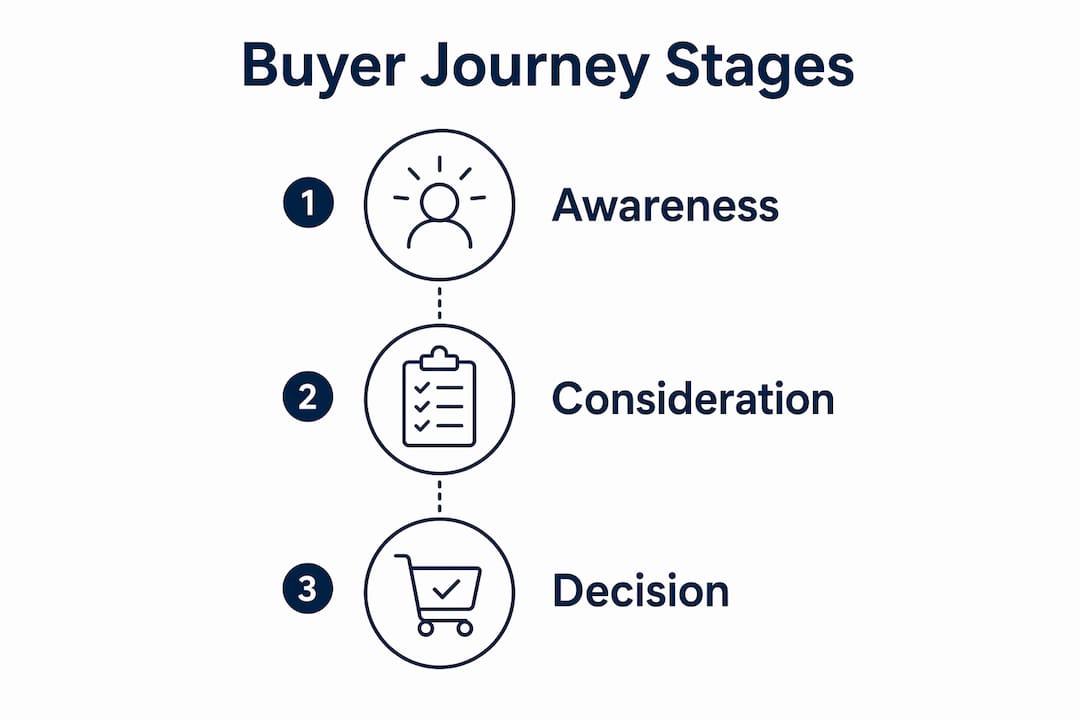
Consideration is where the buyer has defined their problem and is actively researching solution categories. They are now comparing approaches: should they hire a new sales director, invest in CRM software, or bring in external sales training? Your content here needs to position your category of solution as the right fit, using case studies, comparison guides, and webinars.
Decision is where the buyer is choosing between specific providers. They want proof: testimonials, pricing clarity, demos, and a clear articulation of what makes you different. This is where your sales team’s ability to run a consultative conversation becomes critical.
- Awareness content: blog posts, diagnostic articles, educational videos
- Consideration content: comparison guides, case studies, solution-focused webinars
- Decision content: pricing pages, testimonials, demos, free consultations
Pro Tip: Map your existing content library against these three stages. Most businesses discover they have a surplus of awareness content and almost nothing built for the decision stage, which is precisely where deals are won or lost.
Does the buyer journey always follow a straight line?
The buyer journey is often non-linear. Buyers skip stages, revisit earlier phases, and sometimes arrive at the decision stage before you have had a chance to build any relationship at all. A referral from a trusted colleague, for example, can propel a buyer directly from zero awareness to active evaluation of your specific offer within a single conversation.
This matters enormously for how you design your sales and marketing motions. If you assume every prospect enters at awareness and progresses neatly through consideration to decision, you will frustrate buyers who arrive mid-journey and confuse those who circle back after a new stakeholder joins the evaluation process.
“Buyer journey progression is often non-linear; recognising and adapting to buyers’ current stage is critical to engagement success.” — ActiveCampaign
In B2B environments, the complexity multiplies. Multi-stakeholder buying means a procurement manager, a department head, and a finance director may each be at a different stage simultaneously. Your content and sales conversations need to serve all of them, often at the same time.
Designing for non-linear behaviour means building re-entry pathways into your content strategy. A buyer who downloaded a comparison guide six months ago and has now returned to your website is not starting over. They need a different conversation, not the same one repeated.
- Referrals often skip awareness entirely and land at consideration or decision
- New stakeholders entering late in the process can reset progress to an earlier stage
- Budget cycles and organisational changes frequently push buyers back to reconsideration
- Competitive intelligence gathered mid-process can trigger a full re-evaluation
Pro Tip: Ask every new prospect directly: “Have you looked at solutions like ours before?” Their answer tells you immediately which stage they are at and saves you from delivering an awareness pitch to someone who is ready to buy.
What is the difference between the buyer journey and the customer journey?
The buyer journey ends at the point of purchase. The customer journey begins there. Confusing the two leads to misallocated budgets, misaligned KPIs, and content strategies that serve neither acquisition nor retention effectively.
Separating these two frameworks allows marketing teams to assign the right resources to the right goals. Pre-purchase content is designed to build awareness, establish credibility, and drive conversion. Post-purchase content is designed to onboard, retain, and turn customers into advocates. The metrics that matter for each phase are entirely different.
| Dimension | Buyer journey | Customer journey |
|---|---|---|
| Scope | Problem recognition to purchase | Onboarding through to advocacy |
| Primary goal | Acquisition and conversion | Retention and loyalty |
| Key content types | Blogs, case studies, demos, pricing | Onboarding guides, support, upsell campaigns |
| KPIs | Lead volume, conversion rate, sales cycle length | Churn rate, NPS, lifetime value |
| Teams responsible | Marketing and sales | Customer success and account management |
The practical implication is straightforward. If your marketing team is producing retention content before you have a strong acquisition engine, you are solving the wrong problem. Equally, if your sales team is still running awareness-style conversations with buyers who are ready to decide, you are losing deals that should be closing.
How do you map the buyer journey to improve sales results?
Buyer journey mapping is the process of charting every decision, action, and emotion a prospect experiences from first recognising a problem to completing a purchase. Done well, it reveals funnel gaps where leads are dropping off and tells you precisely where to focus your sales and marketing effort.
According to Harvard Business School, effective journey mapping requires asking the right questions about customer motivation and identifying the key moments where you can intercept and influence a buyer’s decision. This is not a one-time exercise. It is a living document that should be updated as you gather data from real sales conversations and customer feedback.
Here is a practical approach to building your first buyer journey map:
- Define your buyer personas. Identify who your buyers are, what problems they face, and what success looks like for them. For B2B businesses, this means mapping multiple stakeholders, not just the primary contact. The types of B2B buyers involved in a single deal can vary significantly in their priorities and stage of readiness.
- List every touchpoint. Document every interaction a prospect has with your brand, from a Google search to a sales call to a proposal review. Include digital and human touchpoints.
- Assign content and sales actions to each stage. Awareness touchpoints need educational content. Consideration touchpoints need proof of concept. Decision touchpoints need clear commercial conversations.
- Identify drop-off points. Where are prospects going quiet? Where are deals stalling? These are your highest-priority areas for improvement.
- Build re-entry pathways. Design nurture sequences and sales follow-up cadences that account for buyers who pause, reconsider, or return after a period of inactivity.
- Align marketing and sales on stage definitions. If marketing defines a lead as “consideration stage” and sales treats them as “decision ready,” you will create friction at the handover point. Agreement on definitions is non-negotiable.
Pro Tip: Use your CRM data to identify the average time prospects spend at each stage. If buyers are lingering in consideration for months, you likely have a content gap or a sales conversation problem at that specific phase. Targeted funnel management fixes this faster than any amount of additional top-of-funnel activity.
For businesses with complex sales cycles, consultative selling is the approach that best mirrors the buyer journey. It prioritises understanding the buyer’s current situation before proposing any solution, which naturally aligns your sales motion with wherever the buyer sits in their process.
Key takeaways
The buyer journey is the single most important framework for aligning your marketing content and sales conversations with how your prospects actually make decisions.
| Point | Details |
|---|---|
| Three core stages | Awareness, consideration, and decision each require different content and sales approaches. |
| Non-linear progression | Buyers skip stages and revisit earlier phases; design your strategy to accommodate re-entry. |
| Buyer vs. customer journey | The buyer journey ends at purchase; conflating it with the customer journey misallocates budget and distorts KPIs. |
| Mapping reveals gaps | Charting touchpoints and drop-off points shows precisely where your funnel is losing prospects. |
| B2B complexity | Multi-stakeholder environments require content and sales motions tailored to multiple decision-makers at different stages. |
Why most businesses are still getting this wrong
I have worked with dozens of sales teams across a wide range of sectors, and the pattern I see most often is this: businesses invest heavily in awareness content, build a reasonable pipeline, and then watch deals stall at the consideration and decision stages because nobody has designed the right intervention for those moments.
The assumption that buyers will naturally progress from one stage to the next if you just keep producing content is, in my experience, one of the most expensive beliefs in B2B marketing. Buyers do not self-serve their way to a decision on complex, high-value purchases. They need well-timed, well-informed human contact at the right moments.
What I have also observed is that when sales teams genuinely understand the buyer’s journey phases, their conversations change. They stop leading with product features and start asking questions that surface where the buyer actually is. That shift alone, from pitching to diagnosing, is what separates teams that consistently hit target from those that are always chasing it.
The other mistake I see regularly is treating journey mapping as a marketing exercise that sales never sees. The map needs to live in your CRM, your sales playbooks, and your coaching conversations. When marketing and sales share the same picture of how buyers move, the handover from marketing qualified lead to sales conversation becomes far less painful for everyone, including the buyer.
Refine your journey map every quarter. Use real data from closed deals and lost opportunities. The buyers who did not convert will tell you more about your funnel gaps than the ones who did.
— Jerry
How Aheadofsales helps you turn buyer journey insight into sales growth
Understanding the buyer journey is one thing. Building a sales team that operates in alignment with it is another. Aheadofsales combines bespoke 1:1 coaching with structured training and consultancy to help businesses translate buyer journey frameworks into real commercial results. Our sales training programmes are built around consultative selling principles that mirror how modern buyers actually make decisions, so your team is always having the right conversation at the right time. If your pipeline is healthy but your conversion rate is not, or if your sales team is working hard without hitting target, the answer is almost always found in how well they understand and respond to the buyer’s current stage. Our sales consultancy services are designed to fix exactly that.
FAQ
What is the buyer journey in simple terms?
The buyer journey is the process a prospect goes through from recognising a problem to making a purchase decision. It is typically divided into three stages: awareness, consideration, and decision.
How many stages does the buyer journey have?
The standard model includes three stages: awareness, consideration, and decision. Harvard Business School’s extended model identifies six stages, adding learning, preference and trial, and conviction for more complex buying processes.
Is the buyer journey always linear?
No. Buyers frequently skip stages, revisit earlier phases, or enter mid-journey through referrals. In B2B environments, multiple stakeholders entering at different points make non-linear progression the norm rather than the exception.
What is the difference between the buyer journey and the customer journey?
The buyer journey covers pre-purchase behaviour from problem recognition to conversion. The customer journey extends beyond purchase to include onboarding, retention, and advocacy. Treating them as the same framework leads to misaligned content strategies and inaccurate KPIs.
Why does mapping the buyer journey improve conversion rates?
Mapping the buyer journey identifies where prospects are dropping out of your funnel and which touchpoints are missing or misaligned. Fixing those gaps with the right content and sales interventions at each stage directly improves the rate at which prospects move to purchase.
One Response