
TL;DR:
- Effective sales pipeline management involves overseeing current deals through defined stages, emphasizing data integrity and disciplined activity. It requires clear stage exit criteria, regular updates, and proactive decision-making to ensure predictable revenue. AI enhances pipeline insights only when built upon a foundation of strong, disciplined sales processes.
Most business owners and sales professionals think sales pipeline management is simply about pushing deals over the line before month end. It is not. Understanding what is sales pipeline management properly, and treating it as a structured, ongoing discipline, is what separates teams that hit target every quarter from those lurching between feast and famine. In this guide, you will learn what the pipeline actually means, how to build one that works, which stages and metrics matter most, how AI is changing the picture in 2026, and the practical steps to keep your pipeline healthy and your revenue predictable.
Table of Contents
- Key takeaways
- What sales pipeline management really means
- Sales pipeline stages and the metrics that matter
- The discipline behind effective pipeline management
- AI and analytics in 2026 pipeline management
- How to build a strong sales pipeline
- My honest take on what most teams get wrong
- Ready to build a pipeline that actually performs?
- FAQ
Key takeaways
| Point | Details |
|---|---|
| Pipeline vs funnel | A sales pipeline tracks active deals in real time; a funnel analyses buyer conversion patterns over time. |
| Stages and discipline | Use 5 to 7 clearly defined pipeline stages with strict exit criteria to prevent deals stalling or inflating. |
| Data integrity is everything | Daily updates to stage progress and next steps are what keep a pipeline reliable rather than a guessing game. |
| AI needs foundations first | AI-driven analytics only add value when your underlying data and pipeline processes are already disciplined. |
| Walk away from weak deals | Knowing when to disqualify a deal is as important as knowing how to close one. |
What sales pipeline management really means
When people ask what does sales pipeline mean, they often picture a CRM screen with coloured cards. That is the visual representation. The actual discipline is something deeper.
Sales pipeline management is the ongoing process of overseeing, measuring, and acting on every active sales opportunity as it moves through your defined stages, from first contact to closed deal. It is operational and real-time, focused on current deals, current activity, and current decisions. You are not analysing historical patterns here. You are managing live situations.
It is worth being clear on one common confusion: the sales pipeline and the sales funnel are not the same thing. The pipeline represents your active opportunities and where each one sits in your sales process. The funnel is an analytical tool that looks at how leads convert across stages over time. Both are useful, but they answer different questions. The pipeline asks “what do I need to do this week?” The funnel asks “where are we losing deals over time?”
Here is a simple comparison to make this concrete:
| Concept | Focus | Primary use |
|---|---|---|
| Sales pipeline | Active deals, real-time stage tracking | Daily sales activity and short-term forecasting |
| Sales funnel | Conversion rates across stages | Long-term strategy and process improvement |
For forecasting to be reliable, you need to track three things across your pipeline: deal quantity (how many opportunities you have), deal quality (how well qualified they are), and deal maturity (how far along each one is). Most teams only track volume. That is why their forecasts are wrong.
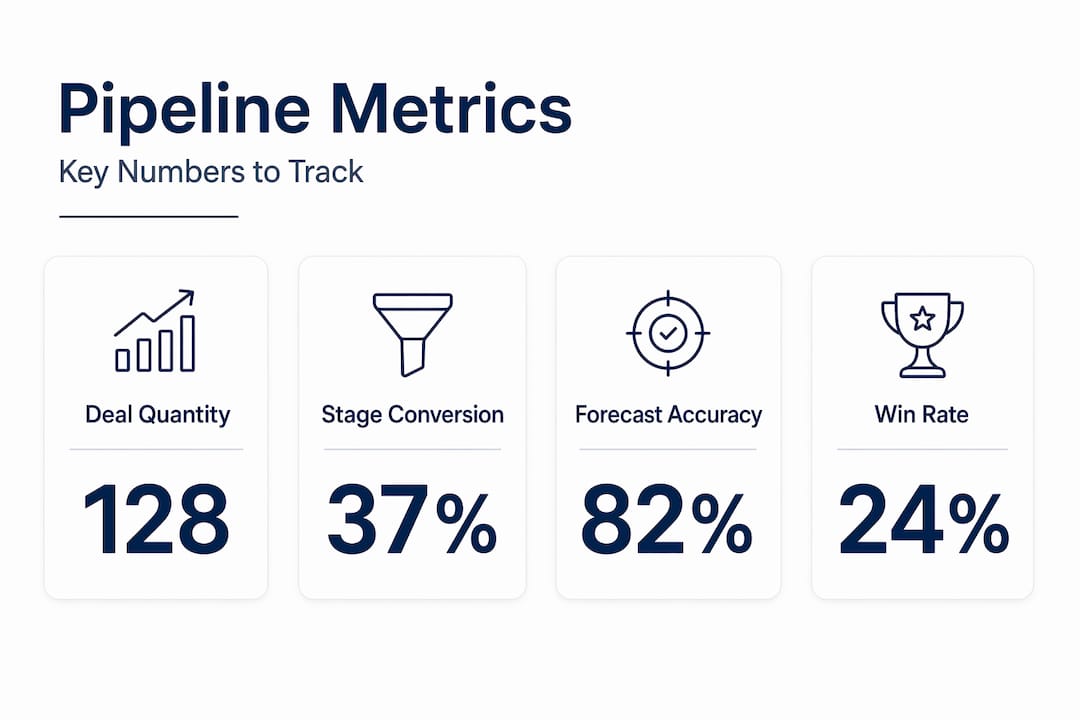
Best practice recommends using 5 to 7 pipeline stages. Fewer than five creates dangerous information gaps. More than seven adds unnecessary complexity that slows your team down and muddles your data.
Pro Tip: If your pipeline has more than seven stages, audit it immediately. Combine any stages where the buyer behaviour or your required action is essentially the same. Complexity in a pipeline does not add rigour; it adds noise.
Sales pipeline stages and the metrics that matter
The typical pipeline stages
A well-structured sales pipeline process generally runs through seven stages: prospecting, qualification, discovery, proposal, negotiation, closing, and handoff. Each stage should represent a meaningful shift in the relationship or commitment from the buyer, not just a change in your internal admin status.

The stage people most often get wrong is qualification. Many teams treat it as a checkbox exercise. In practice, qualification is the engine of a healthy pipeline. It is where you decide whether this opportunity is worth your time, whether the budget is real, whether the decision-maker is engaged, and critically, whether what you are selling can be delivered profitably and realistically.
Stage exit criteria
Every stage needs a clear exit criterion: a specific, objective event or commitment that confirms the deal is genuinely ready to advance. For example, a deal should not move from discovery to proposal simply because you have had a second call. It should move when the prospect has confirmed their budget range, identified their decision timeline, and you have agreed the scope of the proposed solution.
Without this rigour, you get what is known as stage inflation: deals that linger in stages far longer than they should because no one wants to mark them as lost. Stage inflation corrupts your forecast and wastes your team’s time on opportunities that were never going anywhere.
The metrics worth tracking
Here are the four metrics that give you the clearest picture of pipeline health:
- Stage conversion rates. What percentage of deals successfully move from each stage to the next? A sharp drop at a specific stage tells you exactly where your process or messaging is breaking down.
- Sales cycle length. How long does the average deal take to move from first contact to close? Track this by stage, not just overall.
- Average deal size. Is this increasing or decreasing over time? Declining deal sizes often signal that your team is gravitating toward easier but smaller opportunities.
- Lead quality score. Not all leads are equal. A crude volume metric tells you little. Quality indicators tied to your ideal customer profile are far more revealing.
Pro Tip: Run a conversion rate audit by stage every month. You will almost certainly find one stage where deals consistently stall. That stage is your highest-priority coaching and process fix.
The discipline behind effective pipeline management
This is where most teams fall down, not on knowledge, but on consistency.
Pipeline management is a discipline that requires balancing consistent top-of-funnel activity with effective deal progression. The most common failure pattern is this: a team gets busy closing deals, stops prospecting, and then wonders why the pipeline looks empty three months later. Revenue valleys are almost always caused by neglecting the pipeline during busy periods.
Here are four disciplines that genuinely move the needle:
- Maintain prospecting activity regardless of how busy you are. Set a non-negotiable weekly number of new prospect conversations. Treat it like a fixed appointment, not a nice-to-have.
- Use the pipeline as a decision-making tool, not a reporting tool. That means reviewing it regularly and making active decisions: which deals to accelerate, which to deprioritise, and which to disqualify entirely. Pipeline management is as much about walking away from the wrong deals as it is about closing the right ones.
- Update your CRM daily. Not weekly. Not before your one-to-one. Daily. Without daily updates on stage progress and next steps, your pipeline data degrades quickly and your forecasts become unreliable.
- Align what you are selling with what you can deliver. Before advancing a deal to proposal, confirm it is scoped correctly, priced for margin, and that you have the capacity to deliver it well. Winning deals you cannot deliver profitably is not success. It is a liability.
This alignment between sales and delivery is one of the most overlooked aspects of pipeline management best practices. Most sales teams are rewarded on revenue booked, which creates a structural incentive to ignore delivery risk. Resist that.
AI and analytics in 2026 pipeline management
Technology has changed what is possible in sales pipeline management. The shift from manual pipeline reviews to AI-driven analysis means that patterns which would have taken weeks to spot are now surfaced in real time.
Leading sales organisations now use AI-powered prescriptive analytics to identify systemic deal bottlenecks, such as regional procurement delays occurring 40% more frequently in certain areas. That kind of targeted insight allows managers to intervene earlier and with more precision than a weekly pipeline review ever could.
AI tools in 2026 also do a much better job of reading buyer intent signals: tracking email engagement, response times, meeting attendance, and content consumption to surface a probability score that reflects actual buyer behaviour rather than a salesperson’s optimism. That alone is worth a great deal.
The catch, and this is a significant one, is that AI only delivers genuine advantage when it sits on top of disciplined systems. AI in organisations with weak pipelines does not fix the problems. It amplifies them. Garbage in, garbage out, at machine speed.
If your CRM data is inconsistent, if your stage definitions are vague, and if your team is not updating records reliably, then adding an AI layer will give you faster, more confident wrong answers. Sort the foundations first. Then add the technology.
For teams exploring how AI-driven tools connect with sales strategy, Spyra Business Therapy offers useful perspectives on where technology and human judgement genuinely complement each other in sales operations.
How to build a strong sales pipeline
If you are starting from scratch or rebuilding a pipeline that has lost discipline, here is where to focus:
- Start with lead generation that produces qualified opportunities. Not just volume. A pipeline filled with poorly qualified leads is worse than a small pipeline of strong ones. You will shorten your sales cycle significantly when your leads are properly pre-qualified before they enter the pipeline.
- Define each stage with clear entry and exit criteria. Write them down. Share them with the team. Review them quarterly. Vague stages produce vague forecasts.
- Use your pipeline data proactively. Do not wait for your monthly review to spot a bottleneck. Set up a simple weekly habit of reviewing deal velocity by stage and flagging anything that has not moved in ten days.
- Integrate pipeline review into coaching sessions. When managers review the pipeline with their team, the conversation should be about the quality of thinking behind each deal, not just the numbers. Ask “what is the next committed action?” for every live opportunity. If there is no committed next step, the deal is stalling.
Effective pipeline management integrates lead generation, stage definitions with exit criteria, and strategic sales activities tailored to each stage. It is not a one-off project. It is a permanent rhythm.
My honest take on what most teams get wrong
I have worked with enough sales teams to recognise a consistent pattern. They invest in CRM, they build a pipeline, they train the team on the stages, and then they wonder why nothing improves. The reason is almost always the same: they built the structure but not the discipline.
The most common problem I see is what you could call data rot. Teams enter information into the CRM during onboarding and then treat it as an administrative chore from that point on. Within three months, the pipeline is a graveyard of zombie deals, no one trusts the forecast, and managers are making decisions based on gut instinct rather than data. That is not a technology problem. It is a behaviour problem.
What I have found actually works in real teams is making the pipeline visible. Put it on a screen in the office. Review it in your team meetings. Talk about individual deals publicly, not to embarrass people, but to normalise the discipline of thinking carefully about every opportunity. When pipeline management becomes part of the team’s daily language rather than a back-office reporting task, the whole culture shifts.
The uncomfortable truth about AI and fancy analytics tools is this: they reward teams that are already disciplined. If you are not there yet, start with the fundamentals. Get your stage definitions right, get your team updating records daily, and get comfortable disqualifying deals that are going nowhere. Master those before you spend money on technology that amplifies whatever your current system produces.
— Jerry
Ready to build a pipeline that actually performs?
If this article has made you think harder about how your pipeline is actually being managed, that is a good sign. The gap between knowing what sales pipeline management involves and doing it consistently is where revenue is won or lost.

At Aheadofsales, we work with sales teams and business owners to build the kind of pipeline discipline that produces predictable, consistent growth. From auditing your current pipeline stages and CRM setup to coaching your team on qualification, deal progression, and forecasting, we get involved at a practical level. If you are serious about hitting target every quarter, explore our sales training services or take a look at our sales consultancy services to see which route fits your business best.
FAQ
What is sales pipeline management?
Sales pipeline management is the ongoing process of tracking, managing, and progressing active sales opportunities through defined stages, from initial contact to closed deal. It combines data discipline, qualification rigour, and consistent sales activity to produce predictable revenue.
How many stages should a sales pipeline have?
A well-structured pipeline should have between 5 and 7 stages. Fewer than five creates gaps in your process visibility; more than seven adds complexity without adding useful information.
What is the difference between a sales pipeline and a sales funnel?
A sales pipeline tracks your current active deals and supports day-to-day sales decisions. A sales funnel analyses conversion patterns across stages over time and is used for longer-term process improvement.
What does stage inflation mean in a sales pipeline?
Stage inflation happens when deals remain stuck in a pipeline stage longer than they should, usually because salespeople are reluctant to mark them as lost. It corrupts forecasting and wastes resource on opportunities that are unlikely to close.
How does AI improve sales pipeline management?
AI helps by surfacing buyer intent signals, identifying bottlenecks in specific pipeline stages, and producing probability scores based on actual deal behaviour. However, AI only adds genuine value when the underlying pipeline data and processes are already disciplined and well-maintained.