
TL;DR:
- Effective sales training must be treated as a continuous system rather than a one-off event to ensure lasting behavior change. Incorporating live coaching, technology, and leadership modeling significantly enhances consultative selling skills and results. Sustained growth depends on reinforcement, managerial alignment, and embedding these practices into daily operations.
Most sales professionals have sat through a training day that felt genuinely useful in the moment, only to find themselves defaulting to old habits within a fortnight. That is the central problem with how most businesses approach training consultative selling. They treat it as an event rather than a system. The result is a team that knows the theory but cannot apply it under pressure. This article cuts through that cycle. You will find practical frameworks for embedding consultative selling as a sustainable capability, not just a workshop memory, with specific guidance on coaching, technology, and leadership alignment.
Table of Contents
- Key takeaways
- What consultative selling really is and why training often fails
- Building a training framework that actually embeds skills
- Consultative vs value-based selling: when to evolve your training
- Practical steps to sustain consultative selling in your team
- My honest take on what actually works
- How Aheadofsales can build your consultative selling capability
- FAQ
Key takeaways
| Point | Details |
|---|---|
| Training is a system, not an event | Consultative selling skills require ongoing reinforcement to stick beyond the initial course. |
| Live coaching multiplies results | Real-time feedback during actual sales conversations transfers skills far more effectively than classroom learning alone. |
| Leadership sets the standard | When managers model consultative behaviour in pipeline reviews, teams adopt it far more readily. |
| Value-based selling is the next step | Once consultative skills are embedded, evolving training towards quantified business cases drives higher-value deals. |
| Technology accelerates adoption | AI conversation intelligence tools provide personalised feedback at scale, keeping training relevant and specific. |
What consultative selling really is and why training often fails
Consultative selling involves discovery, collaboration, and tailoring solutions to buyer priorities. It requires adaptability throughout the sales process, not a fixed script. That distinction matters enormously when you are designing training.
Many organisations conflate consultative selling with solution selling or value-based selling. They are related, but not interchangeable. Solution selling focuses on matching a product to a stated problem. Consultative selling goes deeper. It means asking the right questions, understanding what the buyer has not yet articulated, and shaping the conversation around their priorities rather than your product catalogue.
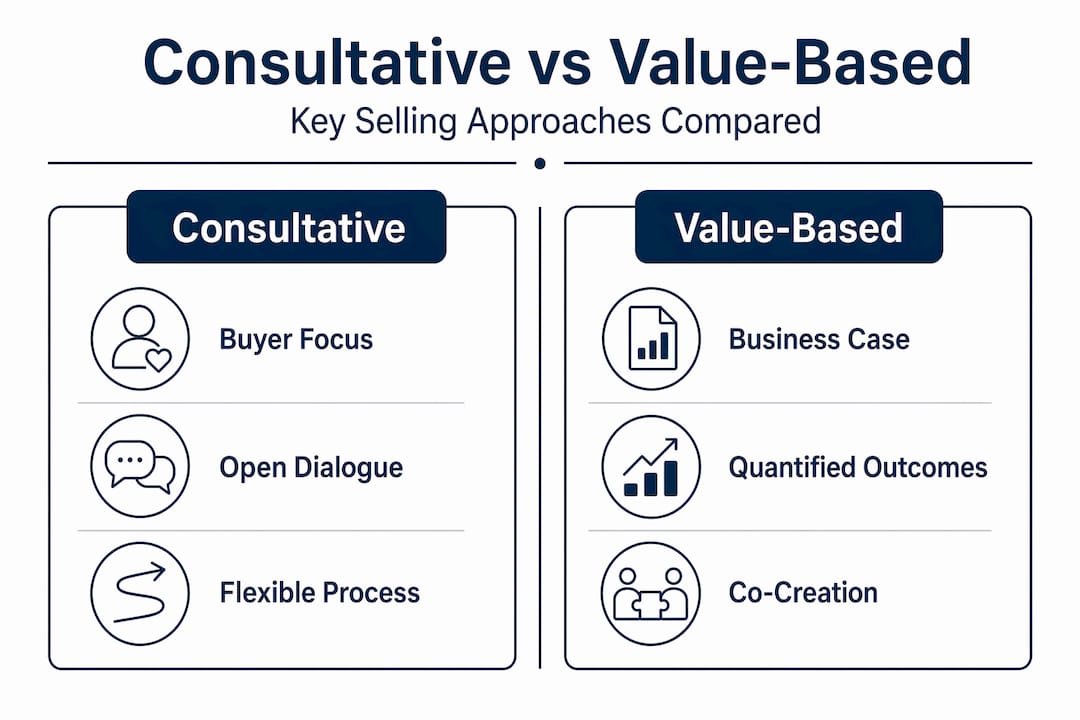
Value-based selling is the more advanced evolution. It quantifies the cost of inaction and co-creates a business case with the buyer, linking solutions to tangible outcomes. Consultative selling is the foundation. Value-based selling is what you build on top of it.
The reason most training fails to produce lasting change comes down to one inconvenient truth: 79% of training is lost within a month without reinforcement. A single consultative selling course, however well designed, cannot override years of ingrained pitch behaviour. The skills require repeated application and timely feedback to become instinctive.
There are several specific reasons why standard training programmes underperform:
- They focus on knowledge transfer rather than behaviour change
- They deliver content in isolation from real sales conversations
- They measure attendance rather than skill adoption
- They lack a coaching system to reinforce learning after the room empties
- They do not align with how the sales team is managed day to day
The last point is particularly revealing. If a seller leaves a consultative selling training session and then returns to a manager who only asks about close dates and pipeline value, the training signal is drowned out almost immediately.
Building a training framework that actually embeds skills
A training framework worth your investment combines formal structured learning with live coaching and, increasingly, technology. Here is a practical sequence for building one:
-
Baseline assessment. Before any training content, map where your team currently sits. What percentage of calls involve genuine discovery? How often do sellers reference the buyer’s business objectives rather than product features? This gives you a clear before and after measure.
-
Structured learning in short bursts. Rather than a full-day workshop followed by silence, break consultative selling training into focused modules covering specific skills such as needs analysis, questioning frameworks, and handling objections consultatively. Shorter, more frequent sessions improve retention considerably.
-
Live coaching during real interactions. Real-time coaching is 2.5 times more effective than delayed feedback in improving sales performance. This means having a coach or manager present on actual calls, not just reviewing recordings days later. The feedback loop needs to be tight.
-
Conversation intelligence tools. AI platforms that analyse calls in real time flag missed discovery questions, talk-to-listen ratios, and whether the seller addressed the buyer’s stated priorities. For leaders running teams of 20 or more, this kind of technology allows coaching at a scale that is simply not possible manually. You can explore how these tools compare through this sales coaching software comparison from Aheadofsales.
-
Reinforcement cadences. Weekly or fortnightly group coaching sessions where the team reviews real call moments, diagnoses what went well, and practises alternatives. This is where interactive sales workshops earn their value. They are not for initial teaching. They are for consolidation.
-
Performance measures aligned to consultative behaviours. Track discovery quality, average deal size progression, and pipeline velocity alongside close rates. If you only measure what you close, you only manage what closes.
Pro Tip: If you are introducing a consultative selling course to your team, run the first reinforcement session within 48 hours of the initial training. That narrow window is when the learning is most receptive to practical application.
Organisations that treat customer-focused selling as an ongoing operational system, not a training calendar entry, achieve up to 38% higher win rates and a 20% improvement in overall sales performance. That gap exists precisely because of how they structure their training approach.

Consultative vs value-based selling: when to evolve your training
Once your team has a genuine consultative foundation, the conversation about value-based selling becomes relevant. This is not a parallel track. It is a maturation of the same capability.
The table below clarifies the distinction and the training implications of each stage:
| Dimension | Consultative selling | Value-based selling |
|---|---|---|
| Primary focus | Understanding buyer needs and priorities | Quantifying business impact and ROI |
| Buyer interaction | Discovery-led dialogue | Co-creating business cases with the buyer |
| Training emphasis | Questioning, listening, adapting | Financial fluency, KPI alignment, deal architecture |
| Deal stage relevance | Qualification and early-stage | Mid to late stage, executive-level conversations |
| Outcome measure | Buyer engagement and solution fit | Win rate on complex, high-value opportunities |
A consultative selling approach must allow flexibility for sellers to adapt mid-deal to shifting priorities and decision-makers. Value-based selling adds another layer: the ability to attach your solution to measurable business outcomes the buyer cares about most.
When introducing value-based concepts into your training programme, timing matters. Pushing financial ROI conversations onto a team that has not yet mastered genuine discovery is counterproductive. They end up presenting business cases built on assumptions rather than insight, which erodes trust rather than building it.
The right progression looks like this:
- Build consultative behaviours first: listening, questioning, adapting
- Introduce business case construction once discovery quality is consistently high
- Layer in value-based selling skills at the point where your team is regularly reaching senior decision-makers
This sequenced approach is particularly relevant for SaaS businesses and professional services firms where deal complexity and unique selling propositions need to be articulated clearly at every stage of the buying process.
Practical steps to sustain consultative selling in your team
Getting skills to stick requires more than good intentions after a training day. Here is what sustainable adoption looks like in practice:
Leadership alignment first. When leaders model consultative behaviour, specifically focusing pipeline reviews on business case quality rather than just forecast numbers, teams align rapidly. Leadership behaviour change is one of the single most reliable indicators of whether consultative and value selling will take hold across an organisation. If the manager asks “What does winning this deal mean for their business?” rather than “When is it closing?”, that question reshapes the entire sales culture.
Peer learning as a coaching mechanism. Create structured opportunities for your team to review each other’s calls and share effective questioning techniques. The best consultative selling training for sales teams draws heavily on real examples from within the team itself, because sellers recognise their own contexts immediately.
Technology for tracking adoption. Use conversation intelligence data to measure whether consultative behaviours are increasing over time. Look at discovery question frequency, buyer talking time, and whether seller responses acknowledge buyer priorities. These metrics tell you whether training is translating into behaviour, not just whether people enjoyed the session.
Pro Tip: When designing incentive structures, add a quarterly recognition for consultative process quality, not just quota attainment. Recognising sellers who demonstrate strong discovery and client-focused selling signals to the whole team what the organisation values, separate from commission.
You can see real examples of sales coaching that have driven measurable behaviour change across different team sizes and sectors on the Aheadofsales website. The consistent thread in every case is that coaching did not stop after the training event.
Effective selling strategies at the team level are built through repetition, feedback, and leadership modelling. There is no shortcut to that combination.
My honest take on what actually works
I have worked with sales teams across a wide range of industries, and the same pattern appears repeatedly. A business invests in a well-structured consultative selling course, the team leaves energised, and six weeks later the pipeline looks no different. Not because the training was poor. Because nothing changed around the training.
What I have found consistently is that the businesses who see real growth from consultative selling training are the ones who treat it as a leadership priority, not an HR initiative. The moment a senior leader starts asking questions in the language of the buyer during team meetings, the entire organisation shifts.
The other thing I have seen fail repeatedly is over-reliance on process and scripts. Adaptive selling skills are what separate average consultative sellers from excellent ones. You cannot script your way to genuine discovery. You need a team that is curious, that listens to respond rather than to answer, and that knows how to adjust when the buyer’s priorities shift mid-conversation.
Live coaching embedded in real sales interactions is, in my experience, the single most underfunded and underused element of training for sales teams. Ongoing live coaching can multiply training effectiveness by four times compared to training alone. That number should change how you budget for development. Spend less on the event. Spend more on the follow-through.
— Jerry
How Aheadofsales can build your consultative selling capability
If you recognise the patterns described in this article, specifically the one-off training event that produces short-term enthusiasm but no lasting shift in pipeline behaviour, Aheadofsales was built to solve exactly that problem.
Aheadofsales combines bespoke 1:1 coaching with structured consultative selling training and live sales enablement to produce measurable, sustained performance improvement. Every programme is designed around your specific sales process, sector, and team maturity. Whether you run a 50-person team or a 500-person organisation, the approach is the same: real coaching on real deals, reinforced consistently. For SaaS businesses specifically, the sales training for SaaS programme addresses the precise challenges of complex, value-based conversations with technical buyers. Reach out to explore what your team’s next step looks like.
FAQ
What is consultative selling training?
Consultative selling training teaches sales professionals to prioritise discovery, active listening, and tailoring solutions to buyer priorities. Effective training embeds these as habitual behaviours rather than a checklist to follow during calls.
How long does it take to see results from consultative selling training?
Initial skill adoption can show within four to six weeks when training is combined with live coaching and reinforcement. Sustained behaviour change that affects pipeline and win rates typically takes three to six months of consistent application.
Why do most sales training programmes fail to produce lasting change?
79% of training content is lost within a month without reinforcement. Training that lacks follow-up coaching, management alignment, and behaviour-based performance measures rarely produces durable change.
What is the difference between consultative and value-based selling?
Consultative selling focuses on understanding buyer needs through discovery and dialogue. Value-based selling goes further by quantifying business impact and co-creating measurable business cases with buyers. Consultative selling is the foundation that value-based selling builds upon.
How does live coaching improve consultative selling skills?
Live coaching during actual sales conversations is 2.5 times more effective than delayed feedback at improving performance. It provides immediate, contextual correction that is far more memorable and applicable than feedback delivered days after the call.