
TL;DR:
- Most B2B sales cycles are misunderstood as simple checklists, but modern buyers complete over 80% of their journeys independently. Larger deals require complex qualification frameworks like MEDDIC, as traditional methods like BANT often fail, especially in enterprise contexts. Aligning sales and marketing, improving qualification, and leveraging tailored strategies at each stage accelerate pipeline velocity and increase conversion rates.
Most sales teams treat the B2B sales cycle stages as a straightforward checklist. Prospect, qualify, present, close. Done. But that mental model is already out of step with how modern buyers actually behave. 83% of the buying journey happens before a buyer ever speaks to a supplier. By the time your prospect picks up the phone, they have already shortlisted options, formed opinions, and in many cases, made a near-final decision. If your strategy starts at outreach and ends at close, you are working with an incomplete map. This guide will give you the full picture.
Table of Contents
- Key takeaways
- The b2b sales cycle stages explained
- How deal size changes the cycle
- Enterprise sales cycle nuances
- Optimising each stage for pipeline velocity
- Aligning sales and marketing across the funnel
- My honest take on b2b sales cycle stages
- How Aheadofsales can help you master the cycle
- FAQ
Key takeaways
| Point | Details |
|---|---|
| Buyers lead before you engage | Over 80% of the purchase journey is completed independently before speaking to sales. |
| Cycle length varies dramatically | Deals under £5K can close in under two weeks; strategic enterprise deals take 12 months or more. |
| BANT fails enterprise deals | Complex multi-stakeholder opportunities require MEDDIC or MEDDPICC for accurate qualification. |
| Evaluation is the longest stage | This single phase consumes 30 to 35% of the entire sales cycle and is where most deals stall. |
| Alignment prevents pipeline leaks | Sales and marketing misalignment is one of the most common causes of drop-off between funnel stages. |
The b2b sales cycle stages explained
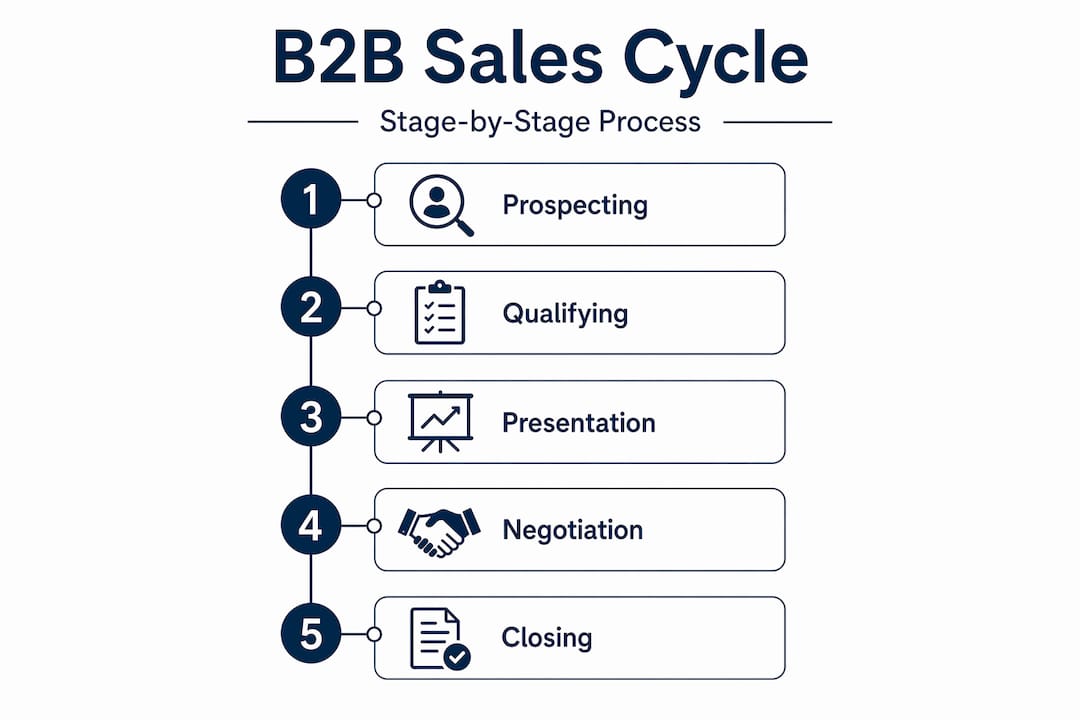
The B2B sales cycle stages are the defined sequence of steps a seller takes from identifying a potential buyer to completing a transaction. Most models share a common core, even if the labels differ slightly. Understanding these b2b sales process steps gives your team a shared language and a framework for measuring performance at each transition.
The most widely used models organise the cycle into five, six, or seven stages. Here is how they compare:
| Stage count | Stages included | Best suited for |
|---|---|---|
| 5-stage model | Prospect, qualify, present, close, retain | SME transactional sales |
| 6-stage model | Prospect, qualify, discover, present, negotiate, close | Mid-market B2B deals |
| 7-stage model | Prospect, qualify, discover, present, handle objections, negotiate, close | Complex or enterprise sales |
The distinction between a sales funnel and a sales pipeline is also worth clarifying here. The sales funnel describes the buyer’s journey from awareness to decision, often used by marketing. The sales pipeline describes the seller’s view of active opportunities at each stage. Both are useful, but they serve different purposes and should not be used interchangeably when discussing b2b sales pipeline definitions with your team.
Pro Tip: Align your CRM pipeline stages with your marketing funnel stages. When both teams use the same language for each phase, handoffs become cleaner and reporting becomes far more accurate.
How deal size changes the cycle
Not all B2B selling cycles are created equal. The median B2B SaaS sales cycle in 2026 is 84 days, but that figure masks enormous variation depending on deal size and complexity.

| Deal size | Typical cycle length | Where time is spent |
|---|---|---|
| Under £5,000 | 14 to 30 days | Prospecting and qualification (60%) |
| £5,000 to £100,000 | 30 to 120 days | Discovery, presentation, negotiation (65%) |
| Over £100,000 | 180 to 365+ days | Evaluation, procurement, legal review (70%) |
There are a few reasons why larger deals take disproportionately longer to close. Consider the following:
- Multiple departments need to sign off, not just the original champion
- Formal procurement processes come into play at higher price points
- Legal review is almost always required for significant contract values
- Enterprise deals above £100K ACV add procurement and legal cycles of 30 to 45 days on average
- Internal budgeting and approval cycles often restart if the deal crosses a financial year boundary
The evaluation stage alone consumes 30 to 35% of total cycle time. Structured proof-of-concept periods of around 14 days can actually cut this phase by 23%. If you are running an enterprise or mid-market motion, consider building structured evaluation frameworks into your sales methodology rather than leaving this stage to chance.
Understanding the phases of B2B sales at different deal sizes allows you to set realistic expectations with stakeholders, resource your team appropriately, and coach reps on where to focus their energy.
Enterprise sales cycle nuances
Enterprise B2B selling is a different discipline from transactional sales. Enterprise sales cycles involve 6 to 10 or more stakeholders, span three to twelve months, and rarely follow a straight line from discovery to close. Most sales teams that struggle with enterprise deals do so because they approach them with frameworks designed for simpler transactions.
BANT (Budget, Authority, Need, Timeline) is a prime example. It works reasonably well for quick, low-complexity deals. But BANT fails with complex multi-stakeholder enterprise deals where budgets evolve, authority is distributed across a committee, and the timeline is subject to internal politics. Relying on BANT for an enterprise opportunity is like using a ruler to measure a curved surface. It will give you a number, but it will be wrong.
MEDDIC offers a far more reliable structure for enterprise qualification. The acronym stands for Metrics, Economic Buyer, Decision Criteria, Decision Process, Identify Pain, and Champion. MEDDPICC extends this further by adding Paper Process (the formal procurement path) and Competition (how you compare against alternatives). Teams using MEDDPICC systematically manage stall points and produce significantly more accurate forecasts.
The non-linear nature of enterprise buying committees is something many reps underestimate. You might close on a decision criteria conversation, only to discover that a new stakeholder has entered the picture and wants to restart the evaluation. This is not a setback. It is the normal behaviour of a complex buying group.
Pro Tip: Map every stakeholder in an enterprise deal using a simple influence grid: list each person’s role, their level of support, their key concern, and whether they have been spoken to recently. Update this map at every stage review.
Optimising each stage for pipeline velocity
Knowing the b2b sales funnel stages is one thing. Knowing how to improve performance at each one is another. Here are stage-specific practices that genuinely move the needle:
-
Prospecting. Build an ultra-targeted ideal customer profile (ICP) rather than casting a wide net. Personalised outreach to 50 well-researched prospects outperforms generic messaging to 500. For guidance on defining your ICP, building out detailed buyer personas is a practical starting point.
-
Qualification. Ask discovery questions that expose real business pain, not just surface-level interest. If you cannot articulate the financial or operational impact of the problem you solve for this specific buyer, you have not qualified them properly.
-
Presentation and demonstration. Tailor every presentation to the specific concerns of each stakeholder in the room. A CFO cares about ROI and risk. A head of operations cares about implementation and disruption. One generic deck serves neither.
-
Objection handling. Treat objections as information, not obstacles. A buyer who says “we are not sure about the integration” is telling you precisely what you need to address to move forward. Welcome that clarity.
-
Negotiation and closing. Obsessing over closing speed over better qualification typically leads to lost deals. The close should feel like a natural conclusion to a well-run process, not a pressure point.
Track conversion rates between every stage. If you lose 60% of opportunities between presentation and negotiation, that is a clear signal that either your presentations are not compelling or your qualification earlier in the cycle was too loose. Metrics reveal where to invest your improvement effort. You can also explore strategies to shorten your sales cycles without sacrificing qualification rigour.
Aligning sales and marketing across the funnel
One of the biggest causes of pipeline underperformance is not poor selling. It is the gap between sales and marketing at key handoff points. Alignment between sales and marketing is a practical requirement for moving prospects smoothly through funnel stages without losing them in the cracks.
Here is where misalignment most commonly appears and what to do about it:
- At lead handoff. Marketing passes leads when they meet a lead score threshold. Sales ignores them because the criteria do not reflect genuine buying intent. Fix this by building a shared definition of a sales-qualified lead (SQL) with input from both teams.
- In content strategy. Marketing creates awareness content but neglects mid-funnel material that supports the evaluation stage. Effective lead nurturing content maps directly to each phase of the buyer journey, not just the top of the funnel.
- In messaging. Sales reps present value propositions that differ from what marketing has been communicating. Prospects notice the inconsistency and lose confidence. Regular cross-team briefings on messaging keep both sides in sync.
- In reporting. Marketing measures traffic and leads. Sales measures pipeline and revenue. Neither team has visibility of the full picture. A shared dashboard tracking stage-by-stage conversion rates gives both teams the same view and creates accountability for every phase.
The goal is not to merge the two functions. It is to remove the friction between them. When sales and marketing operate with a genuinely shared understanding of the b2b selling cycle, the whole pipeline moves more predictably.
My honest take on b2b sales cycle stages
In my experience, most businesses that come to Aheadofsales with pipeline problems think they have a closing problem. They want faster closes, better objection handling scripts, or more persuasive presentations. And sometimes, yes, those things help.
But more often, the real problem is upstream. Qualification is too loose. Reps are spending weeks nurturing opportunities that should have been disqualified in the first conversation. The prospecting is too broad and the messaging too generic. Better qualification and targeting consistently outperform speed obsession in the data I see across teams.
I also see a growing over-reliance on AI-generated outbound. The volume of personalised-sounding-but-not-actually-personal emails hitting inboxes has risen sharply. Buyers have learned to ignore them. The teams winning enterprise deals right now are the ones treating themselves as strategic partners helping build internal business cases for leadership sign-off, not just sellers presenting features. That shift in mindset changes how you approach every stage in the cycle.
My practical recommendation: audit your pipeline stage conversion rates this week. Find the stage where you lose the most deals. That is your coaching priority for the next quarter.
— Jerry
How Aheadofsales can help you master the cycle
If this article has surfaced gaps in how your team understands or executes the B2B sales cycle stages, you are not alone. Most sales teams are working with frameworks that were built for a simpler buying environment.
At Aheadofsales, we combine bespoke 1:1 coaching with hands-on sales training for teams and solo operators to help businesses achieve at least 50% sales growth per year and hit target every quarter. Whether you need a full sales cycle overhaul or targeted coaching on qualification and pipeline management, our sales consultancy services are built for businesses with 50 to 1,000 staff who are serious about growth. Our packages start from £4,500 and are designed to produce measurable results, not just training days. Get in touch to talk through where your cycle is losing ground.
FAQ
What are the main b2b sales cycle stages?
The core B2B sales cycle stages are prospecting, qualification, discovery, presentation, objection handling, negotiation, and close. The number of defined stages varies by model and deal complexity, with enterprise sales often requiring more granular breakdowns.
How long does a typical b2b sales cycle take?
The median B2B SaaS sales cycle in 2026 is 84 days, but this ranges from under two weeks for small deals to over 12 months for strategic enterprise contracts, depending on deal size and stakeholder complexity.
Why does BANT fall short in enterprise sales?
BANT assumes budget and authority are fixed, which is rarely true in enterprise deals where buying committees evolve and budgets are approved incrementally. Frameworks like MEDDIC and MEDDPICC are better suited to complex, multi-stakeholder opportunities.
What is the difference between a sales funnel and a sales pipeline?
A sales funnel represents the buyer’s journey from awareness to decision, typically owned by marketing. A sales pipeline is the seller’s view of active opportunities at each stage, owned by sales. Both are part of the broader b2b sales funnel stages conversation but serve distinct purposes.
How do you optimise the b2b sales cycle for faster conversions?
Focus first on tightening qualification rather than accelerating the close. Track stage-by-stage conversion rates to identify where deals stall, build structured evaluation frameworks for the evaluation stage, and align sales and marketing on lead definitions and messaging.
One Response