
TL;DR:
- Most sales training efforts fail to produce lasting results because they lack a deliberate, structured workflow. Effective training begins with a needs assessment, clear success metrics, stakeholder engagement, and ongoing reinforcement, not just a single session. Sustained behavior change depends on leadership commitment, continuous coaching, and adapting workflows based on data insights.
Most sales training investments fail quietly. The workshop happens, the team feels motivated for a week or two, and then everything drifts back to exactly where it was before. No behaviour change. No uplift in revenue. Just a significant invoice and a fading memory of a PowerPoint presentation. I see this pattern repeatedly when I speak with business owners and sales leaders who are frustrated that training never seems to stick. The truth is, it is not the training content that fails them. It is the absence of a deliberate, structured workflow around that content. High-performing B2B sales training works when it starts with a proper needs assessment, uses varied delivery methods, and builds in reinforcement from the very beginning.
Table of Contents
- What you need before starting your sales training workflow
- Step-by-step: Building your sales training workflow
- How to reinforce learning for lasting sales impact
- Common mistakes to avoid with your sales training workflow
- Why most ‘step-by-step’ sales training guides miss the point
- Take your sales training workflow to the next level with expert support
- Frequently asked questions
Key Takeaways
| Point | Details |
|---|---|
| Tailored needs assessment | Begin every workflow with a comprehensive assessment to target real skill and process gaps. |
| Blended, interactive formats | Blended approaches and real-world practice ensure engagement and real behaviour change. |
| Continuous reinforcement | Embed microlearning and regular coaching into the workflow for lasting sales impact. |
| Context-aware methodology | Adapt your workflow to suit your team, market, and sales cycles to avoid common pitfalls. |
What you need before starting your sales training workflow
Having established the importance of a structured workflow, it is critical to lay the right groundwork before launch. Many businesses rush straight to booking a trainer or setting up an online course, skipping the preparation that makes the difference between training that changes results and training that merely fills time.
The very first step is a proper sales skills assessment to identify exactly where your team is underperforming. Are your sales people struggling with discovery conversations? Is it objection handling? Perhaps it is closing, or maybe the pipeline management itself is the issue. Without this diagnostic clarity, you risk delivering generic content to people who actually need something specific and targeted.
Programmes should begin with a needs assessment to align training directly with your organisational goals. This is not a formality. It is the foundation that ensures every hour of training your team experiences is relevant and purposeful.
Beyond the needs assessment, you need to set concrete success metrics before a single session takes place. What does good look like in three months’ time? A 20% improvement in conversion rate? Shorter sales cycles? Consistent quota attainment across the team? Define it clearly, because without a measurable target, you cannot evaluate whether your training workflow has delivered value.
Here is a quick overview of the preparation essentials:
| Preparation element | Why it matters | Common mistake |
|---|---|---|
| Skills needs assessment | Pinpoints real gaps, not assumed ones | Relying on manager opinion alone |
| Business objectives | Gives training a clear commercial purpose | Setting vague goals like “improve selling” |
| Stakeholder alignment | Secures leadership buy-in and resources | Treating training as an HR-only initiative |
| Platform and tool readiness | Ensures smooth delivery and tracking | Choosing technology at the last minute |
You also need to identify your training sponsors. These are the senior leaders and line managers who will actively champion the process, reinforce new behaviours in day-to-day management, and hold people accountable to applying what they learn. Without them, even the best designed programme fades rapidly. Review in-house training best practices to understand what high-commitment sponsorship looks like in practice.
Pro Tip: Run a short structured interview with three to five of your sales people before finalising the training design. Ask them where they feel least confident in the sales process. Their answers will often reveal gaps that management has completely missed.
Step-by-step: Building your sales training workflow
Once you have prepared your team and resources, you can begin constructing the workflow itself. A sales training workflow is not a single event. It is a sequence of connected activities, each building on the last.
Step 1: Diagnose. Use your needs assessment data to map out the exact skills, knowledge, and mindset gaps across your team. Segment your team if needed. A new sales executive has different needs from a senior account manager who has been with you for five years.
Step 2: Design the programme. Select your delivery format, your content, and your sequencing. Think carefully about how much can realistically be absorbed in each session. Less is often more here. Overloading your team with content in a single day rarely leads to lasting change.
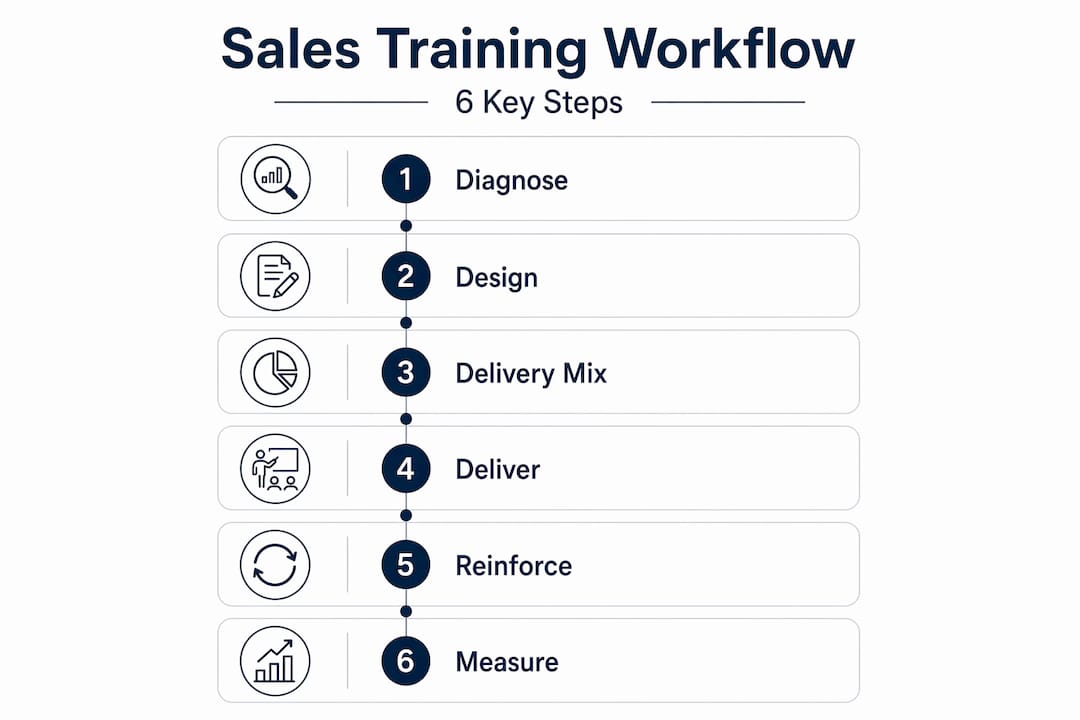
Step 3: Choose your delivery mix. Mixing formats such as in-person, blended, and online and using real-world materials like role-playing and case studies delivers stronger outcomes than any single format alone. Use face-to-face sessions for high-stakes skill practice such as objection handling and negotiation. Use online content for frameworks, product knowledge, and pre-work.
Here is a practical comparison to help you choose the right delivery method for each part of your workflow:
| Delivery format | Best for | Limitations |
|---|---|---|
| In-person | Role-play, group discussion, live coaching | Higher cost, requires scheduling |
| Online / eLearning | Knowledge transfer, self-paced study | Lower engagement if used alone |
| Blended | Balanced skill and knowledge development | Requires careful coordination |
| 1:1 coaching | Personalised skill development | Time-intensive for managers |
Explore effective sales training methods that combine these formats for maximum impact, and consider tailored coaching approaches that address individual performance at a deeper level.
Step 4: Deliver the training. This is where most organisations stop. But delivery is only the midpoint of the workflow, not the end.
Step 5: Reinforce. A workflow should include a diagnose, prescribe, and reinforce loop, because without reinforcement, training rarely leads to sustained behaviour change. Schedule follow-up coaching sessions, assign on-the-job practice tasks, and build in regular check-ins for the weeks following delivery.
Step 6: Measure. Track performance against the KPIs you defined in preparation. Are conversion rates moving? Is pipeline velocity improving? Are team members using the new skills in real customer interactions?
For practical techniques on structuring live sessions effectively, look at presentation training techniques that improve facilitator-led delivery. You can also explore the full range of sales training options available to structure your programme around your team’s specific context.
Pro Tip: Build a simple one-page workflow map that shows each stage from diagnosis through to measurement. Share it with every stakeholder before the programme begins. Clarity at the start prevents confusion and disengagement later.
How to reinforce learning for lasting sales impact
With the core workflow in place, it is time to make learning stick and ensure change lasts. This is the stage where most training investments are either protected or wasted.
Microlearning for retention support greatly improves skill development and sustainment after the main training. Microlearning means delivering short, focused content in the days and weeks following a training session. Think five-minute video refreshers, a quick quiz on a key objection handling framework, or a brief written scenario for your team to work through during a team meeting.
Here are the core reinforcement mechanisms every sales training workflow should include:
- Weekly microlearning touchpoints covering one focused skill or concept at a time
- Fortnightly 1:1 coaching conversations between managers and individual sales people to address real obstacles encountered in live selling situations
- Peer learning groups where team members share what is working and what is not from recent calls and meetings
- Call recording reviews where specific examples from real customer interactions are used to reinforce or adjust technique
- Monthly group review sessions to track collective progress and celebrate improvements
“Reinforcement is not optional. It is where the return on your training investment is either realised or lost. One session, however brilliant, cannot rewire deeply ingrained selling habits. Repetition, practice, and coaching over time are what change behaviour for good.”
Scheduling follow-up coaching sessions is essential, not aspirational. Put them in the diary before the main training event takes place. If managers only commit to follow-up when they find the time, it will not happen consistently enough to make a difference.
Technology can support this stage well. Platforms that track skill development, send automated reminders, and flag where individuals are falling behind give managers the visibility they need to intervene promptly. Review key essential sales training topics to ensure reinforcement content stays relevant and commercially focused. A well-designed sales team management workflow will integrate reinforcement naturally into the rhythm of your sales management process.

Lead nurturing principles applied to coaching reinforcement offer a useful framework here: just as a prospect needs multiple touchpoints before converting, a sales person needs repeated exposure and practice before a new skill becomes second nature.
Pro Tip: Ask each sales person to choose ONE specific skill to focus on applying in the two weeks after a training session. Track it in your next 1:1. Focused application beats scattered attempts to implement everything at once.
Common mistakes to avoid with your sales training workflow
Even with a robust workflow, certain missteps can undermine your results, and it is worth being direct about the ones I see most often.
Assuming one methodology fits all contexts. This is a significant error. Applying the wrong methodology to the wrong buying context can actually harm performance rather than improve it. The Challenger Sale approach, for example, works powerfully in complex, consultative B2B environments where buyers are somewhat complacent. Apply it to a transactional, price-sensitive buying context and you will frustrate customers and confuse your sales team. Methodology selection must follow context analysis, not trend or personal preference.
Neglecting reinforcement after the main event. Workflows without reinforcement and follow-up consistently fail to produce sustained behaviour change. Yet this is the mistake organisations make most frequently. The training happens, the trainer departs, and the workflow quietly stops. Within three to four weeks, most of the learning has degraded significantly.
Ignoring stakeholder engagement at critical workflow points. If your senior leadership team is not actively visible and supportive of the process, your sales team will rightly conclude that the training is not a priority. Stakeholder engagement is not just about approving the budget. It means leaders attending sessions, reinforcing messages in team meetings, and holding managers accountable for follow-through.
Not measuring impact against business KPIs. If you cannot demonstrate that your training workflow improved revenue, conversion rates, or customer retention, you will struggle to justify future investment. Measurement is not a bureaucratic exercise. It is how you protect and grow your training budget.
Key mistakes to watch for at each stage:
- Rushing past the needs assessment to save time
- Choosing training content based on what the trainer enjoys delivering rather than what the team actually needs
- Scheduling all reinforcement activity in one heavy week immediately after training, then nothing
- Measuring activity (hours trained, sessions attended) rather than outcomes (revenue growth, conversion improvement)
Learn more about how to conduct sales training in a way that avoids these pitfalls. If you operate in a professional services context, it is also worth reading about sales training for legal firms to see how workflow design adapts to high-value, relationship-based selling environments.
Pro Tip: After every training cycle, run a brief retrospective with your sales managers. Ask three questions: What worked well? What would we change? What did the team actually apply? The answers will shape a better workflow next time.
Why most ‘step-by-step’ sales training guides miss the point
I want to be honest with you here, because I think most guides on this topic, including many that are well-intentioned, present sales training workflows as a series of tidy boxes to tick. Complete the needs assessment, deliver the training, add some microlearning, measure results. Done. Workflow complete.
But that framing misses something fundamental. A workflow is not a project with a start and end date. It is a living process, and its effectiveness depends almost entirely on the ongoing commitment of sales leadership well beyond any training event.
I have worked with businesses that followed every step correctly on paper and still saw minimal performance change. The common thread was always the same: sales managers reverted to their previous management habits within weeks of the programme ending. They stopped using coaching conversations to reinforce skills. They stopped tracking application of new techniques. They accepted that things had gone back to normal and quietly moved on.
Genuine behaviour change in a sales team requires leaders who stay actively engaged for months, not days. It requires a culture where learning and practice are embedded into the daily rhythm of sales management, not bolted on annually as a separate initiative.
The most effective workflows I have seen are reviewed quarterly, adapted based on what the data and coaching conversations reveal, and owned firmly by the sales management team rather than outsourced entirely to a training provider. Sales consultancy services can help you design that kind of embedded approach, but the leadership commitment to sustaining it must come from within your organisation.
The honest message is this: a great workflow gives you the structure. Leadership gives it life.
Take your sales training workflow to the next level with expert support
Designing and sustaining an effective sales training workflow is genuinely achievable, and the rewards are substantial when you get it right. But I also know from experience that the design, facilitation, and ongoing management of a high-performing workflow takes time, expertise, and commitment that many growing businesses simply cannot dedicate internally.
That is where expert support makes the difference. Our bespoke sales training services combine structured workflow design with hands-on 1:1 coaching and consultancy, all built around your specific team, your sales context, and your commercial objectives. We work with businesses across the UK with 50 to 1,000 staff who are serious about achieving at least 50% sales growth year on year. If you are ready to move from inconsistent results to consistent, measurable performance, explore how tailored coaching drives growth and find out how we can build the right workflow for your team.
Frequently asked questions
Why is needs assessment so important before sales training?
Needs assessment ensures your training directly targets the specific skills gaps and business goals that matter most, making every hour of investment far more effective rather than generically useful.
How do I choose between in-person, online, or blended learning for my team?
Blended methods typically deliver the strongest results, combining the interactive depth of face-to-face sessions with the accessibility and flexibility of online content.
What are the signs a sales training workflow needs improvement?
Watch for poor skills retention after sessions end, little visible behaviour change in live selling situations, low engagement with reinforcement activities, or performance KPIs that remain flat despite training investment. Without reinforcement, sustained behaviour change is unlikely to occur.
Can the same workflow work in every sales organisation?
No. Applying the wrong methodology to the wrong context can actively harm performance, so workflows must be tailored to your specific buying environment, sales cycle length, and team experience level.
How should training be reinforced after the initial session?
Use microlearning to support retention alongside regular 1:1 coaching conversations and structured on-the-job practice tasks to turn initial learning into sustained, measurable performance improvement.