
TL;DR:
- Quota attainment is the percentage of a sales target achieved within a specific period, guiding performance and forecasting. It should be tracked consistently at individual and team levels, with real-time data to inform coaching, quotas, and growth strategies. Leaders who use attainment as a diagnostic tool rather than a pass/fail measure foster accountability, continuous improvement, and sustainable sales success.
Sales leaders in UK companies often track a dozen metrics at once, yet the one that matters most remains the most misunderstood. Quota attainment sits at the heart of every meaningful conversation about sales performance, compensation, and growth strategy, yet I regularly speak with directors and sales managers who either measure it inconsistently or misinterpret what the numbers are actually telling them. In this guide, I want to give you a clear definition, a practical calculation method, a frank look at why teams stall, and a roadmap for turning this single metric into a genuine driver of business growth.
Table of Contents
- Defining quota attainment: What does it really mean?
- How to calculate quota attainment (with real examples)
- Why quota attainment matters: Impact on performance, forecasting and pay
- Common pitfalls: Why quota attainment stalls and how to avoid failure
- From metric to momentum: Building a culture of quota attainment
- What most sales leaders miss about quota attainment
- Drive higher quota attainment with tailored sales training
- Frequently asked questions
Key Takeaways
| Point | Details |
|---|---|
| Core performance metric | Quota attainment is essential for measuring sales effectiveness and driving accountability. |
| Calculation clarity | Understanding how to measure attainment correctly enables clear team evaluation and improvement. |
| Growth driver | Using quota attainment proactively can fuel continuous growth, informed coaching, and smarter business planning. |
| Avoid common mistakes | Steering clear of common quota-setting and tracking errors boosts motivation and results. |
Defining quota attainment: What does it really mean?
With the challenge around understanding quota attainment established, let’s clarify exactly what this metric means for sales professionals.
At its simplest, quota attainment is the percentage of an assigned sales target (the quota) that a salesperson or team has actually achieved within a defined period. If your quarterly quota is £100,000 and you close £85,000 in that period, your quota attainment is 85%. Clean and straightforward in theory, but often complicated in practice.
What makes this metric so powerful is its versatility. Quota attainment is tracked at multiple levels, both individual and team, and is used for performance evaluation, forecasting, and compensation and bonus decisions. That means it is not just a number to review at the end of a quarter. It is a live signal about how your business is performing, how well your targets are set, and where your coaching efforts should be focused.
One of the most common misconceptions I encounter is treating quota attainment as a static, backward-looking measure. Sales leaders look at it once, note whether reps hit their numbers, and move on. But the real value lies in the trend. Is attainment improving quarter on quarter? Are certain reps consistently above 100% while others hover around 60%? Those patterns reveal far more than any single result.
Here are the core dimensions quota attainment covers:
- Individual performance: How each salesperson is performing against their personal target.
- Team performance: Whether the collective sales effort is on track to meet company revenue goals.
- Compensation triggers: Many UK firms tie commission and bonuses directly to attainment thresholds.
- Forecasting accuracy: Consistent attainment data makes revenue forecasting far more reliable.
- Coaching priorities: Attainment gaps point directly to where training or support is needed.
Understanding setting sales quotas correctly is the essential precondition for measuring attainment meaningfully. If your quotas are poorly constructed from the outset, every attainment figure you generate will be misleading.
“Quota attainment is not just about whether someone hit a number. It is about understanding why they did or did not, and what you are going to do about it.”
How to calculate quota attainment (with real examples)
Now that the definition is clear, the next logical step is understanding how to calculate quota attainment accurately and why it matters.
The formula itself is simple:
Quota Attainment (%) = (Actual Sales Revenue ÷ Quota Target) × 100
Where it gets nuanced is in deciding what counts as “actual sales revenue.” Closed won deals? Recognised revenue? Contracted value? Your business needs to define this clearly and apply it consistently. Inconsistency in what you measure is one of the fastest ways to undermine trust in your data.
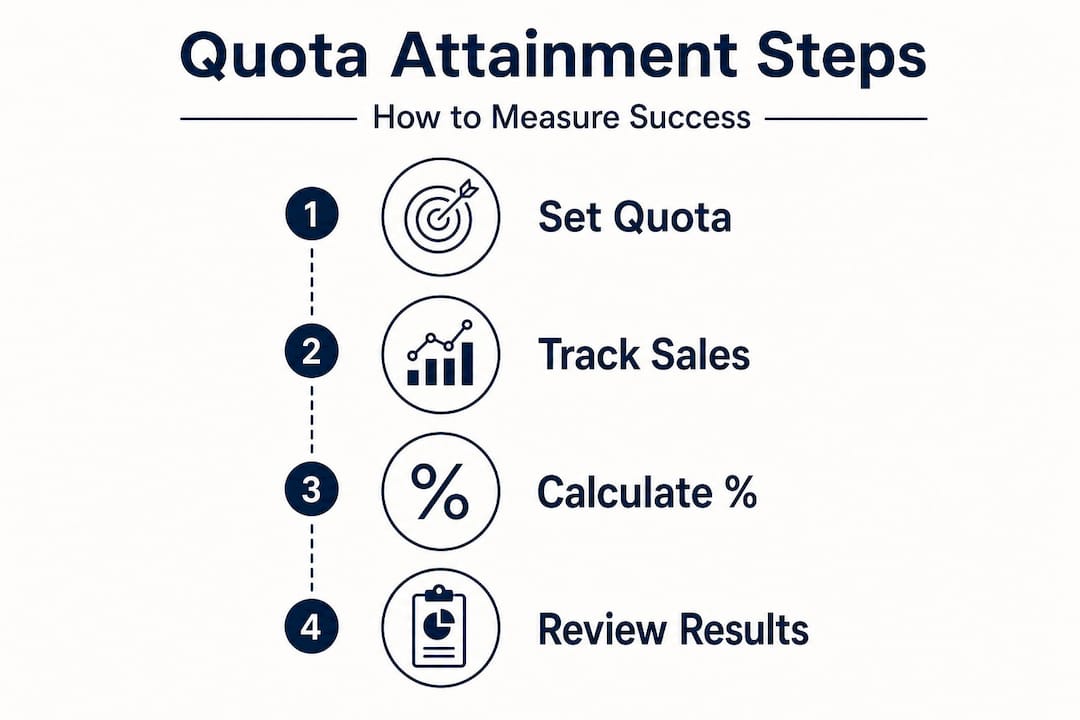
Here is a step-by-step approach for calculating quota attainment accurately:
- Define the measurement period. Monthly, quarterly, and annual quotas each serve different purposes. Monthly reviews help spot problems early. Quarterly figures inform performance reviews and bonuses. Annual attainment shapes strategic planning.
- Agree on what counts as closed revenue. Is it contracts signed? Invoices raised? Cash received? Define this in writing before the period begins.
- Set individual quotas based on role and territory. Not every rep should carry the same quota. New starters, market conditions, and product complexity all warrant different targets. Look at your setting sales targets approach to make this fair and motivating.
- Record actual sales data in a single source of truth. Your CRM should be the definitive record. Disputes about “what we actually closed” are a red flag about data hygiene.
- Apply the formula and review at the agreed cadence. Monthly and quarterly reviews both have value.
As a concrete example, if a quarterly quota is $100,000 and actual closes are $90,000, attainment is 90%. Translate that to a UK context: if your rep’s Q1 target is £60,000 and they close £54,000, attainment sits at 90%. That is a solid result but still leaves £6,000 of potential on the table. The question worth asking is: where did that shortfall come from?
| Measurement period | Quota target | Actual revenue | Attainment rate |
|---|---|---|---|
| Monthly | £20,000 | £17,500 | 87.5% |
| Quarterly | £60,000 | £54,000 | 90% |
| Annual | £240,000 | £228,000 | 95% |
The table above illustrates how attainment can look different depending on the period you choose. Annual figures can mask monthly dips that, left unaddressed, become serious problems.
Pro Tip: Build your quota attainment report so it updates in real time within your CRM. Waiting until the end of a quarter to discover you are at 60% attainment is far too late to course correct.
Why quota attainment matters: Impact on performance, forecasting and pay
Calculating this metric is only useful if you know why it matters. Let’s uncover why quota attainment is a keystone metric for growth-minded UK organisations.

Performance accountability is the most immediate reason. When attainment is visible, reps know exactly where they stand. There is no ambiguity, no room for the narrative that “I was close.” Numbers create clarity, and clarity drives accountability. Quota attainment is tracked at both individual and team level for this very reason, providing an objective basis for performance conversations that might otherwise become uncomfortable or subjective.
Forecasting reliability is the second major driver. When your team consistently achieves 85 to 95% attainment, your revenue forecast becomes far more credible. Finance directors can plan headcount, marketing can allocate budgets, and operations can prepare for fulfilment. When attainment is erratic, everything downstream becomes guesswork. Understanding sales forecasting properly depends heavily on having reliable attainment data to build from.
Compensation and retention are also directly linked. Most UK sales compensation plans include commission thresholds, accelerators above 100% attainment, and bonus triggers at quarterly milestones. If your attainment measurement is inconsistent, you risk paying out incorrectly, creating disputes, or worse, losing high performers who feel the system is unfair.
Here is why attainment data signals deeper business health:
- Consistently low attainment across the whole team often points to quotas that are unrealistically high, not poor individual performance.
- Consistently high attainment across everyone may mean quotas are set too low, and you are leaving growth on the table.
- A wide spread, where some reps hit 120% while others struggle to reach 50%, usually highlights a coaching or onboarding gap.
- Sudden drops in previously strong reps can signal market changes, product issues, or personal challenges that need early intervention.
Reviewing your sales performance benchmarks alongside attainment data gives you a fuller picture of where your team stands relative to broader industry expectations, which is invaluable context for any performance conversation.
Common pitfalls: Why quota attainment stalls and how to avoid failure
Optimising quota attainment is as much about avoiding common mistakes as it is about best practice.
The number one pitfall I see in mid-sized UK companies is unrealistic quota setting. When targets are set based on aspirational growth plans rather than historical data and market reality, reps start the quarter already expecting to miss. That erodes motivation fast. On the flip side, quotas that are too easy produce complacency and inflate attainment figures without delivering real business growth.
The second major issue is inconsistent measurement. If marketing-sourced deals count differently from outbound deals, or if mid-year rule changes alter what qualifies as closed, attainment figures lose their meaning. Because quota attainment is used for performance evaluation, forecasting, and compensation decisions, any inconsistency in measurement creates real business risk.
Lack of communication is the third pitfall. Reps who do not understand how their quota was set, or who receive no feedback on attainment trends until a formal review, operate in an information vacuum. Regular, transparent conversations about quota progress are essential.
Failure to adjust for market shifts is increasingly relevant in the current UK economic climate. If your market contracts, or a major competitor enters your space, maintaining unchanged quotas is demoralising and counterproductive. Build in a formal review process to assess whether quotas remain realistic at the midpoint of each period.
Here are the most effective strategies to avoid these stalls:
- Involve reps in the quota-setting process. They have ground-level insight into what is genuinely achievable.
- Document your measurement methodology in writing and share it with the whole team before each period begins.
- Schedule monthly one-to-one check-ins specifically focused on attainment progress rather than pipeline activity alone.
- Use attainment data to identify training needs early. A rep at 55% of target in month two needs support now, not at quarter end.
Strong sales team management processes directly support better attainment outcomes by ensuring reps are managed proactively rather than reactively. Pairing that with consultative selling skills development helps reps close more effectively, which ultimately lifts attainment rates.
Pro Tip: If more than 40% of your team are missing quota in a given quarter, look at the quota-setting process first, not the people. That ratio almost always indicates a systemic problem rather than widespread individual failure.
From metric to momentum: Building a culture of quota attainment
With potential pitfalls clarified, it’s time to consider how quota attainment can drive your company culture and team’s ongoing development.
The difference between high-performing and average sales teams is rarely talent alone. It is almost always about how systematically the team uses data, including attainment data, to drive continuous improvement. Here is how the two approaches compare:
| Behaviour | High-performing teams | Average teams |
|---|---|---|
| Quota setting | Collaborative, data-driven | Top-down, aspirational |
| Attainment tracking | Real-time, transparent | End-of-period, reactive |
| Response to misses | Immediate coaching intervention | Delayed or no action |
| Forecasting | Based on attainment trends | Based on gut feel |
| Culture | Growth and accountability | Activity-focused |
Because attainment is tracked at individual and team level and informs compensation and evaluation, embedding it as a daily reference point rather than a quarterly verdict transforms how your team behaves throughout a period.
Here is how to make that transition practically:
- Share attainment dashboards with the whole team, not just managers. Visibility creates self-accountability.
- Celebrate progress at 75%, 90%, and 100% milestones, not just final results.
- Use attainment gaps to trigger specific development actions, whether that is product knowledge, negotiation skills, or prospecting technique.
- Build quarterly attainment reviews into your formal development conversation structure, not just annual appraisals.
- Invest in sales training programmes that are directly aligned with the attainment gaps you identify. Generic training rarely moves the needle. Targeted training does.
Working with sales consultancy insights can also accelerate this culture shift by providing an external, experienced perspective on where your current processes are holding attainment back.
What most sales leaders miss about quota attainment
Most conversations about quota attainment focus on whether people hit their numbers. That framing, while understandable, actually limits the value of the metric considerably.
In my experience working with UK sales teams across a range of sectors and sizes, the leaders who genuinely move the needle do not primarily use attainment as a verdict on performance. They use it as a diagnostic. When attainment is low, the first question they ask is not “Who failed?” but “What does this tell us about our process, our market, or our support?” That is a fundamentally different mental model, and it produces fundamentally different results.
Conventional wisdom treats a missed quota as a problem to be managed after the fact. The more effective approach is to treat every attainment data point as a signal that feeds back into hiring, onboarding, coaching, pricing, and quota-setting decisions. It is a continuous loop, not a pass-or-fail gate.
I also think far too many leaders focus exclusively on the reps who miss quota and ignore what is happening at the top end of the distribution. Your reps achieving 130% attainment are telling you something too. Either their quotas are too low, or they have figured out something the rest of the team has not. Both scenarios deserve attention.
The best sales leaders I work with review sales coaching examples from their highest attainers and systematically apply those insights to the rest of the team. That kind of deliberate knowledge transfer is one of the most underused tools for lifting team-wide quota attainment, and it costs nothing beyond intentional effort.
Quota attainment should be a vehicle for positive behavioural change, not a stick for punishment. When you build your culture around that principle, you will find that attainment improves almost as a by-product of people feeling genuinely supported and clearly directed.
Drive higher quota attainment with tailored sales training
If your team is leaving revenue on the table or struggling to hit quota consistently, the answer rarely lies in working harder. It lies in working smarter, with the right structure, the right coaching, and a clear system for measuring and improving performance over time.

At Ahead of Sales, we specialise in helping UK companies with 50 to 1,000 staff achieve at least 50% sales growth every year and hit target every quarter. Our approach combines bespoke 1:1 coaching, practical professional sales training, and hands-on consultancy, all tailored to the specific attainment challenges your team faces. For solo service businesses looking to accelerate, our sales acceleration packages offer a focused route to faster, more consistent results. If you are ready to turn quota attainment from a source of frustration into a driver of real growth, we would love to help.
Frequently asked questions
How is quota attainment different from sales target achievement?
Quota attainment measures actual results against individually assigned targets at both rep and team level, while target achievement simply refers to meeting a stated goal without necessarily tracking individual contribution or using the data for compensation and forecasting decisions.
What is a good quota attainment rate for UK sales teams?
A strong rate is typically above 80%, with consistent achievement above 100% signalling excellent performance. Context matters too, because if a quarterly quota is $100,000 and actual closes are $90,000, that 90% attainment would be considered healthy in most sectors.
Can quota attainment be used for team performance reviews?
Absolutely. Quota attainment is tracked at individual and team level specifically because it provides an objective, data-driven basis for performance evaluation, forecasting, and compensation discussions.
What happens if sales teams consistently miss their quotas?
Persistent misses usually indicate that quotas are set unrealistically high or that there is a training and development gap somewhere in the team. Either way, it warrants a structured review of both the quota-setting methodology and the coaching support in place.
How often should quota attainment be reviewed?
Monthly reviews allow for early course correction, while quarterly reviews are best suited to formal performance conversations and compensation calculations. Using both together gives you the most complete and actionable picture of where your team stands.