
TL;DR:
- Effective funnel management requires enforcing clear stage criteria, coaching deal progression, and aligning marketing with sales to improve predictability and revenue growth. Regularly diagnosing leaks, tracking velocity, and leveraging automation are crucial for maintaining an active, high-quality pipeline. Building disciplined processes with well-defined stages and routine reviews separates consistently growing businesses from those chasing unreliable forecasts.
Funnel management is one of those topics that mid-sized UK sales teams often think they’ve got covered, right up until the quarter closes and the numbers don’t add up. You’ve got a packed pipeline, your CRM looks busy, and yet deals keep slipping away without a clear reason why. The uncomfortable truth is that having leads in your funnel is very different from actively managing that funnel. For ambitious businesses with 50 to 1,000 staff aiming to hit target every single quarter, the gap between those two things is where growth either happens or gets quietly lost.
Table of Contents
- Understanding funnel management: What it is and why it matters
- Essential stages and criteria in a high-performing sales funnel
- Diagnosing and fixing leaks: Where funnels fail (and how to prevent it)
- Modern trends: AI, automation, and evolving buyer journeys
- Implementing effective funnel management: Frameworks and action steps
- Our perspective: Funnel management that actually drives growth in mid-sized UK businesses
- Take your sales funnel further with Ahead of Sales
- Frequently asked questions
Key Takeaways
| Point | Details |
|---|---|
| Stage clarity is vital | Clearly defined funnel stages and criteria prevent confusion, leaks, and ‘vanity pipeline’ issues. |
| Regular audits deliver growth | Frequent inspection for leaks, especially at handoffs, drives stronger deal progression and revenue. |
| Integrate automation and real-time insights | Modern sales teams must leverage CRM, AI, and automation to maintain visibility and adapt to evolving buying journeys. |
| Align sales and marketing | Shared definitions and close collaboration between sales and marketing eliminate major sources of funnel failure. |
Understanding funnel management: What it is and why it matters
Funnel management is not simply logging deals in a CRM and tracking which stage they’re in. That’s pipeline tracking, and while it matters, it’s only the starting point. True funnel management means enforcing stage discipline, defining what next actions are required at every point, and coaching your sales team to move deals forward with intent rather than hope.
When you manage your funnel proactively, you gain something genuinely valuable: predictability. You can forecast revenue with far greater accuracy, uncover where deals are stalling, and identify which sales behaviours are driving results versus which ones are quietly costing you money. The sales funnel impact on consistent revenue is enormous when it’s treated as a living system rather than a static record.
One of the most important things funnel management does is align marketing and sales. When both teams agree on what constitutes a qualified lead and what criteria a deal must meet to progress, the quality of your pipeline improves dramatically. Fewer deals enter that shouldn’t be there, and the ones that do move faster.
| Funnel management element | Why it matters |
|---|---|
| Stage entry/exit criteria | Removes ambiguity and stops vanity pipelines forming |
| Next action enforcement | Keeps deal momentum and accountability high |
| Velocity tracking | Highlights stalling deals before they go cold |
| Weighted forecasting | Provides realistic revenue projections per quarter |
| CRM integration | Gives real-time visibility across the whole team |
| Marketing and sales alignment | Ensures high-quality leads reach the right stage |
As a key principle from Sales Pipeline Management: The Complete Guide states: define clear entry/exit criteria per stage, enforce next actions, conduct routine pipeline inspections for bottlenecks, use weighted forecasting, coach reps on deal progression, and integrate CRM for real-time visibility.
For UK mid-sized sales leaders, the recommended approach is to implement 5 to 6 stage models with CRM automation, target 3x pipeline coverage, audit mid-funnel leaks weekly using velocity metrics, and align marketing and sales on qualification. These aren’t aspirational ideals. They are the baseline standards that separate consistently growing businesses from those that are perpetually chasing their tail.
“A funnel that looks full but lacks discipline isn’t an asset. It’s a distraction that gives sales leaders false confidence right when they need honest signals most.”
Essential stages and criteria in a high-performing sales funnel
With a clearer grasp of funnel management’s value, it’s crucial to structure your funnel for actionable oversight and steady deal movement.
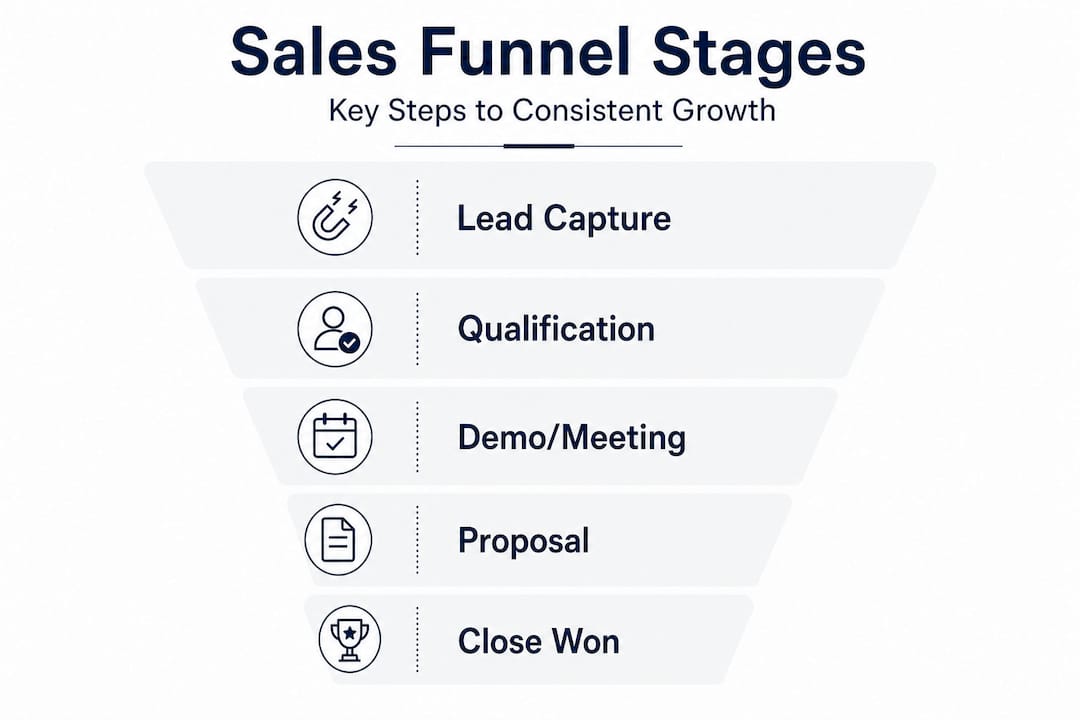
For most mid-sized B2B UK businesses, a well-structured funnel covers five to six clearly defined stages. A typical model looks like this:
- Lead — Contact identified with potential fit; source and basic data captured in CRM.
- Qualified — Needs confirmed, budget scope established, decision-making process understood (BANT or similar framework applied).
- Proposal — Bespoke solution or proposal submitted; key stakeholders engaged.
- Decision — Verbal agreement or shortlisting confirmed; legal and procurement review underway.
- Win/Loss — Deal closed or formally lost with reason captured for learning.
Each of these stages must have explicit entry and exit criteria. Without those criteria, your pipeline becomes what I call a “vanity pipeline”: it looks impressive on screen but doesn’t reflect genuine commercial reality. A deal that your rep says is “at proposal stage” but where the decision-maker hasn’t even seen the proposal yet is not a proposal-stage deal. It’s wishful thinking dressed up as data.
As the guidance from Sales Pipeline Management: The Complete Guide makes clear, defining clear entry/exit criteria per stage and enforcing next actions are foundational, not optional.
A clear sales pipeline explained framework also helps you onboard new salespeople faster and reduces the variance in how different reps interpret deal progress. That consistency is what makes forecasting reliable.
Pro Tip: For each stage in your funnel, create a one-page reference sheet listing exactly what must be true for a deal to enter and exit that stage. Share it with both your sales team and marketing so everyone operates from the same playbook.
Think carefully about your lead generation workflow too, because the quality of leads entering at the top determines everything that happens downstream. A well-built entry process reduces the number of unqualified deals clogging your mid-funnel and wasting your team’s time.
Diagnosing and fixing leaks: Where funnels fail (and how to prevent it)
Once stages are clear, the next challenge is ensuring deals move smoothly and don’t disappear before closing.
Funnel leaks are the silent killer of sales performance. They don’t announce themselves; they just quietly drain revenue from your pipeline week after week. The most common places where funnels leak in mid-sized UK businesses include:
- The MQL to SQL handoff: Marketing passes leads to sales that don’t meet agreed qualification criteria, wasting rep time and generating frustration on both sides.
- Idle stages: Deals that sit in the same funnel stage for more than 10 days without a recorded next action. These stalled deals erode pipeline velocity and are rarely rescued.
- Proposal without progression: Sending a proposal without confirming the decision timeline or next conversation date almost always results in silence.
- Poor discovery: If qualification wasn’t thorough enough early on, deals reach late stages only to collapse because a critical requirement or stakeholder wasn’t identified.
According to research on leaky sales funnels, the main causes are leaks at transitions such as the MQL to SQL handoff, poor qualification creating vanity pipelines, stalled deals from idle stages lasting more than 10 days, and misaligned marketing and sales definitions.
The fix is a combination of strict qualification criteria, velocity tracking within your CRM, and honest qualitative feedback from your sales reps. Your reps know which deals feel genuinely alive and which ones are being kept in the pipeline to avoid an awkward conversation with their manager. Creating a culture where it’s safe to remove dead deals is as important as any technical solution.

Weekly funnel audits are non-negotiable. Set aside time each week to review deals that haven’t progressed, identify why, and agree next actions. Understanding why pipelines matter to your overall revenue health makes these audits feel purposeful rather than punitive.
Pro Tip: Flag any deal that hasn’t had an activity update in seven days with a visual alert in your CRM. That simple trigger forces a conversation about whether the deal is genuinely alive or should be archived.
Modern trends: AI, automation, and evolving buyer journeys
Even with vigilant monitoring, external forces like AI and empowered buyers are changing the sales landscape. Here’s how you should adapt.
The traditional linear sales funnel, where a prospect moves neatly from awareness through to decision, is being disrupted. Buyers today do significantly more research before engaging a sales rep. In some sectors, buyers are completing parts of the purchase journey entirely without human interaction, what researchers are calling “rep-free purchases.”
According to analysis of AI-driven buyer journeys, traditional linear funnels are being challenged by bottom-up acquisition models, rep-free purchases, and longer sales cycles that can extend up to 281 days. Yet core funnel management principles remain essential for mid-sized B2B predictability.
| Traditional funnel approach | Modern funnel reality |
|---|---|
| Linear, rep-led progression | Non-linear, buyer-led exploration |
| Short predictable cycles | Extended cycles, sometimes 6 to 12 months |
| Single decision-maker | Multiple stakeholders, committee decisions |
| Sales rep drives information | Buyer self-educates before first contact |
| CRM is a record | CRM is a real-time coaching tool |
What does this mean practically? It means your funnel management framework needs to account for buyers who are further along in their thinking than your first touchpoint suggests, and for deals that require more nurturing at middle stages before they’re ready to advance.
The advantages of sales automation become more apparent in this environment. Automation handles routine follow-up, sends relevant content at the right stage, and surfaces priority deals based on engagement data. That frees your team to focus on high-value conversations rather than administrative tasks.
“The businesses that will thrive are those that use modern tools to support rigorous funnel discipline, not replace it. Automation without criteria is just faster chaos.”
Understanding how to work on shortening sales cycles is increasingly important too, particularly as buyer journeys lengthen. The right combination of earlier qualification, multi-stakeholder engagement, and clear next-step agreements at every stage can meaningfully reduce the time from first contact to close.
- Use CRM automation to send stage-relevant content automatically when a deal moves forward.
- Implement real-time dashboards so sales managers can spot velocity drops instantly.
- Use A/B testing on proposal formats and outreach sequences to improve conversion at critical stages.
- Invest in multi-stakeholder mapping tools so you understand the full buying committee early.
Implementing effective funnel management: Frameworks and action steps
Armed with this modern perspective, it’s time to put robust funnel management into practical action steps.
Getting this right doesn’t require a complete overhaul of everything you’re doing. It requires consistent discipline applied to a clear framework. Here’s a practical approach for mid-sized UK sales teams:
- Build your 5 to 6 stage funnel model with written entry and exit criteria for each stage. Involve both sales and marketing in this process to ensure alignment.
- Set your pipeline coverage target at 3x your quarterly revenue goal. If you’re targeting £1 million this quarter, you need at least £3 million in active, qualified pipeline. This ratio accounts for natural attrition and gives you room to hit target even when deals slip.
- Integrate your CRM fully so that every deal update, activity, and next action is recorded in real time. A team management workflow built around CRM data means your reviews are based on facts, not anecdote.
- Introduce weekly funnel review meetings focused on velocity, not just volume. Ask: which deals have moved this week, which haven’t, and why? What support does each rep need?
- Track deal velocity as a key metric. Average days per stage across your team reveals where your funnel is consistently slow. Address those stages with targeted coaching and process improvement.
- Align marketing and sales monthly on lead quality, qualification definitions, and which content is supporting deal progression. This alignment, according to best practice guidance, is what drives sustained growth amid lengthening buyer cycles.
Pro Tip: Introduce a “deal health score” for every active opportunity. Rate each deal against five criteria: budget confirmed, decision-maker engaged, clear timeline agreed, next action booked, and competitive position known. Any deal scoring below three out of five needs immediate attention.
The goal is to build a system where your funnel tells you what’s happening and what needs to happen next, without your managers having to chase updates manually. That shift from reactive to proactive is where significant sales growth begins.
Our perspective: Funnel management that actually drives growth in mid-sized UK businesses
Here’s the uncomfortable truth I’ve seen play out repeatedly with growing UK sales teams: they invest in expensive CRM platforms, onboarding consultants, and sales tools, and then completely undermine it all by ignoring entry and exit criteria. The CRM becomes a gravestone for deals that should have been removed months ago.
The obsession with technology is real, and I understand the appeal. Dashboards look impressive in board meetings. But no platform compensates for poor qualification discipline. I’ve worked with teams where the average deal age was over 120 days because nobody had the courage to mark a deal as lost. That dead weight destroys forecast accuracy and demoralises good reps who are being judged against a distorted pipeline.
The other thing most guides gloss over is the power of velocity metrics over volume metrics. Most sales leaders fixate on pipeline value. I’d rather look at how fast deals are moving through each stage. A deal moving quickly through qualification and proposal, even if it’s smaller, tells me far more about team health than a large deal sitting idle in the decision stage for six weeks.
Weekly rituals matter more than monthly reviews. Brief, honest, deal-by-deal conversations every week create accountability and surface problems early. When combined with genuinely consultative selling steps, those rituals help reps develop the judgement to qualify better, progress deals more effectively, and ultimately close more consistently.
The businesses I see hitting 50% growth year on year are not those with the fanciest tools. They’re the ones where the sales manager genuinely knows the status of every deal, where marketing and sales speak the same language, and where nobody is afraid to cut a dead deal and move on.
Take your sales funnel further with Ahead of Sales
If this article has given you a clearer picture of where your funnel management could be stronger, the logical next step is putting that clarity into practice with the right support behind you.
At Ahead of Sales, we work with mid-sized UK businesses to build the kind of structured, high-performing sales functions that hit target every quarter and achieve at least 50% growth year on year. Whether you’re looking to explore our sales acceleration packages, deepen your team’s capability through our sales training guide, or explore practical sales growth strategies tailored for UK firms, we have the frameworks and coaching expertise to make it happen. Let’s build a funnel that actually performs.
Frequently asked questions
What is the difference between funnel management and pipeline management?
Funnel management emphasises stage discipline, entry and exit criteria, and systematic deal progression, while pipeline management often focuses on tracking deal quantity and overall forecast value. As clear stage criteria show, enforcing next actions and conducting routine inspections for bottlenecks are what separate the two in practice.
What causes the biggest leaks in sales funnels?
The largest leaks typically occur at stage transitions, particularly when sales and marketing aren’t aligned on qualification. Research on stalled deals confirms that vanity pipelines and idle stages lasting more than 10 days are among the most common and damaging causes.
How has AI changed sales funnel management?
AI enables real-time insights, supports buyer-driven journeys, and often produces longer but more considered sales cycles. Analysis of rep-free purchases shows cycles can extend up to 281 days, making strong core funnel principles even more critical, not less.
What’s the best first step for improving funnel management?
Clarify entry and exit criteria for every funnel stage, then review stalled deals weekly to identify patterns early. The recommended approach for UK mid-sized sales leaders is to implement a 5 to 6 stage model with CRM automation and target 3x pipeline coverage as a starting baseline.