
Sales automation transforms how mid-sized UK companies scale revenue. Automation saves 20-30% of sellers’ time, freeing teams to focus on high-value client relationships. Yet many mid-sized firms struggle to adopt automation effectively. This guide provides actionable insights and practical steps to help sales leaders drive measurable growth through strategic automation.
Table of Contents
- Understanding Sales Automation: Definitions And Scope
- How Automation Enhances Sales Team Efficiency
- Quantifiable Impact Of Sales Automation On Revenue Growth
- Common Misconceptions About Sales Automation
- Frameworks For Integrating Automation With Sales Processes
- Evaluating And Choosing Automation Tools
- Avoiding Pitfalls In Automation Adoption
- Case Studies Of Automation-Driven Growth In Mid-Sized UK Companies
- Explore Sales Training Solutions For Growth
Key takeaways
| Point | Details |
|---|---|
| Sales automation definition | Technology that automates repetitive sales tasks like lead management, follow-ups and pipeline work, distinct from marketing automation. |
| Efficiency gains | Reduces manual admin by 20-30%, improves lead scoring, speeds personalised follow-ups and lowers cold-call rejection by 25%. |
| Revenue impact | Boosts lead conversion 10-15% within six months and increases email open rates by 50% through AI personalisation. |
| Implementation success | Phased adoption using a maturity model, strong CRM integration and ongoing coaching prevent common failures. |
| Tool selection | Choose platforms based on integration capability, scalability and user adoption potential to avoid the 22% failure rate from poor vendor choices. |
Understanding sales automation: definitions and scope
Sales automation technology automates repetitive sales tasks and manages leads effectively. This includes CRM platforms, AI-driven lead scoring tools, email sequencing software and predictive analytics engines. For mid-sized UK companies with 50-1000 employees, these tools streamline workflows that previously consumed valuable seller time.
Sales automation covers the entire sales funnel. It handles lead capture, qualification, nurturing, follow-up scheduling and pipeline management. Unlike marketing automation, which focuses on generating and warming leads before handoff, sales automation works post-handoff to convert prospects into customers.
The distinction matters. Marketing automation tools like Mailchimp or Marketo generate leads through campaigns. Sales automation platforms like Salesforce Sales Cloud or HubSpot Sales Hub help sellers close those leads efficiently. Mid-sized companies often confuse the two, leading to misaligned investments.
Key sales automation capabilities include:
- Automated email sequences triggered by prospect behaviour
- AI-powered lead scoring to prioritise high-value opportunities
- Calendar integration for seamless meeting scheduling
- Task reminders to ensure timely follow-ups
- Performance dashboards tracking pipeline health
For UK sales teams targeting aggressive growth, exploring advantages of sales automation for rapid growth reveals how these tools multiply seller effectiveness. Understanding this foundation sets the stage for measurable efficiency improvements.
How automation enhances sales team efficiency
Automation eliminates time-consuming manual tasks that plague sales teams. Automation reduces repetitive tasks by 20-30%, freeing sellers to focus on relationship building and strategic selling. Mid-sized companies see immediate productivity gains when automation handles data entry, email logging and appointment scheduling.

Lead prioritisation improves dramatically with AI-driven scoring. Traditional manual qualification wastes hours on low-intent prospects. Automated systems analyse behaviour patterns, engagement history and firmographic data to surface the hottest leads. Your team spends time where it counts.
Follow-up speed accelerates with automated sequences. Research shows response time directly correlates with conversion rates. Automation triggers personalised emails within minutes of prospect actions, maintaining momentum when manual processes would lag hours or days.
Predictive analytics transforms cold calling. Predictive analytics lowers cold-call rejection rates by 25% by identifying prospects most likely to engage. Sellers make fewer calls with higher success rates, boosting morale and results simultaneously.
Pro Tip: Start automation with your most repetitive, high-volume tasks like follow-up emails and meeting reminders. This delivers quick wins that build team buy-in for broader adoption.
Efficiency gains compound across multiple dimensions:
- Time savings reinvested in strategic account planning
- Reduced admin burden lowering seller burnout
- Consistent follow-up preventing lead leakage
- Data-driven prioritisation improving close rates
Implementing effective sales team management workflow growth practices amplifies these benefits. Pairing automation with proven sales productivity hacks uk sales leaders creates multiplicative effects. The advantages of sales automation extend beyond individual efficiency to transform entire team performance.
Quantifiable impact of sales automation on revenue growth
The numbers tell a compelling story. Lead conversion rates improve 10-15% within six months of implementing sales automation. This translates directly to revenue growth for mid-sized UK firms targeting aggressive expansion.
Email engagement skyrockets with AI personalisation. Email open rates increase by 50% when automation tailors messaging based on prospect behaviour and preferences. Higher engagement means more conversations, more pipeline and more closed deals.
Real-world results demonstrate automation’s power. A UK manufacturing firm with 200 employees combined automation with bespoke coaching to achieve 62% sales growth in twelve months. They automated lead scoring and follow-ups whilst maintaining personal touchpoints for high-value prospects. Every quarter, 85% of their sales team hit or exceeded quota.
| Metric | Before Automation | After 6 Months | Improvement |
|---|---|---|---|
| Lead conversion rate | 12% | 14% | +16.7% |
| Email open rate | 18% | 27% | +50% |
| Average deal size | £45,000 | £52,000 | +15.6% |
| Quota attainment | 68% | 85% | +25% |
Quarterly target consistency improves when automation removes variability from sales processes. Teams execute proven sequences reliably, eliminating the feast-or-famine cycles that plague manual operations.
Pro Tip: Track baseline metrics for three months before implementing automation. This establishes clear benchmarks to measure ROI and justify continued investment.
The measurable benefits extend beyond top-line revenue. Cost per acquisition drops as efficiency gains reduce the time and resources needed to close each deal. Implementing comprehensive sales performance improvement guide growth strategies alongside automation accelerates results. Many firms discover why 1 1 sales coaching combined with automation creates breakthrough performance.
Common misconceptions about sales automation
Myth one: automation removes the personal touch. This misunderstands automation’s purpose. Automation augments personal relationships by handling routine work, enabling more meaningful client interaction. Your team spends less time on admin and more time understanding customer needs.
Myth two: automation can fully replace the sales cycle. Completely false. Successful selling requires human judgement, empathy and relationship building that no software replicates. Automation handles predictable, repeatable tasks whilst sellers focus on complex negotiations and strategic account management.
The reality? Automation frees your team to build stronger relationships. When systems handle follow-up reminders, data entry and basic qualification, sellers invest energy in high-value conversations. Clients receive more attention, not less.
Common fears about automation include:
- Loss of personal connection with prospects
- Robotic, impersonal customer experiences
- Reduced need for skilled salespeople
- Over-reliance on technology replacing human insight
Each fear stems from misunderstanding automation’s role. Think of it as a highly capable assistant, not a replacement. The assistant handles scheduling, note-taking and research. You handle the strategic thinking and relationship cultivation.
Mid-sized UK companies often hesitate, fearing automation will alienate their customer base. Experience proves the opposite. Customers appreciate faster responses, consistent follow-up and personalised attention that automation enables. Understanding sales team effectiveness explained clarifies how technology and human skill combine for superior results.
Frameworks for integrating automation with sales processes
The Sales Automation Maturity Model provides a structured adoption path. This framework defines four stages: basic, developing, advanced and optimised. Phased adoption based on maturity model significantly improves implementation success.
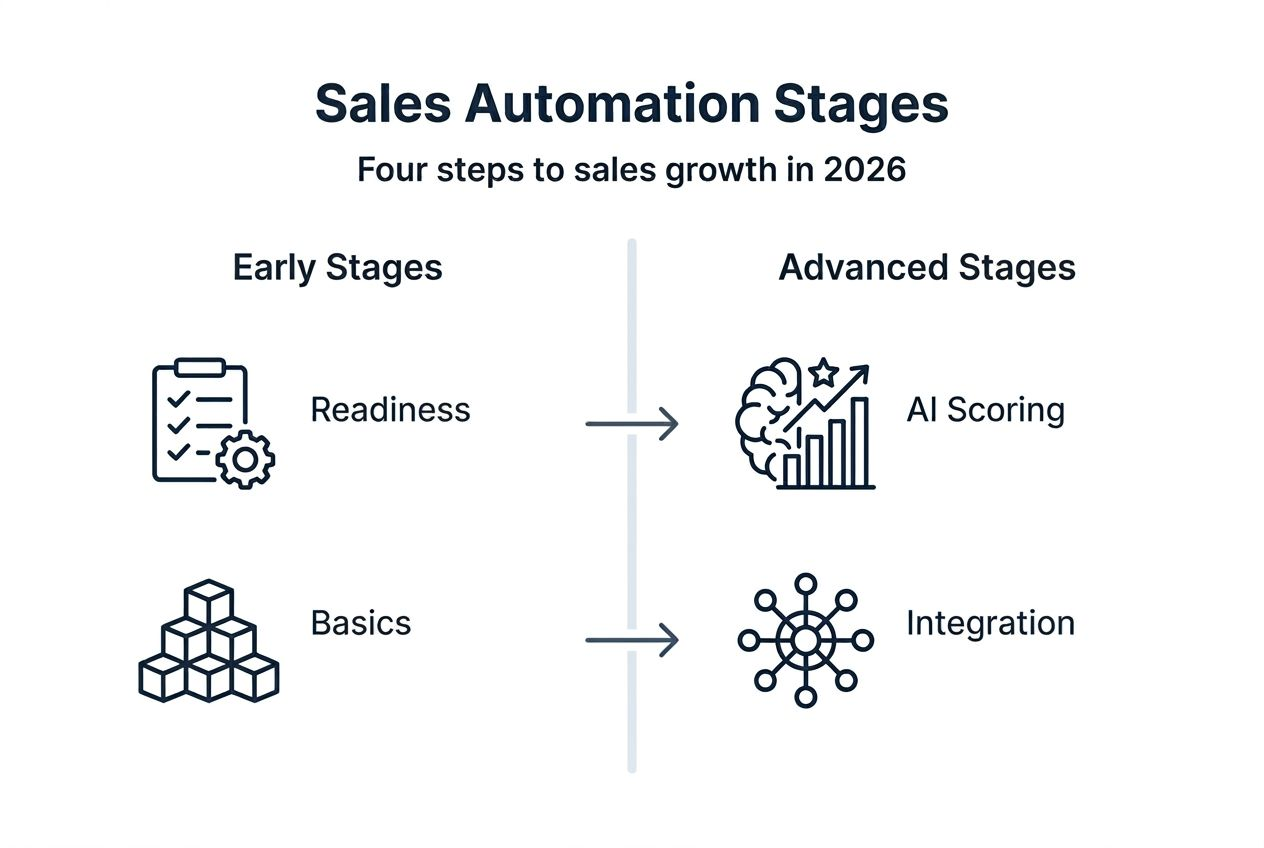
Stage one begins with readiness assessment. Evaluate your current CRM usage, data quality and team digital literacy. Companies jumping to advanced automation without foundational CRM discipline fail predictably.
Stage two introduces basic automation like email sequences and meeting scheduling. This builds team confidence and demonstrates quick wins. Most mid-sized firms spend three to six months here.
Stage three adds AI-driven lead scoring, predictive analytics and advanced workflow automation. Teams operate more strategically, focusing energy on high-probability opportunities.
Stage four achieves full optimisation with continuous improvement loops, AI-powered coaching and seamless integration across sales, marketing and customer success.
Implementation steps include:
- Audit existing sales processes and identify repetitive tasks
- Assess CRM data quality and clean databases
- Select automation tools aligned with maturity stage
- Train teams thoroughly on new systems
- Launch pilot programmes with early adopters
- Gather feedback and refine workflows
- Scale successful automations across the entire team
- Monitor metrics and optimise continuously
CRM integration proves non-negotiable. Automation without solid CRM foundations creates disconnected systems and data silos. Every automation tool must sync seamlessly with your central database.
| Maturity Stage | Key Characteristics | Typical Timeline | Success Indicators |
|---|---|---|---|
| Basic | Manual processes, limited CRM use | 0-6 months | CRM adoption >80% |
| Developing | Email automation, basic scoring | 6-12 months | 15% efficiency gain |
| Advanced | AI scoring, predictive analytics | 12-24 months | 25% conversion lift |
| Optimised | Full integration, continuous improvement | 24+ months | 50%+ growth achieved |
Phased implementation with comprehensive training ensures adoption success. Companies rushing deployment without adequate preparation face the resistance and confusion that doom technology initiatives. Learning how to scale saas sales growth principles applies equally to product and service businesses. Understanding the role of technology in sales contextualises automation within broader sales effectiveness strategies.
Evaluating and choosing automation tools
Tool selection determines automation success or failure. Poor vendor selection causes 22% of failures, making careful evaluation essential. Mid-sized UK companies must prioritise three criteria: integration capability, scalability and user adoption potential.
Integration capability means seamless connectivity with existing CRM, email and calendar systems. Tools operating in isolation create data silos and duplicate work. Your automation platform must be the hub connecting all sales technology.
Scalability ensures the platform grows with your business. A solution perfect for 50 employees but unable to handle 500 creates costly migration headaches later. Evaluate vendor roadmaps and enterprise capabilities even if you’re not there yet.
User adoption potential separates theoretical features from practical results. The most powerful platform fails if your team won’t use it. Prioritise intuitive interfaces, mobile accessibility and robust training resources.
| Feature | Salesforce Sales Cloud | HubSpot Sales Hub |
|---|---|---|
| CRM integration | Native, comprehensive | Native, comprehensive |
| AI lead scoring | Advanced Einstein AI | Good, improving |
| Email automation | Excellent | Excellent |
| Pricing (mid-sized) | £100-£150/user/month | £60-£120/user/month |
| Learning curve | Steeper | Gentler |
| Best for | Complex enterprises, customisation needs | Growing companies, ease of use priority |
Common vendor selection pitfalls include:
- Choosing based on features rather than business needs
- Ignoring total cost of ownership including training and customisation
- Failing to involve end users in evaluation
- Overlooking vendor support quality and responsiveness
Salesforce suits companies with complex sales processes requiring extensive customisation. HubSpot works brilliantly for firms prioritising rapid deployment and user-friendly interfaces. Both excel for mid-sized UK businesses when matched to specific needs.
A detailed sales automation tools comparison helps narrow options. Request trials, involve your team in testing and demand vendor references from similar-sized UK companies.
Avoiding pitfalls in automation adoption
Poor CRM integration causes 35% of failures, making it the top pitfall to avoid. Before implementing any automation, ensure your CRM data is clean, complete and consistently updated. Automation amplifies existing data problems.
Lack of training derails even well-chosen tools. Teams reverting to manual processes because they don’t understand automation capabilities wastes investment and demoralises staff. Budget adequate training time and ongoing coaching.
Over-automation creates robotic customer experiences. Automating every touchpoint removes the human elements that build trust and rapport. Balance efficiency with personalisation by reserving key interactions for human sellers.
Top failure drivers include:
- Inadequate CRM foundation and data quality
- Insufficient user training and change management
- Over-automation eliminating personal touches
- Lack of executive sponsorship and team buy-in
- Unrealistic expectations about implementation timelines
Pro Tip: Identify automation champions within your team who embrace technology and can mentor colleagues. Peer-to-peer coaching accelerates adoption more effectively than top-down mandates.
Maintaining customer relationships requires conscious effort. Automate routine tasks but personalise high-value interactions. Use automation to research prospects thoroughly, then apply that knowledge in personalised outreach.
Change management proves critical. Communicate why you’re implementing automation, how it benefits sellers and what support you’ll provide. Address concerns transparently and celebrate early wins publicly.
Ongoing coaching ensures sustained success. Regular review sessions help teams refine automated workflows, share best practices and identify new automation opportunities. Effective sales team optimization guide strategies incorporate continuous improvement alongside technology adoption.
Case studies of automation-driven growth in mid-sized UK companies
UK mid-sized companies experienced 50%+ sales growth combining automation with coaching. A London-based software firm with 150 employees implemented HubSpot Sales Hub alongside weekly one-to-one coaching sessions. Within eighteen months, they achieved 68% revenue growth and 92% quota attainment.
Their success factors included phased rollout starting with email automation, comprehensive team training and maintaining personal touchpoints for enterprise deals. Automation handled lead nurturing and qualification whilst sellers focused on complex negotiations.
A Manchester manufacturing company with 300 staff took a different approach. They implemented Salesforce Sales Cloud with custom integrations for their ERP system. Combining automation with strategic process redesign and intensive coaching delivered 54% growth over two years.
Key lessons from successful UK implementations:
- Start small with high-impact, low-complexity automations
- Invest heavily in training and ongoing coaching
- Balance automation efficiency with relationship preservation
- Measure results rigorously and adjust workflows based on data
- Maintain executive sponsorship throughout implementation
The coaching component proves essential. Automation provides tools and efficiency, but coaching develops the skills to use those tools effectively. Teams combining both elements consistently outperform those relying solely on technology.
Quota attainment improvements matter as much as top-line growth. Consistent performance across the entire team creates predictable revenue streams and reduces reliance on star performers. Understanding why sales training matters guide clarifies how professional development amplifies technology investments.
Explore sales training solutions for growth
Maximising sales automation benefits requires pairing technology with expert training. Ahead of Sales combines bespoke one-to-one coaching with automation strategies to help mid-sized UK companies achieve 50%+ annual growth and ensure quarterly quota attainment.
Our approach integrates automation implementation with skill development. We help you select the right tools, train your team effectively and optimise workflows for maximum impact. Packages starting from £4,500 suit businesses with 50-1000 employees pursuing aggressive growth.
Explore comprehensive resources on why sales training matters guide for your team’s development. Discover sales team training topics essential for growth and review effective sales training methods rapid growth strategies that complement automation adoption.
Frequently asked questions
What is sales automation and how does it differ from marketing automation?
Sales automation automates sales-specific tasks like lead management, follow-ups, pipeline tracking and CRM updates after leads enter the sales funnel. Marketing automation focuses on generating and nurturing leads before sales handoff through campaigns, email sequences and lead scoring. Sales automation helps close deals whilst marketing automation generates opportunities.
How can mid-sized UK companies integrate automation without disrupting sales culture?
Adopt automation in phases aligned with your team’s readiness and maturity level. Invest heavily in user training and ongoing coaching to build confidence and competence. Maintain personalisation alongside automation by reserving high-value interactions for human sellers whilst automating routine tasks.
What are the biggest mistakes to avoid when selecting sales automation tools?
Choose tools that integrate seamlessly with your existing CRM and technology stack to avoid data silos. Ensure the platform scales with your growth plans and prioritises user adoption through intuitive interfaces. Avoid rushing vendor decisions without thorough evaluation, trials and reference checks from similar-sized UK companies.
How long does it take to see measurable results from sales automation?
Most mid-sized companies see initial efficiency gains within three months of implementing basic automation like email sequences and meeting scheduling. Significant revenue impact typically appears within six to twelve months as lead conversion rates improve and teams optimise workflows. Full transformation achieving 50%+ growth usually requires eighteen to twenty-four months combining automation with coaching.
Can sales automation work for companies with complex, consultative sales processes?
Absolutely. Automation proves especially valuable for complex sales by handling time-consuming administrative tasks, freeing sellers for strategic relationship building. Use automation for lead research, follow-up scheduling and pipeline management whilst maintaining human involvement in discovery, negotiation and closing. The key is balancing efficiency with the personalisation complex sales require.