
Missed targets and unpredictable market shifts put pressure on every Sales Director managing a mid-sized UK team. The mindset you and your leaders choose is not trivial—it changes how your salesforce adapts, learns, and grows. A growth mindset shapes team resilience, commitment, and performance, transforming setbacks into opportunities for skill development and measurable improvement. This article explains how adopting this mindset delivers lasting sales results while nurturing a culture where abilities evolve through effort, coaching, and continual learning.
Table of Contents
- Growth Mindset Defined for Sales Leaders
- Core Benefits for Business Performance
- Embedding Growth Mindset in Sales Culture
- Overcoming Barriers and Common Pitfalls
- Practical Steps for Sustainable Transformation
Key Takeaways
| Point | Details |
|---|---|
| Embrace a Growth Mindset | Sales leaders should foster belief that abilities and performance can improve through effort and learning. This mindset encourages resilience in the face of setbacks. |
| Shift Focus from Results to Learning | Success should not only be measured by closed deals, but also by effort and the lessons learned from both successes and failures. |
| Invest in Team Development | Prioritising coaching and skill enhancement over replacing underperformers leads to sustained performance and engagement within the team. |
| Create a Culture of Psychological Safety | Encourage open communication and risk-taking during coaching to build a safe environment where team members can learn and grow. |
Growth Mindset Defined for Sales Leaders
A growth mindset is the belief that your sales abilities, team capabilities, and business performance can improve through effort, learning, and persistence. This contrasts sharply with a fixed mindset, where leaders view talent as static and unchangeable.
For sales directors managing teams of 50-500 people, this distinction matters enormously. A growth mindset shapes how you respond to missed targets, market shifts, and competitive pressure—and how your team responds to rejection and setbacks.
The core principle is straightforward: abilities develop through dedication and consistent effort. Your sales team isn’t born with fixed capabilities. Their skills evolve through deliberate practice, feedback, and challenge.
What Sets Growth Mindset Apart
Think of the difference this way. A fixed mindset leader believes:
- Some people are natural-born salespeople; others aren’t
- Your Q3 performance reflects your team’s true capability
- Losing deals to competitors means you’re outmatched
- Training programmes won’t change underperforming team members
A growth mindset leader believes:
- Sales ability develops through coaching, feedback, and intentional practice
- Current performance is a starting point, not a ceiling
- Losing deals provides data for improvement
- Investment in team development delivers measurable returns
This mindset shift unlocks something critical: resilience. Your sales team faces constant rejection. Without a growth perspective, missed targets and lost deals demoralise. With it, they’re information about what to adjust next.
Growth mindset transforms how your team interprets failure—from “I’m not good enough” to “What can I learn here?”
The Framework for Sales Leaders
Growth mindset emphasises improvement over proving ability. This reframe is powerful in a sales environment. Your team stops obsessing about whether they’ll win and starts focusing on what skills they’re developing.
Three practical elements anchor this mindset:
- Valuing effort – Recognising that hard work and deliberate practice drive results, not innate talent
- Embracing feedback – Treating coaching and criticism as essential information, not personal attacks
- Learning from setbacks – Viewing lost deals, missed targets, and difficult conversations as development opportunities
When you adopt this framework, your entire sales operation shifts. Your coaching conversations change. Your response to underperformance changes. Your team’s willingness to attempt new strategies changes.
Pro tip: Start by auditing your own language this week. When your team misses a target, do you ask “Why isn’t this person cut out for sales?” or “What skills do we need to develop?” That single question reveals your mindset—and shapes your team’s future.
Core Benefits for Business Performance
When your sales leadership embraces growth mindset, the impact flows through your entire organisation. This isn’t theoretical—it directly shapes revenue, team retention, and competitive resilience.

For mid-sized UK service companies, the stakes are real. A 50-person sales team thinking differently about capability and improvement generates measurably different results than one trapped in fixed thinking.
Financial and Revenue Impact
Leadership mindsets embracing growth foster profitable business expansion. McKinsey’s research shows this isn’t marginal. Organisations where leaders model growth thinking see sustained revenue improvements and better margins.
Here’s the mechanism. Growth-minded leaders:
- Invest in team development rather than replacing underperformers
- Experiment with new sales strategies without fear of failure
- Pivot quickly when market conditions shift
- Build systems that capture learning from every deal
Your team stops saying “We tried that—it doesn’t work here.” Instead, they ask “What did we learn? How do we refine this?”
Team Engagement and Retention
Turnover in sales is expensive. Recruiting, onboarding, and training a replacement costs 50-200% of that person’s annual salary. Growth mindset directly addresses retention.
Salesperson growth mindsets strengthen commitment and job satisfaction, whilst also boosting trust in supervision. Your team stays longer. They’re more motivated. They perform better.
When your sales directors frame setbacks as learning, not failure, people stay. When they invest in coaching instead of criticism, engagement rises. Your best performers don’t leave for competitors.
Competitive Adaptability
Markets shift. New competitors emerge. Client expectations change. Fixed-mindset organisations struggle with disruption. They have the same playbook, the same scripts, the same approach.
Growth-minded teams adapt. They treat market changes as puzzles to solve, not threats to fear. This agility keeps you ahead.
A growth mindset culture means your team solves problems faster than competitors can even identify them.
The Performance Multiplier
These benefits compound. Better retention means institutional knowledge stays. Lower turnover means higher team experience. More experienced teams close more deals. Higher performance motivates your best people to stay longer.
Your “sales effectiveness” improves not through replacing people, but through developing them.
The financial case is clear: teams with growth mindsets outperform fixed-mindset teams on revenue, retention, and resilience.
Here is a summary of how a growth mindset culture impacts key areas of sales team performance:
| Business Area | Impact With Growth Mindset | Impact With Fixed Mindset |
|---|---|---|
| Revenue Growth | Sustained, predictable expansion | Stagnation or unpredictable swings |
| Team Retention | Higher engagement and lower churn | Frequent turnover and disengagement |
| Adaptability | Fast strategy pivots and innovation | Repeating past approaches |
| Learning Rate | Rapid skill development | Limited improvement |
Pro tip: Track one leading indicator this quarter—percentage of your team receiving monthly coaching conversations. Growth mindset cultures coach constantly. If fewer than 60% of your team gets coaching monthly, your mindset culture hasn’t embedded yet.
Embedding Growth Mindset in Sales Culture
Knowing about growth mindset intellectually and building it into your sales culture are different things entirely. One requires awareness. The other requires deliberate structural change.
For a 50-500 person service company, embedding this culture means changing three critical elements: how leaders communicate, how you respond to setbacks, and what behaviours you reward.
Model Vulnerability as a Leader
Your team watches how you respond to failure. If you hide mistakes or blame others, they learn that failure is dangerous. They become cautious. They avoid risk.
Growth mindset cultures require leaders to model vulnerability and support learning from failures. This means saying things like:
- “I lost that deal. Here’s what I missed and how I’ll approach it differently”
- “That coaching feedback was hard to hear, and it was exactly what I needed”
- “We tried this strategy and it didn’t work. Let’s analyse what we learned”
Your sales directors need to see you owning mistakes without defensiveness. That permission cascades through the entire team.
Shift How You Measure Success
If you only celebrate closed deals, you’re measuring outcomes. Growth mindset cultures also measure effort, learning, and improvement.
Start recognising:
- Team members who seek feedback actively
- Sales reps who try new approaches and report learning, even if deals didn’t close
- Managers who invest time in coaching their teams
- People who acknowledge their gaps and work to close them
This doesn’t mean ignoring results. It means broadening what counts as success.
Your recognition systems shape behaviour more powerfully than any training programme.
Create Psychological Safety in Coaching
Coaching conversations fail when salespeople fear criticism will damage their standing. Growth mindset cultures require psychological safety—the belief that you can take risks and make mistakes without threat.
Practically, this means:
- Regular, frequent coaching – Not just when performance dips
- Curious questions, not interrogation – “What would you do differently?” not “Why didn’t you ask about budget?”
- Focus on future action – “Here’s what we’ll try next” not “You should have known that”
- Privacy and confidentiality – Coaching conversations stay between coach and rep
When coaching feels safe, people open up. They admit gaps. They experiment with new behaviours. Performance improves.
Build Learning Systems
Growth mindset doesn’t happen accidentally. You need structures that capture learning from every deal—won or lost.
Consider:
- Monthly deal reviews: What worked? What would we change?
- Peer learning sessions: Your best performers sharing what they’re testing
- Failure debriefs: Lost deals treated as data, not shame
These systems signal that learning is how you operate, not something done to you.
Embedding growth mindset requires changing structures, not just attitudes.
Pro tip: Start with one change this month: In your next team meeting, share a recent deal you lost and what you learned. Then ask others to share theirs. That single conversation signals safety and models the mindset you’re building.
Overcoming Barriers and Common Pitfalls
Growth mindset isn’t a training module you deliver once and forget. It’s a sustained culture shift that meets real resistance. Understanding the obstacles ahead helps you navigate them effectively.
For mid-sized sales organisations, the barriers are predictable. Knowing them means you can plan around them instead of being blindsided.
The Language Without Behaviour Problem
This is the most common pitfall. Your leadership team adopts the language of growth mindset. You talk about learning from failure. Your sales directors nod along in meetings.
Then everything stays the same.
Common pitfalls include superficial adoption of growth mindset language without changing behaviours. Your team hears the words but sees the actions. If you celebrate only closed deals, if you punish missed targets harshly, if you replace underperformers instead of developing them—the language rings hollow.
The fix is straightforward: Align actions with words. If you’re teaching growth mindset, your coaching, recognition, and hiring decisions must reflect it.
Resistance to Change
Your best performers often resist most. They’ve succeeded with their current approach. Growth mindset asks them to experiment, to be vulnerable, to admit gaps.
That feels risky to someone winning already.
Expect pushback from:
- Top performers who fear new approaches will hurt their numbers
- Managers who’ve built success on pressure and results-only focus
- Salespeople whose identity is tied to being naturally talented
Address this directly. Show how growth mindset protects long-term performance. Demonstrate that experimentation and feedback strengthen their capability, not weaken it.
Implementation Inconsistency
Overcoming barriers requires clear understanding of mindset constructs and tailoring interventions to specific populations. When different managers interpret growth mindset differently, confusion spreads.
One director coaches with curiosity. Another uses it as cover for passive-aggressive feedback. Your team learns not to trust the process.
Solution: Define precisely what growth mindset looks like in your organisation. What does a coaching conversation sound like? How do you respond to missed targets? What does recognition focus on?
Document it. Train on it. Audit it monthly.
Inconsistent implementation undermines more growth mindset initiatives than poor strategy.
Fear of Failure
Your salespeople fear failure because your systems punish it. A lost deal damages their confidence, their commission, and their standing with management.
Growth mindset requires psychological safety. People need to believe they can fail without catastrophic consequences. That’s hard to build if your performance management system crushes risk-taking.
Start small:
- Experiment budgets – Allocate 10% of sales time to trying new approaches with lower stakes
- Failure debriefs, not failure punishment – Lost deals trigger learning conversations, not disciplinary action
- Visible leadership experimentation – Your directors attempt new strategies publicly, report learning openly
Measuring the Wrong Things
If you only measure closed deals, you incentivise short-term thinking and risk avoidance. Growth mindset thrives when you track:
- Coaching conversations completed
- Feedback sought and acted upon
- New approaches attempted and lessons captured
- Team member skill development
These lead indicators predict future performance better than current results.
Pro tip: Audit your recognition and performance systems this month. Ask: Do these systems reward growth mindset or punish it? If your top performers are punished for seeking feedback or trying new approaches, fix that before expecting mindset change.
The following table outlines steps for embedding a growth mindset at the organisational level:
| Implementation Step | Success Indicator | Common Obstacle |
|---|---|---|
| Leadership language alignment | Actions match stated values | Superficial talk without behaviour |
| Measuring coaching frequency | Most team receive regular coaching | Focus only on closed deals |
| Documenting best practices | Playbook used by all managers | Inconsistent manager approaches |
| Auditing recognition systems | Growth behaviour consistently rewarded | Results-only focus dominates |
Practical Steps for Sustainable Transformation
Transforming your sales culture through growth mindset requires structure, not inspiration. Your team needs clear steps, accountability, and visible progress. Vague ambitions fail. Concrete actions succeed.
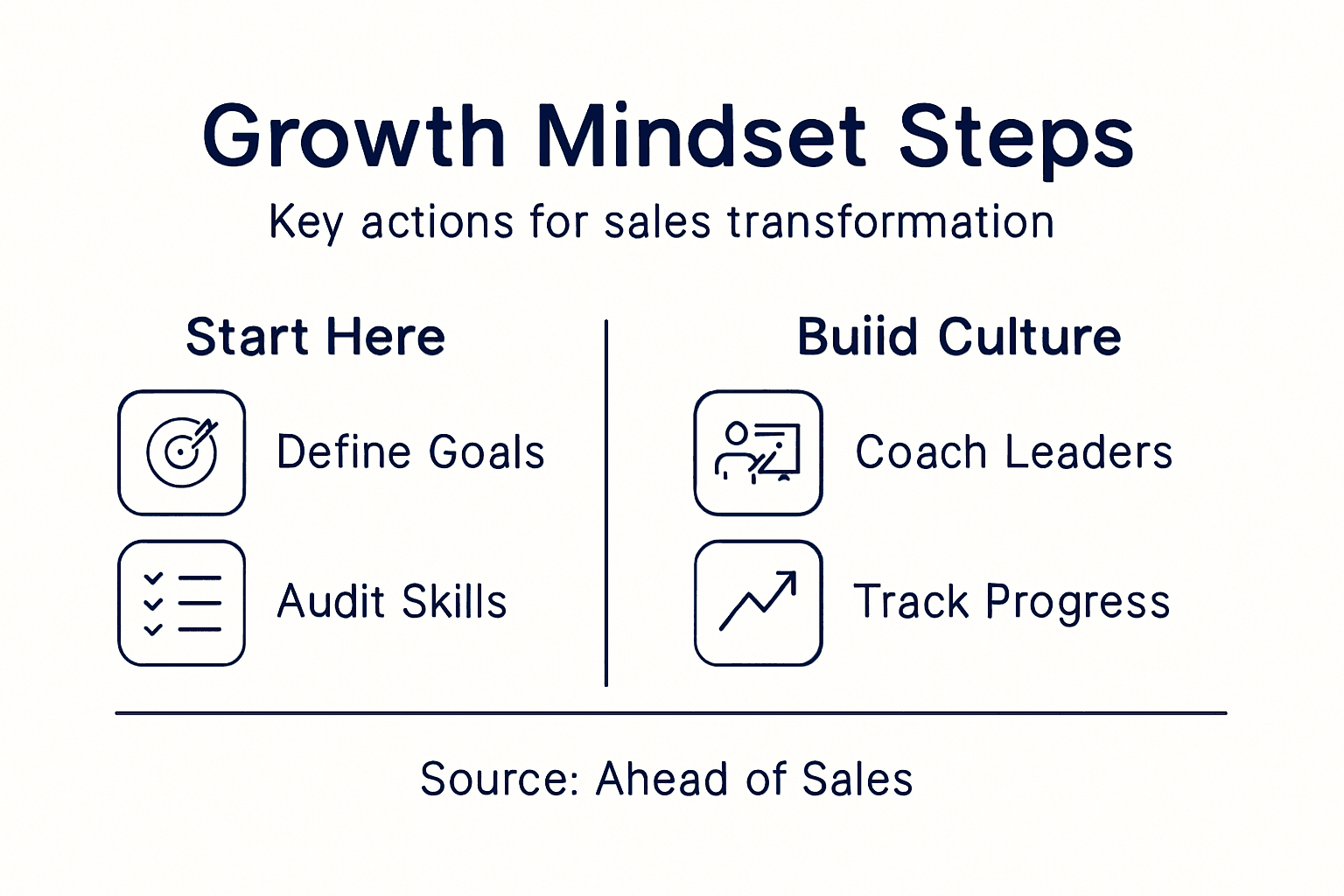
For mid-sized service companies, transformation happens in phases. Start small, prove the concept, then scale.
Step 1: Define Your Growth Aspirations Clearly
Before coaching conversations or culture initiatives, articulate what growth looks like for your organisation. Not vaguely. Specifically.
For sales directors, this means:
- Revenue growth target: 50% in 12 months (not “significant growth”)
- Team capability goal: 80% of reps hitting target quarterly
- Retention target: Reduce annual turnover from 35% to 20%
Write these down. Share them. Refer to them constantly. Your team needs to understand why mindset shift matters to business outcomes.
Step 2: Audit Current Capabilities and Gaps
You can’t close gaps you haven’t identified. Assess where your team stands on growth mindset dimensions.
Ask your sales directors and top performers:
- How do they respond to missed targets?
- Do they seek feedback actively?
- Do they experiment with new approaches?
- How often do they admit gaps or ask for help?
This baseline reveals where resistance will be strongest and where momentum already exists.
Step 3: Invest in Structured Leadership Development
Continuous learning and frequent feedback embed growth mindset principles into leadership programmes. Your directors need coaching before your team can model growth thinking.
Start with your top 5-10 sales leaders. Monthly coaching sessions focusing on:
- How they coach their teams – Moving from criticism to curiosity
- How they respond to setbacks – Modelling learning over blame
- How they measure success – Broadening beyond closed deals
- How they handle vulnerability – Admitting what they don’t know
When your leadership team demonstrates growth mindset consistently, your broader team follows.
Step 4: Embed Accountability Mechanisms
Transformation without measurement disappears. Build accountability into systems, not just intentions.
Track monthly:
- Percentage of team members receiving coaching
- Number of deals reviewed for learning (won and lost)
- Feedback sought by salespeople from managers and peers
- New approaches attempted and results captured
Publish these metrics. Make progress visible. Celebrate improvements.
What gets measured gets done. Without accountability systems, growth mindset remains aspirational.
Step 5: Create Cross-Functional Learning
Your best sales rep’s approach benefits your entire team. Build forums where learning spreads.
Consider:
- Monthly peer learning sessions where top performers share what they’re testing
- Failure debriefs where lost deals become teaching moments
- Rotating deal coaching where salespeople observe how colleagues approach complex prospects
These create psychological safety and distribute knowledge across the team.
Pro tip: Pick one foundational step this quarter—likely leadership coaching or monthly accountability metrics. Master that before adding complexity. Sustainable transformation comes from deepening one element at a time, not launching five initiatives simultaneously.
Unlock Your Sales Team’s Full Potential with a Growth Mindset Approach
The challenge faced by many sales leaders is shifting from a fixed mindset to embracing growth as the engine for developing talent, resilience, and sustained sales success. If your organisation struggles with inconsistent performance, lack of team engagement, or fears around failure then adopting a growth mindset is the critical change you must make. Our tailored solutions at Ahead of Sales combine proven 1:1 coaching with strategic frameworks to help businesses like yours generate at least 50% sales growth yearly while ensuring each quarter your teams confidently hit their targets.
Explore how our Sales Strategy Archives – Ahead of Sales and Sales Playbook Archives – Ahead of Sales provide the tools and insights to embed this transformative mindset. Don’t settle for repeating old patterns when you can revolutionise your sales culture. Visit https://aheadofsales.co.uk today to discover how our bespoke programmes will empower your leadership team to lead with vulnerability, psychological safety, and a clear focus on continuous improvement. Take the decisive step now to build resilience in your sales force and create unstoppable growth.
Frequently Asked Questions
What is a growth mindset in sales leadership?
A growth mindset in sales leadership is the belief that abilities, skills, and team performance can be developed through effort, learning, and persistence, contrasting with a fixed mindset where capabilities are viewed as static.
How can a growth mindset benefit sales teams?
A growth mindset can benefit sales teams by fostering resilience, encouraging learning from failures, and improving adaptability to market changes. It shifts the focus from proving ability to continuous improvement, leading to better performance and retention.
What are practical steps to implement a growth mindset in a sales culture?
Practical steps include modelling vulnerability as a leader, shifting how success is measured, creating psychological safety in coaching, and building learning systems that encourage sharing knowledge and experiences within the team.
How does a growth mindset impact team engagement and retention?
A growth mindset enhances team engagement and retention by creating an environment where employees feel valued, motivated, and supported in their development. This leads to greater job satisfaction and a stronger commitment to the organisation.