
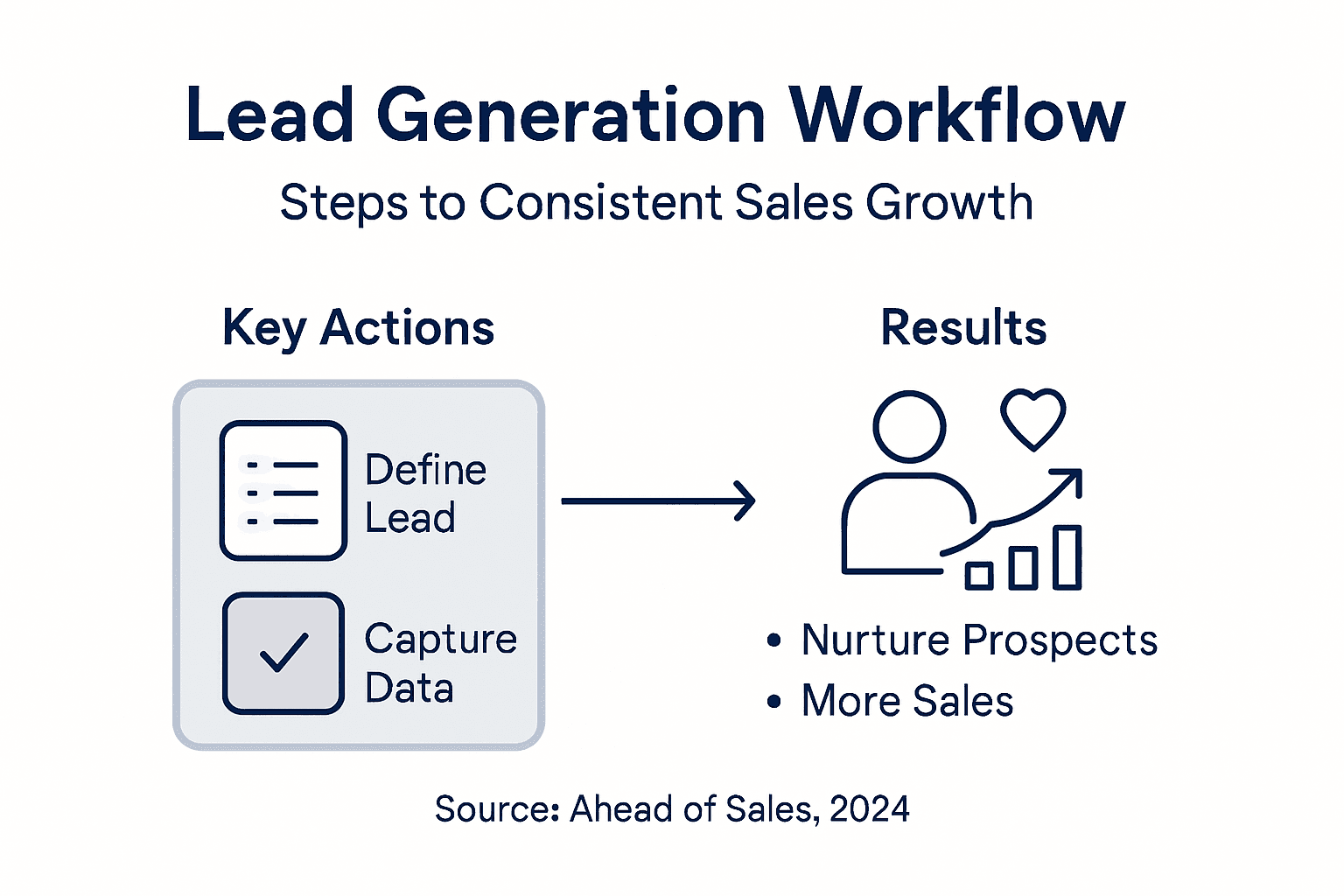
Struggling to separate genuine sales opportunities from wasted prospecting efforts is a challenge many British sales leaders know all too well. Focusing on precisely defining your ideal customer profiles and systematically tracking high-potential lead sources unlocks the potential for reliable quarterly growth across any United Kingdom-based B2B team. This guide demystifies every step of the lead generation journey, from strategic targeting to advanced conversion analysis, providing actionable methods to sharpen your sales engine for lasting results.
Table of Contents
- Step 1: Define Ideal Lead Profiles and Sources
- Step 2: Implement Lead Capture Systems
- Step 3: Nurture Prospects with Targeted Outreach
- Step 4: Qualify Leads Using Proven Criteria
- Step 5: Monitor Conversion Rates and Performance
- Step 6: Refine Workflow Based on Results
Quick Summary
| Key Point | Explanation |
|---|---|
| 1. Define Ideal Lead Profiles | Clearly outline your target customers to focus your sales efforts effectively and maximise conversion potential. |
| 2. Implement Strategic Lead Capture | Use multiple methods to gather prospect information, enhancing your ability to qualify leads and improve user experience. |
| 3. Nurture Prospects Consistently | Tailor your communications to the specific needs of leads, fostering engagement and guiding them toward a purchase decision. |
| 4. Qualify Leads Systematically | Establish clear criteria for evaluating leads to streamline efforts and prioritise high-value prospects for your sales team. |
| 5. Monitor and Refine Performance | Regularly review performance metrics to identify improvement opportunities, ensuring your lead generation workflow remains effective and adaptive. |
Step 1: Define Ideal Lead Profiles and Sources
Building a robust lead generation workflow starts with precisely defining your ideal customer profiles. This critical first step transforms random prospecting into strategic targeting, enabling your sales team to focus energy where it matters most.
To create effective lead profiles, you’ll want to analyse prospects through multiple strategic lenses. Tracking lead engagement characteristics helps identify high-potential opportunities. Consider these key dimensions when mapping your ideal lead:
-
Demographic Characteristics
- Company size
- Industry sector
- Geographic location
- Annual revenue
-
Behavioural Indicators
- Online engagement levels
- Content consumption patterns
- Digital interaction frequency
- Previous purchasing behaviours
An ideal lead demonstrates genuine interest, purchasing authority, and alignment with your solution’s value proposition.
Next, investigate potential lead sources systematically. Diverse lead generation channels provide multiple entry points for potential customers. Explore platforms like:
- Organic search
- Paid advertising
- Social media networks
- Professional referral programmes
- Industry-specific events
By understanding these sources, you’ll create a targeted approach that maximises your lead generation efficiency and quality.

Here’s a summary of lead generation sources and their typical business value:
| Lead Source | Typical Volume | Lead Quality | Business Impact |
|---|---|---|---|
| Organic search | High | Medium | Sustainable, cost-efficient |
| Paid advertising | Medium to high | Variable | Rapid scaling, higher expense |
| Social media networks | Medium | Low to medium | Brand reach, early engagement |
| Referral programmes | Low | High | Trust-based, fast conversion |
| Industry-specific events | Low | High | Niche targeting, personal rapport |
Top tip: Create a dynamic lead profile document that evolves with market changes, allowing continuous refinement of your targeting strategy.
Step 2: Implement Lead Capture Systems
Transforming potential customer interactions into actionable sales opportunities requires a strategic lead capture infrastructure. Your goal is to create seamless systems that efficiently collect and qualify prospect information across multiple touchpoints.
Digital lead capture techniques enable businesses to systematically gather critical prospect data. The most effective approaches incorporate multiple collection mechanisms tailored to different customer engagement channels:
-
Website Contact Forms
- Minimalist design
- Essential information fields
- Clear value proposition
- Mobile-responsive layout
-
Landing Page Strategies
- Single focused objective
- Compelling value offer
- Streamlined data collection
- Immediate visual trust signals
Successful lead capture balances information gathering with user experience, ensuring prospects feel respected throughout the interaction.
Implement these sophisticated capture methods:
- Create targeted landing pages
- Design intuitive contact forms
- Integrate automated lead scoring
- Implement multi-channel tracking
- Develop personalised follow-up workflows
By constructing an intelligent lead capture ecosystem, you’ll transform casual website visitors into qualified sales opportunities.
Top tip: Regularly audit and optimise your lead capture forms, removing unnecessary fields to reduce friction and increase conversion rates.
Step 3: Nurture Prospects with Targeted Outreach
Transforming initial lead interest into genuine sales opportunities requires a strategic and personalised nurturing approach. Your goal is to build meaningful connections that guide prospects smoothly through their decision-making journey.
Targeted prospect nurturing techniques provide a systematic method for delivering relevant, timely communications. By understanding and segmenting your audience, you’ll craft engaging interactions that resonate with their specific needs and pain points:
-
Communication Personalisation
- Segment prospects by interest
- Track engagement levels
- Customise messaging
- Adapt communication frequency
-
Content Strategy
- Develop stage-specific materials
- Address specific buyer challenges
- Demonstrate expertise
- Build trust progressively
Effective nurture campaigns transform cold leads into warm, sales-ready opportunities through consistent, thoughtful engagement.
Implement these strategic nurturing steps:
- Map customer journey stages
- Create personalised content sequences
- Develop multi-channel communication plan
- Implement automated tracking
- Monitor and adjust engagement metrics
By leveraging sophisticated nurture campaign strategies, you’ll systematically convert potential prospects into committed customers.
Top tip: Design your nurture workflow with progressive profiling, gradually collecting more detailed information while providing increasing value to your prospects.
Step 4: Qualify Leads Using Proven Criteria
Elevating your sales performance requires a systematic approach to lead qualification. Your mission is to develop a robust framework that separates high-potential prospects from low-value opportunities, ensuring your team focuses energy on the most promising leads.
Qualifying leads demands a multifaceted evaluation process that goes beyond surface-level assessments. Strategic lead assessment techniques provide a structured methodology for identifying truly valuable prospects:
-
Qualification Dimensions
- Purchasing authority
- Budget availability
- Urgent business need
- Alignment with solution
- Decision-making timeline
-
Evaluation Metrics
- Engagement frequency
- Content interaction depth
- Communication responsiveness
- Strategic fit indicators
- Potential lifetime value
High-quality lead qualification transforms random prospect interactions into targeted, efficient sales opportunities.
Implement these precision qualification steps:
- Define clear ideal customer parameters
- Create weighted scoring criteria
- Establish minimum qualification thresholds
- Develop automated screening processes
- Continuously refine assessment model
By integrating systematic lead qualification approaches, you’ll streamline your sales funnel and dramatically improve conversion potential.
Top tip: Regularly calibrate your qualification criteria by tracking actual conversion rates and reverse-engineering your most successful customer acquisition pathways.
Step 5: Monitor Conversion Rates and Performance
Transforming raw sales data into meaningful strategic insights requires a comprehensive performance monitoring approach. Your mission is to develop a robust system that tracks, analyses, and interprets conversion metrics to drive continuous improvement across your sales ecosystem.
Conversion rate tracking strategies provide a systematic framework for understanding your sales effectiveness. Successful monitoring involves multiple interconnected dimensions:
-
Performance Metrics
- Lead-to-opportunity ratio
- Opportunity-to-closure rate
- Average sales cycle duration
- Customer acquisition cost
- Revenue per lead
-
Analytical Focus Areas
- Channel performance
- Segment conversion rates
- Sales team efficiency
- Pipeline velocity
- Predictive forecasting
Intelligent performance monitoring transforms raw data into actionable strategic intelligence.
Implement these precision tracking steps:
- Establish baseline performance metrics
- Configure comprehensive dashboards
- Set realistic performance benchmarks
- Develop automated reporting mechanisms
- Schedule regular performance reviews
By integrating multi-touch attribution techniques, you’ll gain unprecedented visibility into your sales ecosystem’s true performance potential.
Top tip: Create a dynamic performance dashboard that highlights leading indicators, enabling proactive strategy adjustments before potential performance declines.
Below is a comparison of performance metrics used to monitor lead conversion:
| Metric | What It Shows | Actionable Insight |
|---|---|---|
| Lead-to-opportunity ratio | Initial lead quality | Refine lead profiles for better targeting |
| Opportunity-to-closure rate | Sales process effectiveness | Adjust sales strategy as needed |
| Customer acquisition cost | Cost efficiency of conversion | Optimise marketing spend |
| Revenue per lead | Value generated per prospect | Focus on high-value segments |
Step 6: Refine Workflow Based on Results
Transforming your lead generation strategy requires a dynamic, data-driven approach to continuous improvement. Your mission is to create an adaptive workflow that evolves intelligently based on empirical performance insights.
Workflow refinement methodologies provide a systematic framework for identifying and implementing strategic improvements. Successful refinement involves a comprehensive, multi-dimensional analysis:
-
Performance Review Dimensions
- Conversion rate variations
- Sales cycle efficiency
- Resource allocation effectiveness
- Customer acquisition metrics
- Team productivity indicators
-
Improvement Strategies
- Identify performance bottlenecks
- Eliminate inefficient processes
- Automate repetitive tasks
- Reallocate resources strategically
- Implement targeted training
Intelligent workflow refinement transforms historical data into future performance opportunities.
Implement these precision improvement steps:
- Conduct comprehensive performance analysis
- Identify systematic improvement opportunities
- Develop targeted intervention strategies
- Implement incremental changes
- Monitor and validate improvement outcomes
By integrating adaptive workflow optimization techniques, you’ll create a dynamic sales ecosystem that continuously enhances its own effectiveness.
Top tip: Create a quarterly workflow review process that systematically deconstructs performance data, ensuring your lead generation strategy remains agile and responsive.
Unlock Consistent Sales Growth With Proven Lead Generation Strategies
Building a reliable lead generation workflow is crucial to overcoming challenges like inefficient lead capture and poor qualification criteria discussed in the article. If you want to transform your sales pipeline by defining ideal customer profiles, nurturing prospects effectively, and refining workflows based on data, our specialised coaching and consulting solutions at Ahead of Sales are designed exactly for businesses aiming for accelerated growth.

Explore our tailored programmes within the Sales Strategy Archives – Ahead of Sales that combine bespoke 1:1 coaching with traditional training to help your sales team hit targets quarter after quarter. Don’t let fragmented processes stall your progress. Take the next step to generate at least 50% sales growth annually and ensure your team consistently wins. Visit Ahead of Sales now to discover how our practical sales playbooks and expert guidance can sharpen your lead generation and conversion performance, transforming insight into action.
Frequently Asked Questions
How can I define my ideal lead profiles for effective lead generation?
To define your ideal lead profiles, analyse prospects based on demographic characteristics, behavioural indicators, and purchasing authority. Create a detailed document outlining these profiles to refine your targeting strategy consistently over time.
What lead capture systems should I implement to improve my lead generation?
Implement systems such as streamlined website contact forms and targeted landing pages that focus on specific objectives. Ensure these systems collect essential prospect information while providing a strong value proposition to enhance user experience.
How can I effectively nurture prospects throughout their decision-making process?
Develop personalised communication strategies that segment prospects based on their interests and engagement levels. Create stage-specific content that addresses the unique challenges faced by each segment to build trust and encourage conversions.
What criteria should I use to qualify leads for my sales team?
Use a framework that evaluates leads based on purchasing authority, budget availability, and urgency of need. Assign weighted scoring to different qualification dimensions to ensure your sales team focuses only on the most promising opportunities.
How can I monitor conversion rates to improve my sales performance?
Establish key performance metrics such as lead-to-opportunity ratio and customer acquisition cost to track your sales effectiveness. Regularly review these metrics and adjust your strategies to enhance conversion rates within your sales funnel.
What steps should I take to refine my lead generation workflow?
Conduct thorough performance analysis to identify areas for improvement in your lead generation process. Implement targeted interventions based on your findings and monitor the outcomes to ensure continuous enhancement of your workflow.