
Every sales director knows the challenge of guiding prospects from first contact to loyal customer without losing them along the way. The path through a sales funnel is a dynamic process, shaped by complex buyer behaviours and digital interactions. By mastering advanced funnel techniques, British companies can create more effective strategies for scalable growth, ensuring each stage is optimised to drive higher conversions and long-term relationships.
Table of Contents
- What A Sales Funnel Really Means
- Stages And Types Of Sales Funnels
- How Modern Sales Funnels Function
- Optimising Funnels For Scalable Growth
- Common Errors And How To Avoid Them
Key Takeaways
| Point | Details |
|---|---|
| Understanding the Sales Funnel | The sales funnel represents the journey from awareness to purchase, requiring businesses to facilitate customer progression through tailored strategies. |
| Evolution of Sales Funnels | Modern sales funnels have become dynamic and data-driven, incorporating advanced tracking and personalised communication techniques to cater to non-linear customer behaviours. |
| Optimisation for Growth | Regular analysis of funnel stages is vital to identify drop-off points, allowing companies to enhance conversion strategies and ensure scalable growth. |
| Common Mistakes | Avoid errors like poor journey mapping and neglecting retention strategies to maintain a robust sales funnel and improve conversion rates. |
What a Sales Funnel Really Means
A sales funnel represents the strategic journey potential customers navigate from initial awareness through to final purchase. It’s more than a simple linear path – it’s a dynamic framework that tracks customer progression through multiple interconnected stages of engagement.
The traditional sales funnel model typically involves four critical stages:
- Awareness: Potential customers first discover your product or service
- Interest: Prospects demonstrate curiosity and seek more information
- Desire: Customers develop genuine intent to potentially purchase
- Action: The final conversion where a transaction occurs
Understanding this model enables businesses to design targeted strategies that guide prospects seamlessly through each stage. By mapping customer interactions and creating tailored communication approaches, organisations can dramatically improve conversion rates and sales performance.
A sales funnel is not just a marketing concept, but a comprehensive blueprint for customer relationship management and business growth.
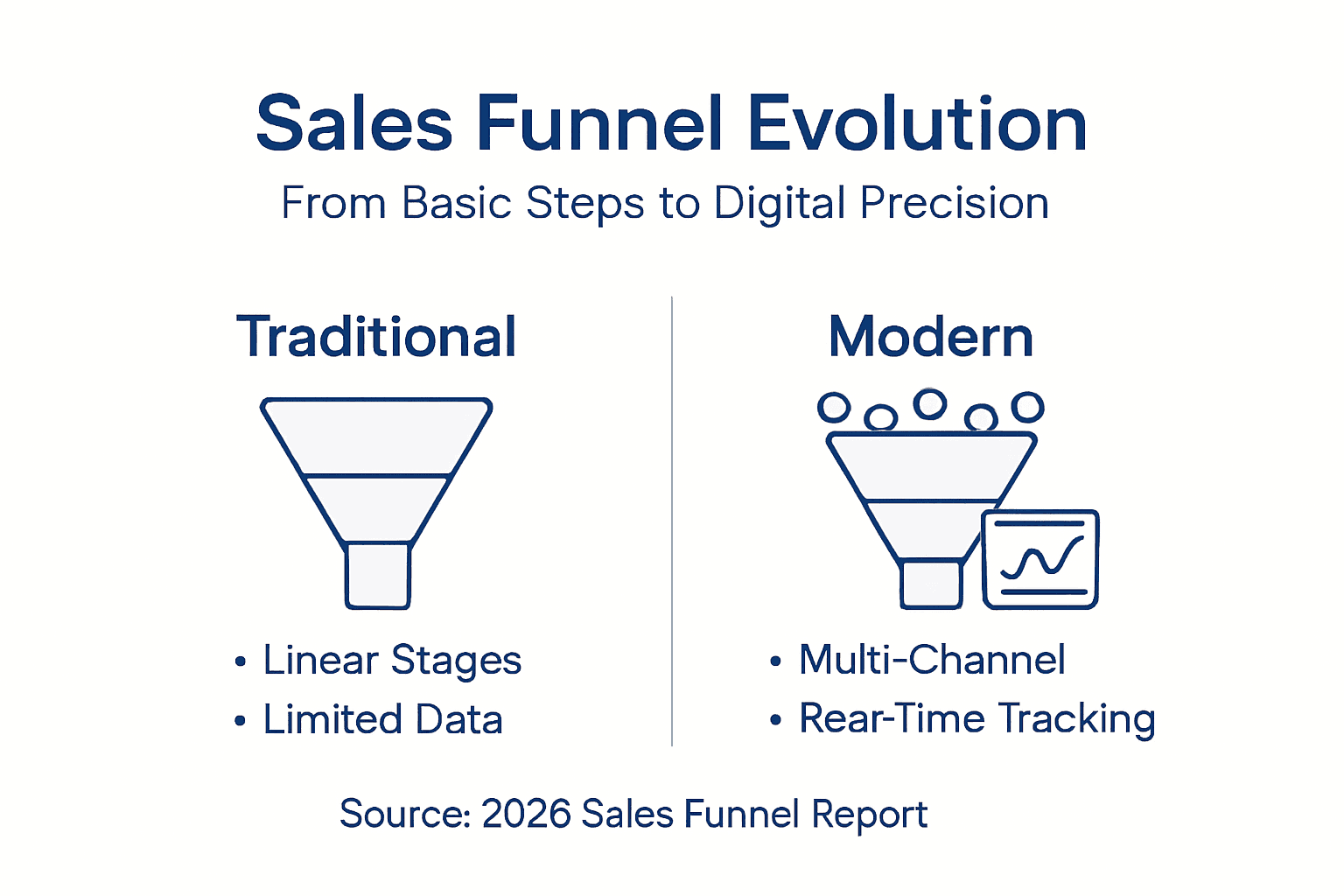
Modern sales funnels have evolved beyond traditional linear models, incorporating sophisticated digital tracking, personalised communication techniques, and data-driven insights. They now account for complex customer behaviours, multiple touchpoints, and non-linear decision-making processes.

Pro tip: Regularly analyse and refine your sales funnel stages to identify potential drop-off points and optimize your customer conversion strategy.
Here’s a summary comparing traditional and modern sales funnels:
| Aspect | Traditional Sales Funnel | Modern Sales Funnel |
|---|---|---|
| Structure | Linear, fixed stages | Dynamic, adaptable stages |
| Customer Behaviour | Assumed predictable | Embraces non-linear actions |
| Technology Involvement | Minimal or manual tracking | Advanced digital analytics |
| Communication Approach | Mass marketing efforts | Personalised, data-driven messaging |
| Decision Points | Few, straightforward | Multiple, complex touchpoints |
| Optimisation Method | Infrequent, manual adjustments | Ongoing, data-informed refinement |
Stages and Types of Sales Funnels
Sales funnels are sophisticated strategic frameworks that segment customer journey stages into distinct phases designed to transform potential leads into committed customers. Unlike simplistic linear models, these dynamic systems recognise the complex nature of modern purchasing decisions.
Traditionally, sales funnels are categorised into four primary types:
- Awareness Funnel: Introduces potential customers to your brand and offerings
- Consideration Funnel: Provides detailed information to help prospects evaluate options
- Conversion Funnel: Focuses on compelling prospects to make a purchasing decision
- Loyalty Funnel: Encourages repeat business and transforms customers into brand advocates
Each funnel type requires unique communication strategies and targeted content designed to address specific customer needs and motivations. Businesses must carefully craft messaging that resonates with prospects at each distinct stage, ensuring a smooth progression through the purchasing journey.
Strategic sales funnel development is less about pushing products and more about creating meaningful customer relationships.
Modern sales funnels incorporate sophisticated digital tracking technologies, allowing businesses to gain unprecedented insights into customer behaviour. By analysing interaction data across multiple touchpoints, organisations can continuously refine their approach, creating increasingly personalised and effective conversion strategies.
Pro tip: Develop granular tracking mechanisms that monitor customer interactions at each funnel stage to identify and address potential friction points in your sales process.
How Modern Sales Funnels Function
Modern sales funnels have transformed from static linear models to dynamic digital engagement systems that leverage sophisticated tracking and personalisation technologies. These advanced frameworks go beyond simple transactional approaches, creating intricate pathways that adapt to individual customer behaviours and preferences.
Key digital touchpoints in modern sales funnels typically include:
- SEO-driven content strategies
- Targeted social media campaigns
- Personalised email marketing
- Paid advertising channels
- Interactive web experiences
The core functionality of these funnels revolves around continuous data collection and intelligent analysis. By monitoring customer interactions across multiple digital platforms, businesses can develop granular insights into purchasing motivations, enabling highly targeted communication strategies.
Modern sales funnels are living ecosystems that breathe and adapt with real-time customer data.
Advanced tracking mechanisms allow organisations to map complex customer journeys, understanding not just where prospects enter the funnel, but precisely how they move through different engagement stages. This approach transforms traditional sales methodologies, shifting from broad-stroke marketing to laser-focused, individual-centric communication techniques.
Pro tip: Implement multi-channel analytics tools that provide comprehensive visibility into customer interaction points, enabling more precise funnel optimization strategies.
Optimising Funnels for Scalable Growth
Successful sales funnel optimization requires a strategic approach to identifying and eliminating performance bottlenecks. By systematically analysing each stage of the customer journey, businesses can create more efficient, responsive, and growth-oriented sales mechanisms that adapt to changing market dynamics.
Key strategies for optimising sales funnels include:
- Continuous Performance Monitoring
- Data-Driven Decision Making
- Targeted Conversion Improvement
- Technological Infrastructure Scalability
- Predictive Analytics Integration
The fundamental principle of funnel optimization revolves around understanding and reducing friction points that prevent potential customers from progressing through the purchasing journey. This involves meticulously mapping customer interactions, identifying drop-off points, and implementing targeted interventions to improve overall conversion rates.
Scalable growth is not about adding more resources, but about intelligently streamlining existing processes.
Modern organizations are increasingly leveraging advanced analytics and machine learning technologies to create dynamic, self-optimizing sales funnels. These intelligent systems can automatically detect performance variations, recommend strategic adjustments, and ensure that sales processes remain agile and responsive to changing market conditions.
Pro tip: Implement quarterly comprehensive funnel audits that combine quantitative metrics with qualitative customer feedback to drive continuous improvement strategies.
Common Errors and How to Avoid Them
Sales funnel performance can be dramatically undermined by critical mistakes that prevent effective customer conversion. Understanding and preemptively addressing these common errors is essential for maintaining a robust and high-performing sales strategy.
Top mistakes businesses frequently encounter include:
- Incomplete Customer Journey Mapping
- Inconsistent Messaging Across Funnel Stages
- Neglecting Customer Retention Strategies
- Overlooking Data Analysis and Performance Metrics
- Failing to Personalise Customer Interactions
Each of these errors represents a significant potential leak in the sales process, where potential customers might disengage or lose interest. By recognising these pitfalls early, organisations can implement targeted interventions to strengthen their sales funnel and improve overall conversion rates.
For quick reference, here are common funnel mistakes and how to avoid them:
| Mistake Identified | Potential Impact | Preventative Action Suggestion |
|---|---|---|
| Poor journey mapping | Leads drop out prematurely | Regularly update customer pathways |
| Unclear messaging | Customer confusion, lost trust | Ensure consistent brand communication |
| Ignoring retention | Low repeat purchases | Incorporate loyalty strategies |
| Neglecting data analysis | Missed optimisation opportunities | Schedule routine performance reviews |
| Lack of personalisation | Customer disengagement | Tailor content to audience segments |
Successful sales funnels are not about perfection, but about continuous improvement and strategic adaptation.
Companies must adopt a proactive approach to funnel management, which involves regular performance audits, consistent metric tracking, and a willingness to iteratively refine strategies based on real-world data. This means developing sophisticated tracking mechanisms that provide granular insights into customer behaviour and funnel performance.
Pro tip: Conduct monthly funnel health checks, systematically reviewing each stage’s conversion rates and identifying potential optimization opportunities before they become significant performance barriers.
Accelerate Your Sales Funnel Impact with Proven Strategies
Navigating the complexities of modern sales funnels to drive rapid growth in 2026 requires more than just theory. This article highlights challenges such as optimising customer journeys, reducing conversion drop-offs, and leveraging data-driven insights. If your business struggles with these pain points or seeks to transform its funnel stages into dynamic growth engines, targeted expertise is essential. At Ahead of Sales, we understand that your sales funnel needs to be a living, adaptable system that ensures consistent quarterly target achievement and sustained revenue expansion.
Explore our bespoke 1:1 coaching combined with traditional training and consultancy designed specifically to help businesses with growth mindsets. Whether you lead a medium-sized enterprise or manage a solo service business, our sales acceleration packages deliver scalable results. Dive deeper into effective Sales Strategy Archives – Ahead of Sales to refine your funnel optimisation. For detailed playbooks and actionable frameworks check Sales Playbook Archives – Ahead of Sales. Ready to transform your sales process and achieve over 50% sales growth every year Visit Ahead of Sales now and take the first step towards accelerating your business performance.
Frequently Asked Questions
What is a sales funnel?
A sales funnel is a strategic framework that outlines the stages potential customers go through, from initial awareness of a product or service to the final purchase action.
How can understanding a sales funnel improve my marketing strategy?
By understanding the sales funnel, businesses can design targeted strategies that guide prospects through each stage, improving conversion rates and overall sales performance.
What are the different types of sales funnels?
The four primary types of sales funnels are the Awareness Funnel, Consideration Funnel, Conversion Funnel, and Loyalty Funnel, each tailored to guide customers through distinct stages of engagement.
What common mistakes should I avoid in my sales funnel?
Common mistakes include incomplete customer journey mapping, inconsistent messaging, neglecting customer retention, neglecting data analysis, and failing to personalise customer interactions. Addressing these can significantly enhance conversion rates.
Recommended
- Sales Growth Strategies 2025: Accelerate Quarterly Wins
- How to Shorten Sales Cycles for Rapid Growth – Ahead of Sales
- How to Accelerate Revenue Growth: Step-by-Step Guide
- Defining Sales Growth Strategies: Accelerating Revenue
- Essential Guide to Marketing to Businesses in 2026 – Aim Set Win
- BabyLoveGrowth | #1 Automated Organic Growth Platform for Google and ChatGPT