
Every quarter brings a new set of pressures for British sales leaders aiming to deliver strong results and steady growth. Knowing when and how much revenue to expect is no longer just a financial exercise—it is a core leadership responsibility that drives smarter decisions on resource planning and risk management. As organisations increasingly turn to advanced tools such as CRM and ERP systems, mastering revenue forecasting sets the most effective teams apart in a changing market.
Table of Contents
- What Revenue Forecasting Means For Sales Leaders
- Main Revenue Forecasting Methods And Models
- Key Steps In Accurate Sales Forecasting
- Common Pitfalls And How To Avoid Them
- Why Revenue Forecasts Matter For Growth
Key Takeaways
| Point | Details |
|---|---|
| Importance of Revenue Forecasting | Revenue forecasting is essential for strategic decision-making, enabling effective resource allocation and talent deployment. |
| Diverse Methodologies | Sales leaders should utilise a combination of qualitative, quantitative, and advanced analytical methods for accurate revenue predictions. |
| Structured Approach | A systematic, methodical approach to sales forecasting enhances accuracy and supports critical business insights. |
| Avoiding Common Pitfalls | Addressing forecasting pitfalls, such as data quality and cognitive biases, is crucial to maintaining predictive accuracy and strategic integrity. |
What Revenue Forecasting Means For Sales Leaders
Revenue forecasting represents a strategic cornerstone for sales leaders seeking consistent business growth and predictable performance. By systematically predicting future sales revenues, leaders can make informed decisions about resource allocation, talent deployment, and strategic planning. Modern sales organisations recognise that forecasting is far more than a financial exercise – it’s a critical leadership tool for navigating market complexity.
Research highlights the profound importance of robust forecasting methodologies. Sales forecasting perspectives reveal that sales professionals increasingly depend on advanced tools like CRM and ERP systems to drive accurate predictions. However, many organisations still struggle to fully leverage these analytical capabilities.
Key components of effective revenue forecasting include:
- Historical Sales Data: Analysing past performance trends
- Market Intelligence: Understanding industry dynamics and economic indicators
- Pipeline Management: Tracking potential opportunities and conversion rates
- Predictive Analytics: Using statistical models to forecast future revenues
Successful sales leaders understand that forecasting is both an art and a science. It requires a nuanced approach that combines quantitative analysis with strategic insight. By developing sophisticated forecasting capabilities, sales teams can transform uncertainty into actionable intelligence.
Pro tip: Invest in continuous training for your sales team on forecasting tools and methodologies to improve prediction accuracy and strategic decision-making.
Main Revenue Forecasting Methods And Models
Revenue forecasting encompasses a diverse range of methodological approaches that sales leaders can leverage to predict future financial performance. Sales forecasting methods vary significantly based on organisational complexity, data availability, and strategic objectives, requiring nuanced understanding and strategic implementation.
The primary revenue forecasting methods can be categorised into several key approaches:
-
Qualitative Methods: Used when historical data is limited
- Expert opinions
- Market research insights
- Sales team sentiment analysis
-
Quantitative Methods: Data-driven predictive techniques
- Time series analysis
- Regression models
- Moving average calculations
-
Advanced Analytical Methods: Leveraging modern technologies
- Machine learning predictions
- Artificial intelligence forecasting
- Predictive analytics platforms
Successful forecasting requires selecting the appropriate method aligned with your organisation’s specific context. Sophisticated sales teams often combine multiple approaches to create robust, multi-dimensional revenue predictions that account for market variability and internal performance dynamics.

The table below compares the distinct revenue forecasting methods and their ideal usage contexts:
| Method Type | Typical Use Case | Strength | Limitation |
|---|---|---|---|
| Qualitative | New markets or products | Leverages expert judgement | Potential for subjectivity |
| Quantitative | Established businesses with robust data | Objective, data-driven outputs | May overlook qualitative factors |
| Advanced Analytical | Large datasets with complex variables | Identifies subtle patterns and trends | Requires specialist tools and expertise |
Understanding these methodological nuances allows sales leaders to develop more accurate, responsive forecasting strategies. By matching the right forecasting technique to specific business scenarios, organisations can transform raw data into strategic insights that drive meaningful financial planning and resource allocation.
Pro tip: Implement a hybrid forecasting approach that blends quantitative data with qualitative insights to create more comprehensive and reliable revenue predictions.
Key Steps In Accurate Sales Forecasting
Accurate sales forecasting requires a structured, methodical approach that transforms raw data into meaningful strategic insights. Sales forecasting techniques demand meticulous attention to detail and a comprehensive understanding of organisational dynamics.
The key steps in developing a robust sales forecast include:
-
Data Collection and Preparation
- Gather comprehensive historical sales data
- Ensure data consistency and quality
- Clean and standardise existing information
-
Pipeline Analysis
- Evaluate current sales opportunities
- Assess deal probability and potential value
- Filter deals based on realistic closing chances
-
Stakeholder Engagement
- Involve sales team in forecast development
- Incorporate sales representative insights
- Validate individual sales team predictions
-
Forecasting Model Selection
- Choose appropriate forecasting methodology
- Match technique to organisational complexity
- Consider quantitative and qualitative approaches
-
Continuous Monitoring and Adjustment
- Implement real-time tracking mechanisms
- Regularly update forecast predictions
- Develop responsive adjustment strategies
Successful forecasting is not a one-time event but an ongoing process of refinement and strategic adaptation. By implementing these systematic steps, sales leaders can create more accurate, reliable revenue predictions that support critical business decision-making.
Pro tip: Develop a collaborative forecasting culture where sales team members are actively engaged in creating and refining predictive models.
Common Pitfalls And How To Avoid Them
Sales forecasting is fraught with potential mistakes that can derail strategic planning and undermine organisational performance. Forecasting practice reveals numerous critical pitfalls that sales leaders must proactively address to maintain forecast integrity.
Key forecasting pitfalls and their strategic solutions include:
-
Data Quality Issues
- Pitfall: Inconsistent or incomplete data collection
- Solution: Implement standardised data entry protocols
- Implement robust data validation processes
-
Cognitive Biases
- Pitfall: Over-reliance on gut feeling
- Solution: Prioritise empirical evidence
- Develop objective assessment frameworks
-
Technological Limitations
- Pitfall: Dependence on manual spreadsheet forecasting
- Solution: Adopt automated forecasting technologies
- Integrate advanced analytical tools
-
Organisational Challenges
- Pitfall: Lack of cross-departmental collaboration
- Solution: Create integrated forecasting teams
- Establish clear communication channels
Successful sales leaders understand that avoiding these pitfalls requires a systematic, disciplined approach. By recognising potential forecast vulnerabilities and implementing strategic countermeasures, organisations can significantly improve their predictive accuracy and strategic decision-making capabilities.
Pro tip: Conduct regular forecast audits to identify and mitigate potential blind spots in your forecasting methodology.
Why Revenue Forecasts Matter For Growth
Revenue forecasting is far more than a financial exercise—it’s a strategic imperative for organisations seeking sustainable growth and competitive advantage. Revenue forecasting fundamentals demonstrate how precise predictions can transform business strategy and performance.
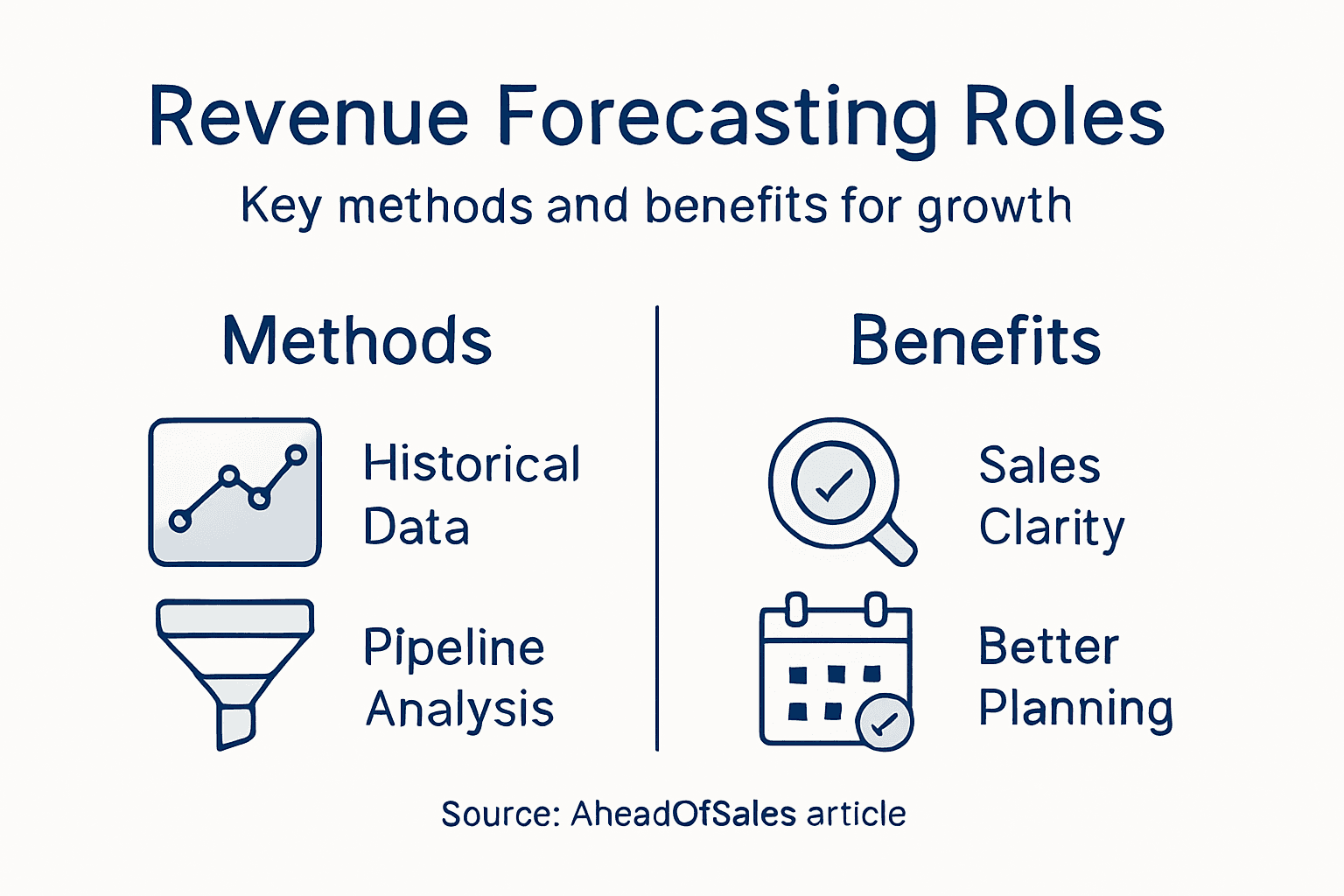
The critical importance of revenue forecasts for organisational growth can be understood through several key dimensions:
Here is a summary of how accurate revenue forecasting drives core business outcomes:
| Outcome Area | Benefit of Accurate Forecasts | Example Impact |
|---|---|---|
| Resource Allocation | Informs precise staffing and budgeting | Reduces waste, maximises ROI |
| Risk Management | Flags early warning indicators | Enables rapid risk mitigation |
| Performance Tracking | Clarifies growth and progress | Supports agile performance reviews |
| Strategic Planning | Strengthens long-term decision-making | Helps sustain competitive advantage |
-
Strategic Resource Allocation
- Enables precise budgeting decisions
- Optimises investment across departments
- Minimises financial waste
-
Risk Management
- Identifies potential financial vulnerabilities
- Allows proactive mitigation strategies
- Supports contingency planning
-
Performance Benchmarking
- Creates measurable growth targets
- Provides comparative performance insights
- Facilitates data-driven goal setting
-
Operational Agility
- Supports rapid decision-making
- Helps anticipate market changes
- Enables responsive business strategies
By treating revenue forecasting as a dynamic, strategic tool, sales leaders can transform uncertainty into actionable intelligence. Organisations that develop sophisticated forecasting capabilities gain a significant competitive edge, turning predictive insights into tangible growth opportunities.
Pro tip: Treat revenue forecasting as a collaborative process, integrating insights from multiple departments to create more holistic and accurate predictions.
Unlock Predictable Sales Growth With Expert Revenue Forecasting Support
The article highlights the challenge many sales leaders face in creating accurate revenue forecasts that transform uncertainty into clear, actionable insights. If you are struggling with inconsistent data, fragmented forecasting methods, or limited forecasting expertise, it is time to move beyond theory and equip your team with proven strategies. Concepts such as pipeline management, predictive analytics, and collaborative forecasting can elevate your sales process and secure sustainable growth.

At AheadOfSales, we specialise in empowering businesses like yours with bespoke 1:1 coaching and tailored consultancy that delivers at least 50% sales growth annually. Our sales acceleration packages ensure your team not only understands key forecasting methodologies but hits every target quarter after quarter. Whether you are leading a mid-sized organisation or a solo service business, our personalised approach integrates the critical forecasting components discussed in this article into your existing sales strategy. Seize the moment to transform your revenue forecasting capabilities. Discover how our training solutions align with your growth mindset by visiting AheadOfSales today and take the first step towards confident, data-driven sales leadership.
Frequently Asked Questions
What is revenue forecasting and why is it important for sales leaders?
Revenue forecasting is the process of predicting future sales revenues based on historical data and market insights. It is crucial for sales leaders as it aids in resource allocation, strategic planning, and navigating market complexities, ultimately driving informed business growth.
What are the main methods for revenue forecasting?
The primary methods for revenue forecasting include qualitative methods (like expert opinions and market research), quantitative methods (such as time series analysis and regression models), and advanced analytical methods that leverage machine learning and AI for more accurate predictions.
How can businesses ensure accurate sales forecasting?
Businesses can ensure accurate sales forecasting by following structured steps such as data collection and preparation, pipeline analysis, stakeholder engagement, selecting appropriate forecasting models, and continuous monitoring and adjustment of forecasts as market conditions change.
What are common pitfalls in sales forecasting, and how can they be avoided?
Common pitfalls in sales forecasting include data quality issues, cognitive biases, technological limitations, and lack of organisational collaboration. These can be avoided by implementing standardised data entry protocols, prioritising empirical evidence, adopting automated technologies, and creating integrated forecasting teams.