
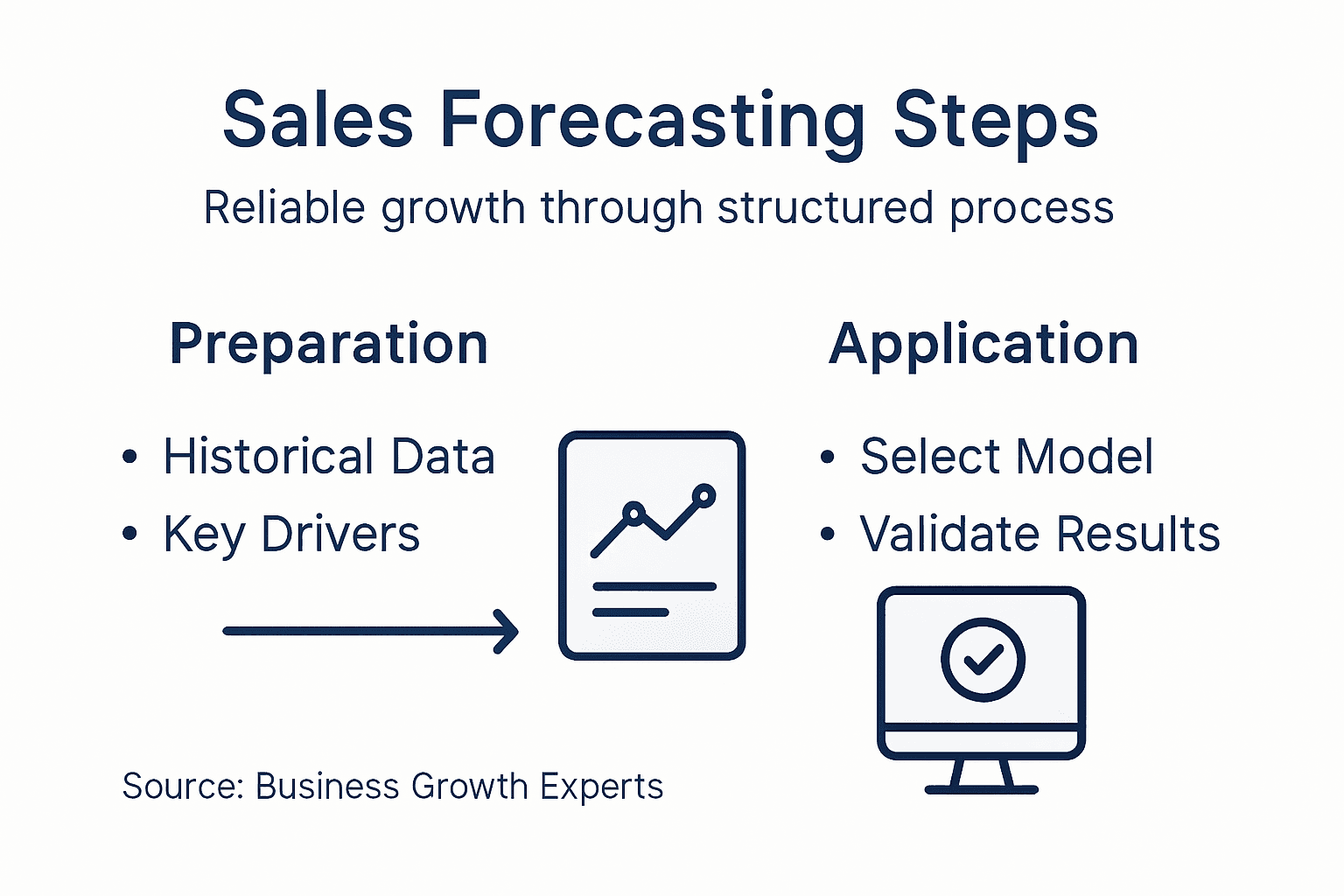
Every British sales leader chasing ambitious growth targets knows the frustration of forecasts that miss the mark. Reliable revenue prediction is not guesswork—it starts with accurate historical data assessment and understanding what truly drives sales. This guide breaks down expert-tested forecasting steps that help you build consistency, spot opportunities, and ground every estimate in reality. Discover practical strategies for turning raw performance data into credible sales projections that withstand scrutiny.
Table of Contents
- Step 1: Assess Historical Sales Data Accurately
- Step 2: Define Key Sales Drivers And Assumptions
- Step 3: Select And Apply The Right Forecasting Model
- Step 4: Validate Projections Against Realistic Benchmarks
- Step 5: Refine Forecasts With Ongoing Performance Data
Quick Summary
| Key Insight | Explanation |
|---|---|
| 1. Assess historical sales data carefully | Examine past sales data to derive insights for accurate revenue forecasting. Consider sales patterns over at least three years. |
| 2. Identify key sales drivers | Understand the primary variables affecting sales, such as market conditions and customer demographics, to create realistic forecasts. |
| 3. Choose the right forecasting model | Select a sales forecasting model that aligns with your business characteristics and historical data, considering both complexity and accuracy. |
| 4. Validate forecasts against benchmarks | Compare projections with industry benchmarks and historical performance for enhanced forecast reliability and credibility. |
| 5. Refine forecasts continuously | Integrate ongoing performance data and market insights to adapt forecasts, ensuring they remain accurate and relevant. |
Step 1: Assess historical sales data accurately
Understanding your company’s historical sales performance is the critical first stage in creating reliable revenue forecasts. By meticulously examining past sales patterns, you can develop insights that transform raw numbers into strategic predictions.
To effectively assess historical sales data, start by gathering comprehensive sales records spanning at least the past three years. This allows you to capture seasonal variations and long-term trends. Focus on collecting detailed sales metrics that provide meaningful context for your analysis.
Key elements to analyse in your historical sales review include:
- Total annual revenue
- Quarterly sales performance
- Monthly sales variations
- Product or service category breakdowns
- Customer segment revenue contributions
- Sales cycle lengths
- Conversion rates
When examining your data, look beyond simple totals. Seek out underlying patterns such as growth trajectories, cyclical fluctuations, and potential emerging market opportunities. Pay special attention to anomalies or significant shifts that might indicate broader economic influences or internal strategic changes.
Accurate historical data assessment isn’t just about numbers—it’s about understanding the story behind those numbers.
Cross-reference your internal sales records with external economic indicators to provide additional context. This comparative approach helps validate your internal data and reveals potential external factors influencing your sales performance.
Expert Recommendation: Invest in robust data management systems that can automatically track and categorise sales data for seamless historical performance analysis.
Step 2: Define key sales drivers and assumptions
Identifying the critical factors that influence your sales performance is fundamental to creating a reliable revenue forecast. This step involves systematically unpacking the primary variables that directly impact your business’s sales potential.
Begin by examining the independent variables affecting sales outcomes, which might include market conditions, customer demographics, pricing strategies, and competitive landscape. These drivers provide the foundational context for understanding potential revenue generation.
Key sales drivers to consider include:
- Market demand trends
- Customer acquisition rates
- Average transaction value
- Sales team performance metrics
- Product pricing and positioning
- Marketing campaign effectiveness
- Economic indicators relevant to your industry
For each identified driver, develop realistic and measurable assumptions that reflect your business’s unique context. This means moving beyond generic projections and creating nuanced estimates grounded in your historical data and current market understanding.
Effective sales forecasting requires more than numbers—it demands a deep understanding of the underlying dynamics driving your business.
When defining these assumptions, maintain a balance between optimism and pragmatism. Consider both internal capabilities and external market forces that could potentially influence your sales trajectory.
Expert Recommendation: Regularly review and recalibrate your sales drivers and assumptions to ensure ongoing forecast accuracy and alignment with changing business conditions.
Step 3: Select and apply the right forecasting model
Choosing the appropriate sales revenue forecasting model is a critical decision that can significantly impact your business’s strategic planning and growth potential. Your selected model must align precisely with your unique business characteristics, data availability, and specific forecasting objectives.
Explore time series forecasting techniques for predicting sales that can accommodate your business’s specific sales patterns. Different models offer distinct advantages depending on your sales complexity, historical data, and future uncertainty levels.
Common forecasting models to consider include:
- Linear regression models
- Exponential smoothing techniques
- Moving average forecasting
- Machine learning predictive models
- Time series decomposition approaches
- Bayesian statistical methods
- Causal/econometric models
When selecting your model, evaluate each option against critical performance criteria such as historical accuracy, computational complexity, and potential predictive power. Your chosen model should provide a balance between statistical sophistication and practical interpretability.

Here is a comparison of common sales forecasting models and their most suitable use cases:
| Forecasting Model | Best For | Key Strength |
|---|---|---|
| Linear regression | Stable trends, limited variables | Simple and interpretable |
| Exponential smoothing | Sales with clear seasonality | Handles cycles well |
| Machine learning models | Complex patterns, large data sets | High accuracy possible |
| Moving average | Short-term forecasting needs | Easy to implement |
| Causal/econometric models | External factor-driven sales | Links to specific causes |
The right forecasting model transforms raw data into actionable business intelligence.
Implement your selected model with rigorous validation processes, including cross-validation techniques and consistent performance monitoring. This ensures your forecasting approach remains responsive to changing market dynamics and maintains predictive reliability.
Expert Recommendation: Start with simpler models and progressively increase complexity, always prioritising model transparency and interpretability over mathematical intricacy.
Step 4: Validate projections against realistic benchmarks
Validating your sales revenue projections is a critical process that transforms theoretical models into reliable business intelligence. By comparing your forecasts against robust, realistic benchmarks, you’ll dramatically improve the accuracy and credibility of your financial predictions.
Utilise industry-specific performance benchmarks that provide comprehensive comparative data across similar businesses and market segments. These external references will help you assess whether your projections align with broader market expectations and performance standards.
Key validation strategies include:
- Comparing forecasts with historical sales performance
- Analysing customer segment purchase behaviours
- Evaluating forecast variance against industry standards
- Assessing predictive model accuracy through backtesting
- Reviewing macroeconomic indicator alignments
- Conducting sensitivity analysis on key assumptions
- Tracking forecast deviation percentages
When performing validation, focus on quantitative and qualitative assessment methods that provide a comprehensive view of your projection’s reliability. Look beyond simple numerical comparisons to understand the underlying dynamics driving your sales estimates.
Robust validation transforms sales projections from guesswork into strategic insights.
Implement a systematic review process that continuously monitors and refines your forecasting approach. This iterative method ensures your projections remain responsive to changing market conditions and maintain high predictive accuracy.
Expert Recommendation: Create a dedicated validation dashboard that tracks forecast performance across multiple dimensions, allowing real-time comparison between projected and actual sales outcomes.
Step 5: Refine forecasts with ongoing performance data
Continuous improvement of your sales revenue forecast is essential for maintaining business agility and strategic precision. By systematically integrating real-time performance insights, you’ll transform static predictions into dynamic, responsive financial models.
Leverage professional economic forecast data to create a robust, adaptive forecasting framework that evolves with market conditions. Regular updates ensure your projections remain aligned with current economic realities and emerging business trends.
Key strategies for ongoing forecast refinement include:
- Establishing monthly performance review cycles
- Tracking actual sales against projected figures
- Identifying variance sources and root causes
- Adjusting predictive model parameters
- Incorporating new market intelligence
- Creating feedback loops between sales and finance teams
- Implementing automated data integration systems
When refining forecasts, focus on creating a culture of continuous learning and adaptive strategy. Look beyond numerical adjustments to understand the broader context driving performance variations.
Successful forecasting is not about perfect predictions, but about creating increasingly accurate and responsive models.
Develop a structured approach that treats forecasting as a dynamic, iterative process rather than a static annual exercise. This mindset enables more nuanced and accurate revenue projections that can genuinely inform strategic decision-making.
The following table shows how ongoing forecast refinement benefits key business areas:
| Business Area | Refinement Impact | Example Benefit |
|---|---|---|
| Strategic planning | Increases agility in decisions | Faster response to market shifts |
| Financial accuracy | Reduces forecast error | More precise budget allocation |
| Sales management | Enables targeted interventions | Timely adjustment of targets |
| Investor relations | Enhances credibility of outlooks | Greater stakeholder trust |
Expert Recommendation: Invest in integrated data management systems that can automatically synchronise sales performance data and facilitate real-time forecast adjustments.
Unlock Precision in Your Sales Forecasts with Expert Support
Forecasting sales revenue with confidence requires more than just data analysis. It demands a deep understanding of key sales drivers, realistic assumptions and the right forecasting model to fuel reliable business growth. If you find yourself struggling to refine your projections or seeking a proven way to ensure your sales team consistently hits targets every quarter then expert coaching can make the difference.
Our tailored approach combines bespoke 1:1 coaching with proven strategies found in our Sales Strategy Archives – Ahead of Sales, transforming complex forecasting principles into actionable sales growth plans. 
Take control now and accelerate your revenue with a proven partner that helps businesses like yours achieve at least 50% sales growth annually. Discover how at Ahead of Sales and explore practical insights in our Sales Playbook Archives – Ahead of Sales. Your journey towards predictable sales success starts here.
Frequently Asked Questions
How can I accurately assess my company’s historical sales data for forecasting?
To accurately assess your company’s historical sales data, gather comprehensive records from at least the past three years to identify trends and seasonal variations. Focus on key metrics such as total annual revenue, quarterly performance, and monthly variations to develop actionable insights.
What are the key sales drivers I should consider when forecasting sales revenue?
Key sales drivers include market demand trends, average transaction value, and customer acquisition rates. Examine these factors and develop realistic assumptions based on your historical data to create a more reliable sales forecast.
Which forecasting model is best for my business when predicting sales revenue?
The best forecasting model depends on your business’s unique characteristics and the complexity of your sales data. Consider options like linear regression for stable trends or machine learning models for complex patterns, and select a model that balances accuracy with ease of understanding.
How do I validate my sales revenue projections against industry benchmarks?
To validate your sales revenue projections, compare your forecasts with industry-specific performance benchmarks to ensure alignment with market standards. Implement strategies such as backtesting and conducting sensitivity analyses to assess the accuracy of your forecasts.
How can I refine my sales forecasts using ongoing performance data?
Refine your sales forecasts by implementing regular performance review cycles and tracking actual sales against your projections. Establish feedback loops between your sales and finance teams to incorporate new market intelligence and adjust your models accordingly to enhance accuracy.
Recommended
- Sales Forecasting: Driving Consistent Business Growth
- Defining Sales Growth Strategies: Accelerating Revenue
- How to Accelerate Revenue Growth: Step-by-Step Guide
- Sales Planning Explained: Achieving 50% Growth
- Talent Forecasting: Shaping the Future Workforce Fit
- Role of Accountancy for Growth – Impact on Business Success
- Elevate Your Business: Boost Revenue & Team Productivity – Wurkn