
Over half of British companies say digital transformation is now the biggest driver of B2B sales change. The shift toward AI-powered tools and self-serve platforms is forcing even traditional industries to rethink their entire sales approach. As businesses across the United Kingdom adapt, understanding the real impact of these trends reveals which strategies actually deliver results in an increasingly complex market.
Table of Contents
- What B2B Sales Trends Mean
- AI‑Powered Sales As Virtual Coworkers
- Self‑Serve Digital Buying Explosion
- Hybrid Selling: Virtual Meets Face‑to‑Face
- Hyper‑Personalisation & Data‑Driven Selling
Key Takeaways
| Point | Details |
|---|---|
| B2B Sales Transformation | The landscape is evolving with a blend of technology and human interaction, requiring strategic adaptation to maintain customer connections. |
| Rise of AI-Powered Tools | AI enhances efficiency in sales operations, helping teams focus on high-value tasks and build robust client relationships. |
| Self-Serve Digital Buying | Modern buyers prefer autonomous, efficient digital experiences; businesses must adapt by providing transparent, user-friendly platforms. |
| Hybrid Selling Strategies | Successful sales now incorporate both digital and face-to-face methods, enabling tailored interactions based on client preferences. |
What B2B sales trends mean
The B2B sales landscape is undergoing a profound transformation, driven by technological advancements and changing buyer expectations. According to Gartner’s research predictions, businesses are navigating a complex environment where digital tools and human interactions must coexist strategically.
Modern B2B sales trends signify more than technological adoption – they represent a fundamental shift in how organisations approach customer relationships. Forbes highlights that emerging technologies like artificial intelligence and virtual reality are reshaping sales strategies, demanding businesses remain agile and responsive to evolving market dynamics. These trends underscore the importance of blending technological efficiency with personalised human touchpoints.
Key implications of current B2B sales trends include:
- Increased emphasis on data-driven decision making
- Greater integration of AI-powered analytics
- Demand for more transparent, collaborative sales processes
- Rising importance of consultative selling approaches
Pro tip for Sales Strategy: Design your sales approach as a flexible ecosystem that balances technological capabilities with genuine human relationship building, ensuring you remain adaptable to emerging market expectations.
Understanding these trends is not about wholesale transformation but strategic evolution. Businesses that can seamlessly integrate technological tools while maintaining authentic customer connections will ultimately emerge as leaders in the B2B sales landscape.
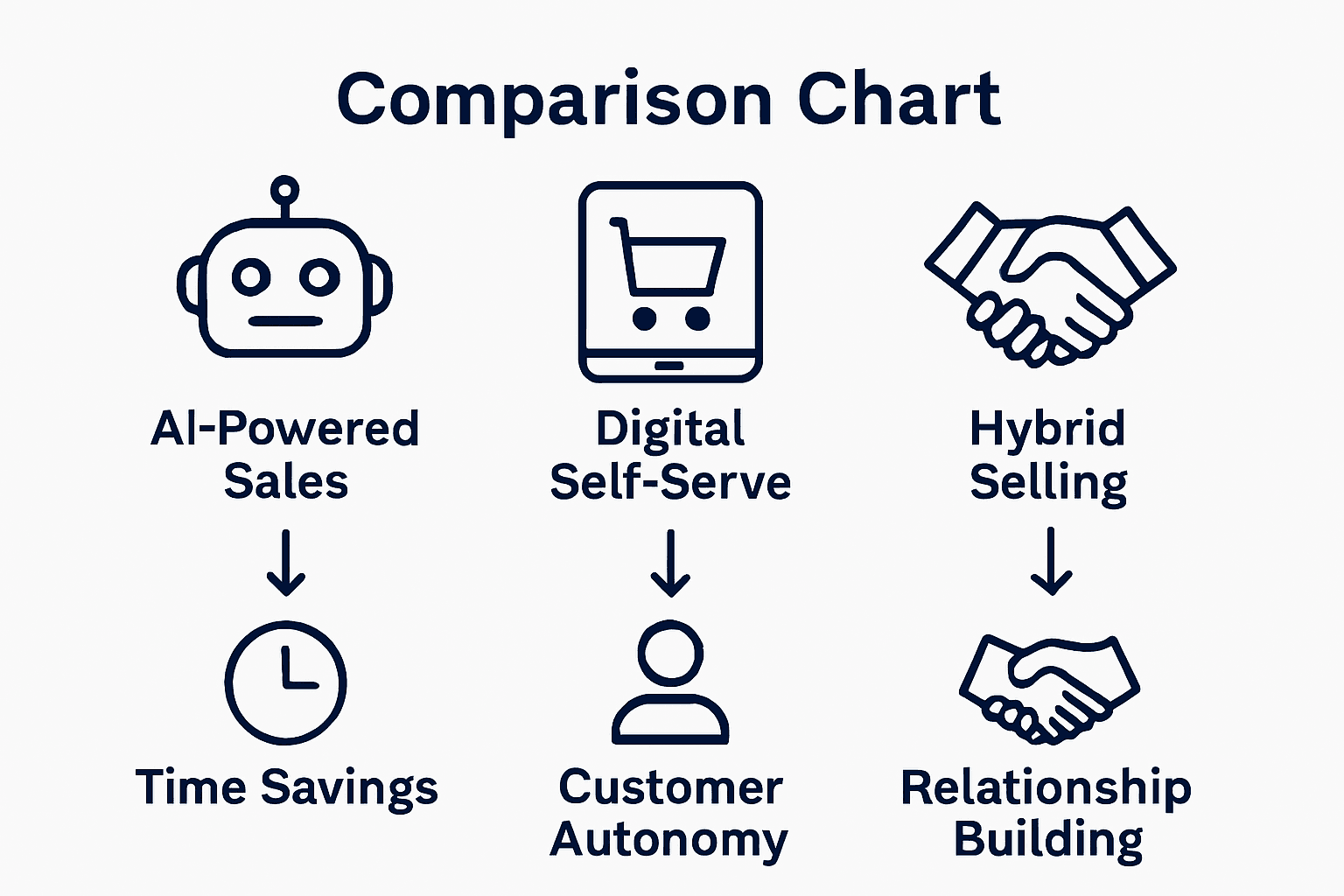
Here’s a comparison of key B2B sales approaches and their unique strengths:
| Approach | Main Benefit | Typical Use Case |
|---|---|---|
| AI-Powered Selling | Enhances efficiency and insight | Lead qualification and analytics |
| Self-Serve Digital Buying | Empowers informed, independent buyers | Fast procurement and product research |
| Hybrid Selling | Blends digital and human interaction | Complex deals and relationship building |
| Hyper-Personalisation | Drives tailored experiences | Targeted outreach and customer retention |
AI‑Powered Sales as Virtual Coworkers
Artificial Intelligence is rapidly transforming sales strategies, emerging as a powerful virtual collaborator that augments human capabilities. Advanced sales automation tools are enabling businesses to reimagine how sales teams operate, introducing intelligent systems that can handle complex tasks with unprecedented efficiency.
These AI-powered virtual coworkers are not about replacing human sales professionals, but enhancing their strategic capabilities. They can perform critical functions like lead scoring, predictive analytics, customer behaviour mapping, and routine communication management. By automating repetitive tasks, AI allows sales representatives to focus on high-value interactions that require emotional intelligence, creativity, and nuanced relationship building.
Key capabilities of AI virtual coworkers include:
- Intelligent lead qualification and prioritisation
- Real-time customer insights and sentiment analysis
- Automated personalised communication workflows
- Predictive sales forecasting and opportunity identification
- Seamless CRM integration and data management
Pro tip for AI Implementation: Start small by integrating AI tools into specific, measurable sales processes, allowing your team to gradually adapt and learn alongside these intelligent systems.
Successful implementation requires viewing AI as a collaborative partner, not a replacement. Sales teams that develop symbiotic relationships with their AI tools will gain significant competitive advantages in an increasingly sophisticated marketplace.
Self‑Serve Digital Buying Explosion
The digital transformation of B2B purchasing is accelerating at an unprecedented pace, with businesses increasingly embracing self-serve buying experiences that prioritise autonomy and efficiency. Sales acceleration strategies are rapidly evolving to accommodate this shift, recognising that modern buyers prefer comprehensive digital research and decision-making processes.

This digital buying explosion represents a fundamental restructuring of traditional sales interactions. Buyers now expect sophisticated online platforms that provide instant access to product information, transparent pricing, comprehensive comparisons, and seamless purchasing capabilities. The transition goes beyond mere technological convenience – it reflects a profound change in buyer psychology, where professionals seek control, speed, and depth of information before engaging with sales representatives.
Key characteristics of the self-serve digital buying landscape include:
- Interactive product configuration tools
- Detailed, transparent pricing models
- Comprehensive digital documentation and specifications
- Automated comparison and evaluation features
- Instant quote generation and procurement options
- AI-powered recommendation engines
Pro tip for Digital Buying Transformation: Design your digital purchasing experience with the same level of care and strategic thinking you would apply to an in-person sales meeting, focusing on user experience, clarity, and comprehensive information delivery.
Successful organisations will view this digital buying explosion not as a threat, but as an opportunity to reimagine customer engagement, creating more intelligent, responsive, and customer-centric sales ecosystems.
Hybrid Selling: Virtual Meets Face‑to‑Face
The evolving B2B sales landscape demands a nuanced approach that seamlessly blends digital interactions with traditional face-to-face engagement. Consultative selling techniques are becoming increasingly sophisticated, recognising that modern buyers expect flexible, personalised communication strategies that adapt to their preferred interaction modes.
Hybrid selling represents more than a technological compromise – it’s a strategic framework that leverages the strengths of both virtual and in-person interactions. Digital platforms enable initial research, preliminary meetings, and ongoing communication, while strategic face-to-face encounters provide depth, trust-building, and complex negotiation capabilities. This approach acknowledges that different stages of the sales process require different levels of personal interaction.
Key components of effective hybrid selling include:
- Intelligent channel selection based on client preferences
- Seamless transitions between virtual and physical touchpoints
- Consistent messaging across digital and in-person platforms
- Technology-enhanced relationship management
- Personalised communication strategies
- Adaptive interaction protocols
Pro tip for Hybrid Selling Strategy: Design your communication approach as a flexible ecosystem, allowing clients to move effortlessly between digital and physical interactions without losing contextual continuity.
Successful hybrid selling is not about choosing between virtual or face-to-face interactions, but creating a sophisticated, client-centric approach that prioritises meaningful engagement over rigid communication protocols.
Hyper‑Personalisation & Data‑Driven Selling
Data-driven selling has evolved from a competitive advantage to an absolute necessity in modern B2B interactions. B2B sales strategy guides increasingly emphasise the critical role of granular, intelligent data analysis in creating hyper-personalised customer experiences that transcend traditional segmentation approaches.
Hyper-personalisation represents a quantum leap beyond generic customer targeting. By leveraging advanced analytics, machine learning, and comprehensive data integration, businesses can now craft individual engagement strategies that respond to unique customer signals, behavioural patterns, and contextual nuances. This approach transforms sales interactions from transactional exchanges to sophisticated, tailored conversations that anticipate and address specific customer needs with unprecedented precision.
Key elements of hyper-personalised, data-driven selling include:
- Predictive behavioural analytics
- Real-time customer intent mapping
- Granular preference profiling
- Contextual interaction modelling
- Dynamic content personalisation
- Intelligent recommendation engines
- Micro-segmentation strategies
Pro tip for Data Personalisation: Develop a holistic data ecosystem that seamlessly integrates multiple touchpoints, ensuring your personalisation strategies are built on comprehensive, real-time customer insights.
Successful hyper-personalisation is not about overwhelming customers with information, but creating genuinely relevant, timely, and meaningful interactions that demonstrate a deep understanding of their unique business challenges and objectives.
The following table outlines how various technologies influence modern B2B sales outcomes:
| Technology | Sales Impact | Customer Benefit |
|---|---|---|
| Artificial Intelligence | Streamlines sales processes | Faster, more relevant responses |
| Digital Buying Platforms | Simplifies purchasing journey | Greater autonomy and transparency |
| CRM Integration | Centralises data for better decisions | More consistent engagement |
| Recommendation Engines | Personalises suggestions | Improved product relevance |
Master the Future of B2B Sales with Proven Strategies
The rise of AI, self-serve digital buying, and hybrid selling presents exciting opportunities but also real challenges for businesses striving to keep pace with 2025 sales trends. If you feel overwhelmed by integrating these technologies or need to balance data-driven selling with genuine human connections this is a critical moment to act. Unlock your sales team’s potential through expert coaching that merges bespoke 1:1 guidance with practical training focused on growth, agility and hitting sales targets every quarter.

Take control of your B2B sales transformation today by exploring our tailor-made programmes designed for companies ready to embrace advanced sales strategies. Discover insightful resources in our Sales Strategy Archives – Ahead of Sales and learn how to accelerate deals with the latest digital tools. Begin your journey at https://aheadofsales.co.uk and partner with us to secure at least 50% sales growth that keeps your business competitive now and beyond.
Frequently Asked Questions
What are the key B2B sales trends to watch for in 2025?
The key B2B sales trends include the rise of AI-powered selling, the growth of self-serve digital buying experiences, the hybrid selling model that combines digital and face-to-face interactions, and the importance of hyper-personalisation driven by data analytics.
How is AI transforming B2B sales strategies?
AI is enhancing B2B sales by automating tasks such as lead qualification and predictive analytics, allowing sales teams to focus on high-value interactions and relationship building, ultimately improving overall efficiency and effectiveness.
What is self-serve digital buying and why is it important?
Self-serve digital buying refers to the trend where businesses offer online platforms for customers to independently research, compare, and purchase products. This trend is important as it caters to the modern buyer’s preference for autonomy, speed, and easy access to product information.
How can businesses implement a hybrid selling approach effectively?
To implement a hybrid selling approach, businesses should focus on intelligent channel selection based on client preferences, ensure seamless transitions between virtual and in-person interactions, and maintain consistent messaging across all platforms.
Recommended
- B2B SaaS Sales Explained: Complete Process and Models – Ahead of Sales
- B2B Sales Strategy Guide for Exponential Growth Success
- B2B SaaS Sales Training | SaaS Sales Training | UK – Ahead of Sales
- Best Sales Automation Tools Comparison – Expert Review 2025 – Ahead of Sales
- Understanding Personal Finance Trends 2025 for Better Decisions – Finblog