
Sales teams that receive ongoing training outperform their peers by as much as 50 percent in revenue growth. In fast-moving markets, yesterday’s tactics rarely win tomorrow’s deals, so keeping skills sharp is crucial. Embracing a continuous training approach equips professionals to adapt, thrive, and convert more prospects into customers. This article uncovers how consistent development not only sharpens sales expertise but also fuels lasting business success.
Table of Contents
- Defining Ongoing Sales Training And Its Purpose
- Key Formats And Customization Options Explained
- Measuring Business Impact And ROI Of Training
- Best Practices For Continuous Sales Development
- Common Pitfalls And How To Overcome Them
Key Takeaways
| Point | Details |
|---|---|
| Ongoing Sales Training is Essential | Continuous training enhances skills, adapts to market changes, and empowers sales teams for sustainable growth. |
| Customization Drives Effectiveness | Tailored training programs that address specific team needs and leverage diverse learning formats maximize engagement and performance. |
| Measuring ROI is Crucial | Establishing robust evaluation frameworks to track key performance indicators ensures training remains relevant and impactful. |
| Best Practices Foster Development | Implementing personalized learning pathways, regular assessments, and a culture of improvement sustains sales development initiatives. |
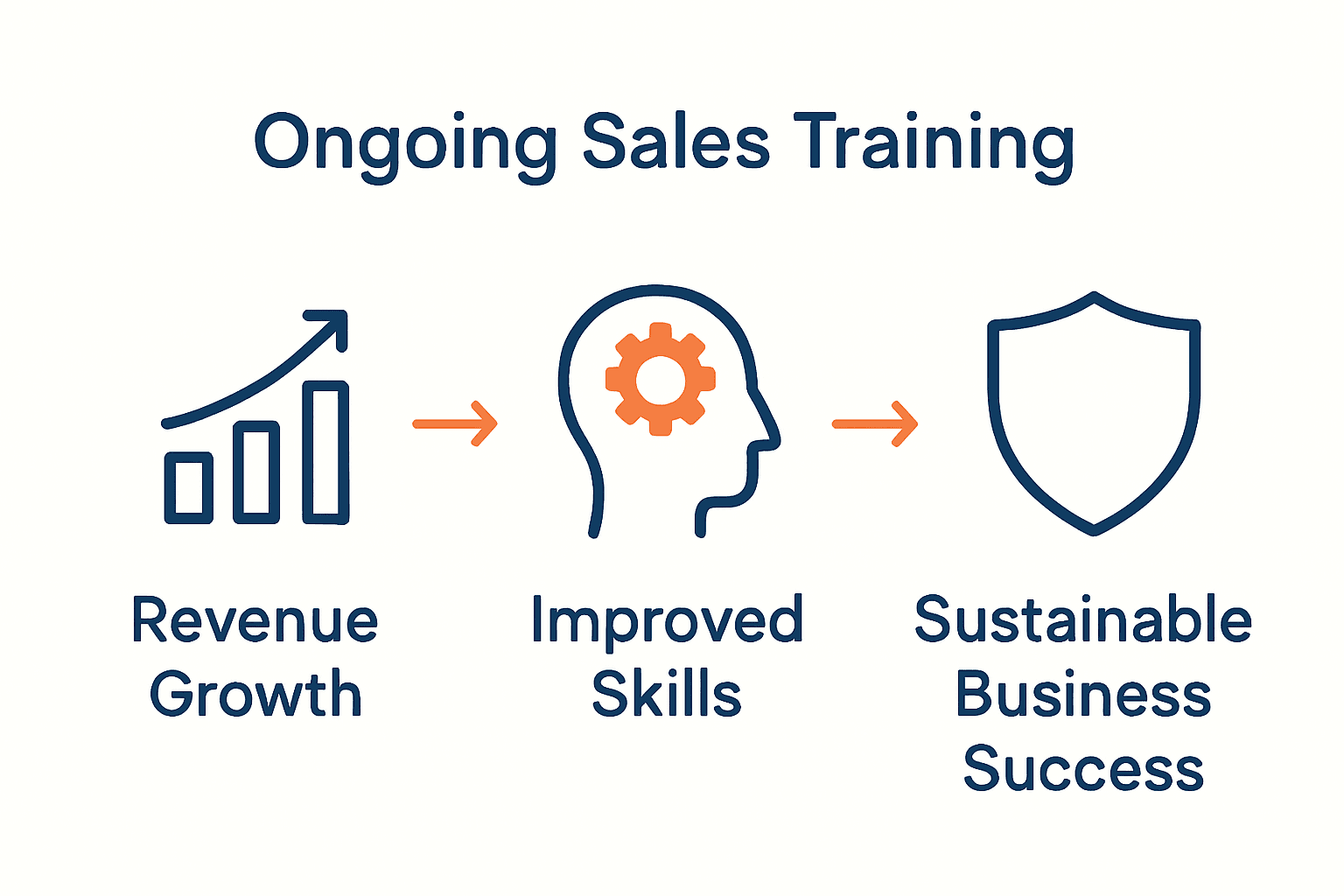
Defining Ongoing Sales Training and Its Purpose
Ongoing sales training represents a strategic, continuous process of skill enhancement and professional development designed to keep sales professionals at the peak of their performance. According to ESA Web, this approach involves continuous skill development that encompasses product knowledge, sales methodologies, and communication techniques to ensure sales professionals remain effective in dynamic business environments.
Sales enablement goes beyond traditional training models by providing comprehensive resources throughout the entire buyer journey. As defined by Talent Development, it represents a strategic effort to enhance productivity through:
- Continuous learning and skill refinement
- Targeted coaching interventions
- Systematic content creation
- Process improvement strategies
The purpose of ongoing sales training extends far beyond basic skill instruction. It serves as a critical mechanism for adapting to rapidly changing market conditions, emerging technologies, and evolving customer expectations. By investing in consistent professional development, organisations create resilient sales teams capable of navigating complex business landscapes with agility and precision.
Businesses that embrace ongoing sales training ultimately position themselves to achieve sustainable growth. These organisations recognize that sales excellence is not a destination but a continuous journey of learning, adaptation, and strategic improvement. Discover our guide on effective sales training methods to understand how structured, ongoing training can transform your sales performance.
Key Formats and Customization Options Explained
Ongoing sales training is not a one-size-fits-all approach but a nuanced strategy that demands sophisticated customization. According to Imarticus, successful training programs integrate interactive learning experiences like role-plays, simulations, and case studies tailored to address unique team challenges and requirements.
A comprehensive sales academy incorporates multiple learning formats to maximise engagement and knowledge retention. Talent Development highlights these diverse training modalities:
- Written instructional materials
- Instructor-led classroom training
- Digital learning platforms
- One-to-one coaching sessions
- Peer-to-peer knowledge sharing
Customization goes beyond selecting training formats. It involves deeply understanding your sales team’s specific skills gaps, individual learning preferences, and organisational goals. By mapping training content directly to performance metrics and strategic objectives, businesses can create targeted development pathways that drive meaningful professional growth.

The most effective customization strategies blend technological tools with human-centric approaches. This means leveraging advanced learning management systems, interactive digital platforms, and data-driven insights while maintaining personal mentorship and contextual learning experiences. Check out our guide on effective sales training methods to explore how tailored training can transform your team’s performance.
Measuring Business Impact and ROI of Training
Measuring the return on investment (ROI) of sales training requires a sophisticated approach that goes beyond simple performance metrics. According to Talent Development, maintaining training relevance is crucial for protecting investment and ensuring that learning programs adapt to evolving market conditions.
To effectively assess training impact, businesses should track multiple key performance indicators (KPIs) that demonstrate tangible business outcomes:
- Sales revenue growth
- Conversion rate improvements
- Customer acquisition costs
- Individual and team performance metrics
- Knowledge retention rates
- Skill proficiency measurements
Strategic measurement involves more than retrospective analysis. As Talent Development suggests, intentional integration of training into sales meetings can enhance ROI by ensuring deliberate time allocation, participant engagement, and clear learning objectives.
Ultimately, the most successful organisations view training ROI as a dynamic, continuous process of investment and evaluation. By establishing robust measurement frameworks and remaining committed to ongoing skill development, businesses can transform training from a cost centre into a strategic growth driver.
Explore our guide on sales team performance strategies to understand how targeted training investments can unlock unprecedented business potential.
Best Practices for Continuous Sales Development
Continuous sales development requires a strategic, holistic approach that goes beyond traditional training methodologies. Talent Development emphasizes the importance of establishing a structured sales academy with a comprehensive competency framework that supports ongoing professional growth and performance benchmarking for sales professionals.
Key best practices for sustaining sales development include:
- Creating personalized learning pathways
- Implementing regular skill assessment checkpoints
- Developing a culture of continuous improvement
- Leveraging technology-enabled learning platforms
- Encouraging peer-to-peer knowledge sharing
- Providing immediate, actionable feedback mechanisms
Adaptability is crucial in sales development. As Talent Development suggests, organisations must consistently update training content to reflect changing market dynamics and evolving buyer behaviors. This ensures that sales professionals remain agile, informed, and capable of meeting emerging business challenges.
Successful continuous development is not about sporadic training interventions but about creating a sustainable ecosystem of learning and growth. Learn more about essential sales team training topics to understand how strategic, ongoing development can transform your sales team’s performance and drive significant business outcomes.
Common Pitfalls and How to Overcome Them
Sales training initiatives often encounter significant challenges that can derail their effectiveness and impact. According to Talent Development, a prevalent critical mistake is attempting to drive behavioral change through isolated, standalone training events without considering realistic time allocation and establishing clear learning objectives.
Common pitfalls in sales training development include:
- Inconsistent or sporadic training approaches
- Lack of personalized learning pathways
- Insufficient performance tracking mechanisms
- Minimal post-training support and reinforcement
- Neglecting individual learning preferences
- Failure to align training with specific business goals
Talent Development emphasizes that organisations must remain adaptable, consistently updating training content to reflect evolving market conditions and buyer behaviors. Overcoming these challenges requires a strategic, holistic approach that views training as a continuous process of skill development and organisational growth.
Successful sales teams transform potential pitfalls into opportunities for improvement by implementing robust, flexible learning ecosystems. Explore our guide on impactful sales coaching strategies to understand how targeted interventions can turn training challenges into competitive advantages.
Unlock Consistent Sales Growth with Expert Ongoing Training
The challenges highlighted in the guide to ongoing sales training resonate deeply with many ambitious businesses. Struggling with inconsistent training, unclear learning objectives and a fragmented approach to skill development can leave your sales team underperforming and unprepared for shifting market demands. If your goal is to create a resilient sales force equipped with personalised learning pathways and continuous coaching that drives real results, the solution lies in a proven strategy designed specifically for your needs.
At Ahead of Sales, we combine bespoke 1:1 coaching with traditional training and consultancy to ensure your sales team hits their targets every quarter and helps your business achieve at least 50 per cent growth annually. Our approach aligns perfectly with the article’s emphasis on customisation, continuous development and measuring ROI. If you are ready to transform your sales performance while avoiding common pitfalls, explore our effective sales training methods and impactful sales coaching strategies.
Are you prepared to elevate your sales team’s abilities and secure lasting growth?
Discover how our tailored programmes can overcome your current sales training challenges and propel your team to success. Visit Ahead of Sales today to start your journey towards higher conversions, stronger sales skills and measurable growth now.
Frequently Asked Questions
What is ongoing sales training?
Ongoing sales training is a strategic, continuous process that enhances the skills and professional development of sales professionals, ensuring they remain effective in changing business environments.
Why is ongoing sales training important for businesses?
Ongoing sales training helps businesses adapt to market changes, emerging technologies, and evolving customer expectations, ultimately positioning them for sustainable growth and sales excellence.
What are the key components of effective ongoing sales training?
Key components include continuous learning, targeted coaching interventions, systematic content creation, and process improvement strategies tailored to meet the specific needs of the sales team.
How can businesses measure the effectiveness of their sales training programs?
Businesses can measure effectiveness through various key performance indicators (KPIs) such as sales revenue growth, conversion rate improvements, customer acquisition costs, and individual team performance metrics.