
Over 70 percent of successful SaaS companies credit long-term customer relationships as their main growth driver. In this space, selling software is not just about closing a deal but building trust and guiding clients through ongoing change. With subscription models and rapid technology shifts, mastering SaaS sales means rethinking every part of the sales journey. Discover what sets SaaS sales apart and why a strategic, relationship-focused approach can transform your company’s growth.
Table of Contents
- Defining Sales In SaaS Growth Context
- Sales Models And Revenue Generation Strategies
- Key Sales Team Roles And Responsibilities
- Sales Impact Across SaaS Growth Stages
- Common Pitfalls And Best Practice Solutions
Key Takeaways
| Point | Details |
|---|---|
| SaaS Sales Focus | SaaS sales prioritize long-term customer relationships and success over one-time transactions, requiring a consultative approach in customer engagement. |
| Revenue Models | Successful SaaS companies utilize varied revenue models such as subscription, freemium, and usage-based pricing to enhance growth and predictability. |
| Sales Team Structure | Specialized roles within SaaS sales teams foster collaboration and customer satisfaction, with responsibilities aligned to different stages of the customer journey. |
| Navigating Pitfalls | Address common SaaS sales challenges through rigorous lead qualification, effective onboarding, and alignment between sales and marketing efforts to enhance customer retention. |
Defining Sales in SaaS Growth Context
Sales in the SaaS (Software as a Service) ecosystem represents a strategic approach fundamentally different from traditional product sales. Subscription-based models demand a nuanced understanding of customer acquisition, retention, and ongoing value delivery. According to Saffron Edge, SaaS sales strategies are uniquely tailored to address the continuous engagement required in cloud-based software environments.
Unlike traditional sales models, SaaS sales focus on long-term customer relationships rather than single transactional interactions. The core objective shifts from initial purchase to sustained customer success and recurring revenue. Alore emphasizes that understanding customer needs becomes paramount, with sales teams acting more as consultative partners who guide clients through continuous software adoption and optimization.
Key characteristics of SaaS sales include:
- Recurring revenue models
- Customer success-driven approaches
- Relationship-based selling
- Emphasis on product usage and value demonstration
- Metrics focused on customer lifetime value

Successful SaaS sales professionals must blend technical understanding, strategic communication, and persistent relationship management. They are no longer mere product pushers but trusted advisors who help businesses leverage technology for transformative growth. By aligning sales strategies with customer outcomes, SaaS companies can create sustainable growth engines that drive both immediate revenue and long-term customer retention.
For deeper insights into developing effective SaaS sales strategies, check out our comprehensive guide on B2B SaaS sales models.
Sales Models and Revenue Generation Strategies
SaaS revenue generation requires strategic alignment between product offering and sales approach. Fincome highlights that modern SaaS companies leverage multiple revenue models to maximize growth potential, including subscription-based, freemium, and usage-based pricing strategies. These models provide flexibility in attracting and retaining customers while creating predictable revenue streams.
Close emphasizes that successful SaaS sales methodologies go beyond traditional selling techniques. Consultative and value-selling approaches have emerged as powerful strategies, focusing on understanding customer pain points and demonstrating tangible business outcomes rather than simply pushing product features.
Key revenue generation strategies for SaaS businesses include:
- Tiered subscription models
- Freemium entry points
- Performance-based pricing
- Customer success-driven upselling
- Targeted enterprise expansion
Navigating these complex sales models requires a nuanced understanding of customer segmentation, value proposition, and long-term relationship building. Sales teams must become strategic partners who not only sell software but also ensure customer transformation and ongoing satisfaction. By integrating sophisticated sales strategy techniques, SaaS companies can create sustainable growth ecosystems that adapt to evolving market demands and customer expectations.
Key Sales Team Roles and Responsibilities
Saffron Edge provides comprehensive insights into the intricate structure of SaaS sales teams, highlighting the critical roles that drive growth and customer success. Unlike traditional sales environments, SaaS sales teams are designed with specialized positions that focus on different stages of the customer journey, ensuring a holistic approach to revenue generation and client satisfaction.
Alore emphasizes the unique responsibilities of each team member in creating a seamless sales ecosystem. The typical SaaS sales team comprises several key roles, each with distinct yet interconnected responsibilities:
Here’s a summary of core SaaS sales team roles and their main responsibilities:
| Role | Primary Responsibilities |
|---|---|
| Sales Development Representative (SDR) | Lead generation Initial prospect qualification |
| Account Executive (AE) | Product demonstrations Deal closing |
| Customer Success Manager | Customer satisfaction Retention and upselling |
| Sales Engineer | Technical support Complex sales assistance |
| Sales Operations Specialist | Process optimisation Performance metric management |
Core Sales Team Roles:
- Sales Development Representatives (SDRs): Responsible for lead generation and initial prospect qualification
- Account Executives (AEs): Handle detailed product demonstrations and closing deals
- Customer Success Managers: Ensure ongoing customer satisfaction and drive retention
- Sales Engineers: Provide technical expertise and support during complex sales processes
- Sales Operations Specialists: Optimize sales processes and manage critical performance metrics
The effectiveness of a SaaS sales team lies in its ability to work collaboratively, with each role contributing to the overall customer acquisition and retention strategy. Modern sales teams must be agile, technologically savvy, and deeply committed to understanding customer needs. For a deeper understanding of building high-performance sales teams, explore our comprehensive guide to sales team structure.
Sales Impact Across SaaS Growth Stages
Saffron Edge reveals the dynamic nature of sales strategies across different stages of SaaS company growth. Each growth phase demands a unique approach to sales, transforming from initial survival mode to sophisticated, scalable revenue generation systems. The sales function evolves from simply closing deals to becoming a strategic driver of company expansion and customer success.
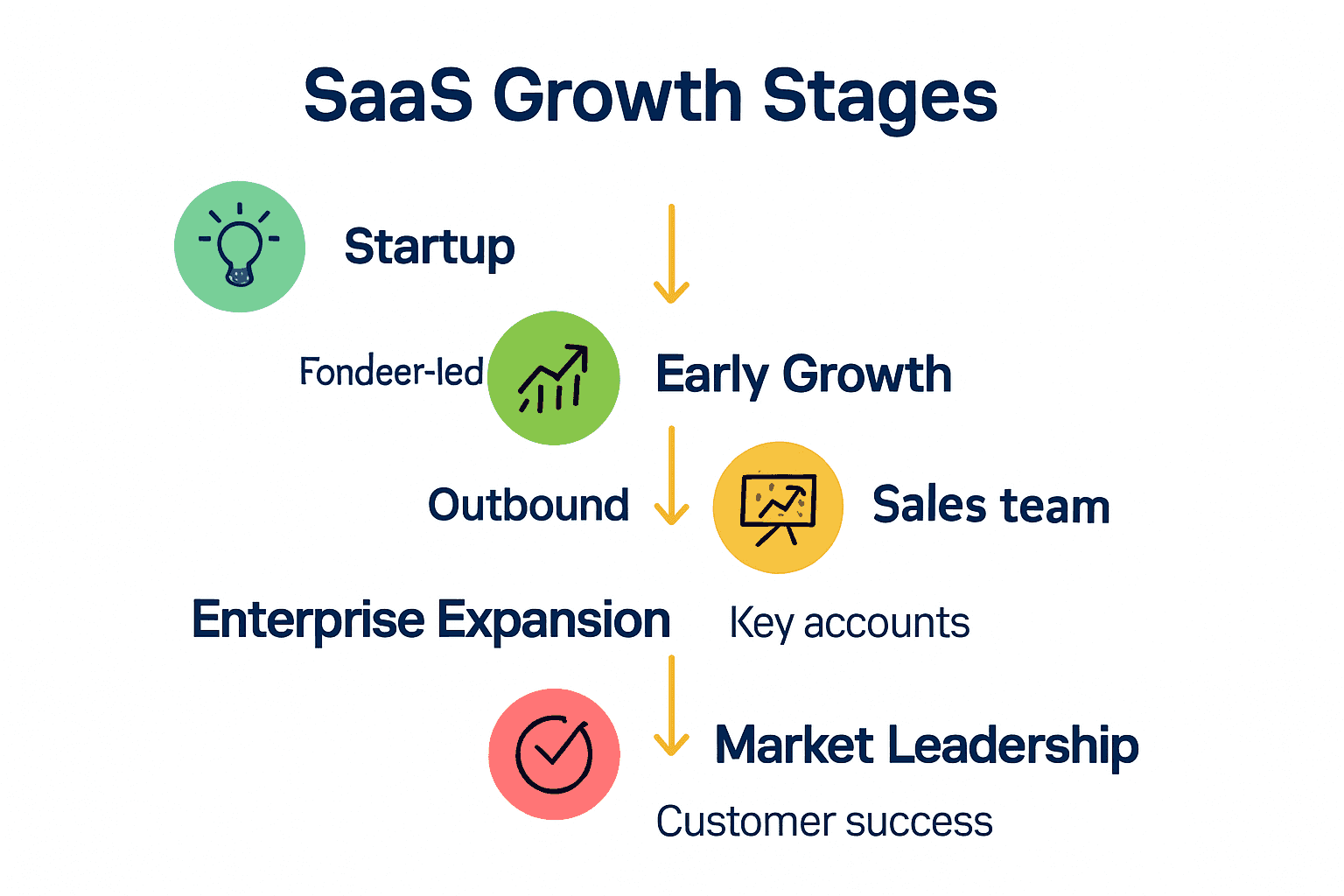
Alore highlights the critical shifts in sales tactics throughout a SaaS company’s lifecycle. The progression typically follows these key stages:
Growth Stage Sales Characteristics:
- Startup Stage: Founder-led sales, relationship-driven approach
- Early Growth: Specialized sales roles emerge, focus on product-market fit
- Scale-up Phase: Robust sales processes, data-driven decision making
- Enterprise Expansion: Complex sales cycles, strategic account management
- Market Leadership: Consultative selling, comprehensive solution offerings
Successful SaaS companies recognize that sales is not a static function but a dynamic capability that must continuously adapt to changing market conditions, customer expectations, and technological innovations. The most effective sales teams remain agile, constantly refining their approach to match the company’s growth trajectory. For more insights into optimizing your sales approach, explore our sales team optimization guide.
Common Pitfalls and Best Practice Solutions
Saffron Edge exposes the critical challenges plaguing SaaS sales teams, highlighting that most failures stem from systemic issues rather than individual performance. The most prevalent pitfalls often emerge from misaligned strategies, inadequate customer understanding, and reactive rather than proactive sales approaches that can dramatically impede growth and customer retention.
Alore provides comprehensive insights into the most common SaaS sales obstacles and their strategic solutions. The landscape of SaaS sales demands a nuanced approach that goes beyond traditional selling techniques, requiring continuous adaptation and sophisticated relationship management.
Key Pitfalls and Corresponding Best Practices:
- Inadequate Lead Qualification: Implement rigorous qualification frameworks
- Poor Customer Onboarding: Design structured, personalized onboarding experiences
- Misaligned Sales and Marketing: Create integrated, collaborative communication channels
- Inconsistent Value Proposition: Develop clear, measurable value narratives
- High Customer Churn: Establish proactive customer success and engagement strategies
Navigating these challenges requires a holistic approach that prioritizes customer understanding, continuous learning, and adaptive sales methodologies. The most successful SaaS organizations view sales not as a transactional process, but as a strategic partnership focused on delivering sustained value. For deeper insights into building resilient sales strategies, explore our comprehensive guide to sales team optimization.
Unlock Your SaaS Sales Potential with Expert Guidance
The role of sales in SaaS growth demands more than just closing deals. If you are struggling with customer retention, lead qualification, or aligning your sales team with modern SaaS revenue models, you are not alone. The article highlights how relationship-driven selling, customer success, and strategic team roles are essential to building predictable, scalable growth. Many businesses face the challenge of evolving their sales function from reactive to proactive strategies that maximise lifetime customer value and reduce churn.
Don’t let these common pitfalls stall your SaaS company’s growth. At Ahead of Sales, we combine bespoke 1:1 coaching with proven training and consultancy to help your sales team not just meet but exceed targets quarter on quarter. Whether you lead a team of 50 or 1000, our tailored packages focus on practical solutions for sales acceleration, team structure optimisation, and value-based selling techniques that drive measurable results. Visit our main landing page to discover how you can transform your sales strategy today and start generating at least 50% growth annually. Also explore our comprehensive guide on B2B SaaS sales models and the sales team optimisation guide for immediate insights to fuel your success.
Take control of your SaaS sales growth now and build a future-proof sales engine designed to win.
Frequently Asked Questions
What is the role of sales in the SaaS growth model?
Sales in the SaaS growth model focuses on building long-term customer relationships, prioritizing customer success, and generating recurring revenue rather than one-time transactions.
How do SaaS sales strategies differ from traditional sales approaches?
SaaS sales strategies emphasize consultative selling, addressing customer needs throughout the lifecycle, and demonstrating ongoing product value, unlike traditional sales that often focus on completing one-time transactions.
What are common pitfalls in SaaS sales and how can they be avoided?
Common pitfalls in SaaS sales include inadequate lead qualification, poor customer onboarding, and misaligned sales and marketing strategies. These can be addressed by implementing rigorous qualification frameworks, structured onboarding experiences, and integrated communication channels.
What key roles are essential in a SaaS sales team?
A SaaS sales team typically includes roles such as Sales Development Representatives (SDRs), Account Executives (AEs), Customer Success Managers, Sales Engineers, and Sales Operations Specialists, each focusing on different stages of the customer journey.