
Every sales executive knows the frustration of deals stalling for reasons that seem unclear. For growing British businesses, understanding the difference between a sales pipeline and a sales funnel is more than a technicality—it shapes how your team tracks progress and chases new opportunities. By focusing on a dynamic, effective pipeline management approach, you can identify bottlenecks, improve forecasts, and set a clear path for steady revenue growth quarter after quarter.
Table of Contents
- Defining Sales Pipelines And Common Misconceptions
- Stages And Structures Of Effective Sales Pipelines
- Driving Predictable Revenue And Business Growth
- Enabling Consistent Team Performance And Accountability
- Risks Of Neglecting Pipeline Management
Key Takeaways
| Point | Details |
|---|---|
| Understanding Sales Pipelines | A sales pipeline is a dynamic tool that tracks potential customer interactions through measurable stages, optimising sales strategies for better revenue generation. |
| Importance of Customisation | Customising sales pipeline structures to reflect unique business models is crucial for effective tracking and responsiveness to market changes. |
| Predictable Revenue Strategies | Developing consistent lead generation mechanisms and maintaining clear performance benchmarks is essential for achieving sustainable business growth. |
| Risks of Neglect | Inadequate pipeline management can lead to unpredictable revenues, decreased morale, and significant operational vulnerabilities, requiring continuous oversight. |
Defining Sales Pipelines and Common Misconceptions
A sales pipeline represents the strategic roadmap tracking potential customer interactions from initial contact through final sale. Unlike generic sales tracking methods, it provides a granular visual representation of where prospects are positioned within your specific sales process.
Businesses often misunderstand sales pipelines, confusing them with related but distinct concepts. Sales pipeline management involves systematically breaking down the sales journey into measurable stages, enabling teams to analyse and optimise their approach. Key characteristics include:
- Tracking individual deal progression
- Monitoring potential revenue at each stage
- Identifying potential bottlenecks in the sales process
- Providing predictive insights about future sales performance
One common misconception is treating the sales pipeline as a static document. In reality, it’s a dynamic tool requiring continuous refinement. Successful organisations recognise that effective pipeline management demands regular data updates, strategic analysis, and adaptive strategies.
Sales pipelines are not just tracking mechanisms; they’re strategic navigation systems for revenue generation.
Another frequent error is conflating sales pipelines with sales funnels. While related, they serve distinct purposes. A sales pipeline focuses on the seller’s actions and deal stages, whereas a sales funnel represents lead conversion rates from a customer perspective.
To clarify the distinction between sales pipeline and sales funnel, here is a comparison:
| Aspect | Sales Pipeline | Sales Funnel |
|---|---|---|
| Perspective | Seller-focused | Customer-focused |
| Tracks | Actions and deal stages | Lead conversion journey |
| Business Use | Managing sales activities | Measuring conversion rates |
| Outcome | Predicts potential revenue | Shows percentage of leads closing |
Pro tip: Invest time in creating a customised sales pipeline that reflects your specific business model and sales cycle stages.
Stages and Structures of Effective Sales Pipelines
Developing a robust sales pipeline requires understanding its distinct stages and creating a strategic framework that accurately reflects your business’s unique sales journey. Sales pipeline stages represent a carefully mapped progression of customer interactions designed to transform potential leads into confirmed sales.
Typically, a comprehensive sales pipeline encompasses several critical stages:
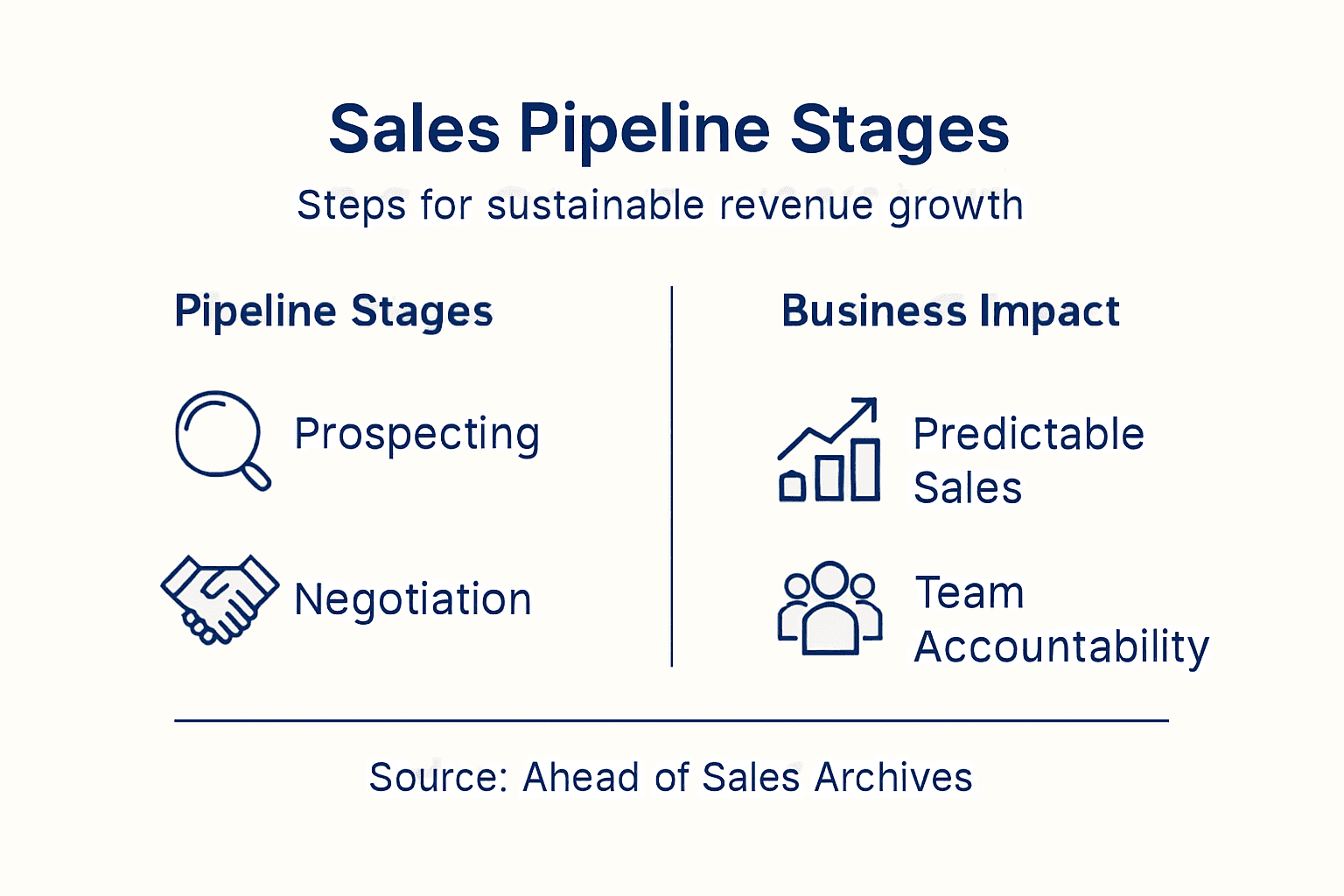
- Prospecting: Identifying and researching potential customers
- Lead Qualification: Assessing whether prospects match ideal customer profiles
- Initial Contact: Establishing first meaningful communication
- Proposal Development: Creating tailored solutions for potential clients
- Negotiation: Discussing terms, pricing, and specific requirements
- Closing: Finalising the transaction
- Post-Sale Support: Ensuring customer satisfaction and potential future opportunities
Successful sales teams recognise that each stage requires specific strategies and measurable benchmarks. By defining clear activities and expectations for each pipeline phase, organisations can systematically track deal progression, identify potential bottlenecks, and improve overall conversion rates.
An effective sales pipeline is not just a tracking tool, but a strategic navigation system for revenue generation.
Customising your pipeline structure is crucial. Different industries and business models demand unique approaches, meaning a one-size-fits-all methodology rarely delivers optimal results. Regular pipeline review and refinement ensure your sales process remains agile and responsive to changing market dynamics.
Pro tip: Conduct quarterly reviews of your sales pipeline stages to ensure they remain aligned with your evolving business objectives and market conditions.
Driving Predictable Revenue and Business Growth
Predictable revenue generation is the lifeblood of sustainable business growth. Pipeline readiness strategies emphasise the critical importance of developing a systematic approach to sales and marketing alignment that consistently drives financial performance.
Successful organisations focus on several key strategies to ensure predictable revenue:
- Maintaining robust pipeline coverage ratios
- Implementing rigorous lead qualification processes
- Developing consistent lead generation mechanisms
- Creating data-driven forecasting models
- Establishing clear performance benchmarks
- Continuously refining sales methodologies
The foundation of predictable revenue lies in understanding and optimising your sales ecosystem. This requires deep insights into conversion rates, customer acquisition costs, and the specific activities that drive meaningful pipeline progression. Businesses must move beyond traditional sales tracking to develop a more nuanced, proactive approach to revenue generation.
Predictable revenue is not about luck, but about creating a repeatable, systematic process for generating business growth.
Technology and data analytics play a crucial role in transforming sales pipelines from reactive tracking tools to strategic growth engines. By leveraging advanced analytics and customer relationship management systems, organisations can gain real-time insights, predict potential bottlenecks, and make informed decisions that directly impact revenue performance.
Pro tip: Implement monthly pipeline health checks to identify and address potential gaps in your revenue generation strategy.
Enabling Consistent Team Performance and Accountability
Consistent team performance requires a structured approach to sales pipeline management that creates clear expectations, measurable outcomes, and transparent accountability. Sales team effectiveness hinges on establishing robust systems that align individual performance with organisational objectives.
Key elements of driving team consistency include:
- Implementing standardised performance metrics
- Creating transparent reporting mechanisms
- Developing clear performance expectations
- Establishing regular performance review cycles
- Providing continuous skills development
- Designing incentive structures that reward team collaboration
Successful sales teams recognise that accountability is not about punitive measures, but about creating an environment of continuous improvement and mutual support. This means developing a culture where team members understand their individual contributions and how they connect to broader organisational goals.
Accountability transforms individual efforts into collective success.
Technology plays a crucial role in enabling team performance and accountability. Modern customer relationship management (CRM) systems and performance tracking tools provide real-time insights, allowing managers to monitor progress, identify potential challenges, and offer targeted support precisely when it’s needed.

Below is a reference summary of sales pipeline technology benefits:
| Technology Benefit | Description | Business Impact |
|---|---|---|
| Real-time insights | Immediate access to sales data | Faster decision-making |
| Bottleneck identification | Quickly spot stalled deals | Improved process efficiency |
| Revenue forecasting | Accurate future sales predictions | Enhanced financial planning |
| Performance tracking | Monitor team and individual activity | Increased accountability |
Pro tip: Conduct monthly team performance reviews that focus on collaborative problem-solving rather than individual criticism.
Risks of Neglecting Pipeline Management
Neglecting sales pipeline management can have devastating consequences for businesses, potentially derailing growth and creating significant operational vulnerabilities. Pipeline risk management represents a critical strategic imperative for organisations seeking sustainable performance.
The primary risks of inadequate pipeline management include:
- Unpredictable revenue streams
- Decreased sales team morale
- Inaccurate financial forecasting
- Missed growth opportunities
- Reduced competitive responsiveness
- Inefficient resource allocation
Businesses that fail to maintain rigorous pipeline oversight often experience a cascading effect of performance challenges. Without clear visibility into sales processes, organisations become reactive rather than proactive, struggling to anticipate market shifts and customer needs.
Neglected sales pipelines are like unattended gardens: without consistent care, they quickly become overgrown and unproductive.
The financial implications of poor pipeline management can be substantial. Inaccurate sales projections, inability to identify potential bottlenecks, and lack of strategic insights can lead to significant revenue losses and diminished market positioning.
Pro tip: Implement weekly pipeline review sessions that involve both sales leadership and individual team members to maintain continuous operational transparency.
Unlock Sustainable Sales Growth with Expert Pipeline Management
Understanding how a sales pipeline drives predictable revenue and team accountability is crucial for overcoming common challenges like unpredictable revenue streams and missed opportunities. If you are seeking to optimise your sales stages, improve forecasting accuracy and empower your team, then mastering pipeline management is your path to success.
Explore tailored solutions in our Sales Strategy Archives – Ahead of Sales that combine bespoke 1:1 coaching with proven training and consultancy. At Ahead of Sales, we help businesses with growth mindsets escalate their sales performance by at least 50 percent every year while ensuring their sales teams consistently hit targets each quarter. Start transforming your sales pipeline into a strategic growth engine today by visiting our website and discovering how our unique approach can secure your sustainable growth.
Frequently Asked Questions
What is a sales pipeline?
A sales pipeline is a strategic roadmap that tracks potential customer interactions from initial contact to final sale, providing a visual representation of where prospects are in the sales process.
How does sales pipeline management improve sales performance?
Sales pipeline management breaks down the sales journey into measurable stages, allowing teams to analyse progress, identify bottlenecks, and optimise their sales approach for better conversion rates.
What are the key stages of an effective sales pipeline?
The key stages typically include prospecting, lead qualification, initial contact, proposal development, negotiation, closing, and post-sale support, each requiring specific strategies and benchmarks.
Why is technology important for sales pipeline management?
Technology, such as CRM systems, provides real-time insights, helping to identify bottlenecks, enhance revenue forecasting, and improve overall accountability, enabling organisations to make informed decisions regarding sales strategies.