
Keeping your sales team focused and driven can feel like a constant balancing act between incentives and genuine engagement. For many British sales directors, the real question is how to inspire lasting motivation when bonus schemes alone stop delivering results. Discover how intrinsic motivation often proves far more powerful than cash rewards, and why top-performing teams are built on purpose, autonomy, and ongoing development rather than commission structures alone.
Table of Contents
- What Motivates High-Performing Sales Teams
- Types of Sales Team Motivation Approaches
- Essential Drivers of Sales Motivation
- Mistakes That Undermine Sales Team Morale
- Innovative Strategies for Sustained Results
Key Takeaways
| Point | Details |
|---|---|
| Understanding Motivation | High-performing sales teams thrive on a blend of intrinsic and extrinsic motivation, with personal growth and recognition often surpassing financial rewards. |
| Effective Motivation Strategies | Strategies should integrate structured goals, autonomy, and opportunities for skill development, addressing both individual and team needs. |
| Common Pitfalls | Sales leaders must avoid demotivational practices such as unrealistic targets and poor communication to maintain morale and engagement. |
| Innovative Approaches for Success | Continuous learning and personalised development programmes are crucial for sustaining exceptional sales performance in a competitive landscape. |
What Motivates High-Performing Sales Teams
Sales team motivation extends far beyond simple financial incentives. Complex intrinsic and extrinsic factors drive sustainable performance and engagement across top-performing teams.
Understanding these motivational drivers requires a nuanced approach. High-performing sales professionals are typically motivated by a combination of personal growth opportunities, recognition, and meaningful organisational alignment. The research indicates that intrinsic motivation – those internal rewards driven by personal satisfaction and professional development – often outweighs traditional monetary compensation.
Key motivational elements for exceptional sales teams include:
- Clear, challenging performance goals
- Regular performance feedback
- Opportunities for skill development
- Recognition of individual and team achievements
- Autonomy in managing sales strategies
- A supportive team culture
- Transparent career progression pathways
Effective motivation strategies require understanding team dynamics and individual aspirations. Sales leaders must create environments that balance structured targets with personal growth opportunities, enabling teams to feel genuinely invested in their professional journey.
Pro tip: Design personalised motivation frameworks that recognise individual salespeople’s unique strengths and career ambitions, moving beyond one-size-fits-all incentive structures.
Types of Sales Team Motivation Approaches
Sales team motivation is a multifaceted strategy that goes well beyond traditional monetary rewards. Six-dimensional motivation frameworks reveal the complex psychological and professional drivers that truly inspire high-performing sales professionals.
These motivation approaches can be categorised into several key types, each addressing different aspects of professional engagement and performance. Intrinsic motivation focuses on internal rewards like personal achievement and professional growth, while extrinsic motivation involves external incentives such as financial compensation and recognition programmes.
Primary motivation approaches include:
- Financial Incentives
- Performance-based bonuses
- Commission structures
- Sales targets with monetary rewards
- Recognition Programmes
- Public acknowledgement of achievements
- Awards and certificates
- Career progression opportunities
- Professional Development
- Ongoing skills training
- Mentorship programmes
- Leadership development tracks
- Psychological Motivation
- Autonomy in sales strategies
- Meaningful work connections
- Supportive team environment
Comprehensive motivation strategies emphasise the importance of creating a holistic ecosystem that addresses individual needs while aligning with organisational goals. Successful approaches integrate multiple motivation types, recognising that salespeople are complex professionals with diverse drivers.
Pro tip: Develop a personalised motivation matrix that combines financial, professional, and psychological incentives tailored to individual sales team members’ unique strengths and aspirations.
Essential Drivers of Sales Motivation
Cognitive and psychological drivers form the foundation of sustainable sales team motivation, extending far beyond simple financial rewards. Understanding these complex motivational mechanisms is crucial for creating high-performing sales environments.

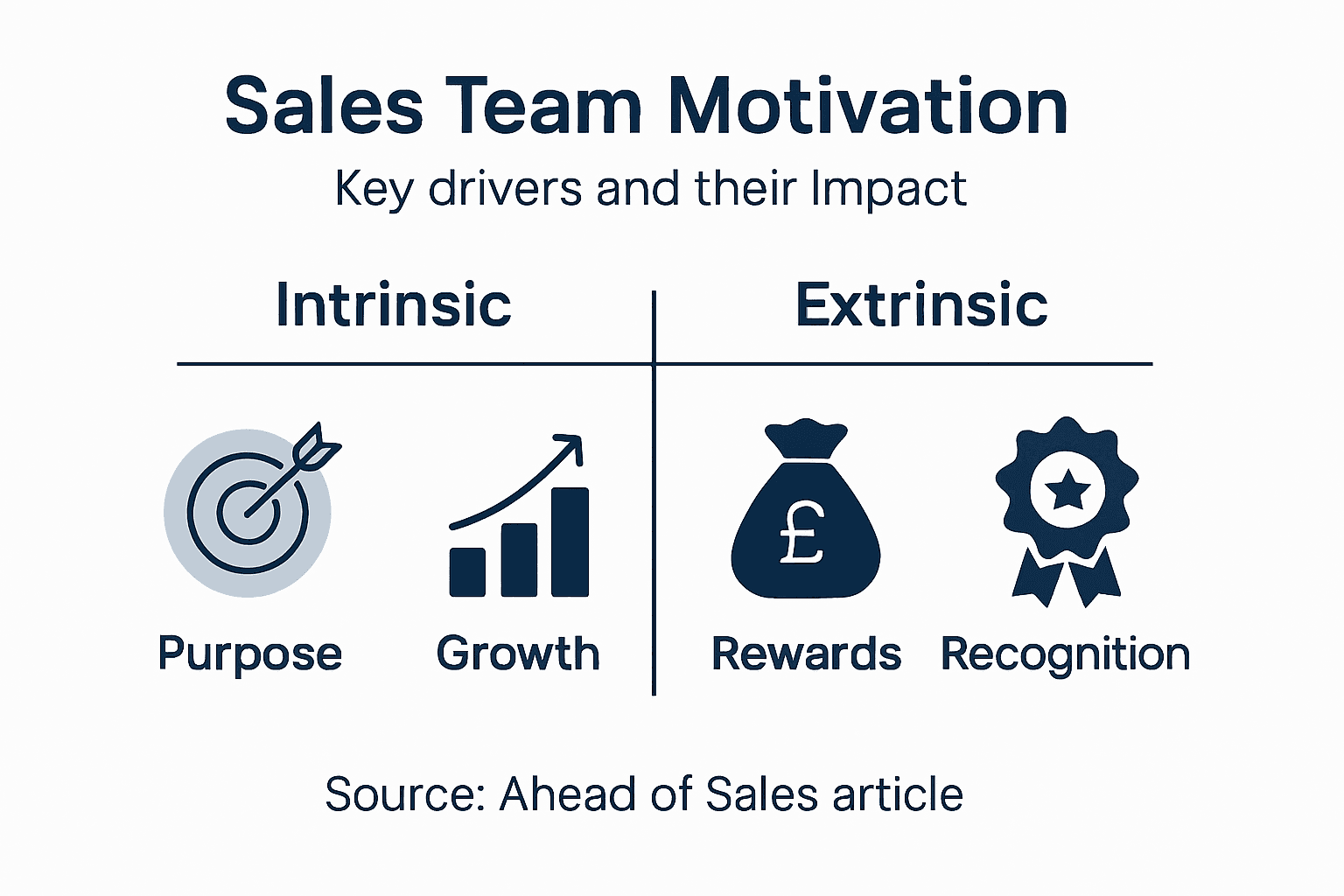
The essential drivers of sales motivation can be categorised into two primary domains: intrinsic motivation and extrinsic motivation. Intrinsic motivation emerges from internal psychological needs, while extrinsic motivation stems from external rewards and recognition. Both play critical roles in maintaining consistent sales performance and team engagement.
The table below contrasts intrinsic and extrinsic motivation, highlighting their psychological focus and typical outcomes for sales teams:
| Motivation Type | Primary Focus | Typical Outcomes | Examples in Sales Context |
|---|---|---|---|
| Intrinsic | Personal satisfaction and development | Increased engagement and resilience | Pursuing mastery or autonomy |
| Extrinsic | External rewards and recognition | Short-term performance boosts | Achieving bonus targets |
Key motivation drivers include:
- Intrinsic Motivation Drivers
- Personal autonomy
- Sense of mastery
- Professional purpose
- Intellectual challenge
- Career growth potential
- Extrinsic Motivation Drivers
- Performance bonuses
- Commission structures
- Public recognition
- Career advancement opportunities
- Competitive compensation packages
Cognitive choice and goal orientation represent sophisticated psychological mechanisms that influence sales performance. These drivers involve deliberate decision-making about effort, focusing on both performance and learning objectives, which create a dynamic and adaptable sales environment.
Successful motivation strategies integrate these intrinsic and extrinsic elements, recognising that salespeople are complex professionals with multifaceted professional aspirations.
Pro tip: Design individualised motivation frameworks that balance psychological fulfilment with tangible performance incentives, creating a holistic approach to sales team engagement.
Mistakes That Undermine Sales Team Morale
Leadership practices and communication failures frequently create significant challenges in maintaining sales team motivation and engagement. Understanding these critical mistakes is essential for creating a productive and supportive sales environment.
Sales leaders often inadvertently damage team morale through several key missteps. Systemic demotivation occurs when organisations neglect the complex psychological needs of their sales professionals, treating them as mere revenue-generating machines rather than skilled, nuanced professionals with unique aspirations and challenges.
Primary mistakes that undermine sales team morale include:
- Performance Management Errors
- Setting unrealistic sales targets
- Inconsistent performance evaluation criteria
- Punitive approach to missed targets
- Lack of constructive feedback
- Communication Failures
- Unclear organisational messaging
- Insufficient team recognition
- Opaque career progression pathways
- Minimal transparent communication
- Motivational Strategy Gaps
- Overreliance on financial incentives
- Ignoring intrinsic motivation factors
- Limited professional development opportunities
- Minimal investment in team skill enhancement
Sales ecosystem management strategies reveal that sustained team performance requires a holistic approach addressing both individual and collective motivational needs. Recognising and rectifying these motivational pitfalls is crucial for building resilient, high-performing sales teams.
Here is a summary of common pitfalls and their likely impacts on sales team morale:
| Mistake Category | Specific Example | Likely Impact on Team |
|---|---|---|
| Performance Management | Unrealistic targets | Heightened stress, turnover risk |
| Communication Failures | Lack of transparent recognition | Decreased motivation, disengagement |
| Motivational Strategy | Ignoring skill development opportunities | Reduced loyalty, missed potential |
Pro tip: Conduct regular, confidential team surveys to identify demotivational factors and develop targeted intervention strategies that address specific team engagement challenges.
Innovative Strategies for Sustained Results
Continuous learning and development programs are essential for maintaining exceptional sales team performance in today’s dynamic business landscape. Innovative approaches must transcend traditional motivational techniques, focusing instead on holistic professional growth and psychological engagement.
Successful organisations recognise that sustained results emerge from sophisticated, multifaceted strategies. Performance consistency requires a nuanced approach that balances data-driven insights, personalised coaching, and creating an environment that nurtures intrinsic motivation among sales professionals.
Key innovative strategies include:
- Learning and Development
- Personalised skill enhancement programmes
- Regular microlearning sessions
- Cross-functional training opportunities
- Adaptive learning technologies
- Performance Optimization
- Advanced analytics for individual coaching
- Real-time performance feedback mechanisms
- Customised development pathways
- Psychological safety interventions
- Motivation Enhancement
- Purpose-driven goal alignment
- Intrinsic reward systems
- Autonomy in sales approach
- Transparent career progression frameworks
Intrinsic motivation strategies demonstrate that sustainable sales performance transcends monetary incentives. By creating an ecosystem that prioritises individual growth, organisational support, and meaningful work, companies can unlock extraordinary team potential.
Pro tip: Implement quarterly personalised development plans that combine data-driven insights with individual career aspirations, ensuring continuous professional growth and sustained motivation.
Unlock Powerful Sales Team Motivation with Ahead of Sales
Driving consistent sales results requires more than just setting targets. The article highlights critical challenges such as balancing intrinsic and extrinsic motivation, providing personalised growth opportunities, and avoiding common leadership mistakes that damage morale. If you recognise these pain points in your organisation, it is essential to move beyond one-size-fits-all incentives and embrace tailored approaches that empower your sales team to perform at their best.
Our revolutionary approach at Ahead of Sales combines bespoke 1:1 coaching with traditional training and consultancy designed specifically to address complex motivational drivers. We help businesses with growth mindsets integrate clear goal-setting, real-time feedback, and skill development into their sales strategy. Discover practical tools and techniques in our comprehensive Sales Strategy Archives and detailed insights in the Sales Playbook Archives to transform motivation into measurable sales growth.
Take control of your sales team’s motivation now by visiting Ahead of Sales to explore how our personalised packages can help you achieve at least 50 percent sales growth every year. Don’t wait until motivation problems cost you valuable deals and morale. Start your journey towards sustained sales success today.
Frequently Asked Questions
What are the main factors that motivate high-performing sales teams?
High-performing sales teams are motivated by a mix of intrinsic and extrinsic factors, including personal growth opportunities, recognition, clear performance goals, regular feedback, skill development, and a supportive team culture.
How do intrinsic and extrinsic motivators differ in driving sales performance?
Intrinsic motivation focuses on internal rewards such as personal satisfaction and professional development, while extrinsic motivation consists of external rewards like financial compensation and recognition programs. Both are crucial for sustaining team engagement and performance.
What common mistakes do sales leaders make that can undermine team morale?
Sales leaders often make mistakes like setting unrealistic sales targets, failing to provide consistent performance evaluation, lacking constructive feedback, and over-relying on financial incentives without addressing intrinsic motivation factors.
What innovative strategies can be employed to sustain sales team motivation?
Innovative strategies include personalised learning and development programmes, real-time performance feedback, purpose-driven goal alignment, and creating an environment that fosters intrinsic motivation holistically.