
Raising sales performance year after year can feel relentless for ambitious sales leaders, especially when growth targets stretch towards the fifty percent mark. The challenge lies in more than managing numbers or processes. True success depends on mastering sales leadership dynamics—the ability to inspire teams, build trust, and strategically steer collective effort. This article highlights how effective leadership can turn team potential into impressive, sustained sales growth in the competitive United Kingdom market.
Table of Contents
- Defining Leadership In Sales Growth
- Key Leadership Styles And Approaches
- Essential Skills And Behaviours For Success
- Strategic Responsibilities Of Sales Leaders
- Risks, Pitfalls And How To Avoid Them
Key Takeaways
| Point | Details |
|---|---|
| Sales Leadership Requires Adaptability | Effective sales leaders must be flexible, tailoring their leadership styles to match team dynamics and market conditions. |
| Emotional Intelligence is Crucial | Understanding team motivations and dynamics is essential for creating a high-performing sales environment. |
| Continuous Development is Necessary | Leaders should engage in regular self-reflection and skill enhancement to inspire growth within their teams. |
| Proactive Risk Management is Key | Anticipating potential pitfalls and implementing strategies to counteract them ensures sustained team performance and morale. |
Defining Leadership in Sales Growth
Leadership in sales growth represents a dynamic and complex process that goes far beyond traditional management approaches. At its core, sales leadership involves guiding, motivating, and strategically directing sales teams to achieve extraordinary performance outcomes. Sales leadership dynamics significantly impact an organisation’s top-line and bottom-line performance.
Sales leadership is not merely about supervising; it involves creating an environment where team members can consistently excel. The key characteristics of effective sales leadership include:
- Inspiring and motivating team members
- Setting clear performance expectations
- Providing strategic guidance and support
- Developing individual and collective sales capabilities
- Creating a culture of continuous improvement
Interestingly, leadership emergence in sales teams demonstrates that effective leaders are not always formally appointed. In high-performing B2B environments, implicit leaders naturally emerge who can guide and motivate their colleagues through influence and expertise.
Successful sales leadership requires a nuanced understanding of team dynamics, individual motivations, and organisational goals. Sales leaders must balance strategic thinking with practical execution, creating pathways for both individual and collective success. They need to be adaptable, resilient, and capable of navigating complex competitive landscapes.
Pro tip: Invest time in understanding each team member’s unique strengths and developmental needs to create targeted leadership strategies.
Key Leadership Styles and Approaches
Sales leadership styles represent a critical determinant of team performance and organisational success. Leadership styles in sales encompass diverse approaches that enable leaders to inspire, motivate, and strategically guide their sales teams through complex business environments.
The primary leadership styles in sales include:
- Transformational Leadership: Focuses on inspiring and motivating team members to exceed expectations
- Transactional Leadership: Emphasises clear performance metrics and reward systems
- Servant Leadership: Prioritises team members’ professional development and individual needs
- Democratic Leadership: Encourages team participation in decision-making processes
- Autocratic Leadership: Provides direct, prescriptive guidance with minimal team input
- Situational Leadership: Adapts leadership approach based on team and individual capabilities
Successful sales leaders understand that no single leadership style is universally effective. The most impactful approach involves flexibly integrating multiple styles, tailoring leadership strategies to specific team dynamics, individual strengths, and organisational objectives. This adaptive approach allows leaders to respond dynamically to changing market conditions and team performance requirements.
Effective sales leadership requires deep emotional intelligence, strategic thinking, and the ability to create an environment of continuous learning and improvement. Leaders must balance performance expectations with genuine support, creating pathways for individual and collective growth.

Pro tip: Develop a flexible leadership approach by continuously observing your team’s performance, individual motivations, and learning how to dynamically adjust your leadership style.
Below is a comparison of key sales leadership styles and the scenarios in which they are typically most effective:
| Leadership Style | Ideal Team Scenario | Business Impact |
|---|---|---|
| Transformational | Motivated teams needing inspiration | Drives long-term engagement |
| Transactional | New or target-driven groups | Ensures performance consistency |
| Servant | Developing or high-potential teams | Boosts loyalty and retention |
| Autocratic | Crisis or urgent change needed | Offers clear direction swiftly |
| Democratic | Experienced, collaborative teams | Fosters innovation and inclusion |
| Situational | Diverse teams or shifting markets | Maximises adaptability |
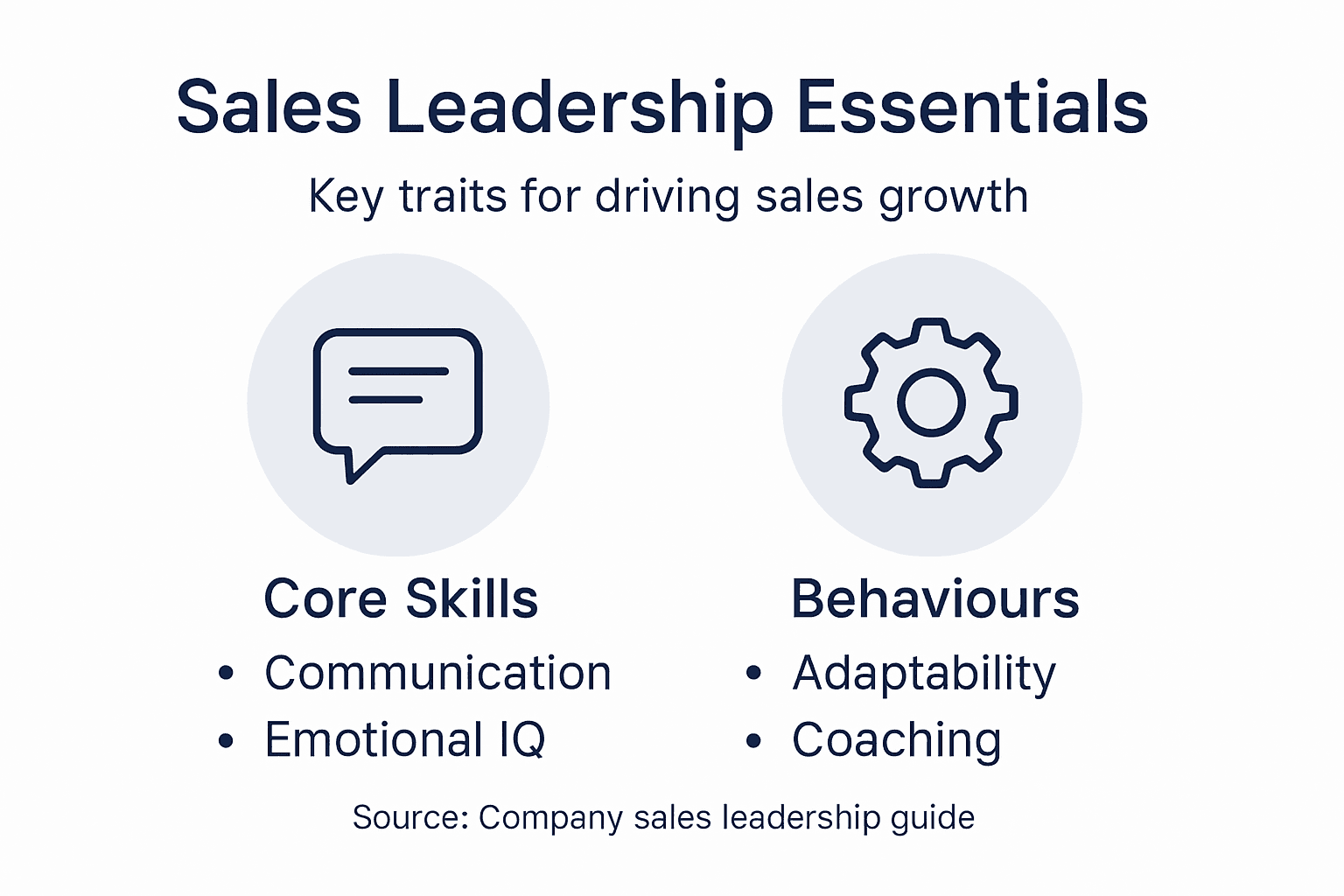
Essential Skills and Behaviours for Success
Sales leadership demands a comprehensive set of skills that go beyond traditional management approaches. Top sales leadership capabilities encompass strategic decision-making, authentic leadership, and the ability to inspire high-performance teams through dynamic engagement.
The essential skills and behaviours for successful sales leadership include:
- Strategic Thinking: Developing long-term vision and adaptive strategies
- Emotional Intelligence: Understanding and managing team dynamics
- Communication Mastery: Articulating clear expectations and providing constructive feedback
- Talent Development: Identifying and nurturing individual team member potential
- Performance Coaching: Providing targeted guidance and support
- Change Management: Navigating organisational disruption and transformation
- Resilience: Maintaining team motivation during challenging periods
Successful sales leaders understand that technical competence alone is insufficient. They must combine deep industry knowledge with exceptional interpersonal skills, creating an environment of trust, continuous learning, and collaborative growth. This holistic approach enables teams to navigate complex sales landscapes and consistently exceed performance expectations.
Continuous personal development remains crucial for sales leaders. This involves regularly reflecting on personal performance, seeking feedback, understanding emerging market trends, and investing in personal skill enhancement. Leaders who demonstrate vulnerability and a commitment to their own growth inspire similar behaviour in their teams.
Pro tip: Dedicate at least one hour per week to structured self-reflection and skill development, focusing on both personal growth and team performance strategies.
The following table summarises how essential sales leadership skills support successful outcomes:
| Skill Area | How It Contributes | Typical Result |
|---|---|---|
| Strategic Thinking | Guides vision and action | Achieves sustainable growth |
| Emotional Intelligence | Builds team cohesion | Reduces internal conflicts |
| Communication | Clarifies objectives | Minimises misunderstandings |
| Talent Development | Fosters expertise | Accelerates capability growth |
| Resilience | Manages adversity | Maintains high morale |
Strategic Responsibilities of Sales Leaders
Sales leadership transcends traditional management, requiring a comprehensive approach to organisational strategy and team performance. Strategic leadership responsibilities encompass a holistic view of driving organisational growth and team potential.
Key strategic responsibilities of sales leaders include:
- Organisational Alignment: Ensuring sales strategies integrate with broader business objectives
- Market Intelligence: Continuously analysing market trends and competitive landscapes
- Performance Architecture: Designing robust sales frameworks and performance measurement systems
- Talent Ecosystem: Creating development pathways and succession planning
- Resource Optimization: Strategically allocating human and technological resources
- Innovation Management: Introducing and implementing cutting-edge sales methodologies
- Risk Mitigation: Identifying and managing potential strategic and operational risks
Successful sales leaders operate as strategic architects, balancing immediate performance requirements with long-term organisational vision. They must develop sophisticated understanding of both internal team dynamics and external market complexities, translating strategic insights into actionable performance frameworks.
The most effective sales leaders view their role as transformational rather than transactional. They create environments that foster continuous learning, encourage calculated risk-taking, and align individual team member aspirations with organisational growth objectives. This approach requires exceptional communication skills, emotional intelligence, and a forward-thinking mindset.
Pro tip: Develop a quarterly strategic review process that systematically evaluates team performance, market shifts, and alignment with organisational objectives.
Risks, Pitfalls and How to Avoid Them
Sales leadership involves navigating complex challenges that can potentially derail team performance and organisational objectives. Costly leadership pitfalls emerge when leaders fail to understand the nuanced human elements of team management.
Common risks and pitfalls in sales leadership include:
- Inadequate Coaching: Neglecting individual team member development
- Misaligned Incentives: Creating reward structures that encourage short-term thinking
- Communication Breakdown: Failing to maintain transparent and consistent dialogue
- Talent Retention Issues: Not investing in team member growth and satisfaction
- Strategic Myopia: Focusing solely on immediate targets while ignoring long-term potential
- Resistance to Change: Maintaining rigid approaches in dynamic market environments
- Insufficient Performance Monitoring: Lacking robust feedback and evaluation mechanisms
Successful sales leaders must proactively identify and mitigate these risks by developing comprehensive strategies that address both systemic and individual challenges. This requires a holistic approach that balances performance expectations with genuine team support and continuous development.
Mitigating leadership risks demands ongoing self-reflection, adaptability, and a commitment to creating a supportive, growth-oriented organisational culture. Leaders must remain vigilant, continuously updating their skills, understanding emerging market dynamics, and maintaining open channels of communication with their teams.
Pro tip: Implement a monthly 360-degree feedback mechanism that allows team members to provide confidential insights into leadership effectiveness and potential improvement areas.
Unlock Exceptional Sales Growth with Proven Leadership Strategies
The article highlights the critical role of sales leadership in driving sustained performance and the complex challenges leaders face in motivating and guiding their teams. If you are struggling with inadequate coaching, misaligned incentives, or the need for a flexible leadership style, it is time to take decisive action. Effective sales leadership is not just about managing targets but creating a culture that inspires growth while navigating market complexities.

Discover how bespoke 1:1 coaching combined with tailored sales training can transform your leadership approach and accelerate your team’s success. Our packages, designed for businesses eager to achieve at least 50% sales growth year on year, will help you align sales strategy with organisational goals while developing resilient, high-performing teams. Start your journey with insights from our Sales Strategy Archives – Ahead of Sales and empower your sales leaders with proven playbooks from Sales Playbook Archives – Ahead of Sales. Ready to transform your sales leadership and consistently hit targets? Visit Ahead of Sales today and take the first step towards mastering the leadership skills that drive real sales growth.
Frequently Asked Questions
What is the role of leadership in driving sales growth?
Leadership in sales growth involves guiding and motivating sales teams to achieve exceptional performance, creating an environment for success, and strategically aligning team objectives with organisational goals.
What are the key characteristics of effective sales leadership?
Key characteristics include the ability to inspire and motivate team members, set clear expectations, provide strategic guidance, develop skills, and foster a culture of continuous improvement.
How can different leadership styles impact sales team performance?
Different leadership styles can significantly influence motivation and productivity. For instance, transformational leadership inspires teams, while transactional leadership focuses on performance metrics and rewards, tailoring approaches to individual and team dynamics leads to better results.
What essential skills should a sales leader develop?
Essential skills for a sales leader include strategic thinking, emotional intelligence, communication mastery, talent development, and resilience, which collectively help to foster a high-performance team environment.