
Chasing higher activity numbers often leaves sales directors wondering why consistent quarterly growth remains elusive. For mid-sized British companies, making a serious investment in your sales force demands more than tracking calls and meetings—it requires focusing on sales effectiveness. When your team excels at each stage of the customer’s buying process, you achieve stronger client relationships, reliable deal closures, and predictable revenue. This overview highlights practical strategies and critical metrics to help you diagnose gaps and elevate your team’s performance.
Table of Contents
- Defining Sales Effectiveness And Its Importance
- Key Metrics And How To Measure Progress
- Distinguishing Effectiveness, Efficiency, And Productivity
- Strategies To Improve Sales Team Performance
- Common Pitfalls And How To Avoid Them
Key Takeaways
| Point | Details |
|---|---|
| Sales Effectiveness vs Activity | Focusing on sales effectiveness, rather than sheer activity, leads to better closure rates and sustainable customer relationships. |
| Importance of Measurement | Tracking key performance indicators consistently helps identify trends and areas needing improvement, ensuring accountability across the sales team. |
| Efficiency vs Effectiveness | Distinguishing between efficiency and effectiveness is crucial; achieving both simultaneously enhances overall productivity and revenue growth. |
| Structured Coaching and Processes | Ongoing personalised coaching and a well-defined sales process are vital for driving performance improvements and achieving targets. |
Defining Sales Effectiveness and Its Importance
Sales effectiveness isn’t about working harder or pushing more deals through the pipeline. It’s about your team winning at every stage of the customer’s buying journey and closing business on the right terms and timeframe. For a sales director managing 10 to 50 salespeople, this distinction matters enormously. You could have a team generating impressive activity numbers—calls made, meetings booked, proposals sent—yet still miss quarterly targets. That’s because raw activity doesn’t translate to revenue. What matters is whether your sales professionals are actually moving customers forward in a way that leads to closed deals and sustainable relationships.
Consider what this means in practical terms. Your company invests roughly 10% of its sales revenue into your sales force, making it one of your largest operational expenses. That’s a serious investment, and it demands serious returns. Sales effectiveness cuts across everything your team does: how they qualify opportunities, the way they communicate value to prospects, their ability to navigate objections, and ultimately, how they close deals. When your team is genuinely effective, you see it reflected in several ways. Your sales per client contact increases. Your win rates improve. Customer relationships strengthen because your salespeople are solving real problems rather than chasing transactions. Revenue becomes more predictable, and you hit your quarterly targets consistently rather than scrambling in the final weeks.
The research shows that sales effectiveness requires collaboration between your sales and marketing teams, continuous improvement of sales knowledge, and regular measurement of performance metrics. This isn’t something you fix once and forget. You need to diagnose where your team is struggling—perhaps your conversion rate at the proposal stage, or your ability to handle objections from procurement teams, or your follow up on stalled deals—and then address it directly. Many sales directors treat effectiveness as a vague concept tied solely to hitting numbers. In reality, understanding your sales force effectiveness framework helps you see the whole picture. Different roles within your sales team contribute to effectiveness differently. Your account managers add value to existing customers. Your business development managers focus on acquiring new clients. Your technical salespeople might be closing complex enterprise deals. Each needs different support, coaching, and measurement criteria.
For a mid-sized company, the stakes are particularly high. You’re probably competing against larger organisations with bigger marketing budgets and smaller, more agile competitors who can move faster than you. Your sales team is often your competitive advantage. Building genuine sales effectiveness means you can punch above your weight. You can take market share. You can achieve consistent quarterly growth without burning out your team through pure hustle and hope. It means turning sales from a cost centre that management questions every budget review into a revenue engine that investors and shareholders actually believe in.
Pro tip: Start by mapping your current sales process stage by stage and identifying where you’re actually losing deals—then focus your coaching and training efforts on fixing those specific leaks rather than trying to improve everything at once.
Key Metrics and How to Measure Progress
You cannot manage what you do not measure. This is the uncomfortable truth that separates sales directors who consistently hit targets from those who scramble through the final weeks of each quarter. Measuring sales effectiveness means identifying which metrics actually matter for your business, then tracking them relentlessly. The problem most mid-sized companies face is drowning in data without clarity on what to pay attention to. Your CRM generates hundreds of reports. Your sales teams log activities constantly. But without the right focus, you end up chasing vanity metrics that feel good but do not drive revenue.
The metrics that genuinely predict success fall into distinct categories. Your lead conversion rate tells you how many prospects become qualified opportunities. Your deal conversion rate shows what percentage of opportunities close as customers. Your quota attainment reveals whether individual salespeople and your team overall are hitting targets. Your win rate measures how many deals you win compared to what you lose. Your pipeline coverage indicates whether you have enough opportunities in your pipeline to hit future targets. Your sales cycle length measures how long deals take from first contact to close. These are not optional metrics you measure when you feel like it. They are the foundation of intelligent sales leadership. When you track key performance indicators consistently, you spot trends before they become problems. You see which salespeople need coaching. You identify which stages of your sales process are leaking opportunities.
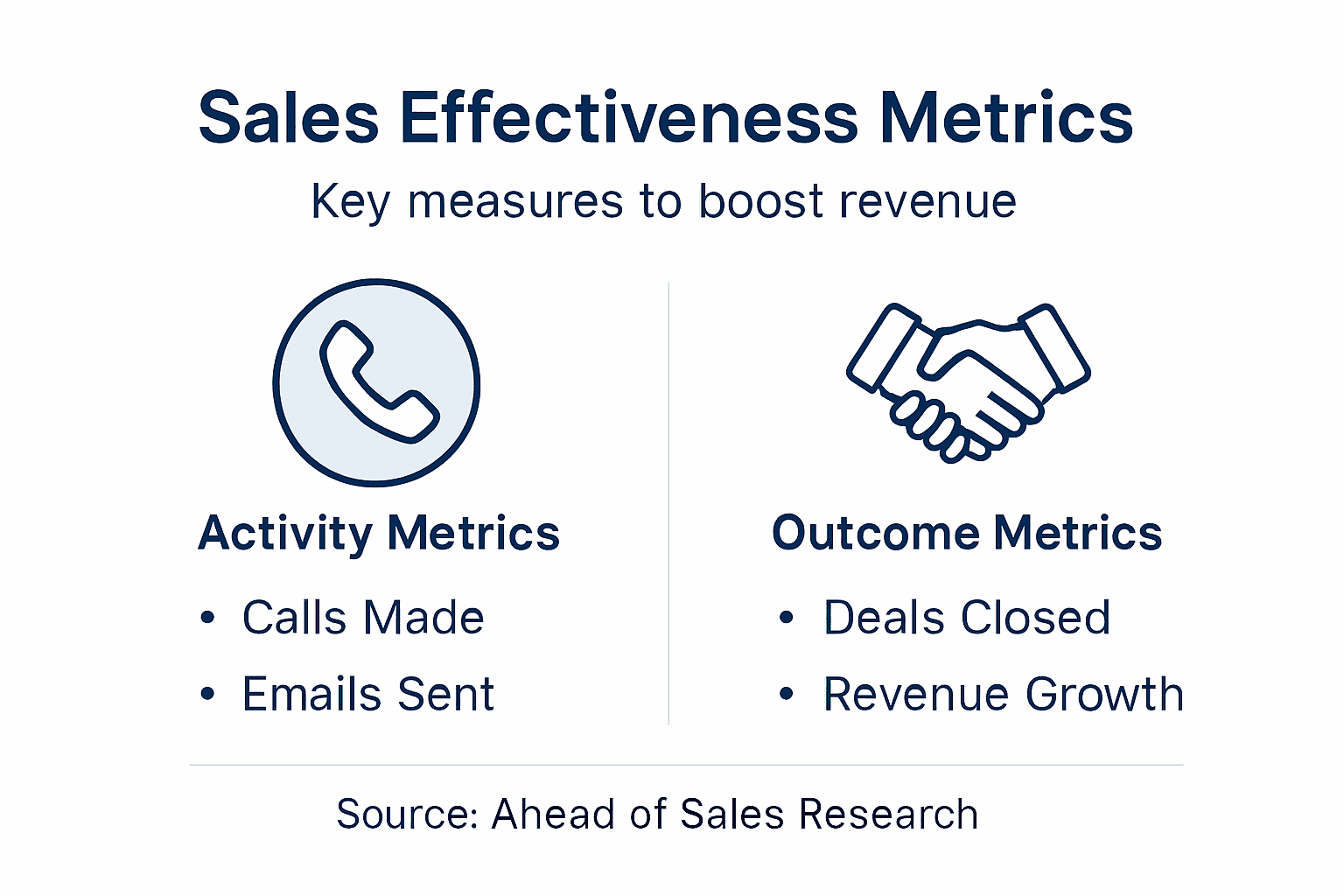
Here is the critical distinction: activity metrics versus outcome metrics. Activity metrics count calls made, emails sent, meetings booked. Outcome metrics measure deals closed, revenue generated, customers retained. Many sales leaders obsess over activity metrics because they feel tangible and controllable. Your salesperson makes twenty calls, and you can verify that happened. But your salesperson could make twenty calls and close zero deals. Outcome metrics are harder to control in the short term, but they are the only ones that matter. You need both working together. Activity metrics help you coach and support your team. Outcome metrics tell you whether the support is actually working. The best sales organisations measure sales effectiveness through multiple lens—win rates, quota attainment, pipeline coverage, and conversion rates—then use this combination to identify exactly where coaching and process improvements will have the highest impact.
Implementing measurement requires discipline. You need to decide which metrics matter most for your specific business, then establish baseline numbers before you start improving. If your average sales cycle is ninety days, that is your baseline. If your current win rate is thirty per cent, that is your starting point. Then you set realistic improvement targets. Perhaps you aim to reduce sales cycle length to seventy-five days over the next two quarters. Perhaps you target a win rate increase to thirty-five per cent. These improvements might seem modest, but compound them across your team and the revenue impact becomes substantial. Track these metrics weekly, review them in one-to-one coaching conversations with your salespeople, and course-correct quickly when numbers drift. The organisations that win are not necessarily the ones with the best individual salespeople. They are the ones with the discipline to measure relentlessly and the willingness to act on what the numbers reveal.
Pro tip: Pick no more than five core metrics to track weekly—your team will actually pay attention to a small number, whereas ten metrics become background noise that nobody acts on.
Distinguishing Effectiveness, Efficiency, and Productivity
These three terms get used interchangeably in sales conversations, and that loose language costs you money. Sales directors often say they want to improve “productivity” when they actually mean “effectiveness”. They chase “efficiency” improvements that look impressive in spreadsheets but do not move the needle on revenue. Understanding the difference between these three concepts is essential because they require completely different strategies, and confusing them leads you down the wrong path. Your sales team could become more efficient, appear busier than ever, and still miss target. That is what happens when you optimise the wrong thing.
Sales efficiency is about how cleverly you use your resources, particularly time. It means eliminating low-value activities so your salespeople spend more hours on activities that actually generate revenue. An efficient sales team wastes minimal time on administrative tasks, lengthy internal meetings, or chasing unqualified prospects. They streamline their processes, automate routine work, and protect selling time fiercely. An efficient salesperson might spend six hours per day actively selling and only one hour on administration. An inefficient one spends three hours selling and four hours on busywork. Both might put in similar total hours, but efficiency is about allocation. You improve efficiency by examining what your salespeople actually do throughout the day, identifying time-wasters, and removing them. When you eliminate a required weekly status meeting that takes thirty minutes, and you have twelve salespeople, you have recovered six hours of selling time per week across your team. That is efficiency.
Sales effectiveness, by contrast, is about how well your team actually uses those resources to achieve your goals. It measures whether your salespeople are winning deals, converting prospects into customers, and generating revenue. You can have the most efficient sales team imaginable, with salespeople perfectly protecting their time, yet they could still be terrible at closing deals because they lack the skills or strategy to win. Effectiveness is measured by outcomes such as lead conversion rates and win rates. An effective salesperson might spend fewer hours selling than an inefficient one, but when they do sell, they close significantly more deals. They ask better questions. They qualify more rigorously. They handle objections confidently. They know how to close. Improving effectiveness requires coaching, training, and process refinement. It requires understanding where your team is actually losing deals and addressing those specific gaps.
Productivity is the marriage of these two. It is what happens when your team becomes both efficient and effective simultaneously. Productivity measures your actual output—revenue per salesperson, percentage of reps hitting quota, deals closed per quarter. A productive sales team has eliminated time-wasting activities and also developed genuine selling skills. They work smarter and sell better. This is why sales productivity matters as your ultimate outcome metric. You could improve efficiency alone and see no change in revenue. You could improve effectiveness alone and see better results but with exhausted salespeople burning out from endless hours. But when you improve both simultaneously, productivity compounds. Your team closes more deals in less time, hits targets consistently, and stays engaged because they are winning.
Here is the practical reality for a sales director. Many companies focus entirely on efficiency improvements. They implement new CRM systems that eliminate paperwork. They reduce meeting time. They automate email sequences. These changes feel productive because they are visible and measurable. But if your salespeople still do not know how to qualify properly or close deals, efficiency gains translate to faster failure. Conversely, some leaders focus only on effectiveness, pushing teams to sell harder and longer. They might see short-term revenue improvement, but burnout follows. The right approach requires measuring all three separately, then strategically improving the right one based on your current bottleneck. Are your salespeople spending half their time on low-value activities? Focus on efficiency first. Are they protected time but struggling to convert? Focus on effectiveness through coaching and training. Only when both are strong do you sustainably boost productivity.
Pro tip: Audit where your team actually spends time this week—track their activities hour by hour—and you will immediately spot efficiency opportunities, but do not confuse those time-savings with sales improvement until you also measure what those reclaimed hours actually produce in terms of closed deals.
The following table summarises the differences and business impact of sales effectiveness, efficiency, and productivity:
| Concept | Focus Area | Measurement Method | Impact on Revenue |
|---|---|---|---|
| Effectiveness | Quality of outcomes | Win and conversion rates | Drives sustainable growth |
| Efficiency | Resource management | Time allocation, processes | Maximises selling time, reduces waste |
| Productivity | Combined result | Revenue per salesperson | Enables consistent target attainment |
Strategies to Improve Sales Team Performance
Knowing what sales effectiveness looks like is different from actually building it. Many sales directors understand the concept but struggle with implementation. They know they should coach their teams, improve processes, and measure results, yet they are not sure where to start or how to sustain change. The reality is that improving sales team performance requires a deliberate, multi-faceted approach that addresses skills, processes, accountability, and culture simultaneously. You cannot improve one aspect in isolation and expect sustainable results. Your strategy needs to touch every element of how your team works.
Start with skill development and coaching. This is where most mid-sized companies underinvest. You might have salespeople who have been doing the job for years, and you assume they are as good as they will ever be. That assumption costs you money. Every salesperson has gaps. One might be brilliant at discovery but terrible at closing. Another might handle objections well but struggle with qualification. A third might be relationship-focused but lack business acumen. Bespoke one-to-one coaching addresses these individual gaps rather than treating your team as a monolith. Group training has its place, but it cannot replace personalised coaching that targets exactly where each person is losing deals. When you invest in regular coaching conversations centred on sales effectiveness, your team develops real skills rather than just attending training days that fade from memory by the following week. Coaching should be structured and ongoing, not sporadic conversations when things go badly.
Second, refine your sales process and methodology. This means documenting exactly how your team should move a prospect from first contact through to close. You should define what qualification looks like at each stage. What questions should your salespeople ask? What information must they gather before advancing a deal? What does discovery look like? What should happen before you present a proposal? What steps lead to close? When your team operates without clear process, each salesperson invents their own approach. Some will be effective. Others will be chaotic. Inconsistency kills predictability. When you standardise your process without being rigid about it, your team becomes more consistent, and you can identify where coaching is needed. You also create a foundation for accountability because everyone knows what good looks like. This ties directly into sales team management workflow that supports sustainable growth rather than feast-famine cycles.

Third, establish accountability through regular one-to-one meetings. Not status updates where salespeople report numbers. Real one-to-one conversations where you review their performance against the metrics that matter, discuss specific deals, identify obstacles, and plan coaching. These conversations should happen weekly with consistency. During these meetings, you look at their conversion rates, their pipeline, their closed deals, and you ask diagnostic questions. Why did that deal stall? What did you learn from that loss? Why was that prospect qualified when they clearly were not? These conversations build accountability because your salespeople know their performance will be reviewed in detail. They also build psychological safety because you are coaching, not just criticising.
Fourth, implement competition and recognition. Humans are motivated by both competition and recognition. Create a visible leaderboard showing sales per person, conversion rates, or quota attainment. Make it transparent. People want to know where they stand relative to their peers. Simultaneously, recognise and celebrate wins publicly. When someone closes a large deal, announce it. When someone improves their conversion rate, highlight it. This creates positive peer pressure and lets people know that performance is noticed and valued.
Finally, invest in sales tools and technology that actually reduce friction. Bad CRM systems or missing tools force your team to work around problems rather than through them. If your CRM is clunky and nobody wants to use it, your data quality suffers and you cannot coach effectively. If your salespeople lack access to competitive information or proposal templates, they waste time creating things from scratch rather than selling.
Pro tip: Pick one area to improve first—usually skill development through coaching has the fastest return on investment—rather than trying to overhaul everything simultaneously, which leads to change fatigue and poor execution.
Common Pitfalls and How to Avoid Them
Most sales improvements fail not because the strategy is wrong, but because implementation runs into predictable obstacles that nobody addressed. Sales directors often know what needs to happen yet still watch improvement initiatives collapse after three months. Understanding these common pitfalls and building safeguards against them dramatically increases your chances of sustainable change. The difference between teams that improve and those that do not often comes down to anticipating problems before they derail your efforts.
The first major pitfall is misalignment between sales, marketing, and leadership. Sales blames marketing for poor-quality leads. Marketing blames sales for not following up properly. Leadership blames both for missing targets. Nobody is actually working toward the same goal because nobody has aligned on what success looks like or what each function is responsible for. This creates finger-pointing and prevents real improvement. When sales and marketing operate in silos, your entire go-to-market engine stutters. Avoiding this requires explicit alignment conversations. You need your sales leadership, marketing leadership, and executive sponsors in a room defining what a qualified lead actually is, what marketing will deliver, what sales will do with those leads, and what metrics you will use to measure success. These conversations feel uncomfortable because they require people to commit publicly. That is precisely why they work. When you have proactive identification of barriers between teams and clear accountability, misalignment gets surfaced and resolved rather than festering.
The second pitfall is expecting training to create permanent behaviour change. A sales director sends their team to a two-day training programme on consultative selling. Everyone leaves energised. They talk about the new approaches they learned. Then, within a week, everything reverts to old habits. Why? Because one training event cannot override years of ingrained behaviour without reinforcement. Knowledge is not skill. Hearing about consultative selling is not the same as actually doing it. Your salespeople need to practise the new approach with real prospects whilst receiving feedback. They need coaching conversations that connect the new techniques to actual deals they are working on. Training launches change. Coaching sustains it. Avoid this pitfall by viewing training as a starter, not a solution. Follow training with structured coaching over weeks and months. Have salespeople record calls so you can review them together. Have them present specific deals in team meetings and discuss their approach. Make the new skills stick through repetition and feedback.
The third pitfall is operating without a clearly documented sales process. When your sales process lives only in people’s heads, improvement becomes nearly impossible. You cannot coach what you have not defined. You cannot measure what you have not standardised. You cannot diagnose bottlenecks when you do not know what the ideal process looks like. Avoid this by documenting your process stage by stage. Define what discovery looks like. Define qualification criteria. Define what must happen before a proposal goes out. When everyone follows the same process, you can identify whose conversion rates are slipping. You can see where deals are stalling. You can coach with specificity. Without this, improvement attempts become vague exhortations to sell better.
The fourth pitfall is failing to establish clear goals and measure progress. Your team needs to know exactly what they are aiming for. Not just revenue target, but specific metrics that predict revenue. What is your team’s target for lead conversion rate this quarter? What is the target win rate? What is the target deal size? When you set measurable targets with real-world scenarios for testing and adaptation, your team knows what good looks like. They can see whether they are on track weekly rather than discovering they have missed target in the final week. Avoid vague goals. Make every target measurable, specific, and connected to something your team can actually influence.
The fifth pitfall is underestimating the time required for change to take root. Sales improvement is not a three-month project. It is an ongoing practice. New processes take at least two quarters before people stop fighting them and accept them as normal. Coaching needs to continue indefinitely because new salespeople join and existing salespeople revert. Metrics need to be tracked perpetually. Avoid the trap of declaring victory too early. Plan for sustained effort. Budget for ongoing coaching. Make metrics tracking a permanent part of how you manage the business.
Here is a quick reference of common pitfalls in sales improvement and their recommended solutions:
| Pitfall | Why It Occurs | Recommended Safeguard |
|---|---|---|
| Team misalignment | Lack of shared goals | Conduct alignment workshops |
| Training without reinforcement | Behaviour reverts post-training | Implement ongoing coaching sessions |
| Undocumented sales process | No standard approach | Create and share process documentation |
| Vague or absent goals | Unclear performance expectations | Set clear, measurable weekly targets |
| Underestimating time for change | Expecting rapid results | Plan for long-term, sustained effort |
Pro tip: Start your improvement initiative by getting explicit written commitment from your leadership team and top performers on the new process and metrics, not as a power play but because public commitment dramatically increases follow-through.
Unlock Your Team’s Sales Potential with Proven Strategies
Struggling to convert activity into consistent revenue or searching for a way to enhance your sales effectiveness without burning out your team Understanding the distinct challenge of improving sales outcomes alongside efficiency and productivity is key to unlocking sustainable growth. This article highlights crucial pain points such as identifying leakage in the sales process and aligning your team around measurable goals Our bespoke 1:1 coaching combined with expert training and consultancy focuses precisely on these areas to guarantee your sales force hits target every quarter and drives at least 50% growth annually.
Explore tailored solutions in our Sales Strategy Archives – Ahead of Sales and discover how structured coaching and process refinement can close deal gaps effectively. With proven frameworks that emphasise accountability and measurable progress, you can confidently evolve your sales team’s capabilities today. Visit Ahead of Sales to start transforming your sales effectiveness and ensure your team not only works harder but smarter and achieves real results.
Frequently Asked Questions
What is sales effectiveness and why is it important?
Sales effectiveness refers to how well a sales team performs at every stage of the customer buying journey, ultimately leading to closed deals and sustainable relationships. It’s important because it ensures that the significant investment in the sales force translates to measurable revenue and consistent quarterly growth.
How can I measure sales effectiveness in my team?
Sales effectiveness can be measured through key performance indicators (KPIs) like lead conversion rates, deal conversion rates, win rates, quota attainment, and sales cycle length. Regularly tracking these metrics will help identify areas for improvement.
What is the difference between sales effectiveness, efficiency, and productivity?
Sales effectiveness focuses on the quality of outcomes, measuring success in terms of revenue generated and deals closed. Sales efficiency refers to how well resources, like time, are used for revenue-generating activities. Productivity combines both effectiveness and efficiency, measuring overall output such as revenue per salesperson.
What strategies can I implement to improve my sales team’s performance?
To improve sales team performance, consider investing in skill development and coaching, refining your sales process, establishing accountability through regular one-to-one meetings, implementing competition and recognition systems, and investing in the right sales tools and technology.
Recommended
- Sales Team Effectiveness Explained: Key Drivers and Strategies – Ahead of Sales
- Sales Team Performance Explained: Maximizing Growth Results – Ahead of Sales
- Sales Team Optimization: Complete Guide to Growth – Ahead of Sales
- 7 Proven Sales Acceleration Strategies for Rapid Growth – Ahead of Sales
- Selling AI Projects Internally Persuasion Strategies for Engineers
- Role of Coaching in Organisations – Enhancing Workplace Wellbeing