
Securing consistent revenue growth and new client acquisition remains a daily challenge for sales directors at British legal firms. In a busy legal market, building robust sales capabilities can be the deciding factor in a firm’s long-term prosperity. Structured sales training methods, tailored to the unique needs of legal professionals, deliver measurable improvements in professional skills and client engagement strategies. Here, you’ll discover the core principles of effective sales training designed to help British law firms outpace their competition and reinforce their reputation for excellence.
Table of Contents
- Core Principles Of Sales Training For Legal Firms
- Types Of Sales Skills Needed In Law Firms
- Integrating Ethical Standards With Sales Growth
- Financial Implications Of Effective Sales Training
- Risks Of Neglecting Sales Development In Legal Teams
Key Takeaways
| Point | Details |
|---|---|
| Structured Training Is Essential | Customised sales training programmes enhance client acquisition and improve relationships in legal firms. |
| Balance Ethics with Sales Objectives | Legal firms must integrate ethical sales practices to maintain trust while pursuing growth. |
| Invest in Continuous Development | Regular skills assessments and personalised coaching are vital for enhancing business development capabilities. |
| Identify Risks of Neglecting Sales Skills | Failing to invest in sales development can lead to reduced profitability and competitive positioning in the market. |
Core principles of sales training for legal firms
Sales training for legal firms represents a strategic approach to transforming professional services delivery and client engagement. Systematic training methodologies enable law firms to develop consistent revenue generation practices while enhancing professional competencies across their teams.
The core principles of effective sales training in legal environments centre around several critical dimensions. First, structured training design must align with the unique professional services landscape of legal practices. This means developing programmes that respect the intellectual rigour of legal work while introducing pragmatic client acquisition and relationship management techniques. Training modules should integrate practical skills such as professional networking, client needs assessment, and consultative selling approaches specific to legal service contexts.
Additionally, legal sales training must emphasise ongoing assessment and adaptation. Firms need dynamic training models that can evolve with changing client expectations, technological advancements, and competitive market conditions. This requires creating feedback mechanisms, regular performance evaluations, and personalised development pathways for legal professionals looking to enhance their business development capabilities.
Pro tip: Implement quarterly skills assessments and personalised coaching to ensure continuous improvement in your legal team’s sales capabilities.
The following table summarises how core sales training principles support business outcomes in legal firms:
| Principle | Application in Law Firms | Resulting Business Impact |
|---|---|---|
| Structured Training Design | Customised programmes for legal teams | Increased client acquisition |
| Practical Skill Integration | Focus on networking and consultative selling | Improved client relationships |
| Ongoing Assessment | Regular feedback and skill evaluations | Sustainable business growth |
| Personalised Development | Tailored coaching plans for lawyers | Higher conversion rates |
Types of sales skills needed in law firms
Law firms require a sophisticated set of sales skills that go beyond traditional legal expertise. Commercial awareness and relationship building are critical competencies that distinguish successful legal professionals in today’s competitive marketplace. These skills enable lawyers to understand client needs, communicate value propositions effectively, and develop strategic business relationships.
The primary sales skills for legal professionals encompass several key dimensions. Interpersonal skills are paramount, including the ability to listen actively, build trust, and communicate complex legal concepts in accessible language. Lawyers must develop negotiation techniques that demonstrate both professional expertise and genuine client understanding. This involves reading non-verbal cues, asking strategic questions, and crafting solutions that align with clients’ business objectives.

Technical sales capabilities are equally important in modern legal practices. Professionals need to master presentation skills, develop compelling business pitches, and understand how to articulate the unique value of their legal services. This includes creating targeted marketing materials, delivering persuasive presentations, and using technology to track and manage client interactions effectively. Strategic networking, both online and offline, becomes a crucial skill for identifying potential clients and maintaining long-term professional relationships.
Pro tip: Invest in regular communication and negotiation skills training to continuously enhance your legal team’s business development capabilities.
Integrating ethical standards with sales growth
Legal firms face a critical challenge in balancing aggressive sales strategies with professional integrity. Ethical sales practices are fundamental to maintaining the reputation and trustworthiness of legal services. This integration requires a nuanced approach that prioritises client interests while pursuing business growth objectives.
The core of ethical sales integration involves developing a comprehensive framework that aligns sales objectives with professional standards. This means creating training programmes that explicitly teach lawyers how to pursue business opportunities without compromising their ethical responsibilities. Key elements include transparent communication, clear conflict of interest protocols, and a commitment to providing genuine value to clients rather than pursuing short-term financial gains.
Practical implementation of ethical sales standards demands a multifaceted approach. Legal firms must establish clear guidelines that define acceptable sales practices, implement robust training programmes, and create accountability mechanisms. This includes developing metrics that reward ethical behaviour, providing ongoing ethics training, and creating a culture that values long-term client relationships over immediate financial returns. Managers should regularly review sales approaches to ensure they maintain the highest professional standards while supporting business growth objectives.
Pro tip: Develop a comprehensive ethics scorecard that integrates ethical performance directly into sales team performance evaluations and professional development pathways.
Financial implications of effective sales training
Effective sales training represents a strategic investment with substantial financial returns for legal firms. Consistent sales training methods can transform revenue generation capabilities by systematically enhancing the professional skills of legal teams. The financial impact extends beyond immediate sales performance, creating long-term value through improved client acquisition, retention, and overall business efficiency.
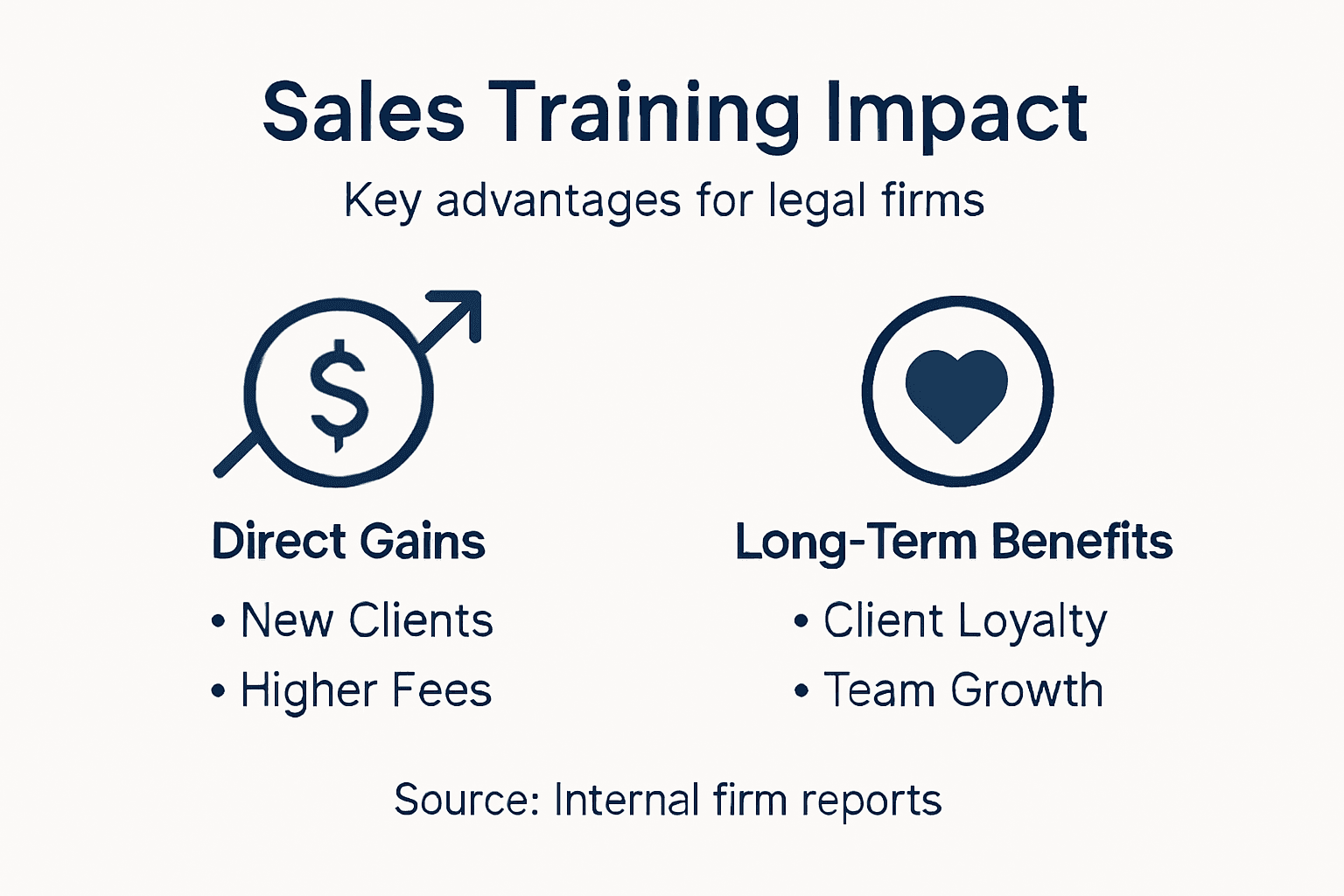
The economic benefits of comprehensive sales training manifest in multiple dimensions. Direct financial gains include increased conversion rates, higher average client transaction values, and more efficient sales processes. Legal firms can expect significant returns by investing in targeted training programmes that equip lawyers with advanced client engagement and business development skills. These improvements translate into measurable financial outcomes, including reduced client acquisition costs, shorter sales cycles, and more predictable revenue streams.
Beyond immediate revenue implications, sales training delivers substantial indirect financial advantages. Enhanced professional capabilities lead to improved client satisfaction, higher referral rates, and stronger market reputation. These intangible benefits contribute to long-term financial stability by creating a sustainable pipeline of high-quality client relationships. Moreover, firms that prioritise continuous skills development demonstrate a commitment to professional excellence, which can differentiate them in a competitive legal marketplace and attract both top talent and premium clients.
Pro tip: Implement a structured return on investment (ROI) tracking mechanism to quantify the financial impact of your sales training investments.
Below is a comparison of direct and indirect financial benefits legal firms gain from sales training:
| Benefit Type | Description | Long-Term Value |
|---|---|---|
| Direct | Higher conversion rates, increased transaction values | Enhanced revenue, predictable income |
| Indirect | Improved client satisfaction, greater referrals | Stronger market reputation |
Risks of neglecting sales development in legal teams
Legal firms that fail to invest in systematic sales development expose themselves to significant operational and financial vulnerabilities. Operational silos between sales and legal functions create substantial barriers to efficient business growth, leading to prolonged contract negotiations and missed revenue opportunities.
The consequences of neglecting sales development manifest in multiple critical areas. Productivity suffers as legal professionals lack structured approaches to client engagement and business development. Without targeted training, teams struggle with inconsistent client experiences, inefficient workflows, and reduced ability to convert potential leads. This skills gap results in longer sales cycles, decreased market responsiveness, and diminished competitive positioning in an increasingly complex legal services landscape.
Moreover, the financial implications of underdeveloped sales capabilities can be profound. Firms experiencing poor sales alignment frequently encounter reduced profitability, higher client acquisition costs, and increased client churn rates. The absence of robust sales development programmes means legal teams remain reactive rather than proactive, missing strategic opportunities to anticipate client needs and create value-added services. This reactive approach not only limits revenue potential but also undermines the firm’s reputation for professional excellence and client-centric service delivery.
Pro tip: Conduct a comprehensive skills gap analysis annually to identify and systematically address sales development needs across your legal team.
Unlock Sustainable Growth for Legal Firms with Bespoke Sales Training
Legal firms face the challenge of transforming professional expertise into consistent revenue while maintaining ethical standards and client trust. This article highlights the need for structured sales training that integrates practical skills like consultative selling, ongoing assessment and ethical business development. If your firm is struggling with inconsistent client acquisition or wants to elevate your sales capabilities, focused 1:1 coaching combined with proven training techniques can deliver measurable results.
Explore our tailored solutions designed specifically to help legal professionals boost conversion rates and build long-term client relationships, all while aligning with your firm’s core values. Discover how a powerful Sales Strategy and customised plans can break down operational silos and drive predictable growth.

Ready to accelerate your firm’s growth with a training approach that respects your unique professional environment? Visit Ahead of Sales to learn more about our bespoke coaching and consultancy offerings. For insights on crafting winning sales tactics, browse our expert resources in the Sales Playbook. Don’t leave your sales success to chance — take action now to empower your legal team and consistently hit your targets.
Frequently Asked Questions
What are the core principles of sales training for legal firms?
The core principles of sales training for legal firms include structured training design tailored to the legal landscape, integration of practical sales skills, ongoing assessment and adaptation, and personalised development pathways for legal professionals.
Why is ongoing assessment important in legal sales training?
Ongoing assessment is crucial as it allows law firms to adapt their training to changing client expectations, technological advancements, and market conditions. Regular feedback and performance evaluations ensure that legal professionals continuously improve their business development skills.
What sales skills are essential for legal professionals?
Essential sales skills for legal professionals include strong interpersonal skills for building relationships, effective negotiation techniques, technical presentation skills, and the ability to engage in consultative selling that aligns with client needs and objectives.
How can legal firms integrate ethical standards with sales growth?
Legal firms can integrate ethical standards by developing training programmes that teach lawyers to pursue business opportunities while maintaining ethical responsibilities. This includes transparent communication, clear conflict of interest protocols, and a commitment to providing genuine client value.