
Most British service companies miss out on consistent quarterly targets because sales calls lack clear strategy and preparation. With research showing that over 60 percent of sales conversations fall short of desired outcomes, defining objectives and building a robust call framework are crucial. For sales managers and business owners aiming to strengthen their quarterly performance, mastering every stage of the sales call process means creating deeper engagement, improving conversion rates, and driving focused business growth.
Table of Contents
- Step 1: Define Your Sales Call Objectives
- Step 2: Research Your Prospect Thoroughly
- Step 3: Develop A Tailored Call Script
- Step 4: Assemble Supporting Materials
- Step 5: Review And Rehearse Your Approach
- Step 6: Verify Readiness With A Pre-call Checklist
Quick Summary
| Key Point | Explanation |
|---|---|
| 1. Define Clear Objectives | Establish specific goals for each call to steer conversations strategically and measure success effectively. |
| 2. Conduct Thorough Research | Gather detailed insights on prospects to tailor interactions and demonstrate genuine understanding of their business environment. |
| 3. Craft a Flexible Script | Develop a call script that guides conversation while allowing natural dialogue tailored to the prospect’s needs. |
| 4. Assemble Relevant Supporting Materials | Prepare engaging resources that substantiate your value proposition and address potential concerns preemptively. |
| 5. Use a Pre-call Checklist | Implement a checklist to verify readiness, ensuring you are well-prepared for the sales conversation. |
Step 1: Define your sales call objectives
Successful sales calls begin with crystal clear objectives that transform unfocused conversations into strategic interactions. By establishing precise goals before picking up the phone, you create a roadmap that guides every moment of your customer engagement.
Your sales call objectives must align directly with your broader business strategy and provide a measurable framework for success. Clear business goals and objectives create a strategic roadmap that helps identify potential risks, boost performance, and execute your sales approach effectively. These objectives should not be generic aspirations but specific targets such as qualifying a lead, scheduling a detailed presentation, understanding a prospect’s specific challenges, or moving an opportunity further down your sales pipeline.
To develop robust sales call objectives, ask yourself specific questions: What exact outcome do you want from this interaction? Are you aiming to book a follow-up meeting, gain critical insights about the prospect’s business needs, or present a specific solution? Document these objectives beforehand and use them as your north star during the conversation. Each call should have one primary objective and potentially one or two secondary objectives that support your overall sales strategy.
Top Advice: Create a one-page objective document for each key sales prospect that outlines your specific goals, potential questions, and desired outcomes to maintain laser-focused communication.
Step 2: Research your prospect thoroughly
Thoroughly researching your prospect transforms an average sales call into a strategic, personalised interaction that demonstrates genuine understanding and commitment. By gathering comprehensive insights before your conversation, you position yourself as a thoughtful, prepared professional who values the prospect’s unique context.
Prospect research best practices emphasise gathering detailed information across multiple dimensions, including demographic data, financial background, professional history, and potential engagement opportunities. Your research should go beyond surface level information and dive into understanding the prospect’s business challenges, organisational structure, recent achievements, and potential strategic needs. Leverage multiple sources such as company websites, LinkedIn profiles, annual reports, news articles, and professional networking platforms to build a multifaceted view of your potential client.
Start by creating a structured research document that captures key insights. What are the prospect’s recent business developments? Who are their key decision makers? What industry challenges might they be experiencing? Look for specific details that will help you tailor your sales approach personalised to their exact circumstances. Pay attention to recent company announcements, leadership changes, financial performance, and strategic initiatives that could inform your conversation and demonstrate your genuine interest.
Top Advice: Allocate 30-45 minutes to comprehensive prospect research before each sales call, treating this preparation time as an investment in building meaningful professional relationships.
The following table compares basic and advanced prospect research practices:
| Aspect | Basic Research | Advanced Research |
|---|---|---|
| Data Sources | Company website | Multi-channel verification |
| Insights Depth | Surface-level facts | Strategic business context |
| Preparation Time | Under 10 minutes | 30–45 minutes as investment |
| Customisation | Generic notes | Documented, prospect-specific findings |
Step 3: Develop a tailored call script
Crafting a personalised call script transforms your sales approach from generic pitching to strategic conversation. Your script serves as a flexible roadmap that guides the interaction while allowing natural, responsive dialogue that resonates with your prospect’s specific needs and context.
Automated prompt optimization techniques suggest developing scripts that are adaptable and contextually relevant. Your script should be a strategic framework rather than a rigid monologue, incorporating key discussion points, potential questions, and adaptive response strategies. Begin by structuring your script around the insights gathered during your prospect research, ensuring each section addresses potential pain points, demonstrates understanding of their business challenges, and highlights how your solution provides specific value.
The most effective scripts balance structure with flexibility. Create sections that cover your primary objectives: an engaging opening that demonstrates immediate relevance, strategic questioning techniques to uncover deeper insights, a value proposition tailored to their specific circumstances, and clear pathways for moving the conversation forward. Include placeholder areas for personalised commentary based on the prospect’s unique background, allowing you to demonstrate genuine interest and adaptability during the call. Remember that a great script is a conversation guide, not a restrictive manuscript.
Top Advice: Record and review your call scripts periodically, tracking which phrases and approaches generate the most positive engagement and continuously refining your approach based on real world feedback.
Step 4: Assemble supporting materials
Building a compelling arsenal of supporting materials transforms your sales call from a simple conversation into a persuasive, evidence-driven interaction. Your goal is to create a strategic collection of resources that substantiate your value proposition and address potential prospect concerns before they even arise.

Professional sales education emphasises collecting diverse supporting materials that provide credibility and depth to your sales narrative. These materials should encompass a range of resources such as industry research reports, detailed case studies showcasing similar client successes, statistical evidence of your solution’s impact, customer testimonials, product specification sheets, and competitive analysis documents. Organise these materials in a manner that allows quick, seamless retrieval during the call, ensuring you can reference specific proof points that directly relate to your prospect’s unique business challenges.
Prioritise quality over quantity when assembling your supporting documentation. Select materials that are recent, relevant, and directly applicable to your prospect’s specific industry and potential pain points. Consider creating a dynamic reference folder that can be quickly customised for each prospect, including sections for general corporate information, specific solution details, implementation case studies, and potential return on investment calculations. Ensure all materials are professionally formatted, visually engaging, and capable of telling a compelling story about the transformative potential of your solution.
Top Advice: Create a digital folder with pre-vetted supporting materials tagged by industry, company size, and specific challenge to enable rapid personalisation before each sales call.
Step 5: Review and rehearse your approach
Rehearsing your sales call approach is the final polish that transforms careful preparation into confident execution. This critical step bridges your strategic planning with real world performance, ensuring you can navigate the conversation with precision and adaptability.
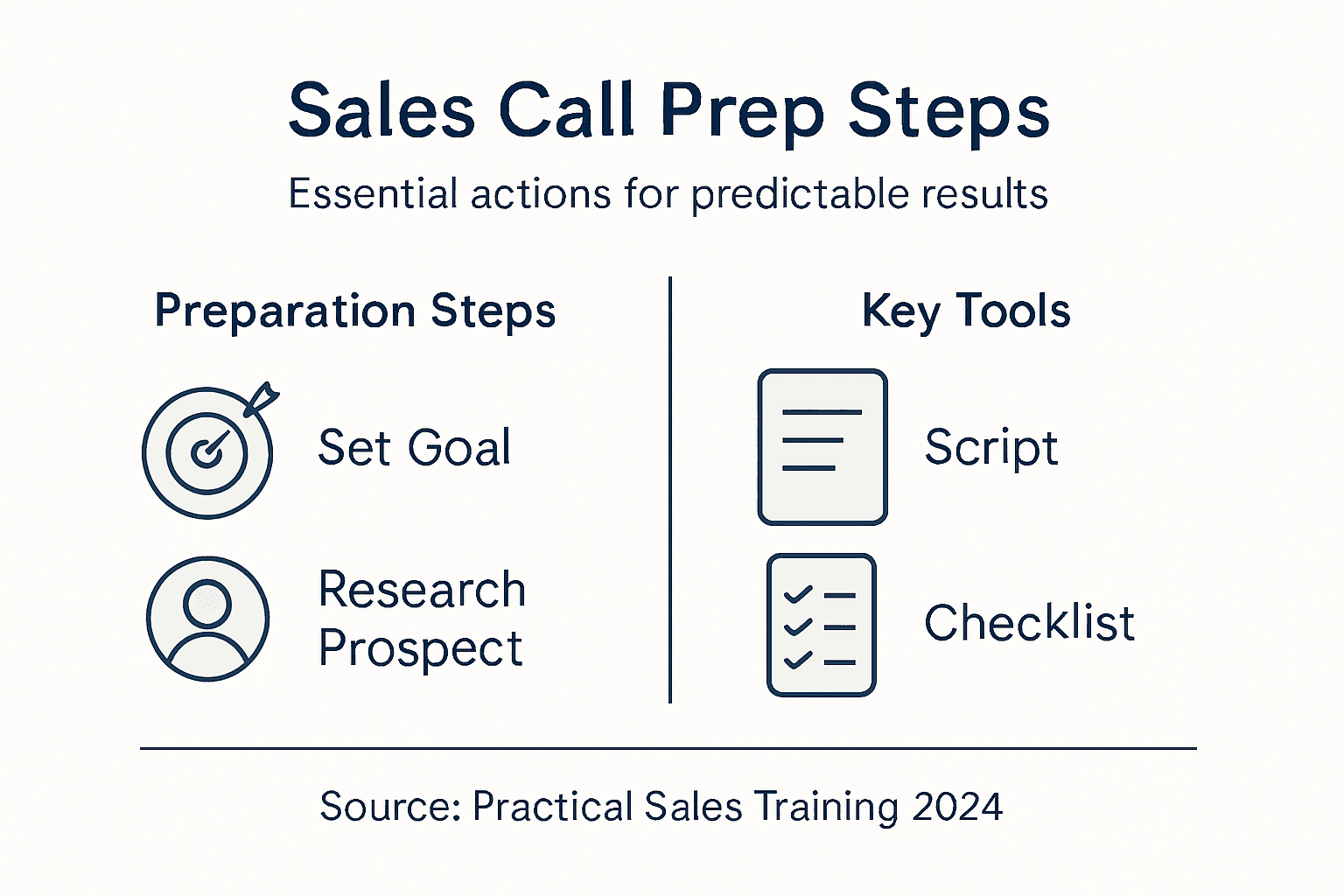
Pre-approach preparation involves systematic rehearsal to anticipate potential scenarios and refine your communication strategy. Begin by conducting a thorough mock sales call with a colleague or mentor who can provide honest, constructive feedback. Record these practice sessions if possible, allowing you to review your tone, pacing, and response techniques objectively. Focus on key areas such as your opening statement, how you handle potential objections, and the clarity of your value proposition. Pay special attention to your listening skills, ensuring you sound genuinely interested and responsive rather than following a rigid script.
Your rehearsal should simulate various potential conversation paths, preparing you to pivot smoothly when the prospect introduces unexpected elements. Practice active listening techniques, develop concise responses to anticipated questions, and work on maintaining a conversational yet professional demeanour. Create a mental map of your key discussion points while remaining flexible enough to follow the prospect’s natural conversation flow. The goal is not to memorise a script, but to internalise your core message so completely that you can deliver it naturally and authentically.
Top Advice: Record yourself during practice sessions and critically analyse your performance, paying close attention to your vocal tone, pacing, and ability to sound conversational rather than scripted.
Step 6: Verify readiness with a pre-call checklist
A comprehensive pre-call checklist transforms your preparation from good intention to guaranteed performance. This final verification step ensures you enter the sales conversation fully equipped and strategically positioned to maximise your potential for success.
Readiness assessments involve systematic checklists to guarantee that every critical element is meticulously prepared before your interaction. Your pre-call checklist should encompass multiple dimensions beyond simple logistical preparation. Include sections that verify your prospect research, confirm your supporting materials are tailored and accessible, validate that your call script is personalised, ensure your technical setup is functional, and double-check that you have anticipated potential conversation trajectories.
Structure your checklist as a strategic tool that provides both psychological confidence and practical readiness. Include specific verification points such as confirming the prospect’s contact details, reviewing their recent business developments, preparing your digital and physical resources, testing your communication technology, and mentally rehearsing potential conversation scenarios. Your checklist should be a living document that you refine after each sales interaction, incorporating lessons learned and continuously improving your preparation methodology.
Top Advice: Create a digital pre-call checklist template that can be quickly customised for each prospect, enabling rapid and consistent preparation across all your sales interactions.
Here is a summary of the main objectives at each sales call stage:
| Step | Primary Objective | Business Impact |
|---|---|---|
| Define Objectives | Set measurable targets | Guides focused conversation |
| Research Prospect | Gather tailored insights | Enables relevant positioning |
| Develop Script | Personalise discussion flow | Increases engagement success |
| Assemble Materials | Prepare credible evidence | Builds prospect confidence |
| Review & Rehearse | Refine delivery | Enhances professionalism |
| Pre-call Checklist | Confirm readiness | Reduces risk of oversight |
Elevate Your Sales Call Preparation for Reliable Growth
Struggling to consistently hit your sales targets despite thorough planning Is mastering each stage from defining objectives to pre-call readiness still a challenge for your team The Sales Call Preparation Guide for Predictable Results highlights the need for strategic clarity, personalised prospect research, flexible scripts, and meticulous rehearsal to transform your customer interactions. If your goal is to generate measurable sales growth while enabling your team to confidently engage prospects with precision this guide resonates deeply with your ambitions.
Unlock your team’s full potential with our proven blend of bespoke 1:1 coaching, traditional training, and expert consultancy. At Ahead of Sales we specialise in helping businesses with growth mindsets scale sales by at least 50% annually. Whether you are refining your Sales Strategy Archives – Ahead of Sales or enhancing your Sales Playbook Archives – Ahead of Sales our targeted packages provide exactly what you need to prepare and perform at peak levels.
Don’t let insufficient call preparation hold back your sales success Act today to access tailored sales acceleration solutions that ensure your team hits target every quarter and transforms preparation into predictable results Visit Ahead of Sales now to discover how we can partner for your sustainable growth.
Frequently Asked Questions
How can I define clear objectives for my sales calls?
To define clear objectives, identify one primary goal for each call, such as qualifying a lead or scheduling a follow-up meeting. Additionally, consider one or two secondary objectives that align with your overall sales strategy to enhance the focus of the conversation.
What steps should I take to research my prospect effectively?
To research your prospect effectively, gather comprehensive information about their business, recent achievements, and challenges. Allocate approximately 30-45 minutes before your call to create a structured document summarising your findings, enabling personalised engagement during the conversation.
How do I develop a tailored call script for my sales conversations?
Develop a tailored call script by incorporating insights from your prospect research that address their specific pain points. Ensure your script includes a flexible structure with key discussion points and allows for personalised commentary to adapt to the flow of the conversation.
What types of supporting materials should I assemble for my sales calls?
Assemble credible supporting materials such as case studies, testimonials, and industry research that clearly illustrate the value of your solution. Organise these resources into a dynamic folder, ensuring easy access to relevant evidence that speaks directly to the needs of your prospect.
Why is it important to rehearse my sales call approach?
Rehearsing your sales call approach is essential for gaining confidence and refining your delivery. Conduct mock sales calls to practice navigating various scenarios, which allows you to deliver your value proposition naturally and respond effectively to unexpected questions.
How can I create a pre-call checklist for my sales preparation?
To create a pre-call checklist, include items that verify your prospect research, ensure your materials are tailored, and confirm your technical setup is functional. Update your checklist periodically based on lessons learned from previous calls to enhance your preparation process.
Recommended
- 7 Essential Sales Team Training Topics for Growth – Ahead of Sales
- Master an Effective Sales Meeting Process for Reliable Results
- 7 Impactful Examples of Sales Coaching for Business Growth – Ahead of Sales
- 7 Essential Steps for a High-Impact Sales Skills Checklist
- Master Insurance Sales Process Steps for Better Results