
Over 80 percent of British sales leaders say their teams are measured by raw totals rather than true productivity. For ambitious executives driving growth in UK companies, relying only on surface-level sales numbers can mask serious performance gaps. Uncovering what really powers sales productivity sets the groundwork for lasting business success through expert coaching and training tailored to your organisation’s needs.
Table of Contents
- Sales Productivity Defined And Common Myths
- Types Of Sales Productivity Metrics And Measures
- Key Drivers: Technology, Training, And Processes
- How Sales Productivity Impacts Business Growth
- Common Barriers And Mistakes To Avoid
- Strategies To Boost Sales Productivity Sustainably
Key Takeaways
| Point | Details |
|---|---|
| Sales productivity is not just about total sales figures | It involves evaluating outputs relative to the inputs used, enabling better resource allocation. |
| Technology, training, and processes are interconnected drivers | To enhance productivity, businesses must align these elements through comprehensive strategies rather than relying solely on technology. |
| Nuanced metrics are essential for measuring productivity | Businesses should consider multiple performance metrics to identify strengths and areas needing improvement. |
| Address systemic barriers for sustainable growth | Avoid common pitfalls by ensuring alignment between teams and implementing holistic performance improvement strategies. |
Sales productivity defined and common myths
Sales productivity represents the efficiency and effectiveness with which sales professionals transform their inputs like time, resources, and effort into valuable business outcomes. Unlike simplistic interpretations, it goes far beyond just measuring total sales volume. Productivity measures economic performance by examining the ratio of output generated against resources consumed.
Traditionally, businesses misunderstand sales productivity through several persistent myths. The first major misconception is equating productivity purely with total sales numbers. In reality, sales productivity involves calculating output per unit of input – meaning a team generating £500,000 in sales might be less productive than another generating £400,000 if they require significantly fewer resources or working hours.
Another critical myth involves assuming technology alone drives productivity. Economic research demonstrates that productivity emerges from complex interactions between technological tools, operational practices, individual skills, and organisational environments. Simply purchasing expensive customer relationship management software won’t automatically enhance sales performance. Genuine productivity improvement requires strategic implementation, continuous training, and aligning technological solutions with specific team capabilities.
Here is a summary of common myths versus reality in sales productivity:
| Myth | Reality | Business Implication |
|---|---|---|
| Total sales equals productivity | Productivity is outputs per input | Improves resource allocation |
| Technology alone boosts productivity | True improvement needs skills, processes | Demands training and strategy |
| Quick software adoption ensures results | Results require alignment and implementation | Avoids wasted technology spend |
Pro tip: Regularly audit your sales team’s productivity by tracking not just total revenue, but revenue generated per sales representative and per working hour to gain more nuanced performance insights.
Types of sales productivity metrics and measures
Sales organisations require nuanced approaches to measuring productivity, moving beyond simplistic total revenue calculations. Sales effectiveness metrics offer sophisticated insights by examining performance through multiple sophisticated lenses. These metrics include critical measurements like sales dollars per client contact, sales potential per account, and comparative analysis across different sales territories.
Comprehensive productivity measurement involves two primary methodological frameworks. Labor productivity calculates output generated per working hour, while multifactor productivity assesses output relative to combined input resources. By tracking productivity changes systematically, businesses can develop more precise understanding of their sales team’s performance dynamics.
Key productivity metrics typically encompass several critical dimensions. These include conversion rates, average deal size, sales cycle length, number of qualified leads generated, customer acquisition cost, and revenue per sales representative. Each metric provides unique insights into different aspects of sales performance, allowing leaders to identify strengths, pinpoint skill gaps, and develop targeted improvement strategies.
Pro tip: Create a comprehensive dashboard integrating multiple productivity metrics to gain holistic insights into your sales team’s performance, ensuring you’re tracking both quantity and quality of sales efforts.
Key drivers: technology, training, and processes
Technology, training, and processes form the critical triad driving sales productivity in modern organisations. Technology sales fundamentals demonstrate that successful sales teams must strategically integrate emerging technologies like artificial intelligence and cloud computing with sophisticated consultative skills. This integration requires more than simply acquiring new tools – it demands a holistic approach to technological adoption.
The relationship between technology and productivity is nuanced and complex. AI and technology adoption reveal that technological investments alone cannot guarantee performance improvements. Instead, organisations must focus on workforce composition, comprehensive training programmes, and systematic process refinement. Effective technology implementation requires alignment between sophisticated digital tools and the human skills necessary to leverage them strategically.

Successful sales organisations approach these key drivers through interconnected strategies. Technology provides sophisticated analytical capabilities and communication platforms. Training ensures sales professionals can effectively utilise these technologies and develop advanced interpersonal skills. Refined processes create standardised frameworks that enable consistent performance, reducing variability and establishing repeatable success models. Each element reinforces the others, creating a dynamic ecosystem of continuous improvement and adaptive capability.
This table outlines how technology, training, and processes work together to drive sales productivity:
| Driver | Primary Role | Impact on Productivity | Example Action |
|---|---|---|---|
| Technology | Enhances analytics/efficiency | Enables data-driven decisions | Deploy AI-powered CRM |
| Training | Develops skills and confidence | Boosts sales effectiveness | Offer consultative selling workshops |
| Processes | Standardises best practices | Reduces variability | Refine lead qualification workflows |
Pro tip: Conduct a quarterly audit of your technology stack, sales training programmes, and core sales processes to identify potential integration opportunities and performance gaps.
How sales productivity impacts business growth
Business growth is fundamentally tied to an organisation’s ability to generate more output with existing resources. Productivity growth underpins economic expansion by enabling companies to achieve more with less, creating a virtuous cycle of enhanced performance and competitive advantage. This mechanism transforms raw potential into tangible business outcomes, driving sustainable development across industries.
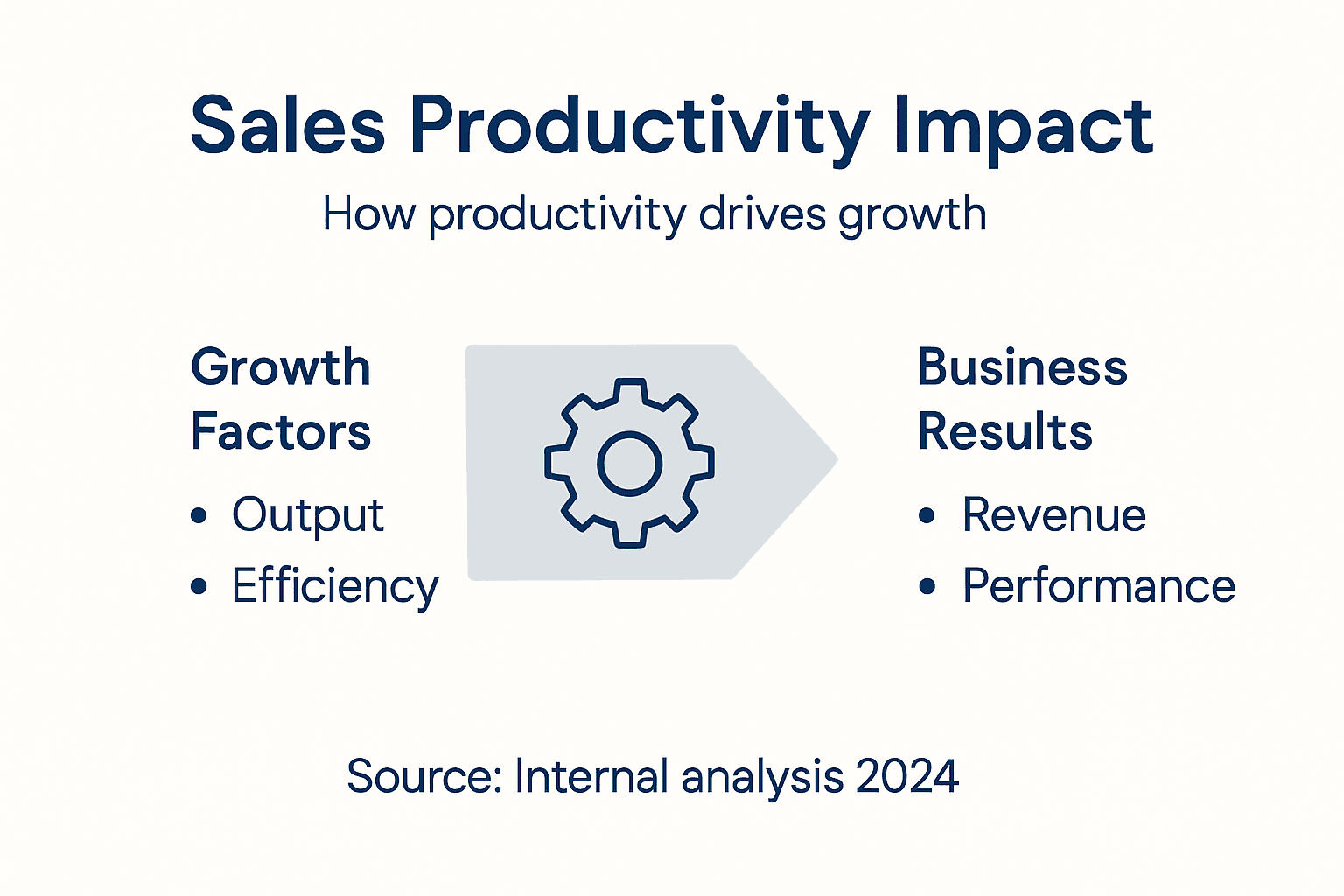
Productivity differences directly impact firm performance, creating substantial variations in organisational success. High-performing sales teams generate significantly more revenue per representative, translate opportunities more efficiently, and maintain lower operational costs. These productivity advantages compound over time, allowing businesses to invest in innovation, attract top talent, and expand market share more aggressively than less productive competitors.
The impact of sales productivity extends beyond immediate financial metrics. Organisations with superior productivity can reinvest efficiency gains into strategic initiatives, create more competitive compensation structures, and develop more sophisticated customer engagement models. By continuously improving sales team performance, businesses build resilience, adaptability, and long-term growth potential that transcends traditional revenue generation approaches.
Pro tip: Implement a quarterly productivity benchmarking process that measures output per sales representative, tracking improvements and identifying specific areas for targeted performance enhancement.
Common barriers and mistakes to avoid
Sales productivity barriers frequently emerge from systemic misalignments and misunderstood performance dynamics. Many organisations unknowingly undermine their sales potential through fundamental strategic errors, creating obstacles that prevent meaningful performance improvements. These barriers often stem from oversimplified approaches to measuring and managing sales team effectiveness.
One critical mistake involves an overreliance on technological solutions without addressing underlying process inefficiencies. Productivity improvements require more than automation, demanding comprehensive workforce engagement and strategic process redesign. Businesses frequently make the error of implementing technology as a quick fix, believing sophisticated tools will automatically enhance performance, when in reality, sustainable productivity gains demand holistic, nuanced approaches.
Additional common barriers include persistent misalignments between sales and marketing teams, inadequate performance monitoring systems, and failure to develop comprehensive training programmes. Many organisations rely excessively on aggregate sales figures, neglecting critical metrics that reveal skill gaps, individual performance variations, and process inefficiencies. This narrow perspective prevents targeted interventions and meaningful performance enhancement strategies.
Pro tip: Conduct monthly cross-departmental reviews that explicitly examine sales productivity from multiple perspectives, ensuring comprehensive understanding beyond surface-level performance metrics.
Strategies to boost sales productivity sustainably
Sustainable sales productivity gains require a multifaceted approach that transcends traditional performance improvement methods. Organisations must develop comprehensive strategies that simultaneously address individual skill development, technological integration, and systemic process refinement. This holistic approach ensures that productivity improvements are not temporary interventions but fundamental transformations of sales team capabilities.
Successful productivity enhancement demands strategic investments in workforce development and technological infrastructure. Improving organisational productivity involves strengthening managerial skills, implementing targeted training programmes, and adopting technologies that genuinely support sales team performance. Critical elements include continuous learning initiatives, data-driven performance monitoring, and creating adaptive systems that evolve with changing market dynamics.
Effective strategies encompass several key dimensions. These include developing comprehensive performance measurement frameworks, creating personalised skill development pathways for sales representatives, implementing intelligent customer relationship management systems, and fostering a culture of continuous improvement. Organisations must move beyond generic training approaches, instead creating tailored development programmes that address specific performance gaps and individual learning needs.
Pro tip: Develop a quarterly skills assessment and development plan for each sales representative, mapping individual performance trajectories and creating targeted improvement strategies.
Elevate Your Sales Productivity and Drive Consistent Growth
Struggling to translate your sales efforts into measurable productivity gains and sustained business growth is a common challenge. This article highlights the importance of measuring sales output per input, integrating technology with skills training, and refining processes to overcome productivity myths and barriers. If you want to move beyond traditional sales measures and truly empower your team to hit targets every quarter while achieving at least 50% growth annually, our tailored solutions are designed specifically for businesses with a growth mindset.

Explore how our bespoke 1:1 coaching combines with expert consultancy and traditional training to enhance your sales team’s performance. Visit our Sales Strategy Archives – Ahead of Sales for insights aligned with these principles. Take the next step towards transforming your sales productivity by discovering our flexible packages at Ahead of Sales. Unlock actionable strategies and proven frameworks through our Sales Playbook Archives – Ahead of Sales and set your business on a sustainable sales acceleration path today.
Frequently Asked Questions
What is sales productivity and why is it important?
Sales productivity measures how effectively sales professionals turn their inputs, such as time and resources, into valuable business outcomes. It’s crucial as it highlights efficiency and guides businesses to optimise their resources for better results.
What are common myths about sales productivity?
Common myths include equating total sales with productivity and believing that technology alone boosts productivity. Real productivity improvement involves understanding outputs per input, and requires skill development and strategic implementation of technology.
How can businesses measure sales productivity effectively?
Businesses can measure sales productivity through metrics like sales dollars per client contact, conversion rates, average deal size, and revenue per sales representative. Comprehensive dashboards that integrate these metrics can provide nuanced insights into team performance.
What are some strategies to enhance sales productivity?
Strategies include investing in training for sales representatives, refining processes to standardise best practices, and leveraging technology for analytics. A holistic approach is key, focusing on continuous improvement and personalized skill development.
Recommended
- Sales Team Performance Explained: Maximizing Growth Results – Ahead of Sales
- 7 Proven Sales Acceleration Strategies for Rapid Growth – Ahead of Sales
- Defining Sales Growth Strategies: Accelerating Revenue
- Why Consistent Sales Training Drives Sustained Growth
- Unleashing the Potential of Power Automate in Microsoft 365: Empowering Small Businesses – Cloudology