
Most british sales teams miss their quarterly targets at least once per year, despite detailed planning and ambitious goals. For sales leaders at UK-based mid-sized companies, fine-tuning performance is a constant challenge with direct impact on growth and morale. This guide unpacks proven methods to define metrics, assess data, and transform sales results—empowering you with strategies that drive steady improvement and reliable outcomes.
Table of Contents
- Step 1: Define Key Sales Metrics And Benchmarks
- Step 2: Collect And Organise Relevant Sales Data
- Step 3: Analyse Performance Against Targets
- Step 4: Identify Strengths And Areas For Improvement
- Step 5: Implement Changes And Monitor Progress
Quick Summary
| Key Point | Explanation |
|---|---|
| 1. Define Key Sales Metrics | Establish metrics like revenue growth to gauge sales effectiveness and align them with strategic objectives. |
| 2. Collect Comprehensive Sales Data | Use systematic methods to gather data from various sources for reliable performance analysis. |
| 3. Analyse Performance Against Targets | Regularly compare actual metrics with set targets to identify achievements and areas needing improvement. |
| 4. Identify Strengths and Improvement Areas | Conduct skills assessments to pinpoint top performers and develop targeted training plans for growth. |
| 5. Implement Changes and Monitor Progress | Create a clear roadmap for changes, ensuring to track progress and adjust based on feedback and data. |
Step 1: Define key sales metrics and benchmarks
Evaluating sales performance begins with establishing precise metrics that reveal genuine insights about your team’s effectiveness. Sales performance metrics represent quantifiable measurements tracking your sales team’s progress against strategic objectives.
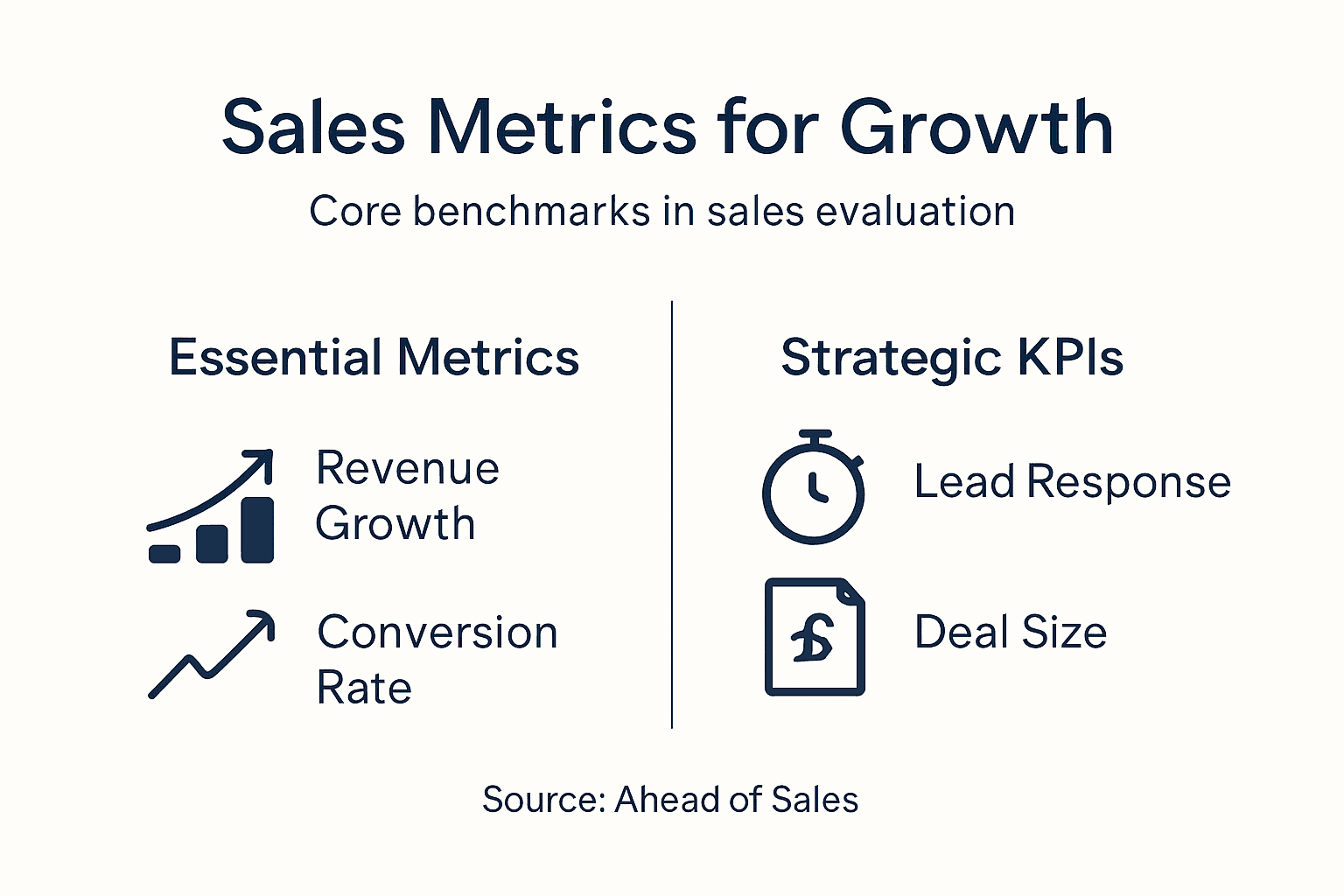
To create robust benchmarks, start by identifying core performance indicators such as revenue growth, conversion rates, average deal size, and customer acquisition costs. These metrics help transform raw sales data into strategic intelligence. Cross reference these indicators with industry standards collected through comprehensive benchmarking studies like those from APQC, which provide standardised performance comparisons across different sectors.
Focus on selecting metrics directly aligned with your specific business goals. This might include tracking lead response times, sales cycle length, win rates, and pipeline velocity. The most effective benchmarks combine both quantitative measurements and qualitative assessments that reflect your unique sales environment.
Here’s a summary of key sales metrics and their strategic impact:
| Metric | What It Measures | Strategic Impact |
|---|---|---|
| Revenue Growth | Increase in sales income | Indicates market expansion |
| Conversion Rate | Leads closed as sales | Shows sales effectiveness |
| Average Deal Size | Value per closed sale | Reveals client spend patterns |
| Customer Acquisition Cost | Cost to win new clients | Assesses profitability of sales |
Top tip: Create a dynamic dashboard that updates key performance indicators in real time, allowing instant visibility into your team’s sales progress and potential improvement areas.
Step 2: Collect and organise relevant sales data
Gathering comprehensive sales data requires a strategic approach that transforms raw information into actionable insights. Systematic data collection methods are essential for creating a robust understanding of your sales team’s performance.
Begin by identifying multiple data sources including customer relationship management systems, financial records, sales pipeline reports, and individual team member performance tracking. Implement a standardised approach to data collection that ensures consistency and accuracy. This might involve creating structured templates for reporting, establishing clear guidelines for data entry, and using integrated software platforms that can aggregate information from different sources.
Ensure your data collection process captures both quantitative metrics like revenue, conversion rates, and average deal size as well as qualitative insights such as customer feedback and sales team observations. Pay special attention to handling missing data points and maintaining data integrity throughout your collection process. Regularly audit and clean your datasets to prevent errors and ensure the most accurate representation of your sales performance.

The following table compares quantitative and qualitative sales data:
| Data Type | Examples | Purpose |
|---|---|---|
| Quantitative | Revenue, deal size | Tracks objective performance |
| Qualitative | Customer feedback, sales rep notes | Reveals context for results |
Top tip: Invest in a centralised data management system that allows real time updating and provides comprehensive analytics dashboards for instant performance insights.
Step 3: Analyse performance against targets
Analysing sales performance requires a meticulous approach that transforms raw data into meaningful strategic insights. Performance assessment frameworks provide critical guidance for understanding how your sales team measures up against predetermined objectives.
Start by comparing actual performance metrics against your established targets across multiple dimensions. This includes examining individual and team revenue generation, conversion rates, average deal sizes, and sales cycle lengths. Create comparative reports that highlight variances between expected and actual performance, identifying both positive overachievements and areas requiring immediate intervention. Break down these assessments into granular levels tracking performance at individual sales representative, team, and organisational levels to understand the nuanced dynamics influencing your sales outcomes.
Utilise statistical analysis and visualisation tools to help interpret complex performance data. Look beyond simple numerical comparisons and explore the underlying factors contributing to performance gaps. Consider contextual elements such as market conditions, product complexity, and individual sales representative skill sets when evaluating performance. This holistic approach ensures a comprehensive understanding of your sales team’s capabilities and potential areas for strategic improvement.
Top tip: Implement a quarterly performance review process that not only evaluates targets but also provides constructive feedback and personalised development strategies for each sales team member.
Step 4: Identify strengths and areas for improvement
Identifying your sales team’s strengths and potential growth areas requires a nuanced approach that goes beyond surface level analysis. Sales performance strategies provide sophisticated frameworks for uncovering both exceptional capabilities and critical development opportunities within your team.
Begin by conducting a comprehensive skills assessment that compares individual and team performance against established benchmarks. Analyse performance metrics across multiple dimensions including revenue generation, customer acquisition rates, conversion effectiveness, and client retention. Pay close attention to variations between top performers and those struggling to meet targets. This detailed examination helps you understand the specific skills and behaviours driving success and those requiring targeted intervention.
Translate your insights into actionable development strategies by creating personalised coaching plans. Focus on bridging performance gaps through targeted training programmes, mentorship initiatives, and skill development workshops. Consider implementing peer learning opportunities where high performing team members can share best practices and provide guidance to colleagues. Remember that identifying strengths is not just about highlighting top performers but creating an environment of continuous learning and collaborative improvement.
Top tip: Design individualised performance improvement plans that balance constructive feedback with motivational support to encourage genuine professional growth.
Step 5: Implement changes and monitor progress
Successful performance improvement requires a strategic approach to implementing changes and tracking their effectiveness. Change monitoring strategies provide a structured framework for ensuring meaningful organisational transformation.
Begin by developing a clear implementation roadmap with specific milestones and measurable objectives. Break down larger performance improvement initiatives into smaller actionable steps that can be tracked individually. Establish regular check in points where you can assess the impact of implemented changes and make necessary adjustments. This might involve weekly team meetings, monthly performance reviews, and quarterly comprehensive evaluations that examine both quantitative metrics and qualitative feedback from your sales team.
Utilise robust tracking mechanisms that provide real time insights into your team’s progress. This could include advanced performance management software, detailed reporting dashboards, and collaborative platforms that enable transparent communication about ongoing improvements. Encourage open dialogue within your team about the changes being implemented, creating an environment where feedback is welcomed and continuous learning is prioritised. Remember that successful change management is not about perfect execution but about creating an adaptive and responsive sales culture.
Top tip: Develop a flexible monitoring system that allows for rapid iteration and adjustment based on emerging performance data and team insights.
Unlock Your Sales Team’s Full Potential with Expert Guidance
Sales performance evaluation is a critical step to sustaining growth yet many businesses struggle to turn data into decisive action. If your challenge is transforming detailed metrics like conversion rates and pipeline velocity into clear strategies that boost results every quarter then you are not alone. This article highlights the vital need to move beyond numbers and leverage personalised coaching, effective benchmarking and continuous monitoring to overcome performance gaps.
Take control of your sales success with bespoke 1:1 coaching combined with proven training and consultancy from Ahead of Sales. Our programmes are designed to help teams connect strategic sales metrics directly to performance improvements so your salesforce consistently hits targets and grows revenue by at least 50% annually. Explore tailored strategies in our Sales Strategy Archives – Ahead of Sales and master practical techniques in the Sales Playbook Archives – Ahead of Sales.

Start transforming how you evaluate and accelerate sales performance today. Visit Ahead of Sales to discover packages suited for ambitious businesses with growth mindsets. Don’t wait for performance issues to escalate — empower your team now with expert support that delivers measurable results every quarter.
Frequently Asked Questions
What key sales metrics should I define to evaluate performance?
To effectively evaluate sales performance, focus on metrics such as revenue growth, conversion rates, average deal size, and customer acquisition costs. Establish benchmarks for these metrics to track progress against your sales goals.
How can I systematically collect and organise sales data?
Begin by identifying multiple data sources, including customer relationship management systems and sales pipeline reports. Use standardised templates for data collection to ensure consistency and accuracy in your sales data.
What steps should I take to analyse performance against my sales targets?
Compare actual performance metrics, like revenue generation and conversion rates, against your predetermined targets. Create reports that highlight both overachievements and areas needing improvement to inform your strategy.
How can I identify my sales team’s strengths and areas for improvement?
Conduct a comprehensive skills assessment that compares individual performances against set benchmarks. Use the findings to create tailored coaching plans that address specific development needs within your sales team.
What changes should I implement to boost sales performance?
Develop a clear implementation roadmap with measurable objectives and actionable steps. Regularly review progress through check-ins and performance evaluations to ensure the effectiveness of implemented changes.
How can I effectively monitor the progress of changes made to improve sales performance?
Utilise real-time tracking mechanisms such as performance management software and reporting dashboards. Set regular check-in points to assess the impact of changes and adjust your strategy as needed.
Recommended
- Sales Team Performance Explained: Maximizing Growth Results – Ahead of Sales
- Defining Sales Growth Strategies: Accelerating Revenue
- Sales Performance Metrics Explained: Complete Guide
- How to Accelerate Revenue Growth: Step-by-Step Guide
- Optimizing Consumer Behavior Analysis Workflow for Luxury Brands – Corrado Manenti