
Securing high-value deals in the british SaaS market demands more than sharp pitching skills. Enterprise sales cycles often stretch beyond 12 months and involve at least six decision-makers, making traditional sales approaches far less effective. For sales leaders in mid-sized UK SaaS companies, understanding the core principles and models behind enterprise sales opens the door to predictable revenue, stronger client partnerships, and improved quarterly performance.
Table of Contents
- What Is Enterprise Sales and Why It Matters
- Types of Enterprise Sales Models in SaaS
- Core Features of the Enterprise Sales Process
- Roles, Responsibilities and Common Misconceptions
- Risks, Costs and Key Mistakes to Avoid
Key Takeaways
| Point | Details |
|---|---|
| Understanding Enterprise Sales | Enterprise sales involves complex, relationship-driven methods aimed at large organisations, necessitating deep knowledge of their business challenges and decision-making structures. |
| SaaS Sales Models | Key enterprise sales models in SaaS include solution selling and strategic partnerships, focusing on tailored solutions and long-term collaborations. |
| Risks and Costs | Entering enterprise sales carries significant financial risks due to prolonged sales cycles and high resource investment, necessitating rigorous prospect qualification. |
| Common Misconceptions | Many professionals underestimate enterprise sales, viewing it merely as an extension of small sales; it requires a consultative, strategic approach to succeed. |
What Is Enterprise Sales and Why It Matters
Enterprise sales represents a sophisticated B2B sales methodology focused on selling complex, high-value solutions to large organisations through strategic, relationship-driven approaches. Unlike transactional sales models, enterprise sales involves intricate processes that demand deep understanding of organisational dynamics and comprehensive value proposition delivery.
The core characteristics of enterprise sales include extended sales cycles involving multiple stakeholders, which distinguish it from traditional sales strategies. These cycles typically span several months and require engagement across multiple departments, from procurement and IT to executive leadership. Success depends on thoroughly understanding the client’s business challenges, crafting tailored solutions, and demonstrating measurable return on investment (ROI).
At its essence, enterprise sales is about building strategic partnerships rather than executing simple product transactions. Sales professionals must navigate complex decision-making environments, manage sophisticated buying committees, and provide consultative insights that align directly with an organisation’s strategic objectives. This approach demands exceptional communication skills, deep industry knowledge, and the ability to articulate nuanced value propositions that resonate with senior executives.
Pro tip: Develop comprehensive account research strategies that map organisational hierarchies, understand key stakeholders’ motivations, and create personalised engagement approaches tailored to each decision-maker’s specific priorities.
Types of Enterprise Sales Models in SaaS
Enterprise sales models in Software as a Service (SaaS) represent nuanced approaches to selling complex, high-value solutions to large organisations. These models are characterised by their strategic depth, complexity, and focus on long-term partnerships rather than transactional interactions. Enterprise sales cycles in SaaS can span 7-18 months, requiring sophisticated engagement strategies that go far beyond traditional sales methodologies.
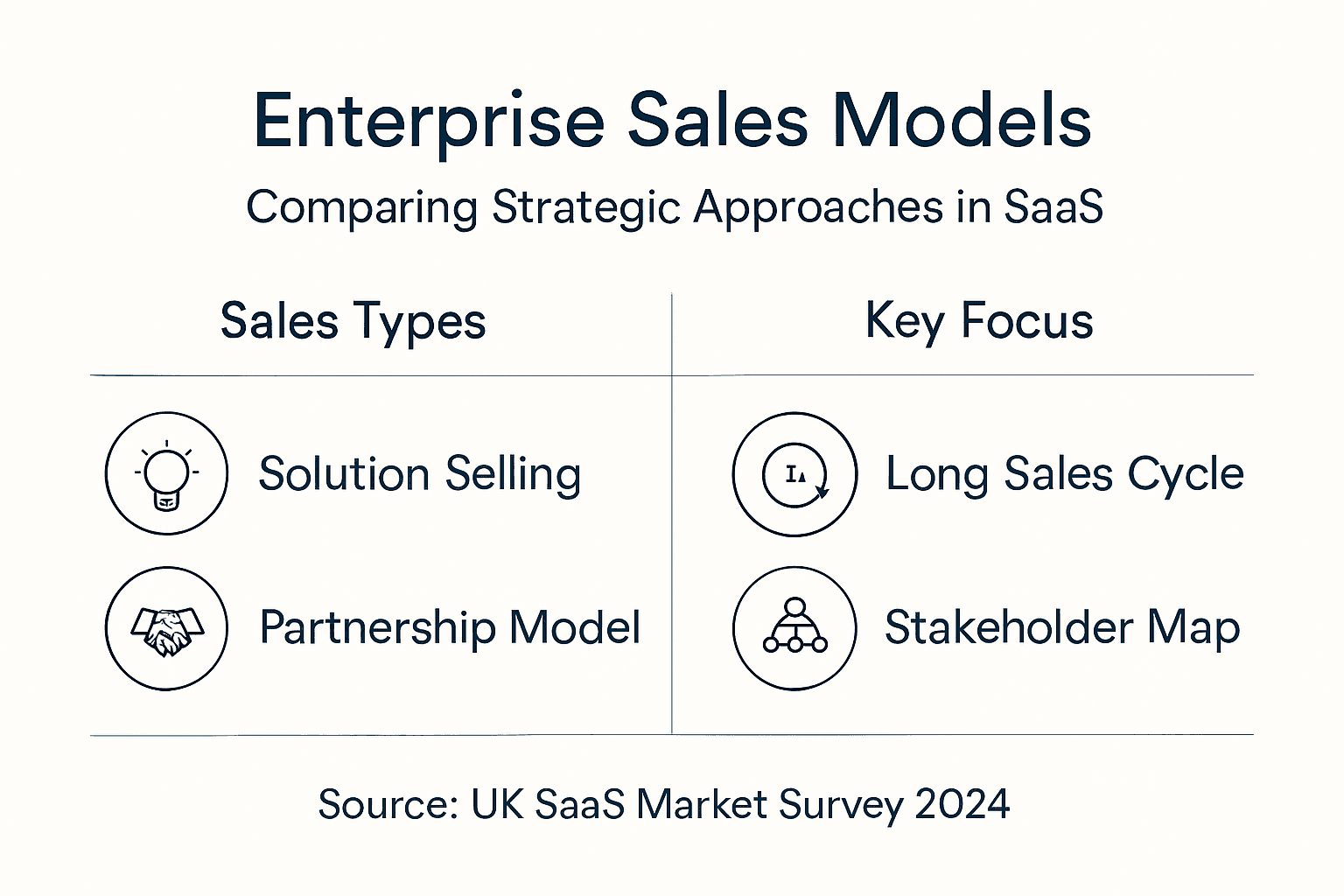
The primary types of enterprise sales models in SaaS include solution selling, strategic partnership approaches, and consultative engagement models. Solution selling focuses on understanding the client’s specific business challenges and crafting bespoke software solutions that directly address their operational needs. This model demands deep technical knowledge, the ability to map software capabilities to organisational objectives, and a consultative approach that positions the sales team as trusted advisors rather than mere vendors.
Strategic partnership models take enterprise sales to an even more sophisticated level, emphasising long-term collaborative relationships with key enterprise clients. These models typically involve multiyear contracts, extensive customisation, and a commitment to ongoing value delivery. Sales professionals must demonstrate not just product functionality, but a comprehensive understanding of the client’s strategic vision, technological ecosystem, and future growth potential. This approach requires cross-functional collaboration, advanced stakeholder management, and the capability to articulate complex value propositions that resonate with executive leadership.
Pro tip: Develop a systematic approach to enterprise account mapping that identifies key decision-makers, understands their individual motivations, and creates tailored engagement strategies for each stakeholder in the buying process.
Here’s a summary of prominent enterprise sales models in SaaS and their unique strengths:
| Sales Model | Strategic Focus | Client Engagement Style | Business Impact |
|---|---|---|---|
| Solution Selling | Solves specific business problems | Consultative, tailored advice | High client satisfaction through fit |
| Strategic Partnership | Long-term collaboration | Deep, ongoing relationship | Predictable revenue, client retention |
| Consultative Engagement | Aligns with client objectives | Advisory, project management | Positions seller as trusted advisor |
Core Features of the Enterprise Sales Process
The enterprise sales process represents a sophisticated, meticulously structured approach to selling complex solutions to large organisations. Strategic relationship-building forms the core foundation of this intricate sales methodology, distinguishing it from more transactional sales models. Unlike traditional sales approaches, enterprise sales demands a comprehensive understanding of an organisation’s strategic objectives, technological infrastructure, and long-term business challenges.
Key features of the enterprise sales process include extensive stakeholder mapping, multi-threading communication strategies, and deep discovery phases. Sales professionals must navigate complex organisational hierarchies, identifying and engaging multiple decision-makers across different departments. This requires developing nuanced value propositions that address specific pain points for each stakeholder, from technical teams to executive leadership. The process involves creating detailed business cases, conducting thorough needs assessments, and demonstrating tangible return on investment through pilot programmes and comprehensive ROI analyses.

The negotiation and closing stages of enterprise sales are equally complex, typically involving formal procurement processes such as request for proposal (RFP) submissions, legal reviews, and extensive contract negotiations. These interactions demand exceptional communication skills, technical knowledge, and the ability to build trust across multiple organisational levels. Successful enterprise sales professionals must position themselves as strategic partners rather than mere vendors, offering tailored solutions that align precisely with the client’s strategic vision and operational requirements.
Pro tip: Develop a systematic approach to enterprise account research that includes creating detailed stakeholder personas, mapping organisational decision-making processes, and developing personalised engagement strategies for each key influencer.
Roles, Responsibilities and Common Misconceptions
Enterprise sales professionals operate within a complex ecosystem that demands far more than traditional sales skills. Multidisciplinary team capabilities are crucial for navigating the intricate landscape of large organisational sales. These roles require individuals who can seamlessly transition between strategic advisor, technical expert, and relationship manager, demonstrating a sophisticated approach that goes well beyond product presentation.
The core responsibilities of enterprise sales professionals encompass comprehensive stakeholder management, strategic relationship building, and complex solution design. Sales representatives must develop deep understanding of potential clients’ technological infrastructures, business objectives, and operational challenges. This involves conducting thorough needs assessments, creating customised proposals, and developing detailed implementation strategies that align precisely with each organisation’s unique requirements. The role demands exceptional communication skills, technical knowledge, and the ability to build trust across multiple organisational levels.
Numerous misconceptions surround enterprise sales, often underestimating the complexity and strategic depth required. Many professionals mistakenly believe enterprise sales is simply a scaled-up version of small business sales, failing to recognise the nuanced approach needed to successfully navigate large organisational structures. In reality, enterprise sales requires patience, extensive research, and a consultative approach that positions the sales team as strategic partners rather than transactional vendors. Success depends on understanding organisational dynamics, managing multiple decision-makers, and demonstrating tangible value beyond immediate product capabilities.
Pro tip: Develop a comprehensive stakeholder mapping strategy that identifies key decision-makers, understands their individual motivations, and creates tailored engagement approaches for each influential individual within the target organisation.
Risks, Costs and Key Mistakes to Avoid
Enterprise sales represents a high-stakes arena where strategic missteps can result in significant financial and operational consequences. Complex decision-making processes create substantial risks for organisations attempting to secure large-scale contracts. These risks extend beyond immediate financial investments, potentially impacting long-term business relationships and organisational reputation.
The financial implications of enterprise sales are profound, with extended sales cycles consuming considerable resources. Organisations frequently underestimate the total investment required, which includes substantial time commitments, detailed product customisation, comprehensive stakeholder engagement, and extensive support infrastructure. Potential losses can be substantial if deals collapse late in the negotiation process, making rigorous prospect qualification and strategic account management critical to mitigating financial exposure.
Key mistakes in enterprise sales often stem from inadequate preparation and insufficient understanding of organisational dynamics. Common pitfalls include neglecting thorough discovery phases, failing to build comprehensive stakeholder consensus, and underestimating the complexity of multi-level decision-making processes. Sales teams must develop sophisticated strategies that go beyond traditional selling techniques, focusing instead on demonstrating genuine value, understanding intricate organisational challenges, and positioning themselves as strategic partners rather than mere product vendors.
Pro tip: Implement a robust qualification framework that thoroughly evaluates potential enterprise opportunities, assessing not just immediate financial potential but long-term strategic alignment and likelihood of successful implementation.
Key risks and cost factors in enterprise sales to consider:
| Risk/Cost Factor | Typical Causes | Consequence | Preventive Strategy |
|---|---|---|---|
| Extended Sales Cycle | Multiple decision-makers | Increased resource spend | Rigorous stakeholder mapping |
| Unqualified Prospects | Poor initial research | Lost time and revenue | Robust qualification framework |
| Late-stage Deal Collapse | Inadequate consensus or preparation | Missed financial targets | Comprehensive pre-negotiation checks |
| Underestimated Costs | Ignored customisation or support needs | Project overruns | Detailed budgeting and ongoing review |
Unlock the Full Potential of Enterprise Sales for Your SaaS Business
If you are grappling with lengthy sales cycles, multiple stakeholders, and the complexity of delivering tailored solutions as highlighted in this article, we understand the challenges holding your UK SaaS business back. Achieving consistent growth while navigating strategic partnership models demands more than traditional sales tactics. You need expert guidance in stakeholder mapping, consultative selling, and strategic account management to transform these challenges into competitive advantage.
Discover how our bespoke 1:1 coaching combined with tried and tested sales frameworks can empower your sales team to hit targets every quarter. Visit our Sales Strategy Archives – Ahead of Sales to explore insights crafted for enterprises ready to scale. Ready to boost your sales growth by at least 50 per cent annually Visit Ahead of Sales today or browse practical approaches in our Sales Playbook Archives – Ahead of Sales. Don’t wait until another sales cycle drags on gain the strategic edge now by contacting us for your tailored sales acceleration package.
Frequently Asked Questions
What is enterprise sales in the context of SaaS?
Enterprise sales in SaaS refers to a B2B sales methodology focused on selling complex software solutions to large organisations. It emphasises strategic relationships and consultative selling rather than simple transactions.
How long do enterprise sales cycles typically last?
Enterprise sales cycles can span from 7 to 18 months, involving multiple stakeholders and departments within a large organisation, which adds to the complexity of the sales process.
What are the key features of the enterprise sales process?
The key features of the enterprise sales process include extensive stakeholder mapping, deep discovery phases, multi-threading communication strategies, and detailed business case development to demonstrate ROI.
What are common misconceptions about enterprise sales?
A common misconception is that enterprise sales is merely a scaled-up version of small business sales. In reality, it requires a nuanced approach, patience, extensive research, and a focus on building strategic partnerships.
Recommended
- Role of Sales in SaaS Growth: Complete Guide – Ahead of Sales
- SaaS Sales Strategy Guide for Rapid Business Growth
- B2B SaaS Sales Explained: Complete Process and Models – Ahead of Sales
- B2B SaaS Sales Training | SaaS Sales Training | UK – Ahead of Sales
- Why Sellers Use Engagement Software to Improve Distributor Engagement |CS
- Sales Director