
Nearly 84 percent of british sales leaders say mentorship drives stronger results than traditional training alone. For directors at United Kingdom mid-sized companies, finding proven methods to improve sales team performance can be the difference maker in competitive markets. Discover the practical mentorship concepts and strategies shaping professional growth, team engagement, and tangible business outcomes among successful british organisations.
Table of Contents
- Sales Mentorship: Core Definition And Concepts
- Types Of Sales Mentorship Models Explained
- How Mentorship Accelerates Sales Team Growth
- Critical Roles And Responsibilities In Mentorship
- Understanding Costs And Return On Investment
- Common Pitfalls And How To Avoid Them
Key Takeaways
| Point | Details |
|---|---|
| Importance of Sales Mentorship | Sales mentorship fosters a supportive relationship for knowledge transfer, enhancing individual capabilities and organisational adaptability. |
| Effective Mentorship Models | Hierarchical, peer, group, and e-mentoring models each serve specific learning objectives and foster team development. |
| Impact on Sales Performance | Mentorship drives rapid skill acquisition, boosts team intelligence, and fosters a culture of continuous improvement within sales teams. |
| Measuring Success | Implement clear metrics to evaluate mentorship effectiveness, including sales growth, onboarding speed, and staff retention rates. |
Sales mentorship: core definition and concepts
Sales mentorship represents a strategic developmental relationship where an experienced sales professional guides and supports a less experienced colleague through personalised knowledge transfer and professional growth. Strategic mentoring approaches focus not just on immediate sales techniques, but on holistic career progression and organisational adaptability.
At its core, sales mentorship transcends traditional training by creating a protected, trust-based environment where knowledge sharing becomes transformative. The mentor provides nuanced insights drawn from years of practical experience, helping the mentee navigate complex professional challenges, develop critical interpersonal skills, and accelerate their commercial capabilities. Unlike generic training programmes, mentorship offers personalised guidance tailored to individual learning styles and specific career trajectories.
Effective sales mentorship programmes typically incorporate several key elements: structured knowledge transfer, skills development, career pathway guidance, and continuous performance feedback. These programmes aim to build confident, adaptable sales professionals who can consistently deliver results while understanding the deeper strategic dimensions of their role. By investing in mentorship, organisations create robust talent pipelines, enhance team performance, and cultivate a culture of continuous learning and professional development.
Pro tip: Design your mentorship programme with clear expectations, structured check-ins, and measurable learning outcomes to maximise its effectiveness and impact on individual and organisational growth.
Types of sales mentorship models explained
Sales organisations employ diverse mentorship approaches to support professional development and drive team performance. These models range from structured formal programmes to more organic, relationship-driven interactions, each designed to address specific learning and growth objectives within sales teams.
Four primary sales mentorship models emerge as particularly effective. Hierarchical mentorship involves senior sales leaders directly guiding junior team members, leveraging their extensive industry experience to transfer strategic knowledge and leadership skills. Peer mentorship creates collaborative learning environments where colleagues at similar professional levels share insights, challenges, and best practices. Group mentorship expands this concept by facilitating collective learning through structured team sessions, enabling knowledge cross-pollination and broader perspective development.
The most contemporary model, e-mentoring, harnesses digital technologies to transcend geographical limitations. This approach allows sales professionals to engage in remote mentorship through video conferencing, shared digital platforms, and asynchronous communication tools. By integrating technology, organisations can create flexible, accessible mentorship experiences that accommodate diverse learning preferences and organisational structures.
Pro tip: Select and blend multiple mentorship models to create a comprehensive development strategy that addresses individual and collective learning needs within your sales team.
Here’s a comparative overview of key sales mentorship models and their typical business impact:
| Mentorship Model | Typical Use Case | Unique Benefits | Business Impact |
|---|---|---|---|
| Hierarchical | Junior staff development | Leadership skill transfer | Builds future leadership pipeline |
| Peer | Knowledge sharing | Mutual support, shared learning | Increases team cohesion |
| Group | Team skill upgrade | Diverse perspectives | Boosts collective innovation |
| E-mentoring | Remote mentorship | Flexible, scalable access | Reduces geographical barriers |
How mentorship accelerates sales team growth
Mentorship serves as a powerful catalyst for accelerating sales team performance, transforming individual potential into organisational success. By creating structured learning environments, mentorship programmes enable sales professionals to rapidly acquire critical skills, overcome performance barriers, and develop the strategic thinking necessary for sustained growth.
The acceleration process occurs through multiple interconnected mechanisms. Skill transfer happens directly through experienced mentors sharing nuanced industry insights, technical knowledge, and strategic approaches that cannot be learned through traditional training. Psychological support plays an equally critical role, with mentors providing emotional guidance, building confidence, and helping mentees navigate complex professional challenges. This holistic approach addresses both technical competencies and the critical soft skills required for sales excellence.

Moreover, mentorship creates a continuous learning ecosystem that extends beyond individual development. By fostering a culture of knowledge sharing and professional growth, organisations develop more resilient, adaptable sales teams capable of responding quickly to market changes. Mentees not only improve their individual performance but also contribute to collective team intelligence, creating a virtuous cycle of continuous improvement and sustained organisational growth.
Pro tip: Design your mentorship programme with measurable outcomes, regular feedback loops, and clear progression pathways to maximise its impact on individual and team performance.
Critical roles and responsibilities in mentorship
Sales mentorship demands a complex set of professional responsibilities and roles that extend far beyond traditional training approaches. The mentor serves simultaneously as a guide, strategist, confidant, and performance catalyst, creating a multifaceted relationship designed to accelerate professional development and organisational growth.
The mentor’s core responsibilities encompass several critical dimensions. Strategic guidance involves sharing industry insights, helping mentees navigate complex sales landscapes, and developing long-term career perspectives. Performance coaching requires providing constructive feedback, identifying skill gaps, and designing personalised development strategies. Psychological support emerges as an equally crucial responsibility, with mentors helping sales professionals build resilience, confidence, and emotional intelligence essential for sustained success.
Moreover, effective mentorship demands a nuanced approach to relationship management. Mentors must balance professional distance with genuine personal investment, creating safe learning environments where mentees feel empowered to explore vulnerabilities, challenge assumptions, and accelerate their professional growth. This delicate equilibrium requires exceptional communication skills, emotional intelligence, and a genuine commitment to the mentee’s holistic development beyond immediate sales performance metrics.
Pro tip: Establish clear expectations and boundaries at the beginning of the mentorship relationship, creating a structured yet flexible framework for meaningful professional development.
Understanding costs and return on investment
Sales organisations must carefully evaluate the financial implications of mentorship programs, recognising that initial investments can yield substantial long-term returns. The cost structure encompasses mentor compensation, training resources, administrative overhead, and time allocation, which might initially appear significant but can generate exponential value through enhanced sales performance and team development.
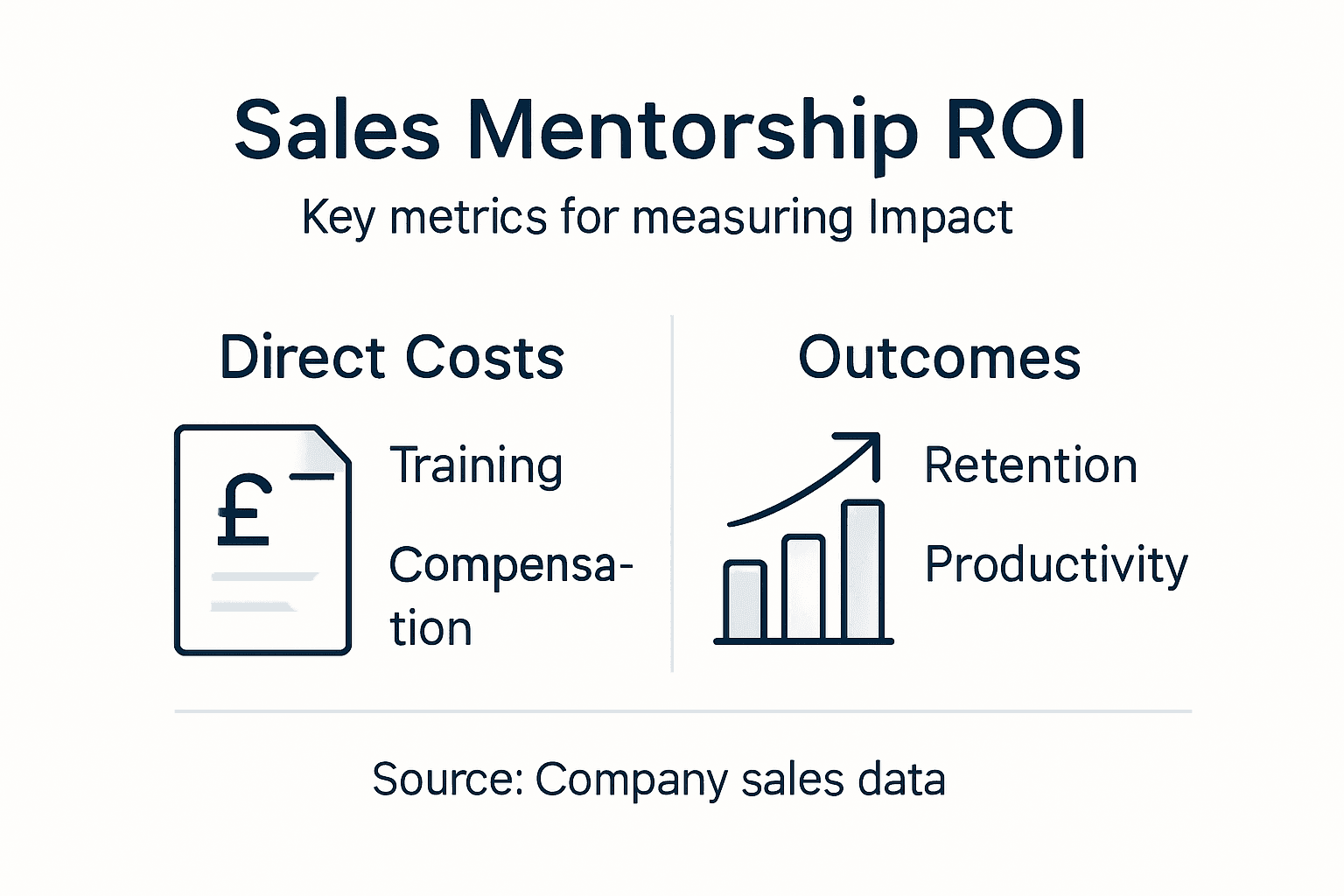
Direct costs typically include formal training programmes, mentor compensation, and dedicated time for mentorship interactions. Indirect costs involve productivity adjustments during mentorship sessions and potential temporary performance variations. However, these investments are counterbalanced by remarkable returns: reduced sales team turnover, accelerated skill development, improved performance consistency, and enhanced organisational knowledge transfer. Organisations that strategically implement mentorship programmes often witness productivity gains that far outweigh the initial financial commitment.
Measuring mentorship return on investment requires a comprehensive approach beyond simple financial metrics. Successful programmes track key performance indicators such as sales volume improvements, individual sales representative growth, reduced onboarding times, and enhanced team cohesion. By establishing clear benchmarks and systematically evaluating mentorship outcomes, organisations can demonstrate tangible value and continuously refine their investment strategies to maximise professional development impact.
Pro tip: Develop a robust measurement framework with specific, quantifiable metrics to track mentorship programme effectiveness and justify ongoing investment.
This summary table highlights key factors for measuring sales mentorship return on investment:
| Measurement Factor | Description | Why It Matters |
|---|---|---|
| Sales growth | Change in sales performance | Demonstrates business impact |
| Onboarding speed | Time for new hires to reach targets | Reduces ramp-up costs |
| Retention rates | Staff turnover before/after mentorship | Signals improved engagement |
| Team knowledge transfer | Skills and insights shared across teams | Fuels continuous improvement |
Common pitfalls and how to avoid them
Sales organisations must be vigilant about identifying mentorship relationship challenges that can undermine programme effectiveness. The most prevalent pitfalls emerge from misaligned expectations, inadequate communication structures, and insufficient mentor preparation, which can derail even the most well-intentioned mentorship initiatives.
Matching incompatibilities represent a significant risk, where mentors and mentees are paired without considering personality dynamics, learning styles, or professional objectives. This mismatch can create friction, reduce engagement, and ultimately diminish the potential for meaningful skill transfer. Communication breakdowns frequently occur when organisations fail to establish clear communication protocols, feedback mechanisms, and mutual performance expectations. Without structured interaction frameworks, mentorship relationships can become inconsistent, superficial, or potentially counterproductive.
Successful mentorship programmes mitigate these risks through strategic design and ongoing evaluation. This involves implementing robust screening processes for mentors, developing comprehensive training programmes, establishing clear performance metrics, and creating flexible frameworks that allow for relationship adjustments. Regular check-ins, anonymous feedback mechanisms, and periodic relationship assessments can help organisations proactively identify and address potential challenges before they escalate, ensuring the mentorship remains constructive and aligned with both individual and organisational growth objectives.
Pro tip: Conduct quarterly mentorship relationship reviews, allowing both mentors and mentees to provide confidential feedback and make necessary adjustments to maintain programme effectiveness.
Unlock Your Sales Team’s Full Potential with Expert Mentorship
Many sales teams struggle with inconsistent performance and lack the strategic guidance needed for sustained growth. This article highlights how tailored sales mentorship is crucial for accelerating skill development, enhancing team cohesion and building future leaders. If your organisation faces challenges such as misaligned expectations, ineffective communication or slow professional growth, these are common pain points that bespoke mentorship programmes can address. At Ahead of Sales, we combine personalised 1:1 coaching with proven training and consultancy methods to deliver measurable sales growth year after year.

Discover how our targeted sales mentorship solutions can transform your team’s capabilities and drive at least 50% sales growth annually. Explore practical strategies within our Sales Strategy Archives – Ahead of Sales and refine your approach with insights from our Sales Playbook Archives – Ahead of Sales. Whether you lead a medium to large business or a solo service operation, visit https://aheadofsales.co.uk to learn how to kickstart your sales acceleration journey today. Don’t wait to unlock the power of mentorship tailored for your business growth ambitions.
Frequently Asked Questions
What is sales mentorship?
Sales mentorship is a strategic relationship where an experienced sales professional guides a less experienced colleague, focusing on knowledge transfer and professional growth.
What are the types of sales mentorship models?
There are several models, including hierarchical mentorship, peer mentorship, group mentorship, and e-mentoring, each designed to support different learning and growth objectives.
How does mentorship accelerate sales team growth?
Mentorship accelerates growth by facilitating skill transfer, providing psychological support, and fostering a culture of continuous learning, which enhances both individual and team performance.
What are the common pitfalls in sales mentorship programmes?
Common pitfalls include matching incompatibilities between mentors and mentees, communication breakdowns, and inadequate mentor preparation, which can hinder programme effectiveness.
Recommended
- Role of Sales Leadership: Complete Guide for Growth – Ahead of Sales
- 7 Essential Sales Leadership Tips for Fast Growth – Ahead of Sales
- 7 Essential Sales Team Training Topics for Growth – Ahead of Sales
- 7 Proven Sales Acceleration Strategies for Rapid Growth – Ahead of Sales
- Employee Retention Solutions | Reduce Turnover | OpenElevator
One Response