
Many British service firms struggle to achieve rapid sales growth, with only a fraction seeing consistent double-digit gains each year. For sales leaders in growing organisations, the pressure is intense. Balancing customer relationships, quality delivery, and innovation feels demanding when your goal is 50 percent annual growth. This article offers practical, clear strategies that speak directly to the realities facing British service firms seeking smarter, sustainable sales success.
Table of Contents
- Understanding Sales Growth In Service Firms
- Types Of Sales Growth Strategies Explained
- How Investing In Sales Drives Profitable Expansion
- Essential Requirements For Sustainable Sales Growth
- Financial Implications And Common Mistakes To Avoid
Key Takeaways
| Point | Details |
|---|---|
| Sales Growth Challenges | Service firms face unique complexities in sales growth related to intangible value delivery and customer relationship management. |
| Strategic Growth Approaches | A balanced growth strategy combining organic growth, market diversification, vertical integration, and product development is essential for service firms. |
| Investment in Sales Capability | Targeted investment in human capital, technology, and customer relationship management is crucial for sustainable growth. |
| Financial Vigilance | Organisations must avoid common financial mistakes by implementing robust forecasting and resource allocation strategies. |
Understanding Sales Growth in Service Firms
Sales growth in service firms represents a nuanced strategic challenge distinctly different from product-based businesses. Unlike tangible product sales, service organisations must navigate complex dynamics of intangible value delivery and relationship management. Comprehensive frameworks for service sector sales performance reveal unique characteristics that significantly impact growth potential.
Modern service firms encounter multifaceted growth challenges rooted in their inherent structural complexity. These organisations must simultaneously manage customer expectations, deliver consistent quality, and demonstrate strategic adaptability. Strategic models for evaluating service growth opportunities highlight critical dimensions such as servitization and service infusion that enable competitive differentiation.
Successful sales growth in service environments requires a holistic approach integrating technological innovation, talent development, and customer-centric strategies. Key focus areas include developing robust sales methodologies, investing in continuous skills training, and creating adaptive frameworks that respond quickly to market changes. Service firms must also prioritise building sophisticated measurement systems that capture both quantitative performance metrics and qualitative relationship indicators.
Pro Tip: Strategic Growth Assessment: Conduct quarterly comprehensive reviews of your service sales ecosystem, examining not just revenue numbers but also customer satisfaction scores, team skill progression, and strategic alignment with emerging market trends.
Types of Sales Growth Strategies Explained
Service firms can implement multiple strategic approaches to drive sales growth, each with distinct operational characteristics and potential outcomes. Comparative analysis of sales growth strategies reveals complex interactions between different growth methodologies, demonstrating that successful expansion requires nuanced, context-specific planning.
The primary sales growth strategies can be categorised into several key approaches:
- Organic Growth: Developing internal capabilities, expanding existing product lines, and deepening market penetration through incremental improvements
- Market Diversification: Strategic expansion across multiple market segments to reduce risk and create new revenue streams
- Vertical Integration: Acquiring or developing complementary business functions to increase control and efficiency
- Product Development: Creating new service offerings or enhancing existing solutions to meet evolving customer needs
Each strategy presents unique challenges and opportunities. Organic growth offers stability and controlled expansion, while diversification provides risk mitigation through multiple revenue channels. Vertical integration can significantly improve operational efficiency, and targeted product development ensures continued market relevance.
To clarify the distinctions between major sales growth strategies in service firms, see the comparison below:
| Strategy Type | Main Advantage | Typical Risk | Best Used When |
|---|---|---|---|
| Organic Growth | Steady scaling with control | Slow impact | Stable markets, strong core |
| Market Diversification | Access to new segments | Resource dilution | Volatile or saturated markets |
| Vertical Integration | Efficiency and process control | Complex implementation | Value chain gaps, cost issues |
| Product Development | Enhanced client relevance | Innovation cost, failure | Changing client needs |
Pro Tip: Strategic Growth Portfolio: Develop a balanced growth strategy that combines multiple approaches, regularly reassessing and adjusting your mix based on market dynamics and organisational capabilities.
How Investing in Sales Drives Profitable Expansion
Investing strategically in sales capabilities represents a fundamental driver of sustainable business growth and financial performance. Empirical research on sales investment strategies demonstrates a direct correlation between targeted sales investments and enhanced organisational value, revealing that systematic and thoughtful resource allocation can transform revenue generation potential.
Successful sales investment requires a multifaceted approach encompassing several critical dimensions:
- Human Capital Development: Training and upskilling sales professionals
- Technological Infrastructure: Implementing advanced sales enablement tools
- Strategic Recruitment: Attracting high-performance sales talent
- Performance Management: Creating robust measurement and incentive systems
- Customer Relationship Management: Developing sophisticated engagement frameworks
The most effective sales investments go beyond traditional spending, focusing instead on creating integrated ecosystems that generate sustainable competitive advantages. This means understanding that sales growth is not merely about increasing headcount or marketing expenditure, but about building intelligent, adaptable systems that can respond rapidly to changing market dynamics.

Pro Tip: Strategic Investment Assessment: Conduct a comprehensive quarterly review of your sales investment portfolio, measuring not just immediate financial returns but long-term capability development and strategic alignment with organisational growth objectives.
Essential Requirements for Sustainable Sales Growth
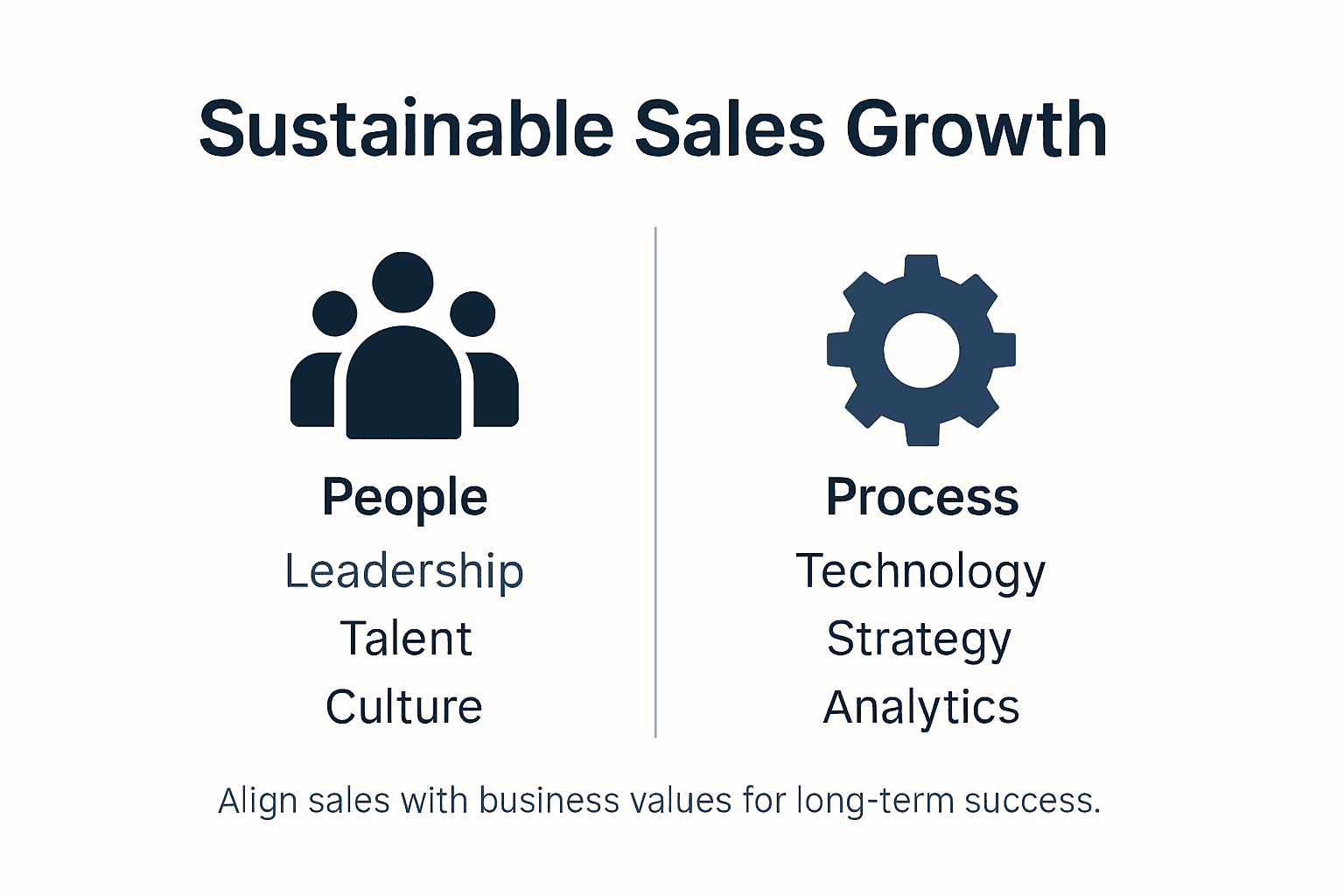
Sustainable sales growth strategies demand a holistic approach that integrates technological innovation, strategic planning, and responsible business practices. Modern organisations must move beyond traditional revenue generation models, developing comprehensive frameworks that balance short-term performance with long-term organisational resilience.
Key requirements for achieving sustainable sales growth include:
- Digital Transformation: Leveraging advanced technological platforms
- Stakeholder Engagement: Creating meaningful, transparent relationships
- Environmental Integration: Embedding sustainability into core business strategies
- Risk Management: Developing adaptive and predictive operational models
- Continuous Learning: Implementing ongoing skills development programmes
Comparative research on global business growth underscores the critical importance of integrating environmental, social, and governance (ESG) principles into sales strategies. This approach requires organisations to reimagine sales not as a transactional process, but as a collaborative ecosystem that creates value for all stakeholders while maintaining financial performance.
Here is a summary of key requirements for sustainable sales growth and their business impact:
| Requirement | Description | Business Impact |
|---|---|---|
| Digital Transformation | Advanced tech integration | Increased efficiency and agility |
| Stakeholder Engagement | Transparent, value-driven relations | Loyalty and reputation boost |
| Environmental Integration | Sustainability at strategy core | Long-term viability, compliance |
| Risk Management | Adaptive models for uncertainty | Reduced disruption, resilience |
| Continuous Learning | Ongoing staff development | Innovation and adaptability |
Pro Tip: Sustainability Alignment: Conduct a comprehensive quarterly review of your sales strategies, ensuring they align with broader organisational sustainability goals and demonstrate measurable social and environmental impact.
Financial Implications and Common Mistakes to Avoid
Understanding the financial landscape of sales growth requires a nuanced approach that goes beyond simple revenue projections. Critical financial planning mistakes often derail promising sales strategies, creating potential long-term economic challenges for organisations.
Common financial pitfalls in sales growth include:
- Overly Optimistic Forecasting: Unrealistic revenue expectations
- Cash Flow Mismanagement: Neglecting timing and liquidity requirements
- Resource Misalignment: Improper allocation of financial resources
- Inadequate Scenario Planning: Failing to model potential economic variations
- Disconnected Strategic Planning: Separating financial objectives from operational realities
Successful sales growth demands a sophisticated financial approach that balances ambitious targets with pragmatic risk management. This requires developing robust financial models that account for multiple potential outcomes, creating flexible strategies that can adapt to changing market conditions while maintaining consistent economic performance.
Pro Tip: Financial Resilience Planning: Develop quarterly financial scenario models that include best-case, worst-case, and most-likely financial projections, ensuring your sales strategy remains adaptable and financially sustainable.
Unlock Sustainable Sales Growth with Expert Guidance
The article highlights the critical challenge of transforming sales growth from a hopeful target into a consistent, measurable reality within service firms. If your organisation struggles with creating adaptive sales strategies or investing wisely in human capital and technological infrastructure you are certainly not alone. Pain points such as balancing financial resilience, sustaining customer relationships, and developing continuous learning frameworks can seem overwhelming but are vital for unlocking true business impact.
At Ahead of Sales we specialise in addressing these key hurdles head-on. Through bespoke 1:1 coaching combined with proven training and consultancy methods we empower businesses with 50 to 1000 employees to generate at least 50 per cent growth every year while ensuring their teams consistently hit targets every quarter. Our focus on strategic sales methodologies and performance management perfectly aligns with the detailed growth strategies discussed in the Sales Strategy Archives – Ahead of Sales and enables you to build adaptive ecosystems that respond effectively to changing market demands.
Ready to channel your sales investment into profitable expansion? Discover how our targeted packages can accelerate your sales journey today.
Explore tailored services that drive measurable results now at Ahead of Sales. To dive deeper into actionable sales insights and step-by-step playbooks visit our Sales Playbook Archives – Ahead of Sales and broaden your understanding with articles from our Uncategorized Archives – Ahead of Sales. Take control of your sales growth strategy and book your initial consultation to transform potential challenges into lasting success.
Frequently Asked Questions
Why should a business invest in sales growth?
Investing in sales growth is crucial for enhancing organisational value and driving sustainable financial performance. It enables businesses to expand their market reach, develop customer relationships, and improve competitiveness.
What are the main strategies for achieving sales growth in service firms?
Key strategies include organic growth, market diversification, vertical integration, and product development. Each approach has its advantages and challenges depending on the market conditions and organisational capabilities.
How does technology play a role in sales growth?
Technology enhances sales capabilities by providing advanced tools for sales enablement, tracking performance metrics, and improving customer relationship management, leading to more efficient sales processes and better outcomes.
What mistakes should businesses avoid when pursuing sales growth?
Common pitfalls include overly optimistic forecasting, cash flow mismanagement, misallocation of resources, and inadequate scenario planning, all of which can disrupt sales strategies and hinder long-term growth.
One Response