
Most british businesses agree that fewer than 30 percent of sales teams consistently hit their targets each year. Understanding your team’s true abilities is more than just crunching numbers. It is about revealing the invisible strengths and gaps that drive real success. Whether you manage a large corporate group or a small local office, discovering how to assess and develop your sales team can make the difference between hitting quotas and falling short.
Table of Contents
- Stage 1: Diagnose Current Sales Team Strengths And Weaknesses
- Stage 2: Define Measurable Sales Performance Targets And KPIs
- Stage 3: Implement Bespoke Training And Hands-On Coaching Strategies
- Stage 4: Optimise Sales Processes And Leverage Technology
- Stage 5: Monitor Progress And Adjust Strategies For Continued Success
Quick Summary
| Effective Insight | Explanation |
|---|---|
| 1. Assess Sales Team’s Strengths and Weaknesses | Conduct a systematic skills assessment to identify areas for improvement and leverage individual strengths within the sales team. |
| 2. Define Clear Performance Targets and KPIs | Establish specific, measurable, achievable, relevant, and time-bound performance indicators to guide your sales team’s efforts effectively. |
| 3. Implement Tailored Training and Coaching | Design personalised training programmes that address individual skill gaps while fostering cohesive team learning to enhance overall performance. |
| 4. Optimise Sales Processes with Technology | Integrate advanced technologies and streamline sales processes to create a data-driven approach that improves efficiency and decision-making. |
| 5. Continuously Monitor and Adapt Strategies | Regularly review team performance against benchmarks to make data-driven adjustments that ensure ongoing improvement and alignment with goals. |
Stage 1: Diagnose current sales team strengths and weaknesses
Diagnosing your sales team’s performance requires a systematic and nuanced approach to uncovering hidden potential and critical improvement areas. By employing a structured methodology, you can transform raw insights into actionable strategies that drive extraordinary growth.
The most effective diagnostic process begins with comprehensive skills assessments designed to evaluate individual behaviours and communication styles. These targeted evaluations help you understand precisely where team members excel and where they need strategic development. Utilising a focused SWOT methodology allows you to examine significant value creation events and identify core competencies that differentiate top performers.
To conduct a robust diagnosis, implement a multi-step assessment strategy. Start by collecting quantitative performance data such as conversion rates, average deal sizes, and sales cycle lengths. Complement this with qualitative insights through one-on-one interviews, peer feedback, and self-assessment surveys. Look for patterns in communication skills, product knowledge, negotiation techniques, and client relationship management. The goal is not just to identify weaknesses but to understand the underlying factors that contribute to performance variations across your sales team.
Warning: Avoid turning this diagnostic process into a punitive exercise. Frame it as a collaborative opportunity for growth and professional development. Your team should feel supported and motivated to improve, not judged or threatened by the assessment.
Stage 2: Define measurable sales performance targets and KPIs
Defining precise and meaningful sales performance targets transforms ambiguous aspirations into strategic roadmaps for extraordinary growth. Your objective is to create a comprehensive measurement framework that captures both quantitative achievements and qualitative capabilities.

The most effective performance frameworks now require comprehensive analytical assessments that align with evolving technological demands. Modern sales performance metrics must transcend traditional numerical targets by incorporating nuanced indicators of team capability. These might include analytical competencies, customer engagement depth, solution complexity understanding, and adaptive problem solving skills.
To construct a robust KPI framework, start by identifying core performance dimensions. Focus on metrics such as conversion rates, average deal value, sales cycle length, customer acquisition cost, and customer lifetime value. Systematically categorise performance indicators to ensure alignment with organisational objectives, creating a holistic view of sales effectiveness. Remember that each metric should be specific, measurable, achievable, relevant, and time bound.
Warning: Avoid creating too many KPIs. Overcomplicating your performance measurement can lead to confusion and diminished focus. Select 5-7 core metrics that truly reflect your strategic priorities and provide meaningful insights into sales team performance.
Stage 3: Implement bespoke training and hands-on coaching strategies
Transforming your sales team’s performance requires a sophisticated approach that goes beyond traditional training methods. Your goal is to create a personalised learning experience that addresses individual skill gaps while building collective team capability.
Modern training strategies are increasingly leveraging advanced technologies to deliver immersive learning experiences tailored to individual skill development. Consider integrating innovative approaches such as virtual reality simulations that allow sales professionals to practise complex negotiation scenarios in a risk free environment. These bespoke training interventions enable team members to refine interpersonal skills, develop adaptive communication techniques, and build confidence without the pressure of real world consequences.
To implement an effective coaching strategy, begin by conducting comprehensive individual assessments that identify specific strengths and developmental opportunities for each team member. Design personalised learning pathways that blend multiple training modalities including one on one coaching sessions, group workshops, online learning modules, and practical skill application exercises. Ensure that your coaching approach is dynamic and responsive focusing on continuous improvement rather than punitive performance management.
Warning: Customisation is key but avoid over individualising your approach. While each team member needs targeted development, maintaining cohesive team learning objectives and shared cultural understanding remains crucial for overall sales team effectiveness.
Stage 4: Optimise sales processes and leverage technology
Optimising sales processes requires a strategic blend of technological innovation and systematic performance management. Your objective is to transform traditional sales workflows into intelligent data driven ecosystems that accelerate growth and decision making.
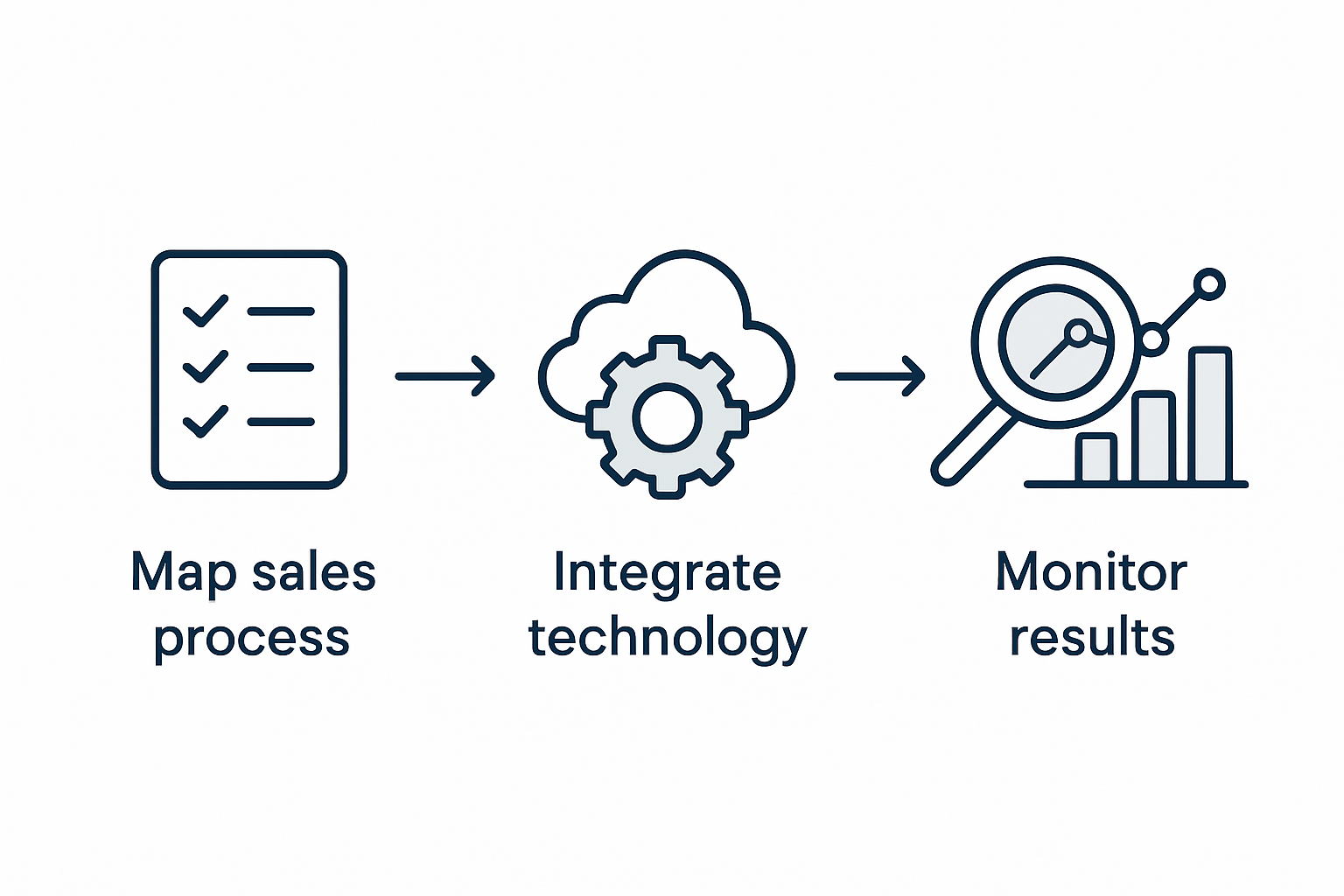
Modern sales organisations are increasingly adopting advanced machine learning frameworks to predict sales opportunity outcomes, enabling more precise targeting and resource allocation. These sophisticated technologies help overcome traditional challenges such as limited transaction data and unpredictable market dynamics. By implementing intelligent predictive models, you can transform raw sales information into actionable insights that guide strategic decision making and enhance overall team performance.
To effectively leverage technology, adopt a comprehensive management approach that aligns individual objectives with organisational goals. Begin by mapping your existing sales processes, identifying bottlenecks and inefficiencies. Integrate cutting edge customer relationship management systems, automated reporting tools, and analytics platforms that provide real time performance visibility. Focus on creating seamless technological ecosystems that reduce administrative burden while providing granular insights into sales team effectiveness.
Warning: Technology is a tool not a solution. Successful implementation requires careful change management, comprehensive team training, and a cultural commitment to data driven continuous improvement. Ensure your technological investments are accompanied by robust training and support mechanisms.
Stage 5: Monitor progress and adjust strategies for continued success
Sustaining sales performance growth requires a dynamic approach of continuous monitoring and strategic adaptation. Your primary objective is to create a responsive system that captures real time performance insights and enables swift strategic recalibration.
Implementing a comprehensive performance management framework helps track the execution and consequences of team activities, providing a structured approach to understanding your sales team’s trajectory. By establishing a robust monitoring system, you can rapidly identify emerging trends, potential bottlenecks, and opportunities for strategic intervention. This approach transforms performance tracking from a passive reporting exercise into an active mechanism for organisational learning and improvement.
To effectively monitor and adjust your strategies, adopt precise objective setting criteria that ensure clarity and actionability. Focus on developing performance indicators that are specific, measurable, achievable, relevant, and time bound. Conduct regular quarterly reviews that critically examine your team performance against established benchmarks. During these reviews, analyse key metrics such as conversion rates, deal velocity, customer acquisition costs, and revenue generation. Be prepared to make data driven adjustments to your training programmes, technological infrastructure, and sales processes based on these insights.
Warning: Beware of overreacting to short term fluctuations. Sustainable strategy adjustment requires a balanced perspective that considers both immediate performance data and longer term organisational objectives. Maintain flexibility while preserving the core strategic vision that drives your sales team forward.
Unlock Extraordinary Sales Growth with Bespoke Coaching and Strategic Support
The challenges of diagnosing sales team strengths, setting measurable KPIs and implementing personalised training are exactly where many businesses struggle to sustain consistent growth. If you are seeking to transform these pain points into competitive advantages by applying tailored 1:1 coaching combined with proven sales strategies and technology optimisation, Ahead of Sales offers the breakthrough you need. Our focus on aligning individual development with measurable results ensures your sales team hits its targets every quarter while driving at least 50% annual growth.

Explore how our expert team can help you elevate your sales performance through customised training and data-driven strategies in the Sales Strategy Archives – Ahead of Sales. Ready to empower your sales team with tools and coaching that deliver real impact? Visit our main website at Ahead of Sales to discover our packages for businesses with 50 to 1000 staff or solo service accelerators. Learn more about practical applications and insights in our Sales Playbook Archives – Ahead of Sales and take the first step toward extraordinary growth today.
Frequently Asked Questions
How can I assess my sales team’s strengths and weaknesses effectively?
To assess your sales team’s strengths and weaknesses, implement comprehensive skills assessments that evaluate individual behaviours and communication styles. Gather quantitative performance data alongside qualitative feedback to identify patterns and areas for improvement.
What key performance indicators (KPIs) should I focus on for my sales team?
Focus on 5-7 core KPIs that reflect your strategic priorities, such as conversion rates, average deal value, and customer acquisition costs. This targeted approach enables clear tracking of performance against measurable objectives and supports informed decision-making.
How do I customise training strategies for my sales team?
To customise training strategies, conduct detailed assessments of each team member’s skills and development needs. Design tailored learning pathways that combine individual coaching, group workshops, and practical exercises to effectively address identified gaps.
What steps should I take to optimise my sales processes with technology?
Begin by mapping your existing sales processes to identify inefficiencies and bottlenecks. Then, integrate advanced tools such as customer relationship management systems and analytics platforms to create a data-driven ecosystem that enhances productivity and insights.
How can I effectively monitor my sales team’s progress?
Implement a robust performance management framework to continuously track key metrics and identify trends. Conduct regular reviews to analyse performance against established benchmarks, and be prepared to make data-driven adjustments to strategies and training as needed.
What precautions should I take when adjusting sales strategies?
When adjusting sales strategies, avoid overreacting to short-term fluctuations in performance data. Maintain a balanced perspective by considering both immediate results and long-term objectives to ensure sustainable growth.
Recommended
- Sales Team Performance Explained: Maximizing Growth Results – Ahead of Sales
- 7 Proven Sales Acceleration Strategies for Rapid Growth – Ahead of Sales
- Sales Performance Metrics Explained: Complete Guide
- 7 Essential Sales Leadership Tips for Fast Growth – Ahead of Sales
- Understanding Managing Customer Expectations in Diesel Services – My WordPress
- Business Presentation Tips: Complete Expert Guide – Projector Display