
Most british businesses rely on a clear sales cycle to turn leads into loyal customers. Research shows that companies with a defined sales process see up to 18 percent more revenue growth compared to those without structure. Knowing each stage and its core concepts is crucial for building predictable results and stronger sales teams. By breaking down the journey from prospecting to closing, you gain better insight into what really drives sales success.
Table of Contents
- Defining The Sales Cycle And Core Concepts
- Key Stages Of A Standard Sales Cycle
- Major Variations And Industry Differences
- Critical Success Factors And Team Roles
- Common Pitfalls And How To Avoid Them
Key Takeaways
| Point | Details |
|---|---|
| Sales Cycle Framework | The sales cycle consists of seven key stages that guide businesses in converting leads into customers. This structured approach aids in performance measurement and identifying bottlenecks. |
| Industry Variations | Despite a consistent framework, the sales cycle may differ significantly across industries, with variations in length and execution based on sector demands. |
| Critical Team Roles | Effective sales teams require strategic alignment of roles, including Sales Development Representatives and Account Executives, to ensure successful lead conversion. |
| Avoiding Pitfalls | Common sales cycle pitfalls can be mitigated through standardised processes, timely communication, and robust training to enhance overall effectiveness. |
Defining the Sales Cycle and Core Concepts
A sales cycle represents the strategic roadmap businesses follow to convert potential prospects into paying customers. According to Salesforce, the sales cycle encompasses seven fundamental stages that guide sales professionals through a structured approach to generating and closing new business opportunities.
At its core, Coursera defines a sales cycle as the comprehensive process that begins with generating a new lead and extends through to post-sale follow-up activities. This systematic approach allows businesses to understand, predict, and optimise their sales performance by breaking down complex customer interactions into manageable, repeatable steps.
The primary objective of a well-defined sales cycle is to create a consistent and predictable framework for sales teams. By implementing a structured approach, organisations can:
- Track and measure sales performance more effectively
- Identify potential bottlenecks in the sales process
- Improve forecasting and revenue projection
- Provide clear guidance for sales representatives
- Enhance overall customer engagement and conversion rates
While the specific stages might vary slightly across different industries, the fundamental principles remain consistent. Sales Strategy Explained: Comprehensive Growth Blueprint provides deeper insights into how businesses can adapt these core concepts to their unique organisational needs and market dynamics.
Key Stages of a Standard Sales Cycle
According to Salesforce, a standard sales cycle typically comprises seven fundamental stages that guide sales professionals through a structured approach to generating and closing business opportunities. While these stages might vary slightly across different industries, the core framework remains consistently effective for most organisations.
Sifthub highlights that the sales cycle begins with prospecting, which involves systematically identifying potential clients who might benefit from the company’s products or services. This initial stage sets the foundation for all subsequent interactions, requiring sales teams to conduct thorough research and develop targeted strategies for engagement.

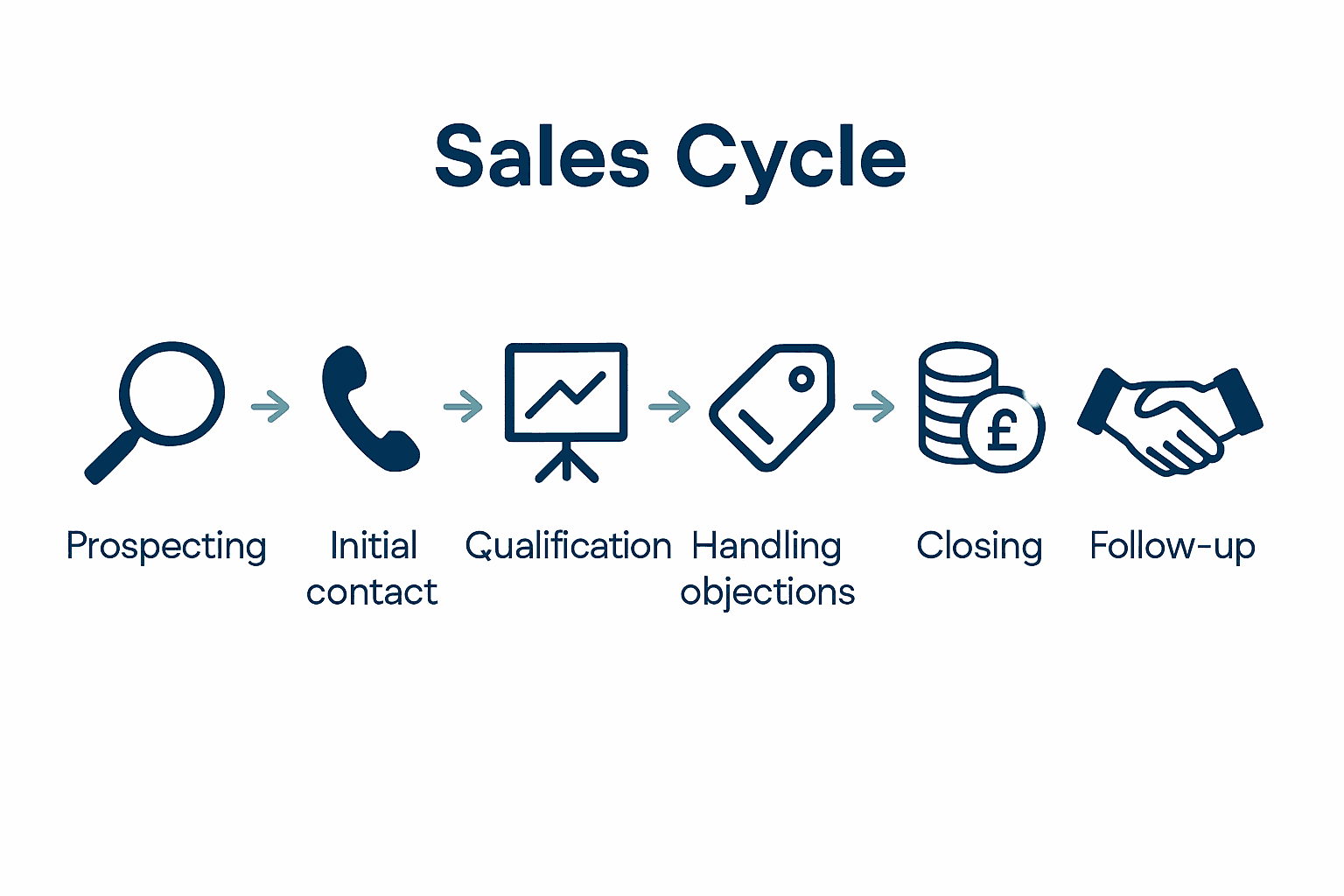
The typical stages of a standard sales cycle generally include:
- Prospecting: Identifying and researching potential leads
- Initial Contact: Reaching out and establishing communication
- Qualification: Assessing whether the prospect matches the ideal customer profile
- Needs Assessment: Understanding the client’s specific challenges and requirements
- Presentation: Demonstrating how your solution addresses their unique needs
- Handling Objections: Addressing potential concerns and reservations
- Closing: Finalising the sale and securing commitment
For businesses looking to optimise their sales processes, Sales Pipeline Explained: Complete Guide for Growth provides comprehensive insights into refining each stage of the sales cycle and improving overall conversion rates.
Major Variations and Industry Differences
While Salesforce emphasises that the fundamental sales cycle framework remains consistent across industries, the nuanced implementation can vary dramatically depending on the specific sector and business model. Industry-specific variations play a crucial role in tailoring the sales approach to meet unique market demands and customer expectations.
Sifthub highlights that the core principles of prospecting and initial contact remain universal, yet the execution differs significantly across different business contexts. For instance, a software-as-a-service (SaaS) company might have a much shorter sales cycle compared to complex industrial equipment manufacturers, who typically require extensive consultation and longer decision-making processes.
Key industry-specific sales cycle variations include:
- Technology/SaaS: Typically shorter cycles, more digital interactions
- B2B Enterprise: Longer cycles with multiple stakeholder approvals
- Retail: Immediate transactional cycles with minimal negotiation
- Manufacturing: Extended cycles involving technical demonstrations
- Professional Services: Relationship-driven cycles with extensive consultative elements
- Healthcare: Highly regulated cycles with complex procurement processes
- Real Estate: Long-term cycles with significant financial considerations
Role of Sales in SaaS Growth provides deeper insights into how different industries adapt their sales strategies to accommodate unique market dynamics and customer engagement models.
Critical Success Factors and Team Roles
According to Sifthub, the performance of sales teams has a direct and profound impact on the quality and speed of the entire sales cycle. Team effectiveness becomes the critical linchpin determining whether an organisation can successfully convert potential leads into committed customers.
Salesforce emphasises that following sales cycle stages systematically and implementing best practices at each stage is crucial for rapidly moving deals towards closure. This requires a strategic alignment of team roles, each contributing unique skills and perspectives to the overall sales process.
Key team roles essential for sales cycle success include:
- Sales Development Representatives (SDRs): Initial lead generation and qualification
- Account Executives: Primary relationship managers and deal closers
- Sales Engineers: Technical solution specialists
- Sales Managers: Strategic oversight and team performance coaching
- Customer Success Managers: Post-sale relationship maintenance
- Sales Operations Specialists: Process optimization and data analysis
Sales Team Structure Explained offers comprehensive insights into how organisations can design and optimise their sales team structure to maximise performance and drive consistent growth.
Common Pitfalls and How to Avoid Them
Sifthub warns that a poorly managed sales cycle can result in losing promising prospects, highlighting the critical importance of understanding and mitigating common strategic errors. Sales cycle disruption can emerge from multiple sources, potentially derailing even the most promising business opportunities.
Salesforce emphasises that systematically following sales cycle stages and implementing best practices at each stage is fundamental to ensuring deals progress smoothly. This requires a proactive approach to identifying and addressing potential bottlenecks before they compromise the entire sales process.
Common sales cycle pitfalls and their strategic solutions include:
- Inconsistent Lead Qualification: Develop rigorous screening criteria and standardised assessment protocols
- Prolonged Response Times: Implement automated follow-up systems and clear communication timelines
- Lack of Personalisation: Create tailored engagement strategies for different customer segments
- Insufficient Sales Training: Invest in continuous skill development and product knowledge programmes
- Poor Customer Relationship Management: Establish clear communication protocols and relationship tracking mechanisms
- Inadequate Performance Tracking: Develop comprehensive metrics and regular performance review processes
How to Shorten Sales Cycles for Rapid Growth provides advanced strategies for organisations looking to streamline their sales processes and overcome traditional performance limitations.
Master Your Sales Cycle to Drive Consistent Growth
Understanding your sales cycle is crucial to overcoming common challenges like inconsistent lead qualification and prolonged response times. This article highlights the importance of a well-structured sales cycle that guides your team through each stage from prospecting to closing. If you want to see real improvements in your sales performance and ensure your team hits their targets every quarter, tailored support is essential.
Boost your sales process with our bespoke 1:1 coaching and traditional training packages designed for businesses ready to grow at least 50 per cent year on year. Explore expert strategies and insights in our Sales Strategy Archives – Ahead of Sales and enhance your approach with practical tools from the Sales Playbook Archives – Ahead of Sales.
Take control of your sales cycle now by partnering with a revolutionary sales training company committed to your success. Visit https://aheadofsales.co.uk to discover how our tailored solutions can accelerate your sales growth and transform your team’s performance today.
Frequently Asked Questions
What is a sales cycle?
A sales cycle is a strategic roadmap that businesses follow to convert potential prospects into paying customers, covering stages from lead generation to post-sale follow-up.
What are the typical stages in a standard sales cycle?
A standard sales cycle generally includes seven stages: prospecting, initial contact, qualification, needs assessment, presentation, handling objections, and closing.
How can a well-defined sales cycle improve sales performance?
A well-defined sales cycle allows businesses to track sales performance, identify bottlenecks, improve forecasting, provide clear guidance to sales representatives, and enhance customer engagement and conversion rates.
What common pitfalls should be avoided in the sales cycle?
Common pitfalls include inconsistent lead qualification, prolonged response times, lack of personalisation, insufficient training, poor customer relationship management, and inadequate performance tracking. Mitigating these issues can streamline the sales process.