
Nearly 75 percent of B2B companies now use SaaS products to run daily operations, making these software sales models a driving force in modern business. As companies move away from one-time licenses to ongoing subscriptions, their success depends on building trust and delivering continuous value. This shift demands new sales techniques, creative strategies, and deep understanding of customer needs in a rapidly evolving marketplace.
Table of Contents
- Defining B2B SaaS Sales And Core Principles
- Major B2B SaaS Sales Models Compared
- Key Stages In The SaaS Sales Process
- Critical Skills And Strategic Approaches
- Common Challenges And Pitfalls To Avoid
Key Takeaways
| Point | Details |
|---|---|
| B2B SaaS Sales Focus | Prioritizes long-term relationships and recurring revenue models, emphasizing continuous value delivery over one-time transactions. |
| Sales Models | Companies can adopt various sales models (Sales-Led, Product-Led, Sales-Assisted, Marketing-Led) based on product complexity and market targets. |
| Sales Process Stages | The B2B SaaS sales journey involves distinct stages from lead generation to closing, requiring a strategic approach to customer engagement. |
| Essential Skills | Successful SaaS sales professionals need technical proficiency, emotional intelligence, and a consultative approach to foster long-term partnerships. |
Defining B2B SaaS Sales and Core Principles
B2B Software as a Service (SaaS) sales represent a sophisticated approach to selling cloud-based software solutions directly to businesses, focusing on long-term relationship building and recurring revenue models. Unlike traditional software sales, B2B SaaS sales prioritise continuous value delivery and customer success rather than one-time transactions.
The core principles of B2B SaaS sales revolve around subscription-based revenue and strategic customer acquisition. According to ijirmps.org, B2B SaaS companies typically generate higher revenue per customer through long-term contracts and larger average deal sizes compared to their B2C counterparts. This model allows businesses to create more predictable income streams and invest in continuous product improvement.
Financial performance in B2B SaaS sales is often measured through specific metrics that demonstrate sustainable growth. hibob.com highlights subscription gross margins as a critical indicator of potential cash generation. Key performance indicators in this sales model include:
- Customer Acquisition Cost (CAC)
- Monthly Recurring Revenue (MRR)
- Customer Lifetime Value (CLV)
- Churn Rate
- Net Revenue Retention
Successful B2B SaaS sales strategies demand a consultative approach where sales professionals act more like trusted advisors than traditional product pushers. This means deeply understanding client challenges, demonstrating clear value propositions, and providing ongoing support that transforms initial sales into long-term partnerships.
Major B2B SaaS Sales Models Compared
Navigating the landscape of B2B SaaS sales models requires a nuanced understanding of different approaches that companies can leverage to drive growth and customer acquisition. Testbox.com reveals that most B2B SaaS companies primarily adopt either sales-led or sales-assisted models, with an increasing number exploring product-led growth strategies.
Primary B2B SaaS Sales Models
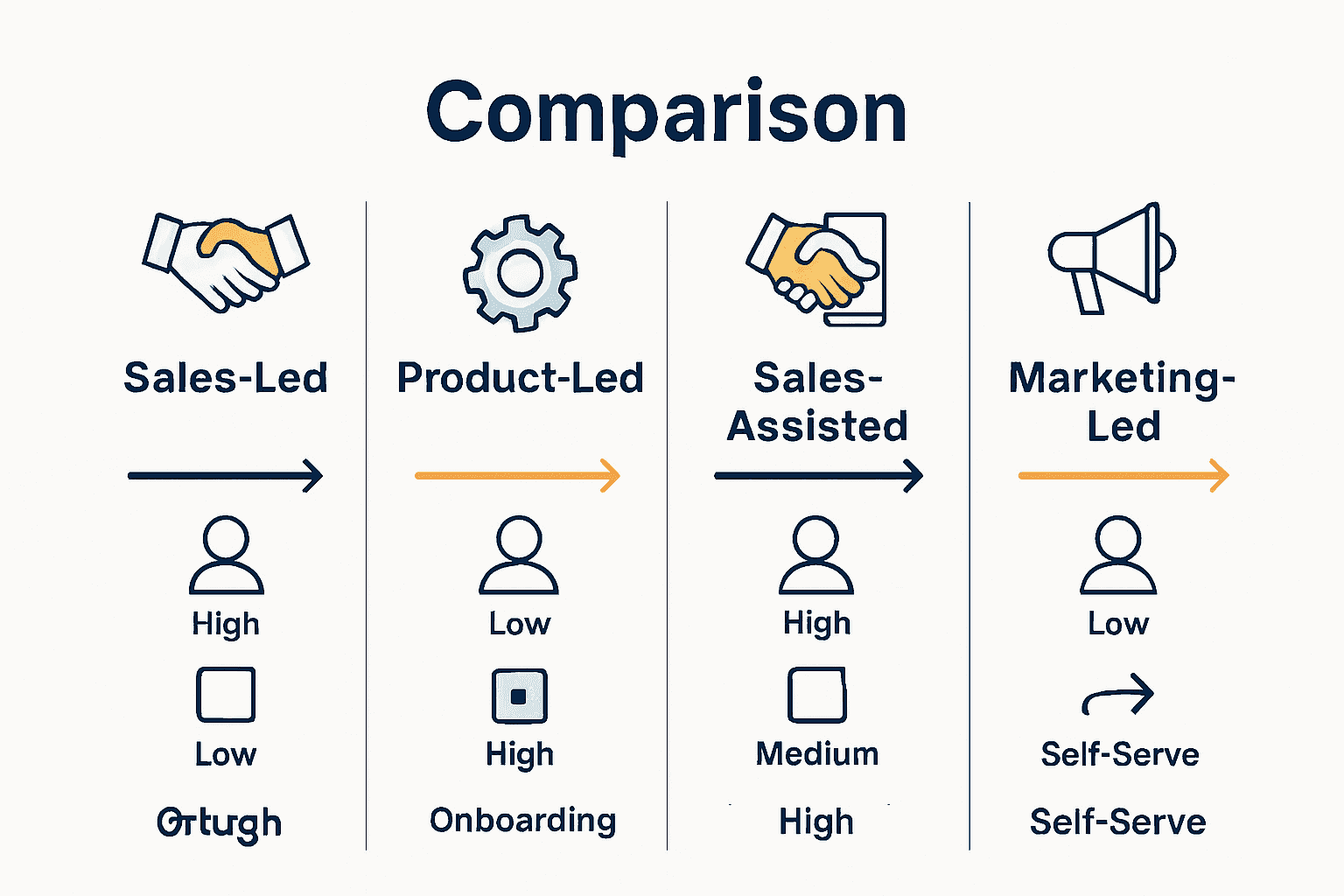
The four primary B2B SaaS sales models each offer unique advantages and suit different product complexity levels and target markets:
Here’s a comparison of the four primary B2B SaaS sales models:
| Model | Key Characteristics | Typical Use Cases | Level of Human Interaction |
|---|---|---|---|
| Sales-Led | High-touch, dedicated sales reps | Complex, enterprise deals | Extensive |
| Product-Led | Self-service onboarding, minimal support | User-friendly, lower-cost software | Minimal |
| Sales-Assisted | Mix of self-service & sales support | Mid-market, tailored onboarding | Moderate |
| Marketing-Led | Content-driven, inbound strategies | Brand awareness, lead generation | Low to moderate |
- Sales-Led Model
- High-touch approach with dedicated sales representatives
- Ideal for complex, enterprise-level software solutions
- Focuses on building personal relationships and consultative selling
- Product-Led Model
- Self-service onboarding and minimal human intervention
- Typically used for lower-cost, user-friendly software
- Relies on product functionality to drive user conversion
- Sales-Assisted Model
- Hybrid approach combining self-service with targeted sales support
- Provides guided assistance while maintaining some user autonomy
- Balances customer acquisition cost with personalised engagement
- Marketing-Led Model
- Emphasises content marketing and inbound strategies
- Attracts potential customers through valuable educational content
- Builds trust and credibility before direct sales engagement
According to Artisan.co, the B2B SaaS sales process fundamentally resembles a traditional sales pipeline, but with unique adaptations specific to software service delivery. This means understanding customer needs, demonstrating value proposition, and creating a seamless transition from initial interest to long-term subscription.
The selection of an appropriate sales model depends on multiple factors including product complexity, target market, pricing strategy, and customer acquisition costs. Successful B2B SaaS companies often experiment and evolve their sales approaches, recognising that no single model fits all scenarios.
Key Stages in the SaaS Sales Process
The B2B SaaS sales process is a strategic journey that transforms potential leads into long-term customers through carefully orchestrated stages. Artisan.co emphasises that lead generation forms the critical first step, involving both inbound marketing strategies and proactive outbound prospecting to attract potential customers.
Comprehensive Sales Process Stages
The typical B2B SaaS sales process encompasses several interconnected stages designed to guide potential clients from initial awareness to committed partnership:
- Lead Generation
- Identify potential target organisations
- Create compelling marketing content
- Utilise multiple channels (digital ads, content marketing, referrals)
- Initial Qualification
- Assess lead’s potential fit and interest
- Conduct preliminary discovery conversations
- Determine technical and budgetary compatibility
- Product Demonstration
- Showcase software capabilities
- Personalise presentation to specific client needs
- Address potential implementation challenges
- Proposal and Negotiation
- Present tailored solution
- Discuss pricing structures
- Negotiate contract terms
- Closing and Onboarding
- Finalise contract
- Implement initial setup
- Provide comprehensive customer support

Testbox.com highlights the importance of evaluating internal resources throughout this process, recognising that different sales models require varying team structures and specialised expertise. Successful organisations adapt their approach based on their specific product complexity, target market, and organisational capabilities.
Ultimately, the SaaS sales process is not a linear progression but a dynamic, iterative approach that demands continuous refinement, active listening, and a genuine commitment to solving client challenges. The most effective sales teams view each interaction as an opportunity to build lasting, value-driven partnerships.
Critical Skills and Strategic Approaches
Successful B2B SaaS sales professionals must develop a sophisticated blend of technical knowledge, strategic thinking, and interpersonal skills to navigate complex enterprise sales landscapes. UPosition Agency highlights the Challenger sales model as a particularly effective approach, teaching representatives to guide conversations, challenge client assumptions, and offer transformative insights.
Essential Skills for SaaS Sales Excellence
The most effective SaaS sales professionals cultivate a diverse skill set that goes beyond traditional sales techniques:
- Technical Proficiency
- Deep understanding of product capabilities
- Ability to translate technical features into business value
- Continuous learning about technological innovations
- Strategic Communication
- Consultative approach to client interactions
- Active listening and needs assessment
- Clear, concise explanation of complex solutions
- Problem-Solving Mindset
- Identifying underlying business challenges
- Creating customised solution frameworks
- Proactive approach to potential implementation barriers
- Emotional Intelligence
- Reading client motivations and hesitations
- Building trust through genuine engagement
- Managing complex stakeholder relationships
Testbox.com emphasises that a sales-led model requires dedicated professionals including sales representatives, account executives, and sales engineers who can expertly handle demos, negotiations, and ongoing relationship management.
The most successful SaaS sales professionals view their role as strategic partners rather than traditional salespeople. They focus on delivering measurable business value, understanding client ecosystems, and creating long-term partnerships that extend far beyond the initial software implementation. This approach transforms sales from a transactional interaction to a collaborative journey of mutual growth and innovation.
Common Challenges and Pitfalls to Avoid
B2B SaaS sales teams encounter numerous complex challenges that can derail even the most promising growth strategies. GetUpLead.com highlights a critical issue with attribution models, noting that traditional tracking methods often fall short in B2B SaaS environments due to extended sales cycles and multiple stakeholder interactions.
Key Challenges in B2B SaaS Sales
Sales professionals must navigate several potential pitfalls that can significantly impact their success:
- Misaligned Expectations
- Overpromising product capabilities
- Failing to set realistic implementation timelines
- Creating disconnects between sales promises and actual delivery
- Poor Customer Qualification
- Pursuing leads without proper fit assessment
- Neglecting total cost of ownership considerations
- Overlooking potential integration challenges
- Ineffective Communication
- Using technical jargon that confuses potential clients- Lack of clear value proposition articulation
- Insufficient understanding of client’s specific business context
- Pricing Strategy Limitations
- One-dimensional pricing approaches
- Inability to adapt to diverse customer needs
- Rigid subscription models that restrict flexibility
Beecoded.io emphasises that rigid pricing models can critically limit growth, warning that sticking to pure subscription or usage-only models risks alienating key customer segments and potentially increasing churn rates.
Successful B2B SaaS sales teams must remain adaptable, continuously refining their approach by learning from each interaction. The most resilient organisations treat challenges not as obstacles, but as opportunities for innovation, constantly evolving their strategies to meet the dynamic needs of enterprise customers.
Accelerate Your B2B SaaS Sales with Expert Coaching and Strategic Support
Navigating the complex landscape of B2B SaaS sales calls for more than just understanding models and metrics. The challenges of aligning client expectations, mastering consultative selling, and adapting pricing strategies require a tailored approach that drives real growth. If your team struggles with converting leads into lasting partnerships or faces difficulties managing extended sales cycles, you are not alone. Achieving consistent sales targets and increasing recurring revenue hinges on skilled sales professionals equipped with precise techniques and strategic insights.
Unlock the full potential of your sales team with Ahead of Sales, where we combine bespoke 1:1 coaching with traditional training and consultancy. Our programmes are designed to help businesses like yours generate at least 50 percent sales growth every year and ensure quarterly target achievement. Whether you are leading a complex sales-led model or exploring hybrid approaches, our sales acceleration packages provide the tailored support your team needs to consistently win enterprise-level deals. Don’t let sales challenges hold back your SaaS growth. Take the next step to transform your sales approach today by visiting Ahead of Sales and discover how we can help you exceed your goals.
Frequently Asked Questions
What is B2B SaaS sales?
B2B SaaS sales refer to the process of selling cloud-based software solutions directly to businesses, focusing on long-term relationships and subscription-based revenue models rather than one-time transactions.
What are the primary B2B SaaS sales models?
The four primary B2B SaaS sales models are Sales-Led, Product-Led, Sales-Assisted, and Marketing-Led, each offering unique advantages depending on the product complexity and target market.
What are key performance indicators (KPIs) in B2B SaaS sales?
Important KPIs in B2B SaaS sales include Customer Acquisition Cost (CAC), Monthly Recurring Revenue (MRR), Customer Lifetime Value (CLV), Churn Rate, and Net Revenue Retention, which help measure financial performance and sustainable growth.
What challenges do B2B SaaS sales teams face?
B2B SaaS sales teams often encounter challenges such as misaligned expectations, poor customer qualification, ineffective communication, and limitations in pricing strategies, which can impact their overall success.