
Did you know that over 80 percent of sales conversations involve customer objections? This number highlights how crucial it is to handle hesitations with skill and empathy. Handling objections well can turn tough questions into windows for trust and connection. When sales professionals understand the real reasons behind a customer’s doubts, they create opportunities to guide conversations toward solutions that benefit everyone.
Table of Contents
- Defining Objection Handling In Sales
- Common Types Of Sales Objections
- Proven Techniques For Objection Handling
- Obligations And Roles In Objection Handling
- Risks, Pitfalls, And Mistakes To Avoid
Key Takeaways
| Point | Details |
|---|---|
| Objection Handling Importance | Effective objection handling transforms potential roadblocks into opportunities for engagement and sales success. |
| Common Objection Types | Understanding types of objections like price, need, and trust is crucial for developing targeted responses. |
| Proven Techniques | Employ methods like the LACE framework, Boomerang Technique, and empathic listening to address objections effectively. |
| Avoid Common Mistakes | Sales professionals must avoid interrupting customers and using a one-size-fits-all approach to ensure meaningful dialogue. |
Defining Objection Handling in Sales
Objection handling represents a strategic approach in sales where professionals proactively address and resolve potential customer concerns before they become barriers to closing a deal. According to junoschool.org, objection handling involves “recognizing and addressing customer concerns to facilitate successful transactions” while fundamentally requiring a deep understanding of customer psychology.
At its core, objection handling is about transforming potential roadblocks into opportunities for deeper customer engagement. Sales professionals must develop a nuanced skill set that allows them to listen actively, empathise with customer reservations, and respond with targeted solutions. apex.wooster.edu highlights this critical skill as “responding to customer concerns with confidence” and preparing strategic approaches to address potential objections.
Effective objection handling typically involves several key strategies:
- Anticipating common customer concerns in advance
- Listening carefully to understand the underlying motivation behind the objection
- Responding with evidence, social proof, or personalised solutions
- Maintaining a confident yet empathetic communication style
- Redirecting the conversation towards value and positive outcomes
Successful sales professionals recognise that objections are not rejections, but invitations for deeper dialogue. By viewing each objection as an opportunity to demonstrate value, understand customer needs, and build trust, sales teams can transform potential deal-breakers into pathways for successful partnerships.
Common Types of Sales Objections
Sales professionals encounter a variety of objection categories that can potentially derail a deal. According to ppai.org, these typically include four primary barriers: lack of budget, lack of trust, lack of need, and lack of urgency. Understanding these core objection types is crucial for developing targeted strategies to overcome potential sales roadblocks.
thrivingtech.org expands on these categories, identifying five critical objection types that sales teams must be prepared to address:
- Price Objections: Concerns about cost and value proposition
- Need Objections: Questioning the actual requirement or relevance of the solution
- Timing Objections: Hesitation related to current readiness or implementation
- Trust Objections: Skepticism about the company, product, or sales representative
- Competitive Objections: Comparisons with alternative solutions in the market
Each objection type requires a nuanced approach. Price objections demand clear value demonstration, need objections require deep understanding of customer challenges, timing objections call for flexibility, trust objections necessitate credibility building, and competitive objections need strategic differentiation. By recognising the underlying motivation behind each objection, sales professionals can craft personalised responses that transform potential barriers into opportunities for meaningful dialogue and successful deal closure.

Here’s a comparison of the main types of sales objections and recommended handling strategies:
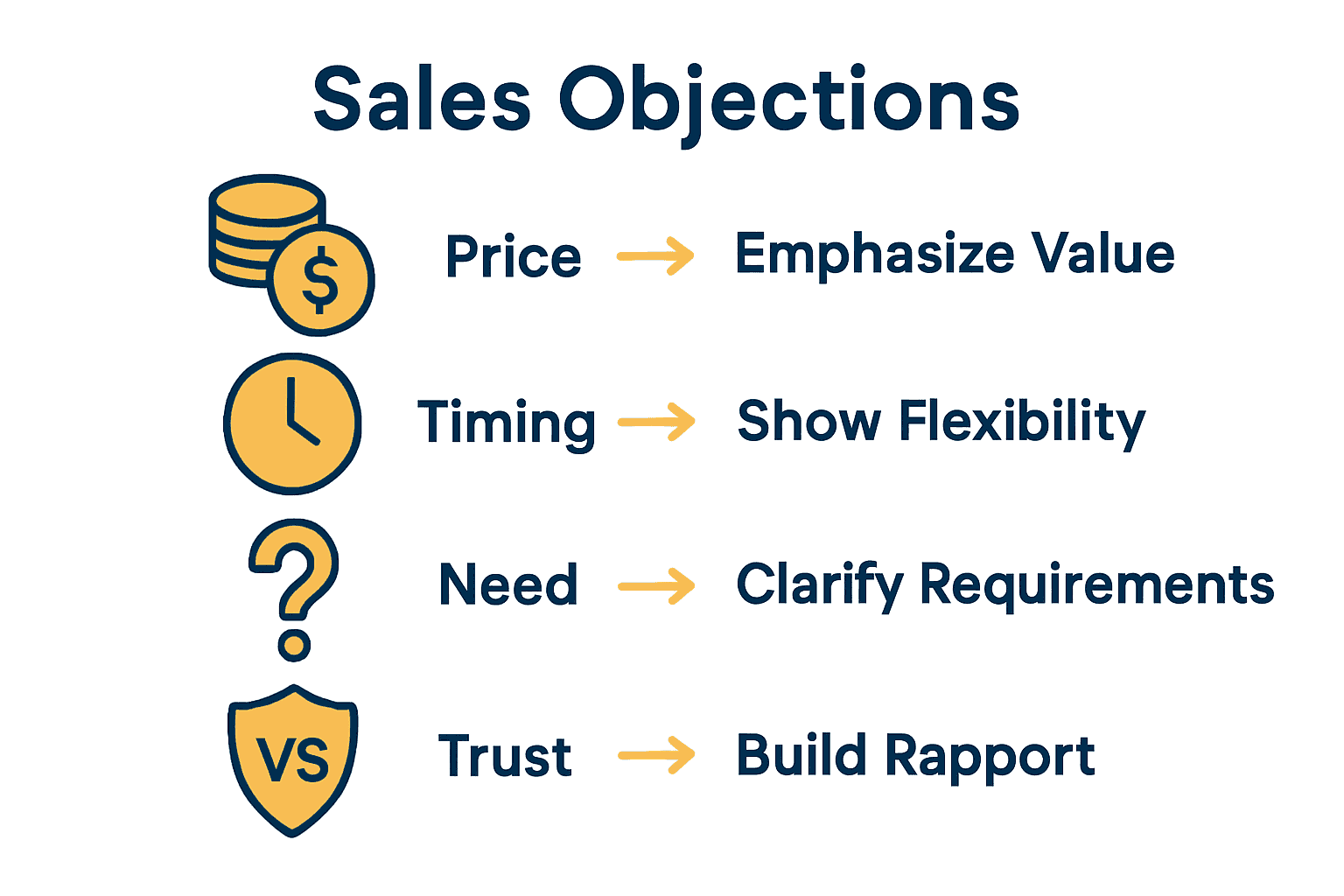
| Objection Type | Description | Handling Strategy |
|---|---|---|
| Price Objection | Concerns about cost or value | Emphasise value Offer evidence |
| Need Objection | Uncertainty about necessity | Explore needs Personalise solutions |
| Timing Objection | Hesitation about readiness or timing | Show flexibility Highlight urgency |
| Trust Objection | Doubts about seller or product | Build credibility Share proof |
| Competitive Objection | Comparison with rival solutions | Differentiate offering Show benefits |
Mastering objection handling isn’t about aggressive persuasion but about genuine connection. Sales teams must develop empathy, active listening skills, and the ability to provide tailored solutions that directly address the customer’s specific concerns and business objectives.
Proven Techniques for Objection Handling
Navigating customer objections requires a strategic and nuanced approach that goes beyond simple persuasion. According to changingminds.org, one of the most powerful frameworks for addressing objections is the LACE method – a systematic technique that breaks down objection handling into four critical stages: Listening, Acknowledging, Clarifying, and Explaining.
files.eric.ed.gov highlights the importance of understanding different objection types before applying specific handling techniques. These objection categories include:
- Real Objections: Genuine concerns that require substantive addressing
- Excuses: Surface-level barriers that mask deeper hesitations
- Hidden Objections: Underlying concerns not immediately articulated
- Buying Decision Objections: Barriers directly related to purchase commitment
Beyond the LACE method, sales professionals can employ additional sophisticated techniques:
- The Boomerang Technique: Transforming objections into reasons for purchasing
- Conditional Close: Offering solutions contingent on addressing specific concerns
- Feel, Felt, Found approach: Empathising, sharing relatable experiences, and presenting solutions
- Question-Based Redirection: Using strategic questions to reframe the customer’s perspective
The most successful objection handling isn’t about winning an argument, but creating a collaborative problem-solving environment. By demonstrating genuine understanding, offering tailored solutions, and maintaining a consultative approach, sales professionals can convert potential roadblocks into pathways for meaningful engagement and successful partnerships.
Obligations and Roles in Objection Handling
Objection handling is a collaborative process that requires clear responsibilities and strategic alignment between sales professionals and their customers. According to files.eric.ed.gov, salespeople bear the primary responsibility of identifying and addressing customer objections across multiple dimensions, including merchandise needs, product features, store policies, and pricing considerations.
files.eric.ed.gov further emphasises that a salesperson’s core role is to “recognize and overcome customer resistance by providing necessary information and addressing concerns”. This involves several critical obligations:
- Actively listening to customer reservations
- Demonstrating comprehensive product knowledge
- Providing transparent and credible information
- Adapting communication strategies to individual customer needs
- Maintaining a solution-oriented approach
The most effective objection handling transcends transactional interactions and focuses on building trust-based relationships. Sales professionals must position themselves as consultative partners rather than traditional sellers. This means going beyond surface-level problem-solving and investing time in understanding the deeper motivations, challenges, and objectives driving customer hesitations.
Successful objection management requires emotional intelligence, strategic communication, and a genuine commitment to mutual value creation. By reframing objections as opportunities for deeper dialogue and collaborative problem-solving, sales teams can transform potential barriers into pathways for meaningful engagement, ultimately creating more robust, long-lasting customer relationships.
Risks, Pitfalls, and Mistakes to Avoid
Objection handling is a delicate art that can quickly unravel if sales professionals fall into common traps. According to nwsales.org, the most critical mistakes often stem from misinterpreting objections and failing to engage in active, empathetic listening. This fundamental misstep can transform a potential opportunity into a complete sales breakdown.
changingminds.org identifies several key risks that sales professionals must vigilantly avoid:
- Interrupting the Customer: Cutting off their explanation before fully understanding their concerns
- Defensive Responses: Becoming argumentative or dismissive when challenged
- One-Size-Fits-All Approach: Applying generic solutions instead of tailored responses
- Inadequate Preparation: Lacking comprehensive knowledge about product offerings
- Emotional Reactivity: Allowing personal feelings to override professional communication
The most destructive mistake in objection handling is treating objections as adversarial encounters rather than collaborative problem-solving opportunities. Sales professionals who view customer hesitations as barriers to overcome, rather than insights to understand, fundamentally misunderstand the nature of effective sales engagement. This approach not only risks losing the immediate sale but can permanently damage potential future relationships.
Successful objection management requires a delicate balance of emotional intelligence, product knowledge, and strategic communication. By cultivating genuine curiosity, practicing active listening, and maintaining a consultative mindset, sales professionals can transform potential obstacles into pathways for deeper customer understanding and mutually beneficial partnerships.
Master Objection Handling to Drive Your Sales Growth
Are you struggling to turn customer objections into sales opportunities? This article highlights the challenge of navigating price, trust, and timing objections while maintaining empathy and credibility. If your sales team finds it difficult to respond confidently and tailor solutions that truly address concerns, you need a proven way to elevate your objection handling skills and boost conversion rates.

Unlock the potential of your salesforce with personalised coaching and expert consultancy from Ahead of Sales. Our bespoke 1:1 training helps businesses develop the emotional intelligence and strategic communication needed to transform objections into strong sales outcomes. Whether you lead a growing team or are a solo service provider ready to accelerate your sales, our packages are designed to create lasting impact and help your team consistently hit their targets. Discover how you can generate at least 50% sales growth every year by visiting Ahead of Sales and taking the next step towards sales mastery today.
Frequently Asked Questions
What is objection handling in sales?
Objection handling in sales refers to the strategic approach used by sales professionals to address and resolve potential customer concerns that may hinder closing a deal. It involves listening actively to customer reservations and providing targeted solutions.
What are the common types of sales objections?
Common types of sales objections include price objections (concerns about cost), need objections (questioning the necessity), timing objections (hesitation regarding readiness), trust objections (doubts about the seller or product), and competitive objections (comparisons with rivals).
What is the LACE method for objection handling?
The LACE method is a systematic approach to objection handling consisting of four stages: Listening, Acknowledging, Clarifying, and Explaining. This method helps sales professionals address objections more effectively by focusing on understanding the customer’s concerns.
How can sales professionals avoid mistakes in objection handling?
Sales professionals can avoid mistakes in objection handling by actively listening to the customer, refraining from interrupting, avoiding defensive responses, tailoring their solutions to individual objections, and maintaining a consultative approach to foster trust and engagement.